PHYSICAL PHARMACY
SOLUBILITY/ SURFACE FREE ENERGY
SURFACE TENSION AND INTERFACIAL TENSION
PHENOMENON
1. Defination
2. Measurements of Surface and Interfacial Tension
3. Spreading Coefficient
4. HLB Scale
5. Solubilisation, Detergency, Adsorption at solid
interface.
SURFACE TENSION AND INTERFACIAL
TENSION PHENOMENON
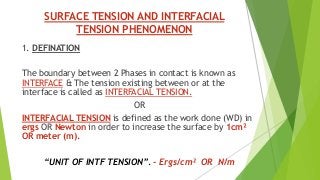
1. DEFINATION
The boundary between 2 Phases in contact is known as
INTERFACE & The tension existing between or at the
interface is called as INTERFACIAL TENSION.
OR
INTERFACIAL TENSION is defined as the work done (WD) in
ergs OR Newton in order to increase the surface by 1cm²
OR meter (m).
ā€œUNIT OF INTF TENSIONā€. - Ergs/cm² OR N/m
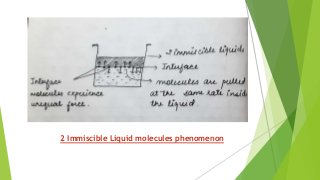
2 Immiscible Liquid molecules phenomenon
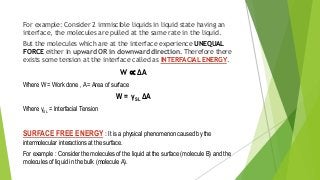
For example: Consider 2 immiscible liquids in liquid state having an
interface, the molecules are pulled at the same rate in the liquid.
But the molecules which are at the interface experience UNEQUAL
FORCE either in upward OR in downward direction. Therefore there
exists some tension at the interface called as INTERFACIAL ENERGY.
W āˆ Ī”A
Where W = Work done , A = Area of surface
W = γSL Ī”A
Where γSL = Interfacial Tension
SURFACE FREE ENERGY : It is a physical phenomenon caused by the
intermolecular interactions at the surface.
For example : Consider the molecules of the liquid at the surface (molecule B) and the
molecules of liquid in the bulk (molecule A).
So the molecule B (at the surface) which is at the surface possess EXTRA
POTENTIAL ENERGY than mol A which is in the bulk.
Molecules āˆ Surface āˆ P.E.
Higher the surface of Liquid, more molecules have this excessive P.E. (Potential
Energy).
Therefore, if the surface of Liquid increases (e.g.. Water to water droplets) ,so
more molecules have this excessive P.E.
Surface of Liquid āˆ Energy of Liquid
Because of this energy is promotional to the size of free surface.. This is called
as SURFACE FREE ENERGY.
Each molecule has a tendency to move inside the liquid
from the surface; Therefore the Liquid takes form with
minimal free surface and minimal surface energy.
2. MEASUREMENT OF SURFACE &
INTERFACIAL TENSION
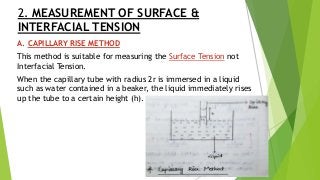
A. CAPILLARY RISE METHOD
This method is suitable for measuring the Surface Tension not
Interfacial Tension.
When the capillary tube with radius 2r is immersed in a liquid
such as water contained in a beaker, the liquid immediately rises
up the tube to a certain height (h).
This rise of liquid in tube occurs because of Force of
Adhesion (FOA) between capillary wall and water which is
greater than the Force of Cohesion (FOC) between the
water molecules.
FOA btwn capillary wall and water > FOC btwn the water
molecules.
The liquid is said to wet the capillary wall by spreading over
it and rising in the tube.
B. DU NOUY TENSIOMETER (RING DETACHMENT METHOD)
This method is suitable for measuring both Surface Tension
and Interfacial Tension.
Apparatus used for determination is called as Du Nouy
Tensiometer OR Torsion Balance OR Du Nouy Balance.
PRINCIPLE: Force required to detachthe Platinum-Iridium
Ring from the surface/interface of 2 immiscible liquids is
proportional to the surface /interfacial tension.
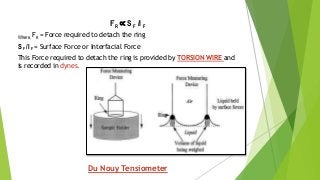
FR āˆ S F /I F
Where, FR = Force required to detach the ring
S F /I F = Surface Force or Interfacial Force
This Force required to detach the ring is provided by TORSION WIRE and
is recorded in dynes.
Du Nouy Tensiometer
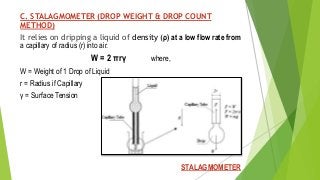
C. STALAGMOMETER (DROP WEIGHT & DROP COUNT
METHOD)
It relies on dripping a liquid of density (ρ) at a low flow rate from
a capillary of radius (r) into air.
W = 2 Ļ€rγ where,
W = Weight of 1 Drop of Liquid
r = Radius if Capillary
γ = Surface Tension
STALAGMOMETER
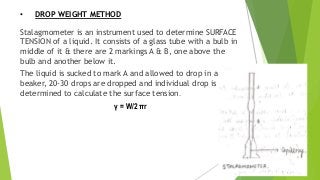
• DROP WEIGHT METHOD
Stalagmometer is an instrument used to determine SURFACE
TENSION of a liquid. It consists of a glass tube with a bulb in
middle of it & there are 2 markings A & B, one above the
bulb and another below it.
The liquid is sucked to mark A and allowed to drop in a
beaker, 20-30 drops are dropped and individual drop is
determined to calculate the surface tension.
γ = W/2 Ļ€r
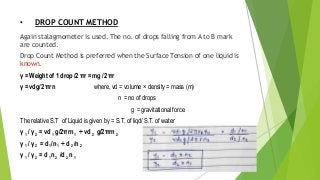
• DROP COUNT METHOD
Again stalagmometer is used. The no. of drops falling from A to B mark
are counted.
Drop Count Method is preferred when the Surface Tension of one liquid is
known.
γ = Weight of 1 drop /2 Ļ€r = mg /2 Ļ€r
γ = vdg/2 Ļ€rn where, vd = volume Ɨ density = mass (m)
n = no of drops
g = gravitational force
The relative S.T of Liquid is given by = S.T. of liqd/ S.T. of water
γ 1 / γ 2 = vd 1 g/2Ļ€rn 1 Ć· vd 2 g/2Ļ€rn 2
γ 1 / γ 2 = d 1/n1 ÷ d 2 /n 2
γ 1 / γ 2 = d 1n2 /d 2 n 1
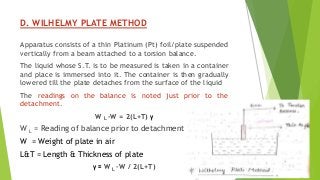
D. WILHELMY PLATE METHOD
Apparatus consists of a thin Platinum (Pt) foil/plate suspended
vertically from a beam attached to a torsion balance.
The liquid whose S.T. is to be measured is taken in a container
and place is immersed into it. The container is then gradually
lowered till the plate detaches from the surface of the liquid
The readings on the balance is noted just prior to the
detachment.
W L –W = 2(L+T) γ
W L = Reading of balance prior to detachment
W = Weight of plate in air
L&T = Length & Thickness of plate
γ = W L –W / 2(L+T)
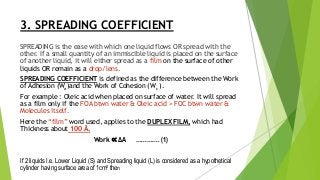
3. SPREADING COEFFICIENT
SPREADING is the ease with which one liquid flows OR spread with the
other. If a small quantity of an immiscible liquid is placed on the surface
of another liquid, it will either spread as a film on the surface of other
liquids OR remain as a drop/lens.
SPREADING COEFFICIENT is defined as the difference between the Work
of Adhesion (Wa)and the Work of Cohesion (Wc ).
For example : Oleic acid when placed on surface of water. It will spread
as a film only if the FOA btwn water & Oleic acid > FOC btwn water &
Molecules itself.
Here the ā€œfilmā€ word used, applies to the DUPLEX FILM, which had
Thickness about 100 ƅ.
Work āˆ Ī”A …………. (1)
If 2 liquids I.e. Lower Liquid (S) and Spreading liquid (L) is considered as a hypothetical
cylinder having surface area of 1cm² then
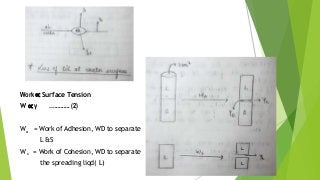
Work āˆ Surface Tension
W āˆ γ ….......... (2)
Wa = Work of Adhesion, WD to separate
L &S
W c = Work of Cohesion, WD to separate
the spreading liqd( L)
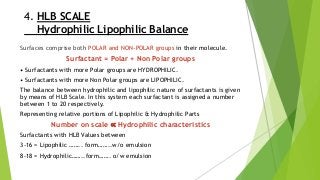
4. HLB SCALE
Hydrophilic Lipophilic Balance
Surfaces comprise both POLAR and NON-POLAR groups in their molecule.
Surfactant = Polar + Non Polar groups
• Surfactants with more Polar groups are HYDROPHILIC.
• Surfactants with more Non Polar groups are LIPOPHILIC.
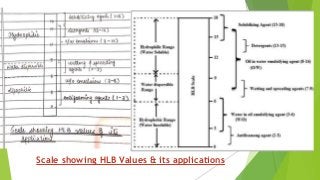
The balance between hydrophilic and lipophilic nature of surfactants is given
by means of HLB Scale. In this system each surfactant is assigned a number
between 1 to 20 respectively.
Representing relative portions of Lipophilic & Hydrophilic Parts
Number on scale āˆ Hydrophilic characteristics
Surfactants with HLB Values between
3-16 = Lipophilic …….. form……..w/o emulsion
8-18 = Hydrophilic……..form……. o/w emulsion
Scale showing HLB Values & its applications
5. SOLUBILISATION, DETERGENCY,
ADSORPTION AT SOLID INTERFACE.
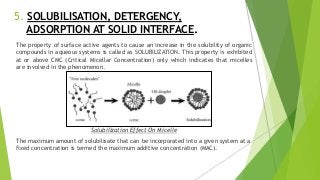
The property of surface active agents to cause an increase in the solubility of organic
compounds in aqueous systems is called as SOLUBILIZATION. This property is exhibited
at or above CMC (Critical Micellar Concentration) only which indicates that micelles
are involved in the phenomenon.
Solubilization Effect On Micelle
The maximum amount of solubilisate that can be incorporated into a given system at a
fixed concentration is termed the maximum additive concentration (MAC).
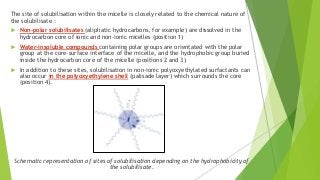
The site of solubilisation within the micelle is closely related to the chemical nature of
the solubilisate :
 Non-polar solubilisates (aliphatic hydrocarbons, for example) are dissolved in the
hydrocarbon core of ionic and non-ionic micelles (position 1)
 Water-insoluble compounds containing polar groups are orientated with the polar
group at the core–surface interface of the micelle, and the hydrophobic group buried
inside the hydrocarbon core of the micelle (positions 2 and 3)
 In addition to these sites, solubilisation in non-ionic polyoxyethylated surfactants can
also occur in the polyoxyethylene shell (palisade layer) which surrounds the core
(position 4).
Schematic representation of sites of solubilisation depending on the hydrophobicity of
the solubilisate.
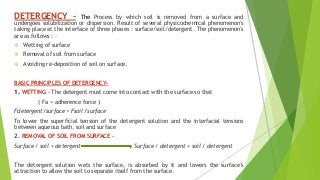
DETERGENCY – The Process by which soil is removed from a surface and
undergoes solubilization or dispersion. Result of several physicochemical phenomenon's
taking place at the interface of three phases : surface/soil/detergent. The phenomenon's
are as follows : –
 Wetting of surface
 Removal of soil from surface
 Avoiding re-deposition of soil on surface.
BASIC PRINCIPLES OF DETERGENCY-
1. WETTING - The detergent must come into contact with the surface so that
( Fa = adherence force )
Fdetergent/surface > Fsoil /surface
To lower the superficial tension of the detergent solution and the interfacial tensions
between aqueous bath, soil and surface
2. REMOVAL OF SOIL FROM SURFACE –
Surface / soil + detergent Surface / detergent + soil / detergent
The detergent solution wets the surface, is absorbed by it and lowers the surface’s
attraction to allow the soil to separate itself from the surface.
3. AVOID RE-DEPOSITION OF SOIL ON SURFACE –
Chemical reactions like-
ļ‚§ lipids undergo saponification
ļ‚§ mineral soil undergoes solubilization
ļ‚§ soil undergoes emulsification
ļ‚§ Liquid soil = hydrophobic ; detergent solution = hydrophilic.
ADSORPTION AT SOLID INTERFACE
Adsorption is the adhesion of atoms, ions or molecules from a gas, liquid or
dissolved solid to a surface. This process creates a film of the adsorbate on the
surface of the adsorbent. This process differs from absorption, in which a fluid (the
absorbate) is dissolved by or permeates a liquid or solid (the absorbent).
Adsorption is a surface phenomenon, while absorption involves the whole volume of
the material, although adsorption does often precede absorption.
The term sorption encompasses both processes, while desorption is the reverse of
it.
Adsorbents are used usually in the form of spherical pellets, rods, moldings, or
monoliths with a hydrodynamic radius between 0.25 and 5 mm. They must have high
abrasion resistance, high thermal stability and small pore diameters, which results in
higher exposed surface area and hence high capacity for adsorption.
For example, most industrial adsorbents fall into one of three classes:
ļ‚§ Oxygen-containing compounds – Are typically hydrophilic and polar, including
materials such as silica gel, limestone (calcium carbonate) and zeolites. Silica is
used for drying of process air (e.g. oxygen, natural gas) and adsorption of heavy
(polar) hydrocarbons from natural gas.
ļ‚§ Carbon-based compounds – Are typically hydrophobic and non-polar, including
materials such as activated carbon and graphite.
Zeolites are applied in drying of process air, CO2 removal from natural gas, CO
removal from reforming gas, air separation, catalytic cracking, and catalytic
synthesis and reforming.
ļ‚§ Polymer-based compounds – Are polar or non-polar, depending on the functional
groups in the polymer matrix. Activated Carbon is the most widely used adsorbent
since most of its chemical (e.g. surface groups) and physical properties (e.g. pore
size distribution and surface area) can be tuned according to what is needed.
THANK YOU
BY: VASTAVI GORE
IPS ACADEMY COLLEGE OF PHARMACY, INDORE
M.P.
vastavigore17@gmail.com

Surface and Interfacial Phenomenon

  • 1.
    PHYSICAL PHARMACY SOLUBILITY/ SURFACEFREE ENERGY SURFACE TENSION AND INTERFACIAL TENSION PHENOMENON 1. Defination 2. Measurements of Surface and Interfacial Tension 3. Spreading Coefficient 4. HLB Scale 5. Solubilisation, Detergency, Adsorption at solid interface.
  • 2.
    SURFACE TENSION ANDINTERFACIAL TENSION PHENOMENON 1. DEFINATION The boundary between 2 Phases in contact is known as INTERFACE & The tension existing between or at the interface is called as INTERFACIAL TENSION. OR INTERFACIAL TENSION is defined as the work done (WD) in ergs OR Newton in order to increase the surface by 1cm² OR meter (m). ā€œUNIT OF INTF TENSIONā€. - Ergs/cm² OR N/m
  • 3.
    2 Immiscible Liquidmolecules phenomenon
  • 4.
    For example: Consider2 immiscible liquids in liquid state having an interface, the molecules are pulled at the same rate in the liquid. But the molecules which are at the interface experience UNEQUAL FORCE either in upward OR in downward direction. Therefore there exists some tension at the interface called as INTERFACIAL ENERGY. W āˆ Ī”A Where W = Work done , A = Area of surface W = γSL Ī”A Where γSL = Interfacial Tension SURFACE FREE ENERGY : It is a physical phenomenon caused by the intermolecular interactions at the surface. For example : Consider the molecules of the liquid at the surface (molecule B) and the molecules of liquid in the bulk (molecule A).
  • 5.
    So the moleculeB (at the surface) which is at the surface possess EXTRA POTENTIAL ENERGY than mol A which is in the bulk. Molecules āˆ Surface āˆ P.E.
  • 6.
    Higher the surfaceof Liquid, more molecules have this excessive P.E. (Potential Energy). Therefore, if the surface of Liquid increases (e.g.. Water to water droplets) ,so more molecules have this excessive P.E. Surface of Liquid āˆ Energy of Liquid Because of this energy is promotional to the size of free surface.. This is called as SURFACE FREE ENERGY. Each molecule has a tendency to move inside the liquid from the surface; Therefore the Liquid takes form with minimal free surface and minimal surface energy.
  • 7.
    2. MEASUREMENT OFSURFACE & INTERFACIAL TENSION A. CAPILLARY RISE METHOD This method is suitable for measuring the Surface Tension not Interfacial Tension. When the capillary tube with radius 2r is immersed in a liquid such as water contained in a beaker, the liquid immediately rises up the tube to a certain height (h).
  • 8.
    This rise ofliquid in tube occurs because of Force of Adhesion (FOA) between capillary wall and water which is greater than the Force of Cohesion (FOC) between the water molecules. FOA btwn capillary wall and water > FOC btwn the water molecules. The liquid is said to wet the capillary wall by spreading over it and rising in the tube. B. DU NOUY TENSIOMETER (RING DETACHMENT METHOD) This method is suitable for measuring both Surface Tension and Interfacial Tension. Apparatus used for determination is called as Du Nouy Tensiometer OR Torsion Balance OR Du Nouy Balance. PRINCIPLE: Force required to detachthe Platinum-Iridium Ring from the surface/interface of 2 immiscible liquids is proportional to the surface /interfacial tension.
  • 9.
    FR āˆ SF /I F Where, FR = Force required to detach the ring S F /I F = Surface Force or Interfacial Force This Force required to detach the ring is provided by TORSION WIRE and is recorded in dynes. Du Nouy Tensiometer
  • 10.
    C. STALAGMOMETER (DROPWEIGHT & DROP COUNT METHOD) It relies on dripping a liquid of density (ρ) at a low flow rate from a capillary of radius (r) into air. W = 2 Ļ€rγ where, W = Weight of 1 Drop of Liquid r = Radius if Capillary γ = Surface Tension STALAGMOMETER
  • 11.
    • DROP WEIGHTMETHOD Stalagmometer is an instrument used to determine SURFACE TENSION of a liquid. It consists of a glass tube with a bulb in middle of it & there are 2 markings A & B, one above the bulb and another below it. The liquid is sucked to mark A and allowed to drop in a beaker, 20-30 drops are dropped and individual drop is determined to calculate the surface tension. γ = W/2 Ļ€r
  • 12.
    • DROP COUNTMETHOD Again stalagmometer is used. The no. of drops falling from A to B mark are counted. Drop Count Method is preferred when the Surface Tension of one liquid is known. γ = Weight of 1 drop /2 Ļ€r = mg /2 Ļ€r γ = vdg/2 Ļ€rn where, vd = volume Ɨ density = mass (m) n = no of drops g = gravitational force The relative S.T of Liquid is given by = S.T. of liqd/ S.T. of water γ 1 / γ 2 = vd 1 g/2Ļ€rn 1 Ć· vd 2 g/2Ļ€rn 2 γ 1 / γ 2 = d 1/n1 Ć· d 2 /n 2 γ 1 / γ 2 = d 1n2 /d 2 n 1
  • 13.
    D. WILHELMY PLATEMETHOD Apparatus consists of a thin Platinum (Pt) foil/plate suspended vertically from a beam attached to a torsion balance. The liquid whose S.T. is to be measured is taken in a container and place is immersed into it. The container is then gradually lowered till the plate detaches from the surface of the liquid The readings on the balance is noted just prior to the detachment. W L –W = 2(L+T) γ W L = Reading of balance prior to detachment W = Weight of plate in air L&T = Length & Thickness of plate γ = W L –W / 2(L+T)
  • 14.
    3. SPREADING COEFFICIENT SPREADINGis the ease with which one liquid flows OR spread with the other. If a small quantity of an immiscible liquid is placed on the surface of another liquid, it will either spread as a film on the surface of other liquids OR remain as a drop/lens. SPREADING COEFFICIENT is defined as the difference between the Work of Adhesion (Wa)and the Work of Cohesion (Wc ). For example : Oleic acid when placed on surface of water. It will spread as a film only if the FOA btwn water & Oleic acid > FOC btwn water & Molecules itself. Here the ā€œfilmā€ word used, applies to the DUPLEX FILM, which had Thickness about 100 ƅ. Work āˆ Ī”A …………. (1) If 2 liquids I.e. Lower Liquid (S) and Spreading liquid (L) is considered as a hypothetical cylinder having surface area of 1cm² then
  • 15.
    Work āˆ SurfaceTension W āˆ γ ….......... (2) Wa = Work of Adhesion, WD to separate L &S W c = Work of Cohesion, WD to separate the spreading liqd( L)
  • 17.
    4. HLB SCALE HydrophilicLipophilic Balance Surfaces comprise both POLAR and NON-POLAR groups in their molecule. Surfactant = Polar + Non Polar groups • Surfactants with more Polar groups are HYDROPHILIC. • Surfactants with more Non Polar groups are LIPOPHILIC. The balance between hydrophilic and lipophilic nature of surfactants is given by means of HLB Scale. In this system each surfactant is assigned a number between 1 to 20 respectively. Representing relative portions of Lipophilic & Hydrophilic Parts Number on scale āˆ Hydrophilic characteristics Surfactants with HLB Values between 3-16 = Lipophilic …….. form……..w/o emulsion 8-18 = Hydrophilic……..form……. o/w emulsion
  • 18.
    Scale showing HLBValues & its applications
  • 19.
    5. SOLUBILISATION, DETERGENCY, ADSORPTIONAT SOLID INTERFACE. The property of surface active agents to cause an increase in the solubility of organic compounds in aqueous systems is called as SOLUBILIZATION. This property is exhibited at or above CMC (Critical Micellar Concentration) only which indicates that micelles are involved in the phenomenon. Solubilization Effect On Micelle The maximum amount of solubilisate that can be incorporated into a given system at a fixed concentration is termed the maximum additive concentration (MAC).
  • 20.
    The site ofsolubilisation within the micelle is closely related to the chemical nature of the solubilisate :  Non-polar solubilisates (aliphatic hydrocarbons, for example) are dissolved in the hydrocarbon core of ionic and non-ionic micelles (position 1)  Water-insoluble compounds containing polar groups are orientated with the polar group at the core–surface interface of the micelle, and the hydrophobic group buried inside the hydrocarbon core of the micelle (positions 2 and 3)  In addition to these sites, solubilisation in non-ionic polyoxyethylated surfactants can also occur in the polyoxyethylene shell (palisade layer) which surrounds the core (position 4). Schematic representation of sites of solubilisation depending on the hydrophobicity of the solubilisate.
  • 21.
    DETERGENCY – TheProcess by which soil is removed from a surface and undergoes solubilization or dispersion. Result of several physicochemical phenomenon's taking place at the interface of three phases : surface/soil/detergent. The phenomenon's are as follows : –  Wetting of surface  Removal of soil from surface  Avoiding re-deposition of soil on surface. BASIC PRINCIPLES OF DETERGENCY- 1. WETTING - The detergent must come into contact with the surface so that ( Fa = adherence force ) Fdetergent/surface > Fsoil /surface To lower the superficial tension of the detergent solution and the interfacial tensions between aqueous bath, soil and surface 2. REMOVAL OF SOIL FROM SURFACE – Surface / soil + detergent Surface / detergent + soil / detergent The detergent solution wets the surface, is absorbed by it and lowers the surface’s attraction to allow the soil to separate itself from the surface.
  • 22.
    3. AVOID RE-DEPOSITIONOF SOIL ON SURFACE – Chemical reactions like- ļ‚§ lipids undergo saponification ļ‚§ mineral soil undergoes solubilization ļ‚§ soil undergoes emulsification ļ‚§ Liquid soil = hydrophobic ; detergent solution = hydrophilic. ADSORPTION AT SOLID INTERFACE Adsorption is the adhesion of atoms, ions or molecules from a gas, liquid or dissolved solid to a surface. This process creates a film of the adsorbate on the surface of the adsorbent. This process differs from absorption, in which a fluid (the absorbate) is dissolved by or permeates a liquid or solid (the absorbent). Adsorption is a surface phenomenon, while absorption involves the whole volume of the material, although adsorption does often precede absorption. The term sorption encompasses both processes, while desorption is the reverse of it.
  • 23.
    Adsorbents are usedusually in the form of spherical pellets, rods, moldings, or monoliths with a hydrodynamic radius between 0.25 and 5 mm. They must have high abrasion resistance, high thermal stability and small pore diameters, which results in higher exposed surface area and hence high capacity for adsorption. For example, most industrial adsorbents fall into one of three classes: ļ‚§ Oxygen-containing compounds – Are typically hydrophilic and polar, including materials such as silica gel, limestone (calcium carbonate) and zeolites. Silica is used for drying of process air (e.g. oxygen, natural gas) and adsorption of heavy (polar) hydrocarbons from natural gas. ļ‚§ Carbon-based compounds – Are typically hydrophobic and non-polar, including materials such as activated carbon and graphite. Zeolites are applied in drying of process air, CO2 removal from natural gas, CO removal from reforming gas, air separation, catalytic cracking, and catalytic synthesis and reforming. ļ‚§ Polymer-based compounds – Are polar or non-polar, depending on the functional groups in the polymer matrix. Activated Carbon is the most widely used adsorbent since most of its chemical (e.g. surface groups) and physical properties (e.g. pore size distribution and surface area) can be tuned according to what is needed.
  • 24.
    THANK YOU BY: VASTAVIGORE IPS ACADEMY COLLEGE OF PHARMACY, INDORE M.P. vastavigore17@gmail.com