Interfacial Phenomena
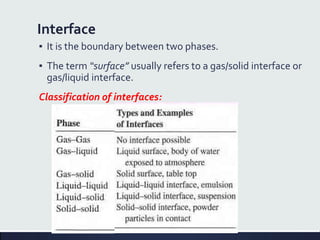
Interface
▪ It is the boundary between two phases.
▪ The term “surface” usually refers to a gas/solid interface or
gas/liquid interface.
Classification of interfaces:
Liquid Interface
Surface and InterfacialTension
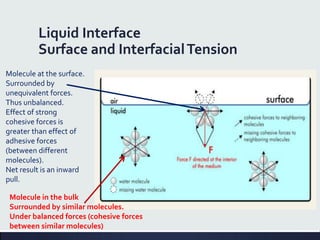
Molecule in the bulk
Surrounded by similar molecules.
Under balanced forces (cohesive forces
between similar molecules)
Molecule at the surface.
Surrounded by
unequivalent forces.
Thus unbalanced.
Effect of strong
cohesive forces is
greater than effect of
adhesive forces
(between different
molecules).
Net result is an inward
pull.
▪ This means that there is an inward force towards the bulk. Such
force pulls the molecules of the surface together and
consequently contracts the surface , resulting in a surface tension.
(The net inward pull experienced by the molecules at the surface
gives the characteristic appearance (stretched band)).
▪ This surface tension is the force acting per unit length (F/ L) that
must be applied parallel to the surface so as to counterbalance the
net inward pull. Its units are: dyne/ cm.
▪ Accordingly, the interfacial tension is the force per unit length
existing between two immiscible liquid phases. Its units are
dyne/cm.
▪ It is quite clear that interfacial tensions are lower than surface
tensions as adhesive forces between two liquid phases are
stronger than adhesive forces that can possibly exist between a
liquid and gas.
▪ N.B:There does not exist interfacial tension between miscible
liquids!
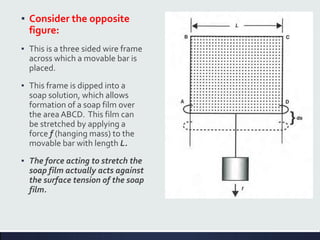
▪ Consider the opposite
figure:
▪ This is a three sided wire frame
across which a movable bar is
placed.
▪ This frame is dipped into a
soap solution, which allows
formation of a soap film over
the area ABCD. This film can
be stretched by applying a
force f (hanging mass) to the
movable bar with length L.
▪ The force acting to stretch the
soap film actually acts against
the surface tension of the soap
film.
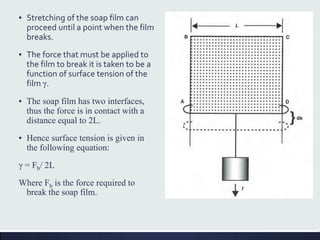
▪ Stretching of the soap film can
proceed until a point when the film
breaks.
▪ The force that must be applied to
the film to break it is taken to be a
function of surface tension of the
film γ.
▪ The soap film has two interfaces,
thus the force is in contact with a
distance equal to 2L.
▪ Hence surface tension is given in
the following equation:
γ = Fb/ 2L
Where Fb is the force required to
break the soap film.
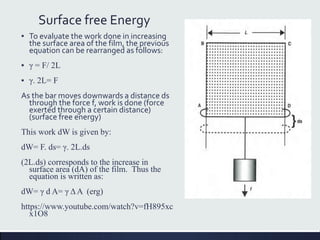
Surface free Energy
▪ To evaluate the work done in increasing
the surface area of the film, the previous
equation can be rearranged as follows:
▪ γ = F/ 2L
▪ γ. 2L= F
As the bar moves downwards a distance ds
through the force f, work is done (force
exerted through a certain distance)
(surface free energy)
This work dW is given by:
dW= F. ds= γ. 2L.ds
(2L.ds) corresponds to the increase in
surface area (dA) of the film. Thus the
equation is written as:
dW= γ d A= γ ΔA (erg)
https://www.youtube.com/watch?v=fH895xc
x1O8
Measurement of Surface and Interfacial
Tension
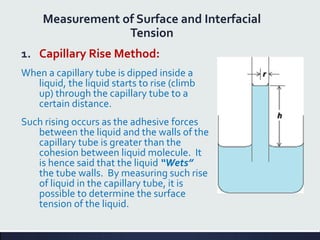
1. Capillary Rise Method:
When a capillary tube is dipped inside a
liquid, the liquid starts to rise (climb
up) through the capillary tube to a
certain distance.
Such rising occurs as the adhesive forces
between the liquid and the walls of the
capillary tube is greater than the
cohesion between liquid molecule. It
is hence said that the liquid “Wets”
the tube walls. By measuring such rise
of liquid in the capillary tube, it is
possible to determine the surface
tension of the liquid.
The surface tension of the liquid allows the rising of the
liquid in the capillary tube.
However, the effect of gravity stops this rising process.
This means that the upward movement is balanced by
the downward force of gravity.
Surface tension is a vector (force acting per unit length),
hence can be analyzed into two perpendicular
components.
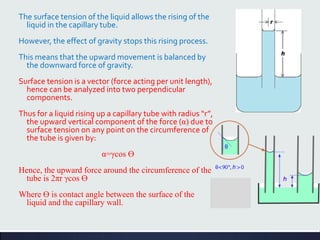
Thus for a liquid rising up a capillary tube with radius “r”,
the upward vertical component of the force (α) due to
surface tension on any point on the circumference of
the tube is given by:
α=γcos Ɵ
Hence, the upward force around the circumference of the
tube is 2πr γcos Ɵ
Where Ɵ is contact angle between the surface of the
liquid and the capillary wall.
▪ Note that:
For water and other commonly used liquids, Ɵ is of no significant
effect. Its value almost approximates zero, which means that the
liquid wets the capillary tube. Consequently, cos Ɵ = 1.
Thus upward force along the circumference of the tube becomes:
2 π r γ
The liquid, as previously mentioned, stops rising when the upward
force is balanced with the downward effect of gravity. This effect
of gravity is given through the weight of the liquid column
generated by rising:
Π r2 h ρ g + w
Where h is the height of the column, ρ is the density of the liquid
and g is the acceleration due to gravity. The weight of the liquid
above h in the meniscus is given the term w.
▪ Once forces are counterbalanced, the liquid stops
rising, and:
2 π r γ = π r2 h ρ g
Where usually contact angle and w can be disregarded
Then the surface tension can be calculated as follows:
γ=1/2 r h ρ g
Surface tension of water is 72.8 dyne/cm at 20 oC
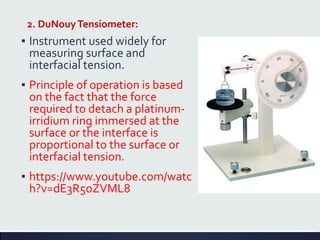
2. DuNouyTensiometer:
▪ Instrument used widely for
measuring surface and
interfacial tension.
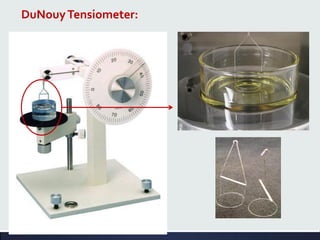
▪ Principle of operation is based
on the fact that the force
required to detach a platinum-
irridium ring immersed at the
surface or the interface is
proportional to the surface or
interfacial tension.
▪ https://www.youtube.com/watc
h?v=dE3R5oZVML8
DuNouyTensiometer:
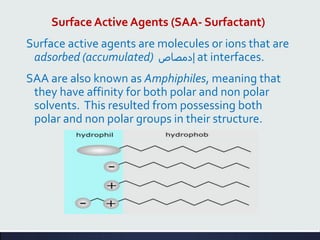
Surface Active Agents (SAA- Surfactant)
Surface active agents are molecules or ions that are
adsorbed (accumulated) ‫إدمصاص‬ at interfaces.
SAA are also known as Amphiphiles, meaning that
they have affinity for both polar and non polar
solvents. This resulted from possessing both
polar and non polar groups in their structure.
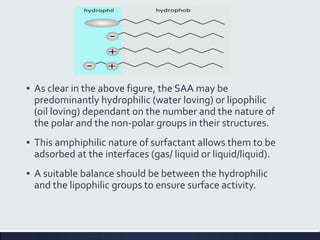
▪ As clear in the above figure, the SAA may be
predominantly hydrophilic (water loving) or lipophilic
(oil loving) dependant on the number and the nature of
the polar and the non-polar groups in their structures.
▪ This amphiphilic nature of surfactant allows them to be
adsorbed at the interfaces (gas/ liquid or liquid/liquid).
▪ A suitable balance should be between the hydrophilic
and the lipophilic groups to ensure surface activity.
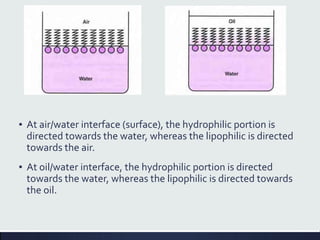
▪ At air/water interface (surface), the hydrophilic portion is
directed towards the water, whereas the lipophilic is directed
towards the air.
▪ At oil/water interface, the hydrophilic portion is directed
towards the water, whereas the lipophilic is directed towards
the oil.
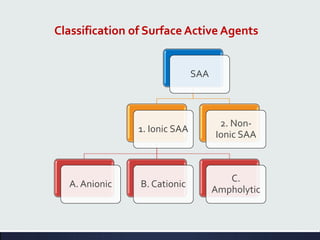
Classification of Surface Active Agents
SAA
1. Ionic SAA
A. Anionic B. Cationic
C.
Ampholytic
2. Non-
Ionic SAA
1. Ionic SAA
A. Anionic SAA:
They are metal salts of long chain fatty acids ( as lauric, palmitic,
myristic, stearic, oleic acid,…etc.)
Bear a negative charge.
Their cations are sodium, potassium and triethanolamine.
Examples:
Soaps
Alkyl sulphates as sodium dodecyl (lauryl) sulphate. (toothpastes)
Alkyl sulphonates as dioctyl sodium sulfosuccinate.(wetting agent)
Bile salts (natural surfactant) as sodium glycholate (solubilize
monoglycerides in the intestines).
B. Cationic Surfactants:
These are quaternary ammonium compounds ( N+).
Have a marked bactericidal activity against microorganisms.
Used as preservatives
Examples:
Benzalkonium chloride
Cetrimide
C. Ampholytic Surfactants:
Can function as anionic or cationic SAA based on the pH of the
medium.
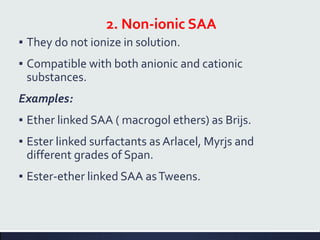
2. Non-ionic SAA
▪ They do not ionize in solution.
▪ Compatible with both anionic and cationic
substances.
Examples:
▪ Ether linked SAA ( macrogol ethers) as Brijs.
▪ Ester linked surfactants as Arlacel, Myrjs and
different grades of Span.
▪ Ester-ether linked SAA asTweens.
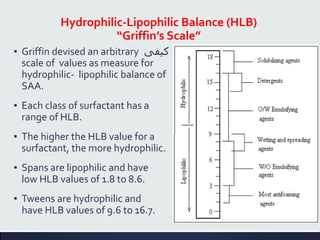
Hydrophilic-Lipophilic Balance (HLB)
“Griffin’s Scale”
▪ Griffin devised an arbitrary ‫كيفى‬
scale of values as measure for
hydrophilic- lipophilic balance of
SAA.
▪ Each class of surfactant has a
range of HLB.
▪ The higher the HLB value for a
surfactant, the more hydrophilic.
▪ Spans are lipophilic and have
low HLB values of 1.8 to 8.6.
▪ Tweens are hydrophilic and
have HLB values of 9.6 to 16.7.
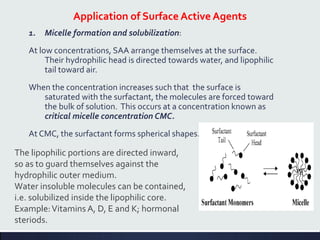
Application of Surface Active Agents
1. Micelle formation and solubilization:
At low concentrations, SAA arrange themselves at the surface.
Their hydrophilic head is directed towards water, and lipophilic
tail toward air.
When the concentration increases such that the surface is
saturated with the surfactant, the molecules are forced toward
the bulk of solution. This occurs at a concentration known as
critical micelle concentration CMC.
At CMC, the surfactant forms spherical shapes.
The lipophilic portions are directed inward,
so as to guard themselves against the
hydrophilic outer medium.
Water insoluble molecules can be contained,
i.e. solubilized inside the lipophilic core.
Example:Vitamins A, D, E and K; hormonal
steriods.
2. Antibacterial Activity:
SAA facilitate the activity of antibacterial agents by promoting their
penetration into the cell membranes of bacteria.
SAA may themselves possess antibacterial activity as quaternary
ammonium compounds.
3. Foam formation and antifoam effect:
Foaming SAA help formation of air globules inside film. They are
important in fire extinguishing products.
Antifoaming SAA destroy air pockets. They help wetting. They have low
HLB (1- 3).
4.Wetting Effect:
Reduce interfacial tension between solid and liquid and reduce the angle
of contact. This occurs through getting adsobred at the interface.
5. Emulsifying agents:
Dependant on the HLB value, they can emulsify water droplets
in oil phase to form w/o emulsion, or emulsify oil droplets in
water forming o/w emulsion.
6. Detergents:
Remove dirt.
Detergency is a complex process as it involves wetting of the
dirt, suspension of dirt and finally emulsification or
solubilization of the dirt.
Adsorption at solid interfaces
▪ Adsorption is defined as the accumulation of gases,
liquids, or solutes on the surface of a solid or liquid.
Adsorption phenomenon at the solid interface deals
with applications as:
1. Removal of toxic gases using gas masks.
2. Removal of objectionable odors from rooms and
foods.
3. Decolorization of liquids.
4. Antidotes in oral intoxication by oral administration
of charcoal to adsorb and remove toxins.
The degree of adsorption of a gas or a solute on a
solid surface depends on:
1. The chemical nature of the adsorbent (the
material that adsorbs), and the adsorbate (the
substance being adsorbed).
2. The surface area of the adsorbent.
3. The temperature (adsorption is exothermic).
4. The partial pressure of the adsorbed gas or
solute concentration in case of solution.
Types of adsorption:
1. Physical orVanderWaal’s adsorption: a reversible
process. The removal of the adsorbate from
adsorbent surface in known as desorption. A
physically adsorbed gas can be desorbed by
increasing the temperature or by reducing the
pressure.
2. Chemical adsorption or chemisorption:The
adsorbate is attached to the adsorbent by
chemical bonds. It is irreversible.
Adsorption Isotherms
▪ An adsorption isotherm is a curve giving the
relationship between adsorbate and adsorbent in a
constant-temperature adsorption process.
▪ For a gas adsorbed at a solid surface, it is the
relationship between the amount of gas physically
adsorbed on a solid, and the equilibrium pressure or
concentration at constant temperature.
Example: Freundlich isotherm
Langmuir Isotherm
Freundlich Isotherm:
The following relationship was
derived:
y=x/m= KP 1/n
Where y is the mass of gas
adsorbed (x) per unit mass of
adsorbent (m). K and n are
constants that can be
evaluated from the results of
the experiment. P is the
pressure of gas.
This equation can be written in a
logarithmic form:
Log x/m = log K + 1/n log P
From the isotherm, log k is the
intercept and 1/n is the slope
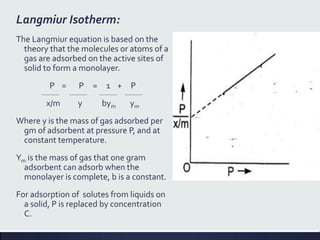
Langmiur Isotherm:
The Langmiur equation is based on the
theory that the molecules or atoms of a
gas are adsorbed on the active sites of
solid to form a monolayer.
P = P = 1 + P
x/m y bym ym
Where y is the mass of gas adsorbed per
gm of adsorbent at pressure P, and at
constant temperature.
Ym is the mass of gas that one gram
adsorbent can adsorb when the
monolayer is complete, b is a constant.
For adsorption of solutes from liquids on
a solid, P is replaced by concentration
C.
Interfacial Phenomena.pdf

Interfacial Phenomena.pdf

  • 1.
  • 2.
    Interface ▪ It isthe boundary between two phases. ▪ The term “surface” usually refers to a gas/solid interface or gas/liquid interface. Classification of interfaces:
  • 4.
    Liquid Interface Surface andInterfacialTension Molecule in the bulk Surrounded by similar molecules. Under balanced forces (cohesive forces between similar molecules) Molecule at the surface. Surrounded by unequivalent forces. Thus unbalanced. Effect of strong cohesive forces is greater than effect of adhesive forces (between different molecules). Net result is an inward pull.
  • 5.
    ▪ This meansthat there is an inward force towards the bulk. Such force pulls the molecules of the surface together and consequently contracts the surface , resulting in a surface tension. (The net inward pull experienced by the molecules at the surface gives the characteristic appearance (stretched band)). ▪ This surface tension is the force acting per unit length (F/ L) that must be applied parallel to the surface so as to counterbalance the net inward pull. Its units are: dyne/ cm. ▪ Accordingly, the interfacial tension is the force per unit length existing between two immiscible liquid phases. Its units are dyne/cm. ▪ It is quite clear that interfacial tensions are lower than surface tensions as adhesive forces between two liquid phases are stronger than adhesive forces that can possibly exist between a liquid and gas. ▪ N.B:There does not exist interfacial tension between miscible liquids!
  • 6.
    ▪ Consider theopposite figure: ▪ This is a three sided wire frame across which a movable bar is placed. ▪ This frame is dipped into a soap solution, which allows formation of a soap film over the area ABCD. This film can be stretched by applying a force f (hanging mass) to the movable bar with length L. ▪ The force acting to stretch the soap film actually acts against the surface tension of the soap film.
  • 7.
    ▪ Stretching ofthe soap film can proceed until a point when the film breaks. ▪ The force that must be applied to the film to break it is taken to be a function of surface tension of the film γ. ▪ The soap film has two interfaces, thus the force is in contact with a distance equal to 2L. ▪ Hence surface tension is given in the following equation: γ = Fb/ 2L Where Fb is the force required to break the soap film.
  • 8.
    Surface free Energy ▪To evaluate the work done in increasing the surface area of the film, the previous equation can be rearranged as follows: ▪ γ = F/ 2L ▪ γ. 2L= F As the bar moves downwards a distance ds through the force f, work is done (force exerted through a certain distance) (surface free energy) This work dW is given by: dW= F. ds= γ. 2L.ds (2L.ds) corresponds to the increase in surface area (dA) of the film. Thus the equation is written as: dW= γ d A= γ ΔA (erg) https://www.youtube.com/watch?v=fH895xc x1O8
  • 9.
    Measurement of Surfaceand Interfacial Tension 1. Capillary Rise Method: When a capillary tube is dipped inside a liquid, the liquid starts to rise (climb up) through the capillary tube to a certain distance. Such rising occurs as the adhesive forces between the liquid and the walls of the capillary tube is greater than the cohesion between liquid molecule. It is hence said that the liquid “Wets” the tube walls. By measuring such rise of liquid in the capillary tube, it is possible to determine the surface tension of the liquid.
  • 10.
    The surface tensionof the liquid allows the rising of the liquid in the capillary tube. However, the effect of gravity stops this rising process. This means that the upward movement is balanced by the downward force of gravity. Surface tension is a vector (force acting per unit length), hence can be analyzed into two perpendicular components. Thus for a liquid rising up a capillary tube with radius “r”, the upward vertical component of the force (α) due to surface tension on any point on the circumference of the tube is given by: α=γcos Ɵ Hence, the upward force around the circumference of the tube is 2πr γcos Ɵ Where Ɵ is contact angle between the surface of the liquid and the capillary wall.
  • 11.
    ▪ Note that: Forwater and other commonly used liquids, Ɵ is of no significant effect. Its value almost approximates zero, which means that the liquid wets the capillary tube. Consequently, cos Ɵ = 1. Thus upward force along the circumference of the tube becomes: 2 π r γ The liquid, as previously mentioned, stops rising when the upward force is balanced with the downward effect of gravity. This effect of gravity is given through the weight of the liquid column generated by rising: Π r2 h ρ g + w Where h is the height of the column, ρ is the density of the liquid and g is the acceleration due to gravity. The weight of the liquid above h in the meniscus is given the term w.
  • 12.
    ▪ Once forcesare counterbalanced, the liquid stops rising, and: 2 π r γ = π r2 h ρ g Where usually contact angle and w can be disregarded Then the surface tension can be calculated as follows: γ=1/2 r h ρ g Surface tension of water is 72.8 dyne/cm at 20 oC
  • 13.
    2. DuNouyTensiometer: ▪ Instrumentused widely for measuring surface and interfacial tension. ▪ Principle of operation is based on the fact that the force required to detach a platinum- irridium ring immersed at the surface or the interface is proportional to the surface or interfacial tension. ▪ https://www.youtube.com/watc h?v=dE3R5oZVML8
  • 14.
  • 15.
    Surface Active Agents(SAA- Surfactant) Surface active agents are molecules or ions that are adsorbed (accumulated) ‫إدمصاص‬ at interfaces. SAA are also known as Amphiphiles, meaning that they have affinity for both polar and non polar solvents. This resulted from possessing both polar and non polar groups in their structure.
  • 16.
    ▪ As clearin the above figure, the SAA may be predominantly hydrophilic (water loving) or lipophilic (oil loving) dependant on the number and the nature of the polar and the non-polar groups in their structures. ▪ This amphiphilic nature of surfactant allows them to be adsorbed at the interfaces (gas/ liquid or liquid/liquid). ▪ A suitable balance should be between the hydrophilic and the lipophilic groups to ensure surface activity.
  • 17.
    ▪ At air/waterinterface (surface), the hydrophilic portion is directed towards the water, whereas the lipophilic is directed towards the air. ▪ At oil/water interface, the hydrophilic portion is directed towards the water, whereas the lipophilic is directed towards the oil.
  • 18.
    Classification of SurfaceActive Agents SAA 1. Ionic SAA A. Anionic B. Cationic C. Ampholytic 2. Non- Ionic SAA
  • 19.
    1. Ionic SAA A.Anionic SAA: They are metal salts of long chain fatty acids ( as lauric, palmitic, myristic, stearic, oleic acid,…etc.) Bear a negative charge. Their cations are sodium, potassium and triethanolamine. Examples: Soaps Alkyl sulphates as sodium dodecyl (lauryl) sulphate. (toothpastes) Alkyl sulphonates as dioctyl sodium sulfosuccinate.(wetting agent) Bile salts (natural surfactant) as sodium glycholate (solubilize monoglycerides in the intestines).
  • 20.
    B. Cationic Surfactants: Theseare quaternary ammonium compounds ( N+). Have a marked bactericidal activity against microorganisms. Used as preservatives Examples: Benzalkonium chloride Cetrimide C. Ampholytic Surfactants: Can function as anionic or cationic SAA based on the pH of the medium.
  • 21.
    2. Non-ionic SAA ▪They do not ionize in solution. ▪ Compatible with both anionic and cationic substances. Examples: ▪ Ether linked SAA ( macrogol ethers) as Brijs. ▪ Ester linked surfactants as Arlacel, Myrjs and different grades of Span. ▪ Ester-ether linked SAA asTweens.
  • 22.
    Hydrophilic-Lipophilic Balance (HLB) “Griffin’sScale” ▪ Griffin devised an arbitrary ‫كيفى‬ scale of values as measure for hydrophilic- lipophilic balance of SAA. ▪ Each class of surfactant has a range of HLB. ▪ The higher the HLB value for a surfactant, the more hydrophilic. ▪ Spans are lipophilic and have low HLB values of 1.8 to 8.6. ▪ Tweens are hydrophilic and have HLB values of 9.6 to 16.7.
  • 23.
    Application of SurfaceActive Agents 1. Micelle formation and solubilization: At low concentrations, SAA arrange themselves at the surface. Their hydrophilic head is directed towards water, and lipophilic tail toward air. When the concentration increases such that the surface is saturated with the surfactant, the molecules are forced toward the bulk of solution. This occurs at a concentration known as critical micelle concentration CMC. At CMC, the surfactant forms spherical shapes. The lipophilic portions are directed inward, so as to guard themselves against the hydrophilic outer medium. Water insoluble molecules can be contained, i.e. solubilized inside the lipophilic core. Example:Vitamins A, D, E and K; hormonal steriods.
  • 24.
    2. Antibacterial Activity: SAAfacilitate the activity of antibacterial agents by promoting their penetration into the cell membranes of bacteria. SAA may themselves possess antibacterial activity as quaternary ammonium compounds. 3. Foam formation and antifoam effect: Foaming SAA help formation of air globules inside film. They are important in fire extinguishing products. Antifoaming SAA destroy air pockets. They help wetting. They have low HLB (1- 3). 4.Wetting Effect: Reduce interfacial tension between solid and liquid and reduce the angle of contact. This occurs through getting adsobred at the interface.
  • 25.
    5. Emulsifying agents: Dependanton the HLB value, they can emulsify water droplets in oil phase to form w/o emulsion, or emulsify oil droplets in water forming o/w emulsion. 6. Detergents: Remove dirt. Detergency is a complex process as it involves wetting of the dirt, suspension of dirt and finally emulsification or solubilization of the dirt.
  • 26.
    Adsorption at solidinterfaces ▪ Adsorption is defined as the accumulation of gases, liquids, or solutes on the surface of a solid or liquid. Adsorption phenomenon at the solid interface deals with applications as: 1. Removal of toxic gases using gas masks. 2. Removal of objectionable odors from rooms and foods. 3. Decolorization of liquids. 4. Antidotes in oral intoxication by oral administration of charcoal to adsorb and remove toxins.
  • 27.
    The degree ofadsorption of a gas or a solute on a solid surface depends on: 1. The chemical nature of the adsorbent (the material that adsorbs), and the adsorbate (the substance being adsorbed). 2. The surface area of the adsorbent. 3. The temperature (adsorption is exothermic). 4. The partial pressure of the adsorbed gas or solute concentration in case of solution.
  • 28.
    Types of adsorption: 1.Physical orVanderWaal’s adsorption: a reversible process. The removal of the adsorbate from adsorbent surface in known as desorption. A physically adsorbed gas can be desorbed by increasing the temperature or by reducing the pressure. 2. Chemical adsorption or chemisorption:The adsorbate is attached to the adsorbent by chemical bonds. It is irreversible.
  • 29.
    Adsorption Isotherms ▪ Anadsorption isotherm is a curve giving the relationship between adsorbate and adsorbent in a constant-temperature adsorption process. ▪ For a gas adsorbed at a solid surface, it is the relationship between the amount of gas physically adsorbed on a solid, and the equilibrium pressure or concentration at constant temperature. Example: Freundlich isotherm Langmuir Isotherm
  • 30.
    Freundlich Isotherm: The followingrelationship was derived: y=x/m= KP 1/n Where y is the mass of gas adsorbed (x) per unit mass of adsorbent (m). K and n are constants that can be evaluated from the results of the experiment. P is the pressure of gas. This equation can be written in a logarithmic form: Log x/m = log K + 1/n log P From the isotherm, log k is the intercept and 1/n is the slope
  • 31.
    Langmiur Isotherm: The Langmiurequation is based on the theory that the molecules or atoms of a gas are adsorbed on the active sites of solid to form a monolayer. P = P = 1 + P x/m y bym ym Where y is the mass of gas adsorbed per gm of adsorbent at pressure P, and at constant temperature. Ym is the mass of gas that one gram adsorbent can adsorb when the monolayer is complete, b is a constant. For adsorption of solutes from liquids on a solid, P is replaced by concentration C.