Ranbeer Tyagi
 The term estimator or filter is commonly used to
refer to system that is designed to extract
information about a prescribed quantity of
interest from noisy data. With such a broad aim,
estimation theory finds application in many
diverse fields: communication, radar among
others
 Two major kinds of impairments:
1. Inter symbol interference.
2. Noise
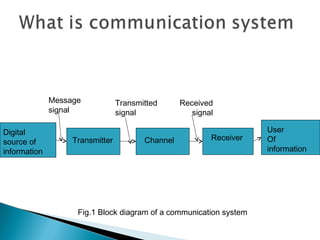
Fig.1 Block diagram of a communication system
Digital
source of
information
Transmitter Channel Receiver
User
Of
information
Message
signal
Transmitted
signal
Received
signal
 The ability of an adaptive filter to operate
satisfactorily in an unknown environment and
track time variation of input statistics makes the
adaptive filter a powerful device for signal
processing and control applications.
 There are four application of adaptive
1. System identification
2. Inverse Modeling
3. Prediction
4. Interference Cancellation
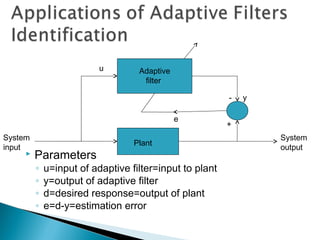
 Parameters
◦ u=input of adaptive filter=input to plant
◦ y=output of adaptive filter
◦ d=desired response=output of plant
◦ e=d-y=estimation error
System
input
Plant
System
output
Adaptive
filter
- y
+
u
e
The term speech processing basically refers to the
scientific discipline concerning the analysis and
processing of speech signals in order to achieve the best
benefit in various practical scenarios . The field of speech
processing is, at present, under going a rapid growth in
terms of both performance and applications. This is
stimulated by the advances being made in the field of
microelectronics, computation and algorithm design
 three engineering applications:
1. • Speech Coding and transmission that is mainly concerned
with man-to man voice communication;
2. • Speech Synthesis which deals with machine-to-man
communications;
3. • Speech Recognition relating to man-to machine
communication.
Kalman filters are widely used in speech
enhancement and much theoretical work has
been done analyzing Kalman filters. The
Kalman filter is the minimum mean-square
estimator of the state of a linear dynamical
system and can be used to derive many
types of RLS filters. Extended Kalman filters
can be expanded to handle nonlinear models
through a linearization process.
Kalman filters have the advantages that they are:
◦ more robust (stationarity not assumed)
◦ require only the previous estimate for the next estimation
(versus all passed values for instance)
◦ computationally efficient
 It is only a tool
 It is a computer program
 It is a complete statistical characterization
of an estimation problem
 In a limited context, it is a learning
method
 Filter algorithm is implementable on a digital
computer
 Stationary properties of the Kalman filter are not
required
 Compatible with state-space formulation of
optimal controllers for dynamic systems
 Requires less additional mathematical
preparation
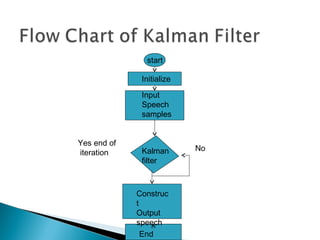
Kalman
filter
Input
Speech
samples
Construc
t
Output
speech
Initialize
End
start
Yes end of
iteration
No
 MatLab : Matrix Laboratory
 Numerical Computations with matrices
 Every number can be represented as
matrix
 Why Matlab?
 User Friendly (GUI)
 Easy to work with
 Powerful tools for complex mathematics
 Matlab has extensive demo and tutorials to learn by
yourself
◦ Use help command
 To enter a matrix
2 5 3
6 4 1
>> A = [2 5 3; 6 4 1]
>> B = [1:1.5:6; 2 3 4 5]
>> for i=1:4
for j=1:3
C(i,j)=i*j;
end
end
>> D =[]; D=[D;5]; D=[D;6;7]
>> E = zeros(4, 5)

Ppt on speech processing by ranbeer

  • 1.
  • 2.
     The termestimator or filter is commonly used to refer to system that is designed to extract information about a prescribed quantity of interest from noisy data. With such a broad aim, estimation theory finds application in many diverse fields: communication, radar among others  Two major kinds of impairments: 1. Inter symbol interference. 2. Noise
  • 3.
    Fig.1 Block diagramof a communication system Digital source of information Transmitter Channel Receiver User Of information Message signal Transmitted signal Received signal
  • 4.
     The abilityof an adaptive filter to operate satisfactorily in an unknown environment and track time variation of input statistics makes the adaptive filter a powerful device for signal processing and control applications.  There are four application of adaptive 1. System identification 2. Inverse Modeling 3. Prediction 4. Interference Cancellation
  • 5.
     Parameters ◦ u=inputof adaptive filter=input to plant ◦ y=output of adaptive filter ◦ d=desired response=output of plant ◦ e=d-y=estimation error System input Plant System output Adaptive filter - y + u e
  • 6.
    The term speechprocessing basically refers to the scientific discipline concerning the analysis and processing of speech signals in order to achieve the best benefit in various practical scenarios . The field of speech processing is, at present, under going a rapid growth in terms of both performance and applications. This is stimulated by the advances being made in the field of microelectronics, computation and algorithm design
  • 7.
     three engineeringapplications: 1. • Speech Coding and transmission that is mainly concerned with man-to man voice communication; 2. • Speech Synthesis which deals with machine-to-man communications; 3. • Speech Recognition relating to man-to machine communication.
  • 8.
    Kalman filters arewidely used in speech enhancement and much theoretical work has been done analyzing Kalman filters. The Kalman filter is the minimum mean-square estimator of the state of a linear dynamical system and can be used to derive many types of RLS filters. Extended Kalman filters can be expanded to handle nonlinear models through a linearization process. Kalman filters have the advantages that they are: ◦ more robust (stationarity not assumed) ◦ require only the previous estimate for the next estimation (versus all passed values for instance) ◦ computationally efficient
  • 9.
     It isonly a tool  It is a computer program  It is a complete statistical characterization of an estimation problem  In a limited context, it is a learning method
  • 10.
     Filter algorithmis implementable on a digital computer  Stationary properties of the Kalman filter are not required  Compatible with state-space formulation of optimal controllers for dynamic systems  Requires less additional mathematical preparation
  • 11.
  • 12.
     MatLab :Matrix Laboratory  Numerical Computations with matrices  Every number can be represented as matrix  Why Matlab?  User Friendly (GUI)  Easy to work with  Powerful tools for complex mathematics  Matlab has extensive demo and tutorials to learn by yourself ◦ Use help command
  • 13.
     To entera matrix 2 5 3 6 4 1 >> A = [2 5 3; 6 4 1] >> B = [1:1.5:6; 2 3 4 5] >> for i=1:4 for j=1:3 C(i,j)=i*j; end end >> D =[]; D=[D;5]; D=[D;6;7] >> E = zeros(4, 5)