DSP application on Mobile
Communication
Keval Patel
100110111007
Applications:
• To reduce bandwidth in Voice communication
• Low power implementation of DSP
• In Real time multimedia facilities
• To synchronice audio and video
• To reduce the bandwidth of video signal
To reduce bandwidth in Voice
communication:
• As we know that if we increase the bitrate than we need more
bandwidth.
• But in celluler system our main aim is to reduce the required
bandwidth.
• For that we have to reduce the bit rate. To do that we may use DSP.
• To reduce the bit-rate required for transmitting telephone quality
speech, a new approach to speech compression is needed.
• Current mobile phones compress to about 13,000 b/s (bit per second)
and weaim to achieve 4,000 b/s and lower using a method called
'DAP-STC'.
To reduce bandwidth in Voice
communication:
• Compression is generallyachieved by spectrally analysing speech
segments to derive a model of the human speech process.
• A variable bit-rate version achieves an average 2,400 b/s and is
suitable for packetised speech as may be transmitted over computer
networks.
Low power implementation of DSP:
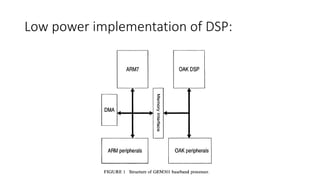
• The requirement for extended battery life, reduced size and low
electromagnetic interference for mobile communication equipment
(i.e. our cellphone)has led to the development of a novel
asynchronous DSP device known as CADRE.
• The special features of CADRE is to minimize energy consumption.
• This optimization at software level builds on the economies achieved
at hardware design level and aims to minimize the switching activity
when the DSP code is implemented.
Low power implementation of DSP:
• This power consumption in CADRE can be achived by:
1. Reducing the Supply Voltage
2. Reducing Switched Capacitance
3. Reducing Switching Activity
Real time multimedia facilities:
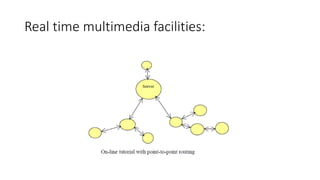
• Real time multimedia is one of the feature of high speed inter net.
• The terminal would be any mobile PC or any desktop or other
equipment.
• The major problem in this type of video is to synchronice between
video & audio information.
• Distance learning can be a major application of fixed and mobile
computer networks and the Internet.
• Delay due to network problem have a more serious effects on real-
time traffic than on text or only voice information.
Real time multimedia facilities:
• One more thing to take in conceder in this is bandwidth.
• As we know that the video require a higher bandwidth, so we have to
accommodate video signals in given bandwidth.
• This will again done by compressing the video signal as we discussed
before in case of voice communication..
Real time multimedia facilities:
THANK YOU

Dsp application on mobile communication

  • 1.
    DSP application onMobile Communication Keval Patel 100110111007
  • 2.
    Applications: • To reducebandwidth in Voice communication • Low power implementation of DSP • In Real time multimedia facilities • To synchronice audio and video • To reduce the bandwidth of video signal
  • 3.
    To reduce bandwidthin Voice communication: • As we know that if we increase the bitrate than we need more bandwidth. • But in celluler system our main aim is to reduce the required bandwidth. • For that we have to reduce the bit rate. To do that we may use DSP. • To reduce the bit-rate required for transmitting telephone quality speech, a new approach to speech compression is needed. • Current mobile phones compress to about 13,000 b/s (bit per second) and weaim to achieve 4,000 b/s and lower using a method called 'DAP-STC'.
  • 4.
    To reduce bandwidthin Voice communication: • Compression is generallyachieved by spectrally analysing speech segments to derive a model of the human speech process. • A variable bit-rate version achieves an average 2,400 b/s and is suitable for packetised speech as may be transmitted over computer networks.
  • 5.
    Low power implementationof DSP: • The requirement for extended battery life, reduced size and low electromagnetic interference for mobile communication equipment (i.e. our cellphone)has led to the development of a novel asynchronous DSP device known as CADRE. • The special features of CADRE is to minimize energy consumption. • This optimization at software level builds on the economies achieved at hardware design level and aims to minimize the switching activity when the DSP code is implemented.
  • 6.
  • 7.
    Low power implementationof DSP: • This power consumption in CADRE can be achived by: 1. Reducing the Supply Voltage 2. Reducing Switched Capacitance 3. Reducing Switching Activity
  • 8.
    Real time multimediafacilities: • Real time multimedia is one of the feature of high speed inter net. • The terminal would be any mobile PC or any desktop or other equipment. • The major problem in this type of video is to synchronice between video & audio information. • Distance learning can be a major application of fixed and mobile computer networks and the Internet. • Delay due to network problem have a more serious effects on real- time traffic than on text or only voice information.
  • 9.
    Real time multimediafacilities: • One more thing to take in conceder in this is bandwidth. • As we know that the video require a higher bandwidth, so we have to accommodate video signals in given bandwidth. • This will again done by compressing the video signal as we discussed before in case of voice communication..
  • 10.
  • 11.