1
DSP - Digital Signal ProcessingDSP - Digital Signal Processing
Part 4Part 4
Dr. Krishnanaik VankdothDr. Krishnanaik Vankdoth
B.EB.E(ECE),(ECE), M.TechM.Tech (ECE),(ECE), Ph.DPh.D (ECE)(ECE)
Professor in ECE Dept
Aksum University, Ethiopia– 1010
Dr. V. Krishnanaik Ph.D
Books.Books.
1.1. Digital Signal Processing Principles, Algorithms and ApplicationsDigital Signal Processing Principles, Algorithms and Applications
John G.Proakis & Dimitris G.Manolakis
2.2. Digital Signal ProcessingDigital Signal Processing By.
Sen M. Kuo & Woon-Seng Gan
3.3. Digital Signal Processing A Practical Approach.Digital Signal Processing A Practical Approach. By
Emmanuel C. Ifeachor & Barrie W. Jervis
4.4. Digital Signal Processing By Dr. Krishnanaik Vankdoth LAPDigital Signal Processing By Dr. Krishnanaik Vankdoth LAP
LAMBERT Academic Publishing Dnfscland/Germany – 2014LAMBERT Academic Publishing Dnfscland/Germany – 2014
krishnanaik.ece@gmail.com 2
3
Grading Policy
krishnanaik.ece@gmail.com
Assignments 1 & 2
20 Marks
Quiz Test -Mid-Term 30 Marks
Final Exam 50 Marks
Class will be divided different level as per their GPA
Group A- GPA
Group B- GPA
Group C – GPA
Multirate Digital Signal
Processing
4Dr. V. Krishnanaik Ph.D
Multirate Digital Signal
Processing
• systems that employ multiple sampling rates in
the processing of digital signals are called
multirate digital signal processing systems.
• Multirate systems are sometimes used for
sampling-rate conversion
• In most applications multirate systems are
used to improve the performance, or for
increased computational efficiency.
5krishnanaik.ece@gmail.com
Multirate Digital Signal
Processing
• The basic Sampling operations in a
multirate system are:
6krishnanaik.ece@gmail.com
Sampling Rate Reduction by Integer Factor D
7krishnanaik.ece@gmail.com
Sampling Rate Reduction by Integer
Factor D
H(n)
Downsampler
D
Digital anti-aliasing
filter
Sampling-rate
compressor
8krishnanaik.ece@gmail.com
Sampling Rate Reduction by Integer
Factor
D
9krishnanaik.ece@gmail.com
Sampling Rate Reduction by
Integer Factor D
10krishnanaik.ece@gmail.com
Sampling Rate Reduction by
Integer Factor D
11krishnanaik.ece@gmail.com
Sampling Rate Reduction by
Integer Factor D
12krishnanaik.ece@gmail.com
Sampling Rate Increase by
Integer Factor I
• Interpolation by a factor of L, where L is a
positive integer, can be realized as a two-step
process of upsampling followed by an anti-
imaging filtering.
L LPF
13krishnanaik.ece@gmail.com
Sampling Rate Increase by Integer
Factor I
• An upsampling operation to a discrete-time
signal x(n) produces an upsampled signal
y(m) according to
14krishnanaik.ece@gmail.com
Sampling Rate Increase by Integer
Factor I
• The frequency domain representation of upsampling can be found by
taking the z-transform of both sides
15krishnanaik.ece@gmail.com
Sampling Rate Increase by Integer
Factor I
16krishnanaik.ece@gmail.com
1
17krishnanaik.ece@gmail.com
Sampling rate conversion by a rational factor ‘L/D’ can be
achieved by first performing interpolation by the factor ‘L’ and
then decimation the interpolator o/p by a factor ‘D’ .
In this process both the interpolation and decimator are cascaded
as shown in the figure below:
Upsampl
er
I
Downsam
pler
D
Sampling RateSampling Rate conversionconversion by Integer Rationalby Integer Rational
Factor L/DFactor L/D
18krishnanaik.ece@gmail.com
19krishnanaik.ece@gmail.com
• Example:
Consider a multirate signal processing problem:
i. State with the aid of block diagrams the process
of changing sampling rate by a non-integer factor.
ii.Develop an expression for the output y[n] and
g[n] as a function of input x[n] for the multirate
structure of fig .
20krishnanaik.ece@gmail.com
• Answer:
i. .
1.We perform the upsampling process by a
factor L following of an interpolation filter
h1(l).
2.We continue filtering the output from the
interpolation filter via anti-aliasing filter h2(l)
and finally operate downsampling.
21krishnanaik.ece@gmail.com
Sampling Rate conversion by Integer Rational
Factor L/D
ii.
22krishnanaik.ece@gmail.com
Polyphase filters
• Polyphase filters A very useful tool in multirate signal
processing is the so-called poly phase representation of
signals and systems facilitates considerable simplifications
of theoretical results as well as efficient implementation of
multirate systems.
• To formally define it, an LTI system is considered with a
transfer function
23krishnanaik.ece@gmail.com
24krishnanaik.ece@gmail.com
25krishnanaik.ece@gmail.com
26krishnanaik.ece@gmail.com
27krishnanaik.ece@gmail.com
28krishnanaik.ece@gmail.com
29krishnanaik.ece@gmail.com
30krishnanaik.ece@gmail.com
31krishnanaik.ece@gmail.com
32krishnanaik.ece@gmail.com
Applications of
Multirate DSP
• Multirate systems are used in a CD player when the
music signal is converted from digital into analog
(DAC).
33krishnanaik.ece@gmail.com
Applications of
Multirate DSP
34krishnanaik.ece@gmail.com
Applications of
Multirate DSP
35krishnanaik.ece@gmail.com
Applications of
Multirate DSP
The effect of oversampling also has some other
desirable features:
 Firstly, it causes the image frequencies to be much
higher and therefore easier to filter out.
 Secondly reducing the noise power spectral
density, by spreading the noise power over a
larger bandwidth.
36krishnanaik.ece@gmail.com
High quality Analog to Digital conversion for
digital audio
37krishnanaik.ece@gmail.com
Digital Signal Processor
38Dr. V. Krishnanaik Ph.D
What is a dsp processor?
• It is a type of processor which is generally used to process
real time data.
• DSP applications such as convolution , correlation need
array multiplication.
• In such cases it is required that multiplication should be
completed before arrival of next input sample in the array.
• Most DSP algorithms involve repetitive arithmetic
operations such as multiply and add, multiple memory
access , heavy dataflow through CPU.
• For these functions to be performed advanced DSP
architecture is required.
39krishnanaik.ece@gmail.com
DSP BLOCKS
• The internal hardware of a digital signal
processor consists of many blocks:
1.CPU
2.Arithmetic Logic Unit (ALU)
3.Accumulators
4.Barrel shifter
5.Multiplier unit
6.Compare Select and Store Unit ( CSSU )
7.Memory cache
8.DMA controller
40krishnanaik.ece@gmail.com
GENERAL DSP ARCHITECTURE
41krishnanaik.ece@gmail.com
Dsp MEMORY architecture
• The DSP architecture is of three types:
1.Von Neumann Architecture
2.Harvard Architecture
3.Super Harvard Architecture (SHARC)
42krishnanaik.ece@gmail.com
VON NEUMANN ARCHITECTURE
• Von Neumann architecture contains a single memory and a
single bus for transferring data into and out of the central
processing unit (CPU).
• Multiplying two numbers requires at least three clock cycles, one
to transfer each of the three numbers over the bus from the
memory to the CPU. We don't count the time to transfer the
result back to memory, because we assume that it remains in the
CPU for additional manipulation (such as the sum of products in
an FIR filter).
• The Von Neumann design is quite satisfactory when you are
content to execute all of the required tasks in serial.
43krishnanaik.ece@gmail.com
Harvard architecture
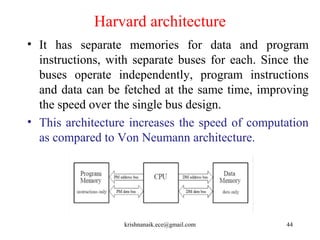
• It has separate memories for data and program
instructions, with separate buses for each. Since the
buses operate independently, program instructions
and data can be fetched at the same time, improving
the speed over the single bus design.
• This architecture increases the speed of computation
as compared to Von Neumann architecture.
44krishnanaik.ece@gmail.com
Super Harvard architecture (sharc)
• SHARC® DSPs, a contraction of the longer
term, Super Harvard ARChitecture.
• SHARC DSPs are optimized by addition of: an instruction
cache, and an I/O controller.
INSTRUCTION CACHE
• DSP algorithms generally spend most of their execution
time in loops, such as instructions . This means that the
same set of program instructions will continually pass from
program memory to the CPU. By including an instruction
cache in the CPU. It is a small memory that contains about
32 of the most recent program instructions. On additional
executions of the loop, the program instructions can be
pulled from the instruction cache. This means that all of the
memory to CPU information transfers can be accomplished
in a single cycle.
45krishnanaik.ece@gmail.com
Super Harvard architecture (sharc)
I/O CONTROLLER
•The SHARC DSPs provides both serial and parallel communications ports.
These are extremely high speed connections. For example, at a 40 MHz clock
speed, there are two serial ports that operate at 40 Mbits/second each, while six
parallel ports each provide a 40 Mbytes/second data transfer. When all six
parallel ports are used together, the data transfer rate is an incredible 240
Mbytes/second.
•Thus the I/O port helps in faster execution.
46krishnanaik.ece@gmail.com
Pipelining
• It is a technique which allows two or more operations to
overlap during execution.
• DSP algorithms are repetitive making them suitable for
pipelining .
• It ensures a steady flow of instructions to the CPU and
increases system performance.
• In pipelining each instruction still takes three clock cycles
but at each cycle the processor is executing up to three
different instructions.
• It has an impact upon the system memory . The no.of
memory accesses increases by the no.of stages.
• In Harvard architecture the separation of data and
instruction memory promotes pipelining.
• It also allows better utilisation of arithmetic unit.
47krishnanaik.ece@gmail.com
PIPELINING
48krishnanaik.ece@gmail.com
Multiplier-ACCUMULATOR UNIT (MAC)
• DSP operations involve many time consuming multiplications
and additions.
• To make real-time operation faster multiplier-accumulator
(MAC) unit using fixed or floating point arithmetic is mandatory.
• The MAC unit consists of a multiplier that has a pair of input
registers that holds the inputs to the multiplier and a 32 bit
product register which holds the result of a multiplication.
• The output of the product register is connected to a double
precision accumulator where the products are accumulated.
• Floating point MACs allow fast computation with minimal
errors.
49krishnanaik.ece@gmail.com
MAC UNIT
50krishnanaik.ece@gmail.com
Multiplier/adder unit
• The multiplier/adder block consists of several elements:
1. A multiplier , an adder ,signed/unsigned input
2. Control logic
3. Zero detector, a rounder, overflow logic
• The multiplier/adder unit performs 17 X 17 bit multiplication
with 40 bit addition in a single instruction cycle.
51krishnanaik.ece@gmail.com
1. Genaral purpose digital signal processors
1. High speed microprocessor
2. Architechture & Instruction sets optimized for DSP operations
1. Fixed point processors ( TMS320C5x, TMS320C54x,
DSP563x)
2. Floating point processors (TMS320C4x, TMS320C67xx)
3. Analog devices (ADSP21xx)
2. Special purpose digital signal processors
1. H/W designed for specific DSP algorithms such as FFT.
2. H/W designed for specific DSP applications such as PCM &
filtering.
1. Mitel’s multi channel telephony voice echo canceller
(MT93001)
2. FFT processor (PDSP 16515A, TM-44, TM-66)
3. Programmable FIR filter (UDSP 16256, Model3092)
52krishnanaik.ece@gmail.com
Need of digital signal processor
53krishnanaik.ece@gmail.com
54krishnanaik.ece@gmail.com
The tms320c3X
• First Texas Instruments 32-bit floating point
digital signal processors.
• It is :
» Easy-to-use architecture
» High performance
• Applications:
» Automotive applications
» Digital audio
» Industrial automation & control
» Data communication
» Office equipments like copiers, laser printers,
etc.
• It has Independent
multiplier and ALU to offer
upto 60 million floating-
point operations per second
(MFLOPS)
• It has upto 30 MIPS.
• Total memory space is 16
million 32-bit words.
55krishnanaik.ece@gmail.com
The tms320c4X
• 32-bit floating point digital signal
processors optimized for parallel
processing.
• It is :
» DMS controller with upto 6 com ports
» High performance
» On chip analysis module that supports h/w
breakpoints for parallel processing dev & debugging
• Applications:
» 3-D graphics
» Image processing
» Networking
» Telecommunication base station 56krishnanaik.ece@gmail.com
The tms320c5X
• Accepts source code from the ‘C1x, ‘C2x
and ‘C2xx generations.
• It is :
» Faster cycle times
» On chip memories
» A Parallel Logic Unit (PLU)
» Zero overhead context switching
» Block repeats differentiate the ‘C5x
• It has also an ANSI C compiler designed
for the ‘C5x, which translates the widely
used ANSI C language directly into highly
optimized assembly language for the ‘C5x.57krishnanaik.ece@gmail.com
The tms320c55X
• 16-bit fixed-point packaged DSP
processor.
• It can execute upto 2 instructions in
parallel (instruction width 8 – 48 bits)
» Interfaces directly to SDRAM
» Used where large memory buffers are needed
• Application:
» Digital cameras
» CD-ROM
» Audio players
58krishnanaik.ece@gmail.com
The tms320c62XX
• Fixed-point DSP processor.
• It is based on VLIW architecture
• For example:
• TMS320C62xx works at 200MHz with 1.8V core
supply
• It executes upto 400 millions MACs per second.
59krishnanaik.ece@gmail.com
Von Neumann architecture
• Proposed by John Von
Neumann
• Also known as the Von
Neumann
model and Princeton
architecture
• Program instructions stored
in ROM
• Both read/write of data and
reading of instructions can’t
be performed simultaneously
60krishnanaik.ece@gmail.com
Von Neumann architecture
Single System Bus
61krishnanaik.ece@gmail.com
Harvard architecture
62krishnanaik.ece@gmail.com
Harvard architecture
63krishnanaik.ece@gmail.com
Modified/super Harvard
architecture (sharc®
)
64krishnanaik.ece@gmail.com
Very long instruction word
architecture
65krishnanaik.ece@gmail.com
Very long instruction word
architecture
• Advantages
– Increased performance
– Better compiler targets
– Potentially easier to
program
– Potentially scalable
– Can add more execution
units, allow more
instructions to be
packed into VLIW
instruction.
• Disadvantages
• New kind of
programmer/compiler
complexity
• Program must keep track
of instruction scheduling
• Increased memory use
• High power consumption
• Misleading MIPS ratings
66krishnanaik.ece@gmail.com
67Dr. V. Krishnanaik Ph.D
Dr. Krishnanaik VankdothDr. Krishnanaik Vankdoth
B.EB.E(ECE),(ECE), M.TechM.Tech (ECE),(ECE), Ph.DPh.D (ECE)(ECE)
Professor in ECE Dept
Aksum University, Ethiopia– 1010
Krishnanaik.ece@gmail.com
Krishnanaik_ece@yahoo.com
Phone : +919441629162
krishnanaik.ece@gmail.com 68

Digital signal processor part4

  • 1.
    1 DSP - DigitalSignal ProcessingDSP - Digital Signal Processing Part 4Part 4 Dr. Krishnanaik VankdothDr. Krishnanaik Vankdoth B.EB.E(ECE),(ECE), M.TechM.Tech (ECE),(ECE), Ph.DPh.D (ECE)(ECE) Professor in ECE Dept Aksum University, Ethiopia– 1010 Dr. V. Krishnanaik Ph.D
  • 2.
    Books.Books. 1.1. Digital SignalProcessing Principles, Algorithms and ApplicationsDigital Signal Processing Principles, Algorithms and Applications John G.Proakis & Dimitris G.Manolakis 2.2. Digital Signal ProcessingDigital Signal Processing By. Sen M. Kuo & Woon-Seng Gan 3.3. Digital Signal Processing A Practical Approach.Digital Signal Processing A Practical Approach. By Emmanuel C. Ifeachor & Barrie W. Jervis 4.4. Digital Signal Processing By Dr. Krishnanaik Vankdoth LAPDigital Signal Processing By Dr. Krishnanaik Vankdoth LAP LAMBERT Academic Publishing Dnfscland/Germany – 2014LAMBERT Academic Publishing Dnfscland/Germany – 2014 krishnanaik.ece@gmail.com 2
  • 3.
    3 Grading Policy krishnanaik.ece@gmail.com Assignments 1& 2 20 Marks Quiz Test -Mid-Term 30 Marks Final Exam 50 Marks Class will be divided different level as per their GPA Group A- GPA Group B- GPA Group C – GPA
  • 4.
  • 5.
    Multirate Digital Signal Processing •systems that employ multiple sampling rates in the processing of digital signals are called multirate digital signal processing systems. • Multirate systems are sometimes used for sampling-rate conversion • In most applications multirate systems are used to improve the performance, or for increased computational efficiency. 5krishnanaik.ece@gmail.com
  • 6.
    Multirate Digital Signal Processing •The basic Sampling operations in a multirate system are: 6krishnanaik.ece@gmail.com
  • 7.
    Sampling Rate Reductionby Integer Factor D 7krishnanaik.ece@gmail.com
  • 8.
    Sampling Rate Reductionby Integer Factor D H(n) Downsampler D Digital anti-aliasing filter Sampling-rate compressor 8krishnanaik.ece@gmail.com
  • 9.
    Sampling Rate Reductionby Integer Factor D 9krishnanaik.ece@gmail.com
  • 10.
    Sampling Rate Reductionby Integer Factor D 10krishnanaik.ece@gmail.com
  • 11.
    Sampling Rate Reductionby Integer Factor D 11krishnanaik.ece@gmail.com
  • 12.
    Sampling Rate Reductionby Integer Factor D 12krishnanaik.ece@gmail.com
  • 13.
    Sampling Rate Increaseby Integer Factor I • Interpolation by a factor of L, where L is a positive integer, can be realized as a two-step process of upsampling followed by an anti- imaging filtering. L LPF 13krishnanaik.ece@gmail.com
  • 14.
    Sampling Rate Increaseby Integer Factor I • An upsampling operation to a discrete-time signal x(n) produces an upsampled signal y(m) according to 14krishnanaik.ece@gmail.com
  • 15.
    Sampling Rate Increaseby Integer Factor I • The frequency domain representation of upsampling can be found by taking the z-transform of both sides 15krishnanaik.ece@gmail.com
  • 16.
    Sampling Rate Increaseby Integer Factor I 16krishnanaik.ece@gmail.com
  • 17.
  • 18.
    Sampling rate conversionby a rational factor ‘L/D’ can be achieved by first performing interpolation by the factor ‘L’ and then decimation the interpolator o/p by a factor ‘D’ . In this process both the interpolation and decimator are cascaded as shown in the figure below: Upsampl er I Downsam pler D Sampling RateSampling Rate conversionconversion by Integer Rationalby Integer Rational Factor L/DFactor L/D 18krishnanaik.ece@gmail.com
  • 19.
  • 20.
    • Example: Consider amultirate signal processing problem: i. State with the aid of block diagrams the process of changing sampling rate by a non-integer factor. ii.Develop an expression for the output y[n] and g[n] as a function of input x[n] for the multirate structure of fig . 20krishnanaik.ece@gmail.com
  • 21.
    • Answer: i. . 1.Weperform the upsampling process by a factor L following of an interpolation filter h1(l). 2.We continue filtering the output from the interpolation filter via anti-aliasing filter h2(l) and finally operate downsampling. 21krishnanaik.ece@gmail.com
  • 22.
    Sampling Rate conversionby Integer Rational Factor L/D ii. 22krishnanaik.ece@gmail.com
  • 23.
    Polyphase filters • Polyphasefilters A very useful tool in multirate signal processing is the so-called poly phase representation of signals and systems facilitates considerable simplifications of theoretical results as well as efficient implementation of multirate systems. • To formally define it, an LTI system is considered with a transfer function 23krishnanaik.ece@gmail.com
  • 24.
  • 25.
  • 26.
  • 27.
  • 28.
  • 29.
  • 30.
  • 31.
  • 32.
  • 33.
    Applications of Multirate DSP •Multirate systems are used in a CD player when the music signal is converted from digital into analog (DAC). 33krishnanaik.ece@gmail.com
  • 34.
  • 35.
  • 36.
    Applications of Multirate DSP Theeffect of oversampling also has some other desirable features:  Firstly, it causes the image frequencies to be much higher and therefore easier to filter out.  Secondly reducing the noise power spectral density, by spreading the noise power over a larger bandwidth. 36krishnanaik.ece@gmail.com
  • 37.
    High quality Analogto Digital conversion for digital audio 37krishnanaik.ece@gmail.com
  • 38.
    Digital Signal Processor 38Dr.V. Krishnanaik Ph.D
  • 39.
    What is adsp processor? • It is a type of processor which is generally used to process real time data. • DSP applications such as convolution , correlation need array multiplication. • In such cases it is required that multiplication should be completed before arrival of next input sample in the array. • Most DSP algorithms involve repetitive arithmetic operations such as multiply and add, multiple memory access , heavy dataflow through CPU. • For these functions to be performed advanced DSP architecture is required. 39krishnanaik.ece@gmail.com
  • 40.
    DSP BLOCKS • Theinternal hardware of a digital signal processor consists of many blocks: 1.CPU 2.Arithmetic Logic Unit (ALU) 3.Accumulators 4.Barrel shifter 5.Multiplier unit 6.Compare Select and Store Unit ( CSSU ) 7.Memory cache 8.DMA controller 40krishnanaik.ece@gmail.com
  • 41.
  • 42.
    Dsp MEMORY architecture •The DSP architecture is of three types: 1.Von Neumann Architecture 2.Harvard Architecture 3.Super Harvard Architecture (SHARC) 42krishnanaik.ece@gmail.com
  • 43.
    VON NEUMANN ARCHITECTURE •Von Neumann architecture contains a single memory and a single bus for transferring data into and out of the central processing unit (CPU). • Multiplying two numbers requires at least three clock cycles, one to transfer each of the three numbers over the bus from the memory to the CPU. We don't count the time to transfer the result back to memory, because we assume that it remains in the CPU for additional manipulation (such as the sum of products in an FIR filter). • The Von Neumann design is quite satisfactory when you are content to execute all of the required tasks in serial. 43krishnanaik.ece@gmail.com
  • 44.
    Harvard architecture • Ithas separate memories for data and program instructions, with separate buses for each. Since the buses operate independently, program instructions and data can be fetched at the same time, improving the speed over the single bus design. • This architecture increases the speed of computation as compared to Von Neumann architecture. 44krishnanaik.ece@gmail.com
  • 45.
    Super Harvard architecture(sharc) • SHARC® DSPs, a contraction of the longer term, Super Harvard ARChitecture. • SHARC DSPs are optimized by addition of: an instruction cache, and an I/O controller. INSTRUCTION CACHE • DSP algorithms generally spend most of their execution time in loops, such as instructions . This means that the same set of program instructions will continually pass from program memory to the CPU. By including an instruction cache in the CPU. It is a small memory that contains about 32 of the most recent program instructions. On additional executions of the loop, the program instructions can be pulled from the instruction cache. This means that all of the memory to CPU information transfers can be accomplished in a single cycle. 45krishnanaik.ece@gmail.com
  • 46.
    Super Harvard architecture(sharc) I/O CONTROLLER •The SHARC DSPs provides both serial and parallel communications ports. These are extremely high speed connections. For example, at a 40 MHz clock speed, there are two serial ports that operate at 40 Mbits/second each, while six parallel ports each provide a 40 Mbytes/second data transfer. When all six parallel ports are used together, the data transfer rate is an incredible 240 Mbytes/second. •Thus the I/O port helps in faster execution. 46krishnanaik.ece@gmail.com
  • 47.
    Pipelining • It isa technique which allows two or more operations to overlap during execution. • DSP algorithms are repetitive making them suitable for pipelining . • It ensures a steady flow of instructions to the CPU and increases system performance. • In pipelining each instruction still takes three clock cycles but at each cycle the processor is executing up to three different instructions. • It has an impact upon the system memory . The no.of memory accesses increases by the no.of stages. • In Harvard architecture the separation of data and instruction memory promotes pipelining. • It also allows better utilisation of arithmetic unit. 47krishnanaik.ece@gmail.com
  • 48.
  • 49.
    Multiplier-ACCUMULATOR UNIT (MAC) •DSP operations involve many time consuming multiplications and additions. • To make real-time operation faster multiplier-accumulator (MAC) unit using fixed or floating point arithmetic is mandatory. • The MAC unit consists of a multiplier that has a pair of input registers that holds the inputs to the multiplier and a 32 bit product register which holds the result of a multiplication. • The output of the product register is connected to a double precision accumulator where the products are accumulated. • Floating point MACs allow fast computation with minimal errors. 49krishnanaik.ece@gmail.com
  • 50.
  • 51.
    Multiplier/adder unit • Themultiplier/adder block consists of several elements: 1. A multiplier , an adder ,signed/unsigned input 2. Control logic 3. Zero detector, a rounder, overflow logic • The multiplier/adder unit performs 17 X 17 bit multiplication with 40 bit addition in a single instruction cycle. 51krishnanaik.ece@gmail.com
  • 52.
    1. Genaral purposedigital signal processors 1. High speed microprocessor 2. Architechture & Instruction sets optimized for DSP operations 1. Fixed point processors ( TMS320C5x, TMS320C54x, DSP563x) 2. Floating point processors (TMS320C4x, TMS320C67xx) 3. Analog devices (ADSP21xx) 2. Special purpose digital signal processors 1. H/W designed for specific DSP algorithms such as FFT. 2. H/W designed for specific DSP applications such as PCM & filtering. 1. Mitel’s multi channel telephony voice echo canceller (MT93001) 2. FFT processor (PDSP 16515A, TM-44, TM-66) 3. Programmable FIR filter (UDSP 16256, Model3092) 52krishnanaik.ece@gmail.com
  • 53.
    Need of digitalsignal processor 53krishnanaik.ece@gmail.com
  • 54.
  • 55.
    The tms320c3X • FirstTexas Instruments 32-bit floating point digital signal processors. • It is : » Easy-to-use architecture » High performance • Applications: » Automotive applications » Digital audio » Industrial automation & control » Data communication » Office equipments like copiers, laser printers, etc. • It has Independent multiplier and ALU to offer upto 60 million floating- point operations per second (MFLOPS) • It has upto 30 MIPS. • Total memory space is 16 million 32-bit words. 55krishnanaik.ece@gmail.com
  • 56.
    The tms320c4X • 32-bitfloating point digital signal processors optimized for parallel processing. • It is : » DMS controller with upto 6 com ports » High performance » On chip analysis module that supports h/w breakpoints for parallel processing dev & debugging • Applications: » 3-D graphics » Image processing » Networking » Telecommunication base station 56krishnanaik.ece@gmail.com
  • 57.
    The tms320c5X • Acceptssource code from the ‘C1x, ‘C2x and ‘C2xx generations. • It is : » Faster cycle times » On chip memories » A Parallel Logic Unit (PLU) » Zero overhead context switching » Block repeats differentiate the ‘C5x • It has also an ANSI C compiler designed for the ‘C5x, which translates the widely used ANSI C language directly into highly optimized assembly language for the ‘C5x.57krishnanaik.ece@gmail.com
  • 58.
    The tms320c55X • 16-bitfixed-point packaged DSP processor. • It can execute upto 2 instructions in parallel (instruction width 8 – 48 bits) » Interfaces directly to SDRAM » Used where large memory buffers are needed • Application: » Digital cameras » CD-ROM » Audio players 58krishnanaik.ece@gmail.com
  • 59.
    The tms320c62XX • Fixed-pointDSP processor. • It is based on VLIW architecture • For example: • TMS320C62xx works at 200MHz with 1.8V core supply • It executes upto 400 millions MACs per second. 59krishnanaik.ece@gmail.com
  • 60.
    Von Neumann architecture •Proposed by John Von Neumann • Also known as the Von Neumann model and Princeton architecture • Program instructions stored in ROM • Both read/write of data and reading of instructions can’t be performed simultaneously 60krishnanaik.ece@gmail.com
  • 61.
    Von Neumann architecture SingleSystem Bus 61krishnanaik.ece@gmail.com
  • 62.
  • 63.
  • 64.
  • 65.
    Very long instructionword architecture 65krishnanaik.ece@gmail.com
  • 66.
    Very long instructionword architecture • Advantages – Increased performance – Better compiler targets – Potentially easier to program – Potentially scalable – Can add more execution units, allow more instructions to be packed into VLIW instruction. • Disadvantages • New kind of programmer/compiler complexity • Program must keep track of instruction scheduling • Increased memory use • High power consumption • Misleading MIPS ratings 66krishnanaik.ece@gmail.com
  • 67.
  • 68.
    Dr. Krishnanaik VankdothDr.Krishnanaik Vankdoth B.EB.E(ECE),(ECE), M.TechM.Tech (ECE),(ECE), Ph.DPh.D (ECE)(ECE) Professor in ECE Dept Aksum University, Ethiopia– 1010 Krishnanaik.ece@gmail.com Krishnanaik_ece@yahoo.com Phone : +919441629162 krishnanaik.ece@gmail.com 68