Download to read offline




![% are several variants for this procedure;
% here we use the simplest expression
s_aposteriori(i)¼s_apriori(i)*(1-K(i)); % Eq (19.20)
% step 2: Project Estimates for the next Step
x_apriori(iþ 1)¼x_aposteriori(i); % Eq (19.21)
s_apriori(iþ 1)¼s_aposteriori(i)þ sw; % Eq (19.22)
end;
% plot the results
figure;hold;
plot(z,'r.');
plot(tru,'g');
plot(x_aposteriori)
axis([1 N -100 10]);
xlabel ('Time (AU)')
ylabel ('Membrane Potential (mV)')
title ('Kalman Filter Application: true values (green); measurements
(red .); Kalman Filter Output (blue)')
19.5 USE OF THE KALMAN FILTER TO ESTIMATE
MODEL PARAMETERS
The vector-matrix version of the Kalman filter can estimate a series of
variables but can also be used to estimate model parameters. If a
parameter of the model is a constant or changes very slowly so that it can
be considered a constant, one treats and estimates this parameter as a
constant with noise, just as we did with xk in Eq. (19.12). The noise
component allows the algorithm of the Kalman filter to find the best fit of
the model parameter at hand.
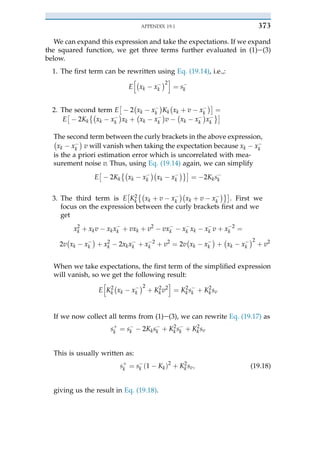
APPENDIX 19.1 DETAILS OF THE STEPS BETWEEN
EQS. (19.17) AND (19.18)
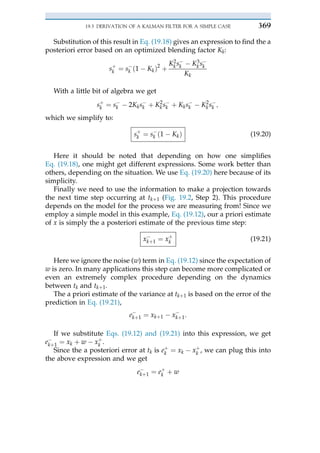
This appendix gives the details of the steps between Eqs. (19.17) and
(19.18). For convenience, we repeat the equation.
sþ
k ¼ E
h""
xk $ x$
k
#
$ Kk
"
xk þ v $ x$
k
##2
i
(19.17)
19. KALMAN FILTER
372](https://image.slidesharecdn.com/vandrongelen2018-2kalmanfiler-210511055649/85/Vandrongelen2018-2-kalmanfiler-12-320.jpg)

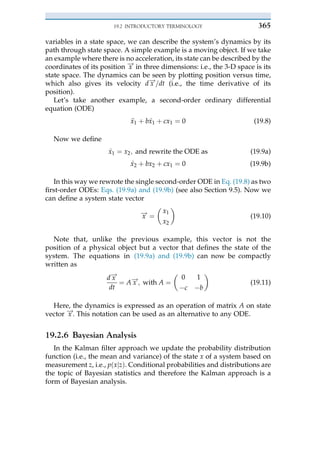
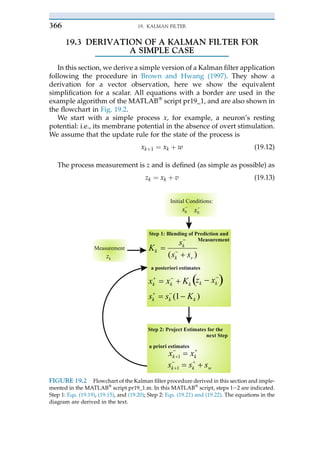
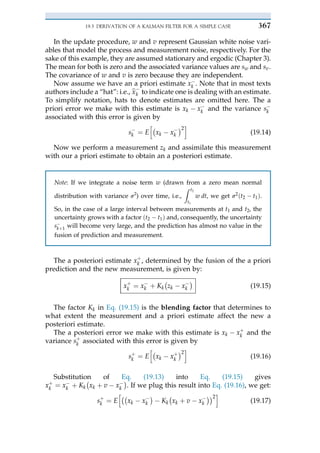
The document describes the derivation of a simple Kalman filter. It begins by introducing a process state x and measurement z, related by equations with additive noise terms w and v. An a priori state estimate x^ is updated using a measurement z to give an a posteriori estimate x+. The blending factor K is derived by minimizing the a posteriori error variance, yielding K = s^/ (s^ + sv), where s^ is the a priori variance and sv is the measurement noise variance. This optimal K balances the a priori estimate and measurement based on their relative uncertainties. The Kalman filter thus combines estimates and measurements in a way that minimizes the estimated error.


![Sensor Fusion Study - Ch7. Kalman Filter Generalizations [김영범]](https://cdn.slidesharecdn.com/ss_thumbnails/ch7kalmanfiltergeneralizations-200715034919-thumbnail.jpg?width=640&height=640&fit=bounds)

![Sensor Fusion Study - Ch13. Nonlinear Kalman Filtering [Ahn Min Sung]](https://cdn.slidesharecdn.com/ss_thumbnails/nonlinearkalmanfiltering200717-200815094232-thumbnail.jpg?width=640&height=640&fit=bounds)

![Sensor Fusion Study - Ch15. The Particle Filter [Seoyeon Stella Yang]](https://cdn.slidesharecdn.com/ss_thumbnails/particlefilter-200815094542-thumbnail.jpg?width=640&height=640&fit=bounds)


