SUBMITTED TO:ANJALI GUPTA

SUBMITTED BY:RAHUL (1113321078)
EN”B”
VI
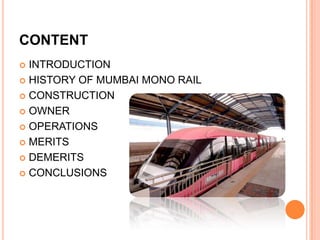
CONTENT
INTRODUCTION
 HISTORY OF MUMBAI MONO RAIL
 CONSTRUCTION
 OWNER
 OPERATIONS
 MERITS
 DEMERITS
 CONCLUSIONS

INTRODUCTION


The Mumbai Monorail is a monorail system in the
city of Mumbai .



The project was implemented by the Mumbai
Metropolitan Region Development
Authority (MMRDA).



It is the first monorail in India since the Kundala
Valley Railway and Patiala State Monorail
Trainways were closed in the 1920s, before the
independence of India.
HISTORY OF MUMBAI MONO RAIL


On 18 August 2008 Vilasrao Deshmukh, Chief
Minister of Maharashtra, approved the construction
of a monorail system in Mumbai.



It was decided that the system would traverse
through Jacob Circle, Wadala, Mahul,
and Chembur, providing a feeder service to the
existingMumbai Suburban Railway.



The two shortlisted consortia to build the line
were Bombardier Transportation and Reliance
Energy.


On 11 November 2008, the contract was given to
Malaysian partner Scomi, who received a 24.6
billion (INR) (US$390 million) to build and operate
the monorail.
CONSTRUCTION


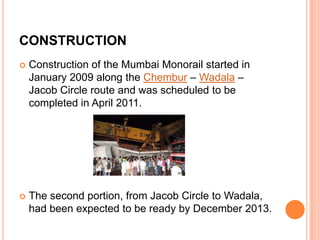
Construction of the Mumbai Monorail started in
January 2009 along the Chembur – Wadala –
Jacob Circle route and was scheduled to be
completed in April 2011.



The second portion, from Jacob Circle to Wadala,
had been expected to be ready by December 2013.
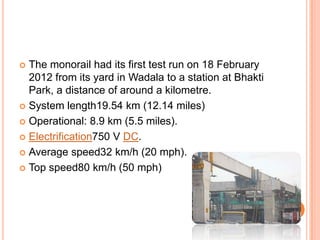
The monorail had its first test run on 18 February
2012 from its yard in Wadala to a station at Bhakti
Park, a distance of around a kilometre.
 System length19.54 km (12.14 miles)
 Operational: 8.9 km (5.5 miles).
 Electrification750 V DC.
 Average speed32 km/h (20 mph).
 Top speed80 km/h (50 mph)

OWNER
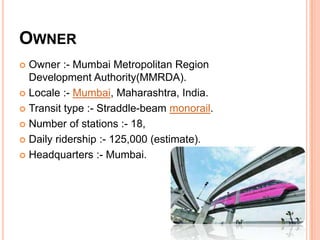
Owner :- Mumbai Metropolitan Region
Development Authority(MMRDA).
 Locale :- Mumbai, Maharashtra, India.
 Transit type :- Straddle-beam monorail.
 Number of stations :- 18,
 Daily ridership :- 125,000 (estimate).
 Headquarters :- Mumbai.

OPERATIONS


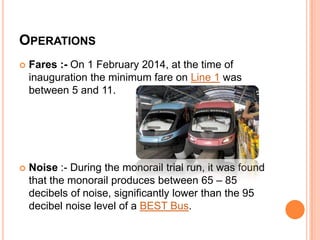
Fares :- On 1 February 2014, at the time of
inauguration the minimum fare on Line 1 was
between 5 and 11.



Noise :- During the monorail trial run, it was found
that the monorail produces between 65 – 85
decibels of noise, significantly lower than the 95
decibel noise level of a BEST Bus.


Speed :- The monorail will have a top speed of 80
kilometres per hour (50 mph), an average speed of
65 kilometres per hour (40 mph) and the overall
speed including dwell time at stations would be
around 31 kilometres per hour (19 mph).



TIMING :- Full-fledged operations of 19 hours, from
5am to midnight.
MERITS


The monorail itself uses no carbon-based fuels and
so does not pollute, unlike cars and buses.



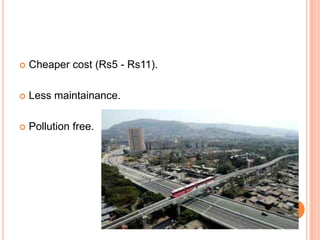
As monorails run around elevated tracks there is no
risk of cars getting stuck on crossings.



Monorails are also practically silent, as opposed to
trains which make a noise traveling along rails.


Cheaper cost (Rs5 - Rs11).



Less maintainance.



Pollution free.
DEMERITS


If a section of track needs to be replaced, the entire
system needs to be shut down resulting in no
service.



Without electricity it can not be run.
BIBLIOGRAPHY


www.google.com



en.wikipedia.org
Ppt on mono rail by rahul

Ppt on mono rail by rahul

  • 1.
    SUBMITTED TO:ANJALI GUPTA SUBMITTEDBY:RAHUL (1113321078) EN”B” VI
  • 2.
    CONTENT INTRODUCTION  HISTORY OFMUMBAI MONO RAIL  CONSTRUCTION  OWNER  OPERATIONS  MERITS  DEMERITS  CONCLUSIONS 
  • 3.
    INTRODUCTION  The Mumbai Monorailis a monorail system in the city of Mumbai .  The project was implemented by the Mumbai Metropolitan Region Development Authority (MMRDA).  It is the first monorail in India since the Kundala Valley Railway and Patiala State Monorail Trainways were closed in the 1920s, before the independence of India.
  • 4.
    HISTORY OF MUMBAIMONO RAIL  On 18 August 2008 Vilasrao Deshmukh, Chief Minister of Maharashtra, approved the construction of a monorail system in Mumbai.  It was decided that the system would traverse through Jacob Circle, Wadala, Mahul, and Chembur, providing a feeder service to the existingMumbai Suburban Railway.  The two shortlisted consortia to build the line were Bombardier Transportation and Reliance Energy.
  • 5.
     On 11 November2008, the contract was given to Malaysian partner Scomi, who received a 24.6 billion (INR) (US$390 million) to build and operate the monorail.
  • 6.
    CONSTRUCTION  Construction of theMumbai Monorail started in January 2009 along the Chembur – Wadala – Jacob Circle route and was scheduled to be completed in April 2011.  The second portion, from Jacob Circle to Wadala, had been expected to be ready by December 2013.
  • 7.
    The monorail hadits first test run on 18 February 2012 from its yard in Wadala to a station at Bhakti Park, a distance of around a kilometre.  System length19.54 km (12.14 miles)  Operational: 8.9 km (5.5 miles).  Electrification750 V DC.  Average speed32 km/h (20 mph).  Top speed80 km/h (50 mph) 
  • 8.
    OWNER Owner :- MumbaiMetropolitan Region Development Authority(MMRDA).  Locale :- Mumbai, Maharashtra, India.  Transit type :- Straddle-beam monorail.  Number of stations :- 18,  Daily ridership :- 125,000 (estimate).  Headquarters :- Mumbai. 
  • 9.
    OPERATIONS  Fares :- On1 February 2014, at the time of inauguration the minimum fare on Line 1 was between 5 and 11.  Noise :- During the monorail trial run, it was found that the monorail produces between 65 – 85 decibels of noise, significantly lower than the 95 decibel noise level of a BEST Bus.
  • 10.
     Speed :- Themonorail will have a top speed of 80 kilometres per hour (50 mph), an average speed of 65 kilometres per hour (40 mph) and the overall speed including dwell time at stations would be around 31 kilometres per hour (19 mph).  TIMING :- Full-fledged operations of 19 hours, from 5am to midnight.
  • 11.
    MERITS  The monorail itselfuses no carbon-based fuels and so does not pollute, unlike cars and buses.  As monorails run around elevated tracks there is no risk of cars getting stuck on crossings.  Monorails are also practically silent, as opposed to trains which make a noise traveling along rails.
  • 12.
     Cheaper cost (Rs5- Rs11).  Less maintainance.  Pollution free.
  • 13.
    DEMERITS  If a sectionof track needs to be replaced, the entire system needs to be shut down resulting in no service.  Without electricity it can not be run.
  • 14.