SHASHIKANT CHOUDHARY
CONTENT
 INTRODUCTION
 HISTORY
 TYPES AND TECHNICAL ASPECTS
 MUMBAI MONORAIL
 CONSTRUCTION
 OPERATIONS
 FEATURES
 FUTURE PLAN
INTRODUCTION
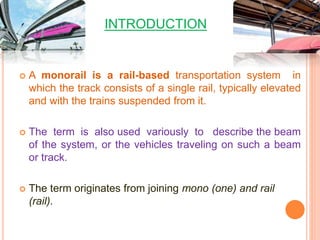
 A monorail is a rail-based transportation system in
which the track consists of a single rail, typically elevated
and with the trains suspended from it.
 The term is also used variously to describe the beam
of the system, or the vehicles traveling on such a beam
or track.
 The term originates from joining mono (one) and rail
(rail).
HISTORY
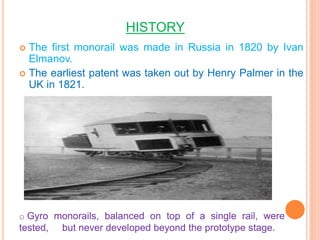
 The first monorail was made in Russia in 1820 by Ivan
Elmanov.
 The earliest patent was taken out by Henry Palmer in the
UK in 1821.
o Gyro monorails, balanced on top of a single rail, were
tested, but never developed beyond the prototype stage.
 One of the first systems put into practical use was that of
French engineer Charles Lartigue, who built a monorail line
in Ireland, which was opened in 1888 and closed in 1924
(due to damage from Ireland's Civil War).
 Tokyo Monorail is the world's busiest monorail line,
averages 127,000 passengers per day since 1964.
TYPES AND TECHNICAL ASPECTS
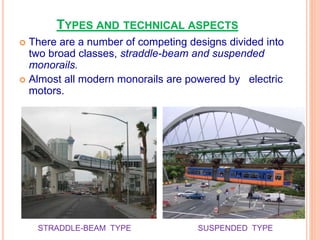
 There are a number of competing designs divided into
two broad classes, straddle-beam and suspended
monorails.
 Almost all modern monorails are powered by electric
motors.
STRADDLE-BEAM TYPE SUSPENDED TYPE
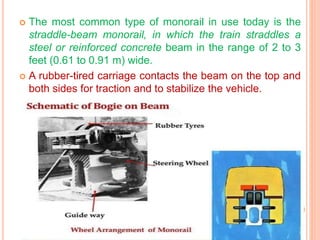
 The most common type of monorail in use today is the
straddle-beam monorail, in which the train straddles a
steel or reinforced concrete beam in the range of 2 to 3
feet (0.61 to 0.91 m) wide.
 A rubber-tired carriage contacts the beam on the top and
both sides for traction and to stabilize the vehicle.
MUMBAI MONORAIL
 The Mumbai Monorail is a monorail system in the city
of Mumbai .
 The project was implemented by the Mumbai
Metropolitan Region Development Authority (MMRDA),
along with a consortium of Mumbai-based conglomerate
Larsen & Toubro and the Malaysian infrastructure firm
Scomi Engineering.
LOGO
HISTORY OF MUMBAI MONO RAIL
 On 18 August 2008 Vilasrao Deshmukh, Chief Minister
of Maharashtra, approved the construction of a monorail
system in Mumbai.
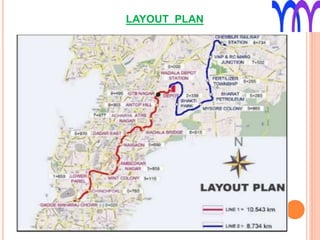
 It was decided that the system would traverse
through Jacob Circle, Wadala, Mahul, and Chembur,
providing a feeder service to the existing Mumbai
Suburban Railway.
 The two shortlisted consortia to build the line were
Bombardier Transportation/Reliance Energy, and Larsen
and Toubro/Scomi engineering.
 On 11 November 2008, Larsen and Toubro was
announced, along with Malaysian partner Scomi, who
received a 24.6 billion contract to build and operate the
monorail until 2029.
 A 108-metre test run was successfully conducted on 26
January 2010.
CONSTRUCTION
 Construction of the Mumbai Monorail started in January 2009
along the Chembur – Wadala – Jacob Circle route and was
scheduled to be completed in April 2011.
 Due to delays, the deadline for operation of the first phase of
the line, between Chembur and Wadala, was postponed to
August 2012
 The second portion, from Jacob Circle to Wadala, had been
expected to be ready by December 2013.
A station under construction in Chembur
 The monorail had its test run on 18 February 2012 from
its yard in Wadala to a station at Bhakti Park, a distance
of around a kilometre.
 The MMRDA invited proposals from agencies for
securing, maintaining and leasing of bulk commercial
advertisement rights to display advertisements.
 The monorail cars for this service will be built in Malaysia
by Scomi Engineering.
LAYOUT PLAN
OPERATIONS
 The Mumbai Monorail was officially inaugurated on 1
February 2014 by the Chief Minister of Maharshtra. It
became the first monorail system in India.
 On 1 February 2014, at the time of inauguration the
minimum fare on Line 1 was between 5 and 11.
 According to studies conducted by the MMRDA during the
monorail trial run, it was found that the monorail produces
between 65 – 85 decibels of noise, significantly lower
than the 95 decibel noise level of a Bus.
 The monorail will have a top speed of 80 Kmph, an
average speed of 65 Kmph.
 The capacity of each four-car consist is 568
passangers.
 There are roughly 18 seated and 124 standing
passengers per carriage.
 The MMRDA has stated that the monorail will operate
in a single shift from between 7 am and 3 pm, for the
first two months of operation.
 Full-fledged operations of 19 hours, from 5am to
midnight, are expected to start only by February 2015.
FEATURS
 The Mumbai Monorail master plan proposed the construction
of 8 lines at a cost of 202.96 billion.
 Further development of the monorail system is on hold until
the current line opens and none will be opened before 2019.
Phas
e
Route Length Cost
1 Chembur – Wadala – Jacob Circle 19.54 27.16 billion
1 Mulund – Goregaon – Borivali 30 41.7 billion
1 Virar – Chikhaldongri 4.60 6399 million
1 Lokhandwala – Kanjurmarg 13.14 18265 million
1 Thane – Mira-Bhayandar – Dahisar 24.25 33708 million
2 Kalyan – Ulhasnagar – Dombivli 26.40 36696 million
2 hembur – Ghatkopar – Khairane 16.72 36863 million
2 Mahape – Shil Phata – Kalyan 21.10 29329 million
2 Thane – Bhiwandi – Kalyan 30 37.5 billion
FUTURE PLAN
PPT on Monorail

PPT on Monorail

  • 1.
  • 2.
    CONTENT  INTRODUCTION  HISTORY TYPES AND TECHNICAL ASPECTS  MUMBAI MONORAIL  CONSTRUCTION  OPERATIONS  FEATURES  FUTURE PLAN
  • 3.
    INTRODUCTION  A monorailis a rail-based transportation system in which the track consists of a single rail, typically elevated and with the trains suspended from it.  The term is also used variously to describe the beam of the system, or the vehicles traveling on such a beam or track.  The term originates from joining mono (one) and rail (rail).
  • 4.
    HISTORY  The firstmonorail was made in Russia in 1820 by Ivan Elmanov.  The earliest patent was taken out by Henry Palmer in the UK in 1821. o Gyro monorails, balanced on top of a single rail, were tested, but never developed beyond the prototype stage.
  • 5.
     One ofthe first systems put into practical use was that of French engineer Charles Lartigue, who built a monorail line in Ireland, which was opened in 1888 and closed in 1924 (due to damage from Ireland's Civil War).  Tokyo Monorail is the world's busiest monorail line, averages 127,000 passengers per day since 1964.
  • 6.
    TYPES AND TECHNICALASPECTS  There are a number of competing designs divided into two broad classes, straddle-beam and suspended monorails.  Almost all modern monorails are powered by electric motors. STRADDLE-BEAM TYPE SUSPENDED TYPE
  • 7.
     The mostcommon type of monorail in use today is the straddle-beam monorail, in which the train straddles a steel or reinforced concrete beam in the range of 2 to 3 feet (0.61 to 0.91 m) wide.  A rubber-tired carriage contacts the beam on the top and both sides for traction and to stabilize the vehicle.
  • 8.
    MUMBAI MONORAIL  TheMumbai Monorail is a monorail system in the city of Mumbai .  The project was implemented by the Mumbai Metropolitan Region Development Authority (MMRDA), along with a consortium of Mumbai-based conglomerate Larsen & Toubro and the Malaysian infrastructure firm Scomi Engineering. LOGO
  • 9.
    HISTORY OF MUMBAIMONO RAIL  On 18 August 2008 Vilasrao Deshmukh, Chief Minister of Maharashtra, approved the construction of a monorail system in Mumbai.  It was decided that the system would traverse through Jacob Circle, Wadala, Mahul, and Chembur, providing a feeder service to the existing Mumbai Suburban Railway.  The two shortlisted consortia to build the line were Bombardier Transportation/Reliance Energy, and Larsen and Toubro/Scomi engineering.
  • 10.
     On 11November 2008, Larsen and Toubro was announced, along with Malaysian partner Scomi, who received a 24.6 billion contract to build and operate the monorail until 2029.  A 108-metre test run was successfully conducted on 26 January 2010.
  • 11.
    CONSTRUCTION  Construction ofthe Mumbai Monorail started in January 2009 along the Chembur – Wadala – Jacob Circle route and was scheduled to be completed in April 2011.  Due to delays, the deadline for operation of the first phase of the line, between Chembur and Wadala, was postponed to August 2012  The second portion, from Jacob Circle to Wadala, had been expected to be ready by December 2013. A station under construction in Chembur
  • 12.
     The monorailhad its test run on 18 February 2012 from its yard in Wadala to a station at Bhakti Park, a distance of around a kilometre.  The MMRDA invited proposals from agencies for securing, maintaining and leasing of bulk commercial advertisement rights to display advertisements.  The monorail cars for this service will be built in Malaysia by Scomi Engineering.
  • 13.
  • 14.
    OPERATIONS  The MumbaiMonorail was officially inaugurated on 1 February 2014 by the Chief Minister of Maharshtra. It became the first monorail system in India.  On 1 February 2014, at the time of inauguration the minimum fare on Line 1 was between 5 and 11.
  • 15.
     According tostudies conducted by the MMRDA during the monorail trial run, it was found that the monorail produces between 65 – 85 decibels of noise, significantly lower than the 95 decibel noise level of a Bus.  The monorail will have a top speed of 80 Kmph, an average speed of 65 Kmph.
  • 16.
     The capacityof each four-car consist is 568 passangers.  There are roughly 18 seated and 124 standing passengers per carriage.  The MMRDA has stated that the monorail will operate in a single shift from between 7 am and 3 pm, for the first two months of operation.  Full-fledged operations of 19 hours, from 5am to midnight, are expected to start only by February 2015. FEATURS
  • 17.
     The MumbaiMonorail master plan proposed the construction of 8 lines at a cost of 202.96 billion.  Further development of the monorail system is on hold until the current line opens and none will be opened before 2019. Phas e Route Length Cost 1 Chembur – Wadala – Jacob Circle 19.54 27.16 billion 1 Mulund – Goregaon – Borivali 30 41.7 billion 1 Virar – Chikhaldongri 4.60 6399 million 1 Lokhandwala – Kanjurmarg 13.14 18265 million 1 Thane – Mira-Bhayandar – Dahisar 24.25 33708 million 2 Kalyan – Ulhasnagar – Dombivli 26.40 36696 million 2 hembur – Ghatkopar – Khairane 16.72 36863 million 2 Mahape – Shil Phata – Kalyan 21.10 29329 million 2 Thane – Bhiwandi – Kalyan 30 37.5 billion FUTURE PLAN