GROUP NO.1

Group members          Roll No:

Akshay Samant             04

Harshita Deotare          19

Tejas Joshi               55
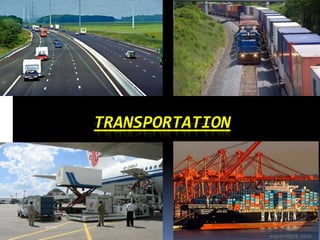
TRANSPORTATION
Meaning and Definition

“The process of moving an item from point A
  to point B.”


 “Safe, efficient, reliable, and sustainable
  movement of persons and goods over time and
  space”
Transportation in Logistics:
 The operation of transportation determines the
  efficiency of moving products
 The progress in techniques and management
  principles improves the moving load, delivery
  speed, service quality, operation costs, the
  usage of facilities and energy saving.
 Transportation takes a crucial part in the
  Logistics Operation
 Therefore, transportation is the base of
  efficiency and economy in business logistics and
  expands other functions of logistics system
Importance of Transportation:
 Without well-developed transportation
  systems, logistics could not bring its advantages into full
  play.

 A good transport system in logistics activities could
  provide better logistics efficiency, reduce operation
  cost, and promote service quality.

 A well-operated logistics system could increase both the
  competitiveness of the government and enterprises.

 Transport system is the most important economic
  activity among the components of business logistics
  systems
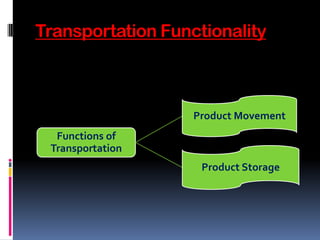
Transportation Functionality


                   Product Movement
  Functions of
 Transportation
                    Product Storage
Product Movement
 Temporal:
   -Product is locked up during transit, hence inaccessible
    -Positive amount of time is spent in transporting material
    -Time is a resource[Temporal Resource] expended in
   Transportation
     -During the time product is locked up costs are incurred
   in proportion of time
 Financial:
   -Administration costs, Salaries, Maintenance costs are
   expended
 Environmental:
    Fuel costs are high[Creates air
   pollution, congestion, Noise pollution
Product Storage

 When unloading and loading is more
 expensive then storage


When storage space is limited[situation
when inventory levels are high]
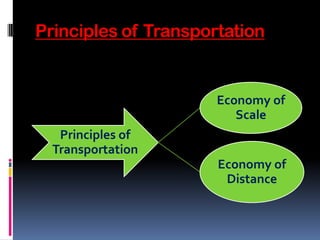
Principles of Transportation


                      Economy of
                         Scale
   Principles of
  Transportation
                      Economy of
                       Distance
Types of Transportation
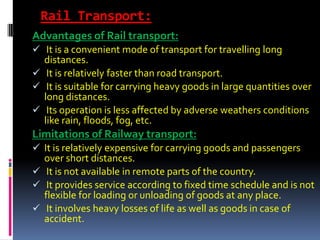
Rail Transport:
Advantages of Rail transport:
 It is a convenient mode of transport for travelling long
  distances.
 It is relatively faster than road transport.
 It is suitable for carrying heavy goods in large quantities over
  long distances.
 Its operation is less affected by adverse weathers conditions
  like rain, floods, fog, etc.
Limitations of Railway transport:
 It is relatively expensive for carrying goods and passengers
  over short distances.
 It is not available in remote parts of the country.
 It provides service according to fixed time schedule and is not
  flexible for loading or unloading of goods at any place.
 It involves heavy losses of life as well as goods in case of
  accident.
Road Transport
 Advantages
 It is a relatively cheaper mode of transport as compared to
  other modes.
 Perishable goods can be transported at a faster speed by road
  carriers over a short distance.
 It is a flexible mode of transport as loading and unloading is
  possible at any destination. It provides door-to-door service.
 It helps people to travel and carry goods from one place to
  another, in places which are not connected by other means of
  transport like hilly areas.
 Limitations of Road transport
 Due to limited carrying capacity road transport is not
  economical for long distance transportation of goods.
 Transportation of heavy goods or goods in bulk by road
  involves high cost.
Water Transport
 Advantages:
 It is a relatively economical mode of transport for bulky and heavy
   goods.
 It is a safe mode of transport with respect to occurrence of accidents.
 The cost of maintaining and constructing routes is very low most of
   them are naturally made.
 It promotes international trade.
 Disadvantages:
 The depth and navigability of rivers and canals vary and thus, affect
   operations of different transport vessels.
 It is a slow moving mode of transport and therefore not suitable for
   transport of perishable goods.
 It is adversely affected by weather conditions.
 Sea transport requires large investment on ships and their
   maintenance.
Air Transport:
 Advantages:
 It is the fastest mode of transport.
 It is very useful in transporting goods and passengers to the
  area, which are not accessible by any other means.
 It is the most convenient mode of transport during natural
  calamities.
 It provides vital support to the national security and defence
 Disadvantages:
 It is relatively more expensive mode of transport.
 It is not suitable for transporting heavy and bulky
  goods.
 It is affected by adverse weather conditions.
 It is not suitable for short distance travel.
 In case of accidents, it results in heavy losses of
  goods, property and life.
Transportation Impacts

 The speed, cost, and capabilities of
 available transportation have a significant
 economic impact on an area ---
 Highway, rail, freight, transit, shipping

 Countries with better/advanced
 transportation networks and services are
 leaders in industry and commerce

         USA, Japan, Germany, ...
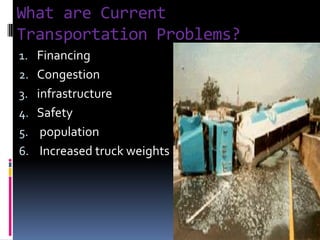
What are Current
Transportation Problems?
1. Financing
2. Congestion
3. infrastructure
4. Safety
5. population
6. Increased truck weights
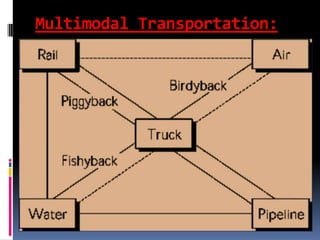
Multimodal Transportation:
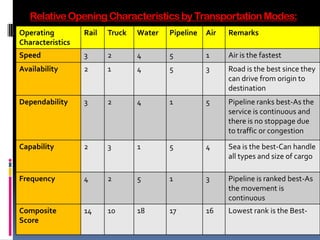
Relative Opening Characteristics by Transportation Modes:
Operating         Rail   Truck   Water   Pipeline   Air   Remarks
Characteristics
Speed             3      2       4       5          1     Air is the fastest
Availability      2      1       4       5          3     Road is the best since they
                                                          can drive from origin to
                                                          destination
Dependability     3      2       4       1          5     Pipeline ranks best-As the
                                                          service is continuous and
                                                          there is no stoppage due
                                                          to traffic or congestion
Capability        2      3       1       5          4     Sea is the best-Can handle
                                                          all types and size of cargo

Frequency         4      2       5       1          3     Pipeline is ranked best-As
                                                          the movement is
                                                          continuous
Composite         14     10      18      17         16    Lowest rank is the Best-
Score
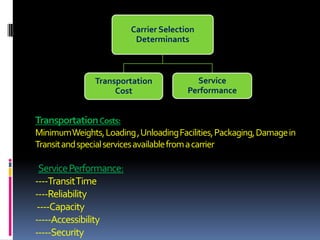
Carrier Selection
                          Determinants


               Transportation             Service
                    Cost                Performance


Transportation Costs:
Minimum Weights, Loading , Unloading Facilities, Packaging, Damage in
Transit and special services available from a carrier

 Service Performance:
----Transit Time
----Reliability
 ----Capacity
-----Accessibility
-----Security
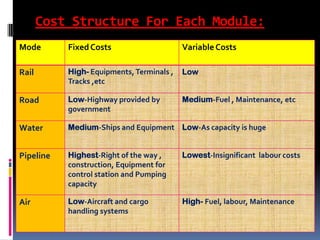
Cost Structure For Each Module:
Mode       Fixed Costs                     Variable Costs

Rail       High- Equipments, Terminals ,   Low
           Tracks ,etc

Road       Low-Highway provided by         Medium-Fuel , Maintenance, etc
           government

Water      Medium-Ships and Equipment Low-As capacity is huge


Pipeline   Highest-Right of the way ,      Lowest-Insignificant labour costs
           construction, Equipment for
           control station and Pumping
           capacity

Air        Low-Aircraft and cargo          High- Fuel, labour, Maintenance
           handling systems
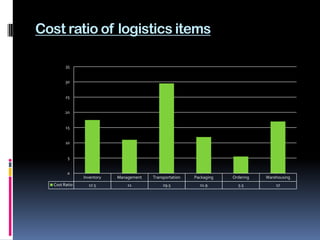
Cost ratio of logistics items

         35


         30


         25


         20


         15


         10


          5


          0
                Inventory   Management   Transportation   Packaging   Ordering   Warehousing
   Cost Ratio     17.5          11            29.5          11.9        5.5          17
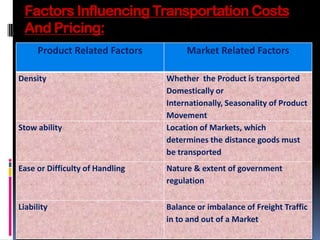
Factors Influencing Transportation Costs
 And Pricing:
     Product Related Factors          Market Related Factors

Density                          Whether the Product is transported
                                 Domestically or
                                 Internationally, Seasonality of Product
                                 Movement
Stow ability                     Location of Markets, which
                                 determines the distance goods must
                                 be transported
Ease or Difficulty of Handling   Nature & extent of government
                                 regulation

Liability                        Balance or imbalance of Freight Traffic
                                 in to and out of a Market
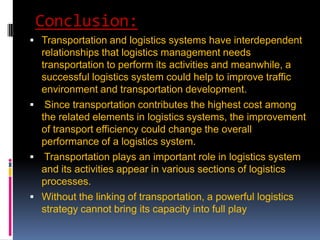
Conclusion:
 Transportation and logistics systems have interdependent
    relationships that logistics management needs
    transportation to perform its activities and meanwhile, a
    successful logistics system could help to improve traffic
    environment and transportation development.
  Since transportation contributes the highest cost among
  the related elements in logistics systems, the improvement
  of transport efficiency could change the overall
  performance of a logistics system.
 Transportation plays an important role in logistics system
  and its activities appear in various sections of logistics
  processes.
 Without the linking of transportation, a powerful logistics
    strategy cannot bring its capacity into full play
Transportation ppt

Transportation ppt

  • 1.
    GROUP NO.1 Group members Roll No: Akshay Samant 04 Harshita Deotare 19 Tejas Joshi 55
  • 2.
  • 3.
    Meaning and Definition “Theprocess of moving an item from point A to point B.” “Safe, efficient, reliable, and sustainable movement of persons and goods over time and space”
  • 4.
    Transportation in Logistics: The operation of transportation determines the efficiency of moving products  The progress in techniques and management principles improves the moving load, delivery speed, service quality, operation costs, the usage of facilities and energy saving.  Transportation takes a crucial part in the Logistics Operation  Therefore, transportation is the base of efficiency and economy in business logistics and expands other functions of logistics system
  • 5.
    Importance of Transportation: Without well-developed transportation systems, logistics could not bring its advantages into full play.  A good transport system in logistics activities could provide better logistics efficiency, reduce operation cost, and promote service quality.  A well-operated logistics system could increase both the competitiveness of the government and enterprises.  Transport system is the most important economic activity among the components of business logistics systems
  • 6.
    Transportation Functionality Product Movement Functions of Transportation Product Storage
  • 7.
    Product Movement  Temporal: -Product is locked up during transit, hence inaccessible -Positive amount of time is spent in transporting material -Time is a resource[Temporal Resource] expended in Transportation -During the time product is locked up costs are incurred in proportion of time  Financial: -Administration costs, Salaries, Maintenance costs are expended  Environmental: Fuel costs are high[Creates air pollution, congestion, Noise pollution
  • 8.
    Product Storage Whenunloading and loading is more expensive then storage When storage space is limited[situation when inventory levels are high]
  • 12.
    Principles of Transportation Economy of Scale Principles of Transportation Economy of Distance
  • 13.
  • 14.
    Rail Transport: Advantages ofRail transport:  It is a convenient mode of transport for travelling long distances.  It is relatively faster than road transport.  It is suitable for carrying heavy goods in large quantities over long distances.  Its operation is less affected by adverse weathers conditions like rain, floods, fog, etc. Limitations of Railway transport:  It is relatively expensive for carrying goods and passengers over short distances.  It is not available in remote parts of the country.  It provides service according to fixed time schedule and is not flexible for loading or unloading of goods at any place.  It involves heavy losses of life as well as goods in case of accident.
  • 15.
    Road Transport  Advantages It is a relatively cheaper mode of transport as compared to other modes.  Perishable goods can be transported at a faster speed by road carriers over a short distance.  It is a flexible mode of transport as loading and unloading is possible at any destination. It provides door-to-door service.  It helps people to travel and carry goods from one place to another, in places which are not connected by other means of transport like hilly areas.  Limitations of Road transport  Due to limited carrying capacity road transport is not economical for long distance transportation of goods.  Transportation of heavy goods or goods in bulk by road involves high cost.
  • 16.
    Water Transport  Advantages: It is a relatively economical mode of transport for bulky and heavy goods.  It is a safe mode of transport with respect to occurrence of accidents.  The cost of maintaining and constructing routes is very low most of them are naturally made.  It promotes international trade.  Disadvantages:  The depth and navigability of rivers and canals vary and thus, affect operations of different transport vessels.  It is a slow moving mode of transport and therefore not suitable for transport of perishable goods.  It is adversely affected by weather conditions.  Sea transport requires large investment on ships and their maintenance.
  • 17.
    Air Transport:  Advantages: It is the fastest mode of transport.  It is very useful in transporting goods and passengers to the area, which are not accessible by any other means.  It is the most convenient mode of transport during natural calamities.  It provides vital support to the national security and defence  Disadvantages:  It is relatively more expensive mode of transport.  It is not suitable for transporting heavy and bulky goods.  It is affected by adverse weather conditions.  It is not suitable for short distance travel.  In case of accidents, it results in heavy losses of goods, property and life.
  • 18.
    Transportation Impacts Thespeed, cost, and capabilities of available transportation have a significant economic impact on an area --- Highway, rail, freight, transit, shipping Countries with better/advanced transportation networks and services are leaders in industry and commerce USA, Japan, Germany, ...
  • 19.
    What are Current TransportationProblems? 1. Financing 2. Congestion 3. infrastructure 4. Safety 5. population 6. Increased truck weights
  • 20.
  • 21.
    Relative Opening Characteristicsby Transportation Modes: Operating Rail Truck Water Pipeline Air Remarks Characteristics Speed 3 2 4 5 1 Air is the fastest Availability 2 1 4 5 3 Road is the best since they can drive from origin to destination Dependability 3 2 4 1 5 Pipeline ranks best-As the service is continuous and there is no stoppage due to traffic or congestion Capability 2 3 1 5 4 Sea is the best-Can handle all types and size of cargo Frequency 4 2 5 1 3 Pipeline is ranked best-As the movement is continuous Composite 14 10 18 17 16 Lowest rank is the Best- Score
  • 22.
    Carrier Selection Determinants Transportation Service Cost Performance Transportation Costs: Minimum Weights, Loading , Unloading Facilities, Packaging, Damage in Transit and special services available from a carrier Service Performance: ----Transit Time ----Reliability ----Capacity -----Accessibility -----Security
  • 23.
    Cost Structure ForEach Module: Mode Fixed Costs Variable Costs Rail High- Equipments, Terminals , Low Tracks ,etc Road Low-Highway provided by Medium-Fuel , Maintenance, etc government Water Medium-Ships and Equipment Low-As capacity is huge Pipeline Highest-Right of the way , Lowest-Insignificant labour costs construction, Equipment for control station and Pumping capacity Air Low-Aircraft and cargo High- Fuel, labour, Maintenance handling systems
  • 24.
    Cost ratio oflogistics items 35 30 25 20 15 10 5 0 Inventory Management Transportation Packaging Ordering Warehousing Cost Ratio 17.5 11 29.5 11.9 5.5 17
  • 25.
    Factors Influencing TransportationCosts And Pricing: Product Related Factors Market Related Factors Density Whether the Product is transported Domestically or Internationally, Seasonality of Product Movement Stow ability Location of Markets, which determines the distance goods must be transported Ease or Difficulty of Handling Nature & extent of government regulation Liability Balance or imbalance of Freight Traffic in to and out of a Market
  • 26.
    Conclusion:  Transportation andlogistics systems have interdependent relationships that logistics management needs transportation to perform its activities and meanwhile, a successful logistics system could help to improve traffic environment and transportation development.  Since transportation contributes the highest cost among the related elements in logistics systems, the improvement of transport efficiency could change the overall performance of a logistics system.  Transportation plays an important role in logistics system and its activities appear in various sections of logistics processes.  Without the linking of transportation, a powerful logistics strategy cannot bring its capacity into full play