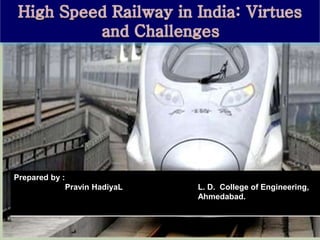
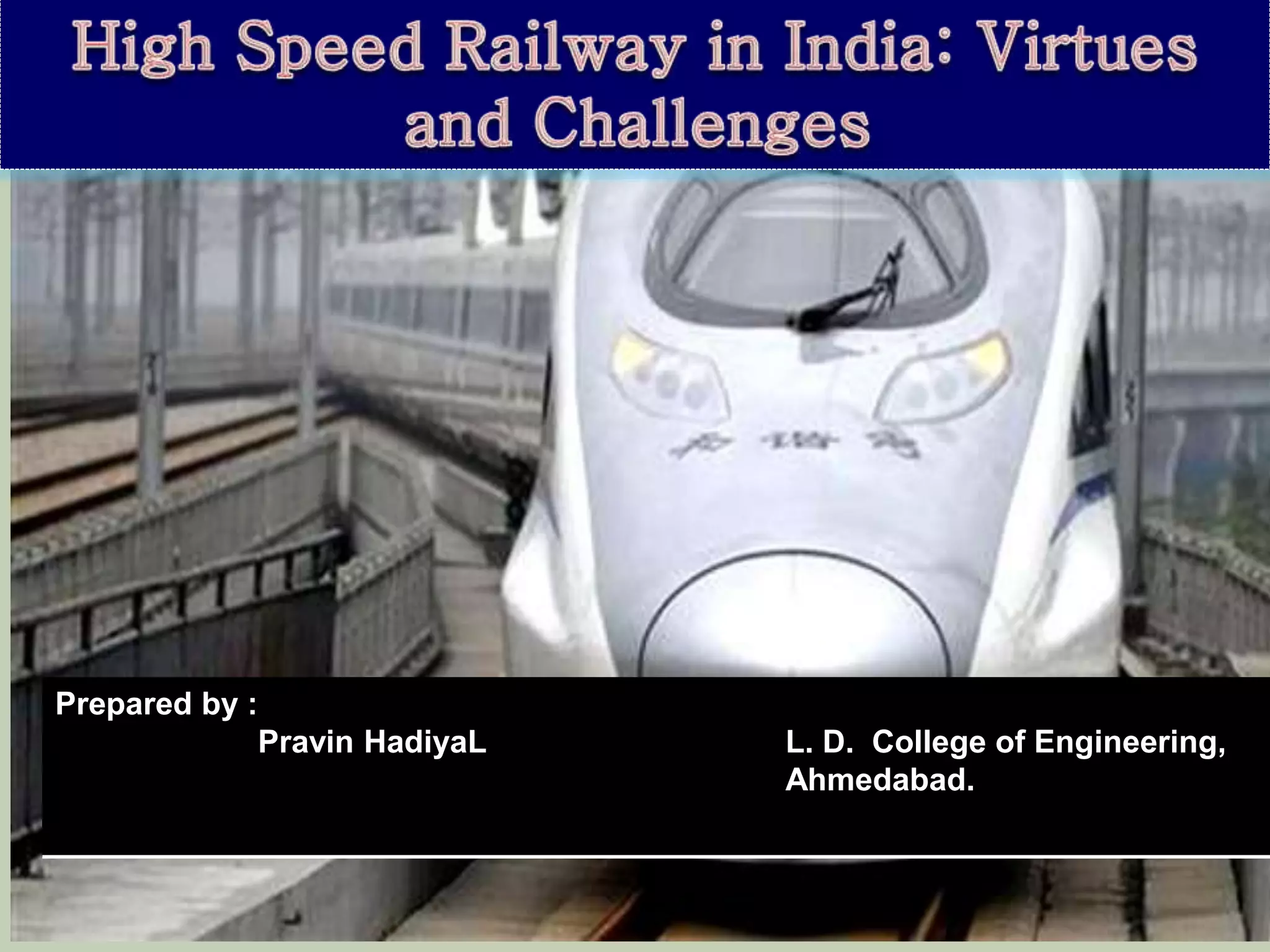
Prepared by :
Pravin HadiyaL L. D. College of Engineering,
Ahmedabad.
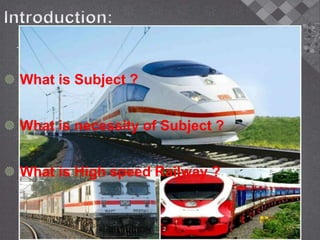
 What is Subject ?
 What is necessity of Subject ?
 What is High speed Railway ?
2
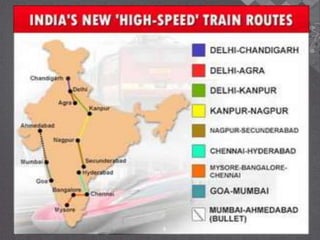
 Vision 2020 Document
 Modernisation of Indian Railways – Report
 Railway Budget-2015-16
 Need of the day
Latest Trial run of 160 KMPH speed between
Delhi-Agra Section 3
4
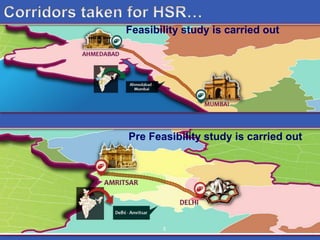
Feasibility study is carried out
Pre Feasibility study is carried out
5
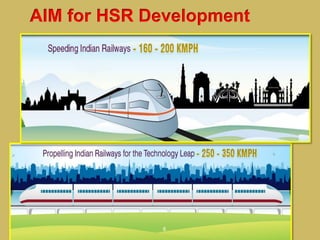
AIM for HSR Development
6
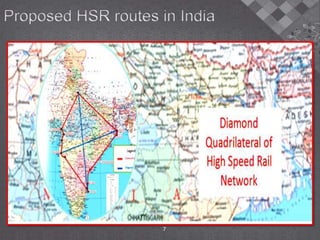
7
8
Advantages of HSR
 Reduction of travel time of passengers
 Fast accessibility to urban centres, lead to
economical and industrial growth
 Cope up higher demand for passenger and
freight traffic
 HSR route will help in commercial growth
 Land required by the HSR is very less,
reducing environmental impact
 It is Energy Efficient mode with compared to
other modes of transportation9
Advantages of HSR
 It runs on alternate energy sources, which
will reduce the environmental impacts with
compared to other mode of transportation.
 Better haulage capacity against less fuel
consumption
 Modern technology, through which the
improvement of transportation mode.
 Better option for Modal shift from Airways
 Creation of new job openings for
construction and maintenance of facility.
10
Disadvantages of HSR
 Huge Investment- Financial Viability is major Issue
 Economical factors- Balance of income and out
goings
 Technological factors like Technology for Tracks-
Trains, Technology for Operation & geometrical
changes required
 High Running and maintenance costs
 Rolling stocks, Locomotives etc. are to be
replaced
11
Disadvantages of HSR
 Social Impacts
 Safety consideration of Passengers as well as
Surroundings
 High cost of journey will affect the affordability
of Common man of India
 In India, Political interference plays important
role
 Only passenger traffic income will not be
sufficient, freight traffic required to be included.
12
 Financial factors
 Economical factors
 Technological Factors
 Social factors
 Environmental factors
 Political Factors
Factors affecting in adoption of HSR
13
 As per one estimate Rs. 115 crores will be
required for track of 1 Km length, thus very
huge Investment is required , so,
 How this funds can be arranged ?
 What are the Alternatives like Central Finance
or State finance of Loan from some agencies or
PPP type Model etc ???
 How it can be recovered ?
14
 What is Expenditure in Installing as well as in
running & Maintenance ??
 What will be the Ridership depending upon
Corridor selection, necessity, Affordability,
Modal shift from other modes of transportation
etc??
 What will be the revenue generation ? And how
the costs will be recovered ?
 How the land would be acquired ? At which
cost ?
15
 Technology for train running- which technology
should be adopted ??
 Changing & straightening of alignment
 Changes in present track structure
 Upgradation in Track geometrics
 Modifications required in permanent way16
 Modification of rail materials
Modifications at points & crossings
 Modifications in stations
 Signalling and communication
 Rolling stocks
 Safety at level crossings17
 Modification on existing C-D works
 Other Engineering factors related to
Mechanical, Electrical & Instrumentation
 Provisions of ROB & RUB for other traffic
 Treatment of Unstable Formation
 Provisions for safety like Fencing to stop
trespassing, Retro reflective sign boards for
improve visibility, Manning of unmanned level
crossing etc.
18
International scenario
 Countries like China, Japan, USA, UK, France,
Germany, Spain etc. have introduced HSR/
HST/ Bullet trains in their transportation
infrastructure
 many countries are till modifies their facility by
adopting more and more modern Technologies
e.g. on 21.04.2015 Japan has tested for
MAGLEV Train having highest speed more then
600 KMPH
19
International scenario
[ Some Examples]
20
MAGLEV TECHNOLOGY
International scenario
[ Some Examples]
21
TGV FRANCE
International scenario
[ Some Examples]
22
SPAIN HST
International scenario
[ Some Examples]
23
GERMAN TRANSRAPID
International scenario
[ Some Examples]
24
HS1 UK
International scenario
[ Some Examples]
25
TAIWAN HST
Salient features of Proposed
Ahmedabad-Mumbai high speed
corridor
26
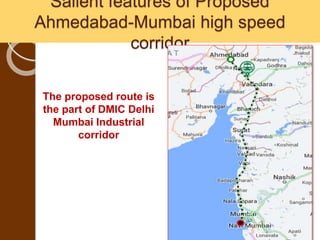
The proposed route is
the part of DMIC Delhi
Mumbai Industrial
corridor
Salient features of Proposed
Ahmedabad-Mumbai high speed
corridor
27
The proposed route will pass
through....
Gujarat (364 KMs),
Dadra-Nagar-Haveli(6 KMs) &
Maharashtra (176 KMs)
--Total 546 KMs
Salient features of Proposed
Ahmedabad-Mumbai high speed
corridor
28
Horizon Year for the Project is estimated
2021
Expected Operational Speed-350 KMPH
Expected Commercial speed- 286 KMPH
Total Travel Time- 1Hr & 52 Minutes.
Salient features of Proposed
Ahmedabad-Mumbai high speed
corridor
29
Cost of Construction
Rs. 45000.00 Crores
Rolling stock cost
Rs. 5000 Crores
Conclusions:
 All the concerned factors should be taken care
of before proceeding for Implementation of
such costly project.
 Financial & Economical viability should be
prime concerns
 HSR should be limited to just 160-200 KMPH
in countries like India
 High speed corridors should be not only for
passenger trains but it should include the
freight movement as well…
30
31

High speed rails in india ppt

  • 1.
    Prepared by : PravinHadiyaL L. D. College of Engineering, Ahmedabad.
  • 2.
     What isSubject ?  What is necessity of Subject ?  What is High speed Railway ? 2
  • 3.
     Vision 2020Document  Modernisation of Indian Railways – Report  Railway Budget-2015-16  Need of the day Latest Trial run of 160 KMPH speed between Delhi-Agra Section 3
  • 4.
  • 5.
    Feasibility study iscarried out Pre Feasibility study is carried out 5
  • 6.
    AIM for HSRDevelopment 6
  • 7.
  • 8.
  • 9.
    Advantages of HSR Reduction of travel time of passengers  Fast accessibility to urban centres, lead to economical and industrial growth  Cope up higher demand for passenger and freight traffic  HSR route will help in commercial growth  Land required by the HSR is very less, reducing environmental impact  It is Energy Efficient mode with compared to other modes of transportation9
  • 10.
    Advantages of HSR It runs on alternate energy sources, which will reduce the environmental impacts with compared to other mode of transportation.  Better haulage capacity against less fuel consumption  Modern technology, through which the improvement of transportation mode.  Better option for Modal shift from Airways  Creation of new job openings for construction and maintenance of facility. 10
  • 11.
    Disadvantages of HSR Huge Investment- Financial Viability is major Issue  Economical factors- Balance of income and out goings  Technological factors like Technology for Tracks- Trains, Technology for Operation & geometrical changes required  High Running and maintenance costs  Rolling stocks, Locomotives etc. are to be replaced 11
  • 12.
    Disadvantages of HSR Social Impacts  Safety consideration of Passengers as well as Surroundings  High cost of journey will affect the affordability of Common man of India  In India, Political interference plays important role  Only passenger traffic income will not be sufficient, freight traffic required to be included. 12
  • 13.
     Financial factors Economical factors  Technological Factors  Social factors  Environmental factors  Political Factors Factors affecting in adoption of HSR 13
  • 14.
     As perone estimate Rs. 115 crores will be required for track of 1 Km length, thus very huge Investment is required , so,  How this funds can be arranged ?  What are the Alternatives like Central Finance or State finance of Loan from some agencies or PPP type Model etc ???  How it can be recovered ? 14
  • 15.
     What isExpenditure in Installing as well as in running & Maintenance ??  What will be the Ridership depending upon Corridor selection, necessity, Affordability, Modal shift from other modes of transportation etc??  What will be the revenue generation ? And how the costs will be recovered ?  How the land would be acquired ? At which cost ? 15
  • 16.
     Technology fortrain running- which technology should be adopted ??  Changing & straightening of alignment  Changes in present track structure  Upgradation in Track geometrics  Modifications required in permanent way16
  • 17.
     Modification ofrail materials Modifications at points & crossings  Modifications in stations  Signalling and communication  Rolling stocks  Safety at level crossings17
  • 18.
     Modification onexisting C-D works  Other Engineering factors related to Mechanical, Electrical & Instrumentation  Provisions of ROB & RUB for other traffic  Treatment of Unstable Formation  Provisions for safety like Fencing to stop trespassing, Retro reflective sign boards for improve visibility, Manning of unmanned level crossing etc. 18
  • 19.
    International scenario  Countrieslike China, Japan, USA, UK, France, Germany, Spain etc. have introduced HSR/ HST/ Bullet trains in their transportation infrastructure  many countries are till modifies their facility by adopting more and more modern Technologies e.g. on 21.04.2015 Japan has tested for MAGLEV Train having highest speed more then 600 KMPH 19
  • 20.
    International scenario [ SomeExamples] 20 MAGLEV TECHNOLOGY
  • 21.
    International scenario [ SomeExamples] 21 TGV FRANCE
  • 22.
    International scenario [ SomeExamples] 22 SPAIN HST
  • 23.
    International scenario [ SomeExamples] 23 GERMAN TRANSRAPID
  • 24.
    International scenario [ SomeExamples] 24 HS1 UK
  • 25.
    International scenario [ SomeExamples] 25 TAIWAN HST
  • 26.
    Salient features ofProposed Ahmedabad-Mumbai high speed corridor 26 The proposed route is the part of DMIC Delhi Mumbai Industrial corridor
  • 27.
    Salient features ofProposed Ahmedabad-Mumbai high speed corridor 27 The proposed route will pass through.... Gujarat (364 KMs), Dadra-Nagar-Haveli(6 KMs) & Maharashtra (176 KMs) --Total 546 KMs
  • 28.
    Salient features ofProposed Ahmedabad-Mumbai high speed corridor 28 Horizon Year for the Project is estimated 2021 Expected Operational Speed-350 KMPH Expected Commercial speed- 286 KMPH Total Travel Time- 1Hr & 52 Minutes.
  • 29.
    Salient features ofProposed Ahmedabad-Mumbai high speed corridor 29 Cost of Construction Rs. 45000.00 Crores Rolling stock cost Rs. 5000 Crores
  • 30.
    Conclusions:  All theconcerned factors should be taken care of before proceeding for Implementation of such costly project.  Financial & Economical viability should be prime concerns  HSR should be limited to just 160-200 KMPH in countries like India  High speed corridors should be not only for passenger trains but it should include the freight movement as well… 30
  • 31.