Sourabh jain 1
*
*A rapid transit system is a public transport
system in an urban area with high capacity,
high frequency not needing timetables, is fast
and is segregated from other traffic. Operating
on an exclusive right of way, rapid transit
systems are typically grade separated and
located either in underground tunnels
(subways) or elevated above street level
(elevated transit line).
Sourabh jain 2
*
*Rapid Transit in India consists of metro,
monorail and light rail systems. The first rapid
transit system in India was the Kolkata Metro,
which started operations in 1984. The Delhi
Metro was India's first modern metro and the
third rapid transit system in India overall, after
Kolkata Metro and Chennai mass rapid transit
system,(Chennai MRTS), beginning operations
in 2002. Rapid Metro Rail Gurgaon, which starts
operations in September 2013, will be India's
first privately owned and operated metro.
Sourabh jain 3
*
*in 2009, it was decided to invest INR2000
billion (US$30.6 billion) on metro rail projects
in the following ten years. It is planned that all
Indian cities having population more that 2
million will have metro rail system. Currently,
rapid transit systems have been under
construction in 7 cities and 16 cities in
planning in several major cities of India.
Sourabh jain 4
*
Sourabh jain 5
*
*Planning for the metro started in 1984, when
the Delhi Development Authority and the Urban
Arts Commission came up with a proposal for
developing a multi-modal transport system for
the city. The Government of India and the
Government of Delhi jointly set up the Delhi
Metro Rail Corporation (DMRC) registered on 3
May 1995 under the Companies Act, 1956.
Construction started in 1998, and the first
section, on the Red Line, opened in 2002
Sourabh jain 6
*
*More registered vehicle than Mumbai
Kolkata & Chennai put together
*Has a high population of 1.675 crores and
overall population density of 11297 person
per km square.
*High rates of accidents
*Average of spending 23 days a year on just
signals in Delhi
*More than 35 study recommended mass
rapid transit system
Sourabh jain 7
*
*Delhi Metro is a rapid transit system serving Delhi,
Gurgaon, Faridabad, Noida , and Ghaziabad in the
National Capital Region of India. Delhi Metro is the world's
thirteenth largest metro system in terms of length. Delhi
Metro is India's first modern public transportation system,
which has revolutionized travel by providing a fast,
reliable, safe, and comfortable means of transport.
*The network consists of six lines with a total length of
189.63 kilometres (117.83 mi) with 142 stations, of which
35 are underground, five are at-grade, and the remainder
are elevated.
*It has a combination of elevated, at-grade, and
underground lines, and uses both broad gauge and
standard gauge rolling stock.
Sourabh jain 8
0
10
20
30
40
50
60
70
Length (km)
Stations
Rolling Stocks
RED Line
Yellow Line
Blue Line
Green Line
Voilet Line
Airpot Express
RED Line Yellow Line Blue Line Green Line Voilet Line Airpot Express
Length (km) 25.09 44.65 58.67 18.46 20.04 22.7
Stations 21 34 51 15 15 6
Rolling
Stocks 26 60 70 15 30 8
Sourabh jain 9
*RED LINE
*Red line The Red Line was the first line of the
Metro to be opened and connects Rithala in the
west to Dilshad Garden in the east
*Length 25.09 km
*Rolling stock 26
*Stations 21
Sourabh jain 10
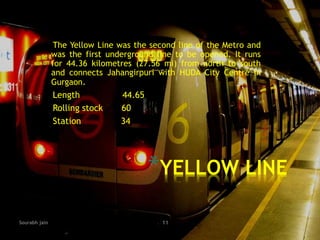
*YELLOW LINE
The Yellow Line was the second line of the Metro and
was the first underground line to be opened. It runs
for 44.36 kilometres (27.56 mi) from north to south
and connects Jahangirpuri with HUDA City Centre in
Gurgaon.
Length 44.65
Rolling stock 60
Station 34
Sourabh jain 11
*BLUE LINE
*Blue line
The Blue Line was the third line of the Metro to be
opened, and the first to connect areas outside
Delhi. Mainly elevated and partly underground, it
connects Dwarka Sub City in the west with the
satellite city of Noida in the east
Length 58.67 km
Rolling stocks 70
Stations 51
Sourabh jain 12
*GREEN VOILET LINE
*The Green Line was the first standard-gauge
corridor of the Delhi Metro. The fully elevated line
connects Mundka with Inderlok
Length 18.46 km
Rolling stock 15
Stations 15
*Voilet line The Violet Line is the most recent line of
the Metro to be opened, and the second standard-
gauge corridor after the Green Line.
Length 20.4 km
Rolling stock 30
Stations 15
Sourabh jain 13
*
*Delhi Metro recorded its highest ever ridership figure
of 2,606,364 on 19 August 2013 which surpassed the
earlier record set on 08 August 2013, when 2,504,900
people travelled by the Metro.
*Currently, DMRC has a pool of 200 train sets with 69 of
these being six coach formations. At present, the Delhi
Metro is operational on six lines where more than 2500
train trips are made each day traversing over 69000
km in a day. With Phase-III of the network expected to
cover about 108 km, the Delhi Metro network will
become 295 km by 2016, making it one of the fastest
expanding Metro networks in the world carrying about
4 million passengers.
Sourabh jain 14
*
*The Metro uses rolling stock of two different
gauges. Phase I lines use 1,676 mm (5.499 ft)
broad gauge rolling stock, while three Phase II
lines use 1,435 mm (4.708 ft) standard gauge
rolling stock. Trains are maintained at seven
depots at Khyber Pass and Sultanpur for the
Yellow Line, Mundka for the Green Line,
Najafgarh and Yamuna Bank for the Blue Line,
Shastri Park for the Red Line, and Sarita Vihar
for the Violet Line.
Sourabh jain 15
*
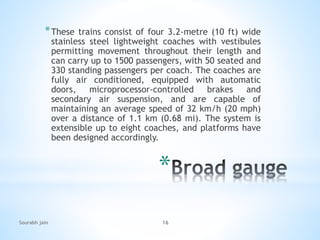
*These trains consist of four 3.2-metre (10 ft) wide
stainless steel lightweight coaches with vestibules
permitting movement throughout their length and
can carry up to 1500 passengers, with 50 seated and
330 standing passengers per coach. The coaches are
fully air conditioned, equipped with automatic
doors, microprocessor-controlled brakes and
secondary air suspension, and are capable of
maintaining an average speed of 32 km/h (20 mph)
over a distance of 1.1 km (0.68 mi). The system is
extensible up to eight coaches, and platforms have
been designed accordingly.
Sourabh jain 16
*
*The standard gauge rolling stock is manufactured by
BEML at its factory in Bangalore. The trains are
four-car consists with a capacity of 1506 commuters
per train, accommodating 50 seated and 292
standing passengers in each coach. These trains will
have CCTV cameras in and outside the coaches,
power supply connections inside coaches to charge
mobiles and laptops, better humidity control,
microprocessor-controlled disc brakes, and will be
capable of maintaining an average speed of 34
km/h (21 mph) over a distance of 1.1 km (0.68 mi).
Sourabh jain 17
Sourabh jain 18
*
*About 1100 train trips operate everyday with
punctuality of nearly 100%
*According to DMRC the metro earns 1 crore rs
daily of which 65% come from passenger fare
and rest 35 % comes from associated activities
live advertising and consultancy
Sourabh jain 19
*
*The Total saving in fuel due to decongestion is
the product of residual traffic fuel saving norm
given by the above formula annual run and
conversion factor (cc to litre ) in a rites study
*Fuel saving due to decongestion effect of cars
and buses are 20714391 litre and 38510952
litre respectively the rites study have assumes
the saving of two wheelers are roughly one-
third of the cars which becomes 6835749 litre
Sourabh jain 20
*
WHAT IS LOSES
Heavy revenue loss due to displaced buses
(estimated 2400 buses will be displaced by
2012)
Investment operation and maintenance of the
metro
The net benefits for the government during the
year 2011-12 are estimated to be RS. 31760
million at 2004 prices
Sourabh jain 21
Sourabh jain 22

Rail rapid transit system (india)

  • 1.
  • 2.
    * *A rapid transitsystem is a public transport system in an urban area with high capacity, high frequency not needing timetables, is fast and is segregated from other traffic. Operating on an exclusive right of way, rapid transit systems are typically grade separated and located either in underground tunnels (subways) or elevated above street level (elevated transit line). Sourabh jain 2
  • 3.
    * *Rapid Transit inIndia consists of metro, monorail and light rail systems. The first rapid transit system in India was the Kolkata Metro, which started operations in 1984. The Delhi Metro was India's first modern metro and the third rapid transit system in India overall, after Kolkata Metro and Chennai mass rapid transit system,(Chennai MRTS), beginning operations in 2002. Rapid Metro Rail Gurgaon, which starts operations in September 2013, will be India's first privately owned and operated metro. Sourabh jain 3
  • 4.
    * *in 2009, itwas decided to invest INR2000 billion (US$30.6 billion) on metro rail projects in the following ten years. It is planned that all Indian cities having population more that 2 million will have metro rail system. Currently, rapid transit systems have been under construction in 7 cities and 16 cities in planning in several major cities of India. Sourabh jain 4
  • 5.
  • 6.
    * *Planning for themetro started in 1984, when the Delhi Development Authority and the Urban Arts Commission came up with a proposal for developing a multi-modal transport system for the city. The Government of India and the Government of Delhi jointly set up the Delhi Metro Rail Corporation (DMRC) registered on 3 May 1995 under the Companies Act, 1956. Construction started in 1998, and the first section, on the Red Line, opened in 2002 Sourabh jain 6
  • 7.
    * *More registered vehiclethan Mumbai Kolkata & Chennai put together *Has a high population of 1.675 crores and overall population density of 11297 person per km square. *High rates of accidents *Average of spending 23 days a year on just signals in Delhi *More than 35 study recommended mass rapid transit system Sourabh jain 7
  • 8.
    * *Delhi Metro isa rapid transit system serving Delhi, Gurgaon, Faridabad, Noida , and Ghaziabad in the National Capital Region of India. Delhi Metro is the world's thirteenth largest metro system in terms of length. Delhi Metro is India's first modern public transportation system, which has revolutionized travel by providing a fast, reliable, safe, and comfortable means of transport. *The network consists of six lines with a total length of 189.63 kilometres (117.83 mi) with 142 stations, of which 35 are underground, five are at-grade, and the remainder are elevated. *It has a combination of elevated, at-grade, and underground lines, and uses both broad gauge and standard gauge rolling stock. Sourabh jain 8
  • 9.
    0 10 20 30 40 50 60 70 Length (km) Stations Rolling Stocks REDLine Yellow Line Blue Line Green Line Voilet Line Airpot Express RED Line Yellow Line Blue Line Green Line Voilet Line Airpot Express Length (km) 25.09 44.65 58.67 18.46 20.04 22.7 Stations 21 34 51 15 15 6 Rolling Stocks 26 60 70 15 30 8 Sourabh jain 9
  • 10.
    *RED LINE *Red lineThe Red Line was the first line of the Metro to be opened and connects Rithala in the west to Dilshad Garden in the east *Length 25.09 km *Rolling stock 26 *Stations 21 Sourabh jain 10
  • 11.
    *YELLOW LINE The YellowLine was the second line of the Metro and was the first underground line to be opened. It runs for 44.36 kilometres (27.56 mi) from north to south and connects Jahangirpuri with HUDA City Centre in Gurgaon. Length 44.65 Rolling stock 60 Station 34 Sourabh jain 11
  • 12.
    *BLUE LINE *Blue line TheBlue Line was the third line of the Metro to be opened, and the first to connect areas outside Delhi. Mainly elevated and partly underground, it connects Dwarka Sub City in the west with the satellite city of Noida in the east Length 58.67 km Rolling stocks 70 Stations 51 Sourabh jain 12
  • 13.
    *GREEN VOILET LINE *TheGreen Line was the first standard-gauge corridor of the Delhi Metro. The fully elevated line connects Mundka with Inderlok Length 18.46 km Rolling stock 15 Stations 15 *Voilet line The Violet Line is the most recent line of the Metro to be opened, and the second standard- gauge corridor after the Green Line. Length 20.4 km Rolling stock 30 Stations 15 Sourabh jain 13
  • 14.
    * *Delhi Metro recordedits highest ever ridership figure of 2,606,364 on 19 August 2013 which surpassed the earlier record set on 08 August 2013, when 2,504,900 people travelled by the Metro. *Currently, DMRC has a pool of 200 train sets with 69 of these being six coach formations. At present, the Delhi Metro is operational on six lines where more than 2500 train trips are made each day traversing over 69000 km in a day. With Phase-III of the network expected to cover about 108 km, the Delhi Metro network will become 295 km by 2016, making it one of the fastest expanding Metro networks in the world carrying about 4 million passengers. Sourabh jain 14
  • 15.
    * *The Metro usesrolling stock of two different gauges. Phase I lines use 1,676 mm (5.499 ft) broad gauge rolling stock, while three Phase II lines use 1,435 mm (4.708 ft) standard gauge rolling stock. Trains are maintained at seven depots at Khyber Pass and Sultanpur for the Yellow Line, Mundka for the Green Line, Najafgarh and Yamuna Bank for the Blue Line, Shastri Park for the Red Line, and Sarita Vihar for the Violet Line. Sourabh jain 15
  • 16.
    * *These trains consistof four 3.2-metre (10 ft) wide stainless steel lightweight coaches with vestibules permitting movement throughout their length and can carry up to 1500 passengers, with 50 seated and 330 standing passengers per coach. The coaches are fully air conditioned, equipped with automatic doors, microprocessor-controlled brakes and secondary air suspension, and are capable of maintaining an average speed of 32 km/h (20 mph) over a distance of 1.1 km (0.68 mi). The system is extensible up to eight coaches, and platforms have been designed accordingly. Sourabh jain 16
  • 17.
    * *The standard gaugerolling stock is manufactured by BEML at its factory in Bangalore. The trains are four-car consists with a capacity of 1506 commuters per train, accommodating 50 seated and 292 standing passengers in each coach. These trains will have CCTV cameras in and outside the coaches, power supply connections inside coaches to charge mobiles and laptops, better humidity control, microprocessor-controlled disc brakes, and will be capable of maintaining an average speed of 34 km/h (21 mph) over a distance of 1.1 km (0.68 mi). Sourabh jain 17
  • 18.
  • 19.
    * *About 1100 traintrips operate everyday with punctuality of nearly 100% *According to DMRC the metro earns 1 crore rs daily of which 65% come from passenger fare and rest 35 % comes from associated activities live advertising and consultancy Sourabh jain 19
  • 20.
    * *The Total savingin fuel due to decongestion is the product of residual traffic fuel saving norm given by the above formula annual run and conversion factor (cc to litre ) in a rites study *Fuel saving due to decongestion effect of cars and buses are 20714391 litre and 38510952 litre respectively the rites study have assumes the saving of two wheelers are roughly one- third of the cars which becomes 6835749 litre Sourabh jain 20
  • 21.
    * WHAT IS LOSES Heavyrevenue loss due to displaced buses (estimated 2400 buses will be displaced by 2012) Investment operation and maintenance of the metro The net benefits for the government during the year 2011-12 are estimated to be RS. 31760 million at 2004 prices Sourabh jain 21
  • 22.