A New Approach Towards
Biometric Authentication System
Using Face Vein
BATCH MEMBERS
L.NIVETHITHA(111911104066)
S.SHOWMIYA(111911104092)
M.SNEHA(111911104094)
S.S.SWATHI(111911104104)
GUIDED BY
Mr.H.ANWAR BASHA,M.Tech.,
(ASSISTANT PROFESSOR)
S.A.Engineering College
OBJECTIVE
• This project is concerned with the task of identifying the
individual’s thermal facial signature for the purpose of
authentication.
• It includes image acquisition, coding the matching algorithm
for processing the face vein pattern and testing of algorithm
module. It can also be used to decrease the percentage of false
rate and rejection rate identification of a person.
ABSTRACT
A new approach towards biometric authentication system using
face vein is to identify the problem of human face recognition. Different
approaches to the problems of face detection and face recognition were
evaluated and implemented using the Matlab technical computing language.
In the implemented frontal-view face detection systems, automated face
detection was achieved based on image invariants. The proposed algorithm
is fully integrated and consolidates the critical steps of feature extraction
through the use of morphological operators, registration using the Linear
Image Registration Tool, and matching through unique similarity measures
designed for this task. The novel approach at developing a thermal signature
template using four images taken at various instants of time ensured that
unforeseen changes in the vasculature over time did not affect the biometric
matching processes the authentication process relied only on consistent
thermal features. The results are based on applying the directional filter
with anisotropic diffusion filter and achieved an average accuracy of
87.16% for skeletonized signatures and 94.63% for anisotropically diffused
signatures with directional filters. The highly accurate results obtained in
the matching process clearly demonstrate the ability of the thermal infrared
system to extend in application to other thermal-imaging-based systems.
..projectThermal Imaging as a Biometrics Approach to Facial
signature authentication.pdf
EXISTING SYSTEM
Identification systems rely on 3 key elements
1. Attribute identifiers
2. Biographical identifiers
3. Biometric identifiers
DISADVANTAGES:
• It is easy to forge by intruders.
• Less secure
• Sensitive to light variability and other factors like difficulty in
detecting facial disguises.
PROPOSED SYSTEM
• We are implementing an biometric authentication system
which uses facial signature to recognize an person’s identity.
• In this the thermal image are taken and features are extracted.
• The extracted features are enhanced by combining diffused
and directional filters.
ADVANTAGES:
With the combined use of Directional and Diffusional
filter, the images extracted are clear and efficient.
LITERATURE SURVEY
S.No Title Author Name of the Jounal Year of Publication Concept Disadvantages
1 Discriminating Color
Faces for
Recognition
Jian Yang, Chengjun
Liu and Jingyu Yang
International Journal
of Recent
Technology and
Engineering (IJRTE)
dec 2008 •Original image is
converted into an
RGB image
•RGB image is again
converted into an
gray scale
•The gray scale
image is enhanced
•Accurate gray scale
image
2 Human Biometrics:
Moving Towards
Thermal Imaging
Nermin K. Negied International Journal
of Recent
Technology and
Engineering (IJRTE)
ISSN: 2277-3878,
Volume-2, Issue-6,
January 2014
Jan 2014 •Uses the heat given
of by an object to
produce an image
•device collects the
infrared radiation
from the object in the
screen and creates an
electronic image
based on the
information
•Image is not clearly
visible
3 A NOVEL
APPROACH TO
FACE
RECOGNITION
BASED ON
THERMAL
IMAGING
MG Sanjith Kumar,
D Saravanan
IJRET: International
Journal of Research
in Engineering and
Technology Mar-
2014
March 2014 •Images captured
using Thermal mid
wave infrared
(MWIR) used to
overcome problem of
light variations.
•Images are captured
as electronic
spectrum of waves
•The noise in the
electronic spectrum
waves are to be
filtered before
registration.
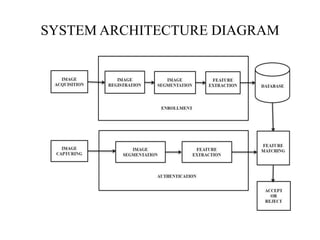
SYSTEM ARCHITECTURE DIAGRAM
DESIGN OF PROPOSED WORK
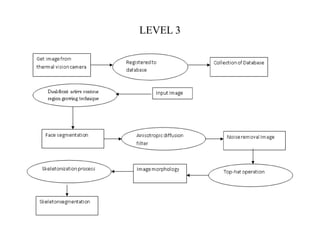
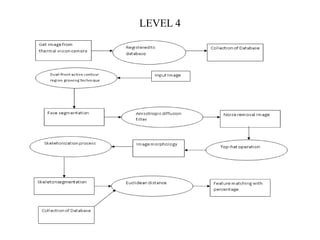
• Module-I:Thermal infrared-Image Registration& Face
Segmentation
• Module-II :Thermal Signature Extraction
• Module-III : Feature Matching
MODULES
MODULE-I:
Thermal infrared-Image Registration& Face Segmentation
• Data is collected using mobile camera system which
operates in thermal vision.
• The frontal view of the image is registered.
• Using the dual-front contour region growing technique
the face image are segmented from the neck and hair
region.
MODULE-II
Thermal Signature Extraction
• Noise Removal:
The significance of the anisotropic diffusion filter is to
reduce spurious and speckle noise effects seen in the
images.
• Image Morphology:
The top-hat segmentation is used to enhance the
brightness of the object in the image.
• Post Processing:
The skeletonization process is used o reduce the
foreground regions into a skeletal remnant that largely
preserves the extent and connectivity of the original region.
MODULE-III:
Feature Matching:
• The thermal signature which is extracted is matched with
the N number of templates stored in the database
• If both the template and the signature is matched, the
individual is authorized else they are unauthorized person
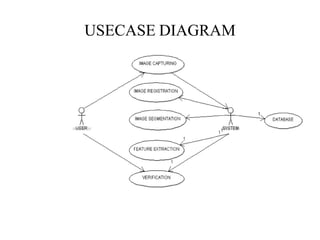
USECASE DIAGRAM
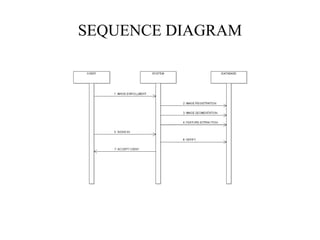
SEQUENCE DIAGRAM
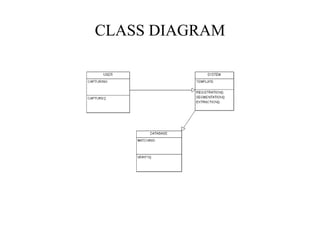
CLASS DIAGRAM
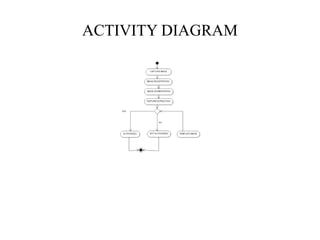
ACTIVITY DIAGRAM
COLLABORATION DIAGRAM
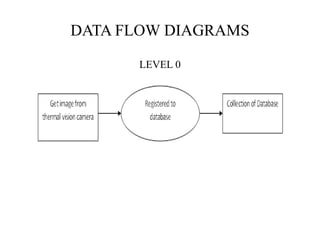
DATA FLOW DIAGRAMS
LEVEL 0
LEVEL 1
LEVEL 2
LEVEL 3
LEVEL 4
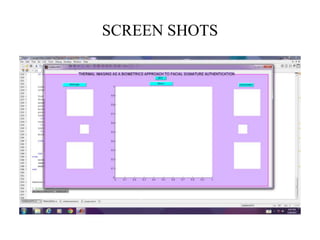
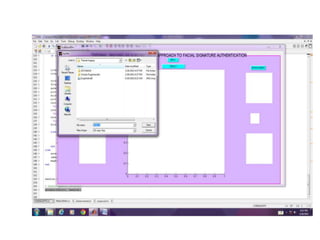
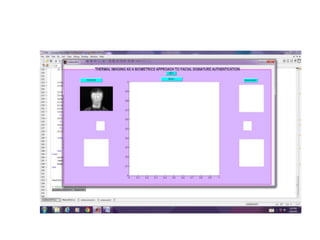
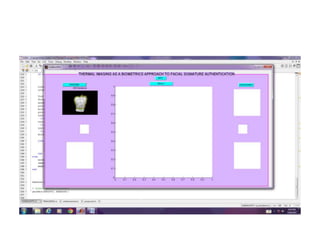
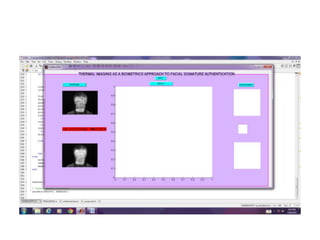
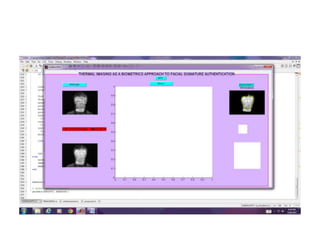
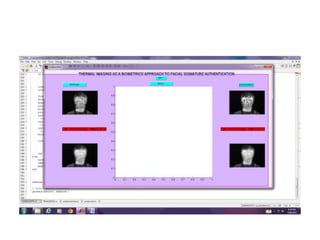
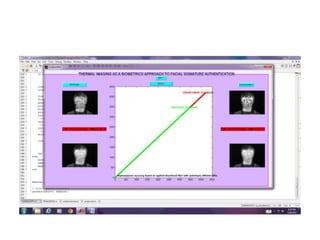
SCREEN SHOTS
ADVANTAGES
• Passport and visa verification can also be done using face
Recognition technology as explained above. Even Driving
license verification can also be exercised face recognition
technology as mentioned earlier.
• To identify and verify terrorists at airports, railway stations
and malls the face recognition technology will be the best
choice in India as compared with other biometric technologies
since other technologies cannot be helpful in crowd places.
FUTURE ENHANCEMENT
• Next generation person recognition systems will need to
recognize people in real-time and in much less constrained
situations.
• We believe that identification systems that are robust in natural
environments, in the presence of noise and illumination
changes, cannot rely on a single modality
REFERENCE
• C. L. Lin and K. C. Fan, “Biometric verification using thermal images of
palm-dorsa vein patterns,” IEEE Trans. Circuits Syst. Video Technol.,vol.
14, no. 2, pp. 199–213, Feb. 2004.
• I. Pavlidis, P. Tsiamyrtzis, P. Buddhraju, and C. Manohar, “Biometrics:Face
recognition in thermal infrared,” in Biomedical Engineering Handbook,J.
Bronzino, Ed. Boca Raton, FL: CRC Press, 2006.
• S. Lankton and A. Tannenbaum, “Localizing region-based active
contours,”IEEE Trans. Image Process, vol. 17, no. 11, pp. 2029–2039,
Nov.2008.
THANK YOU

PPT 7.4.2015

  • 1.
    A New ApproachTowards Biometric Authentication System Using Face Vein BATCH MEMBERS L.NIVETHITHA(111911104066) S.SHOWMIYA(111911104092) M.SNEHA(111911104094) S.S.SWATHI(111911104104) GUIDED BY Mr.H.ANWAR BASHA,M.Tech., (ASSISTANT PROFESSOR) S.A.Engineering College
  • 2.
    OBJECTIVE • This projectis concerned with the task of identifying the individual’s thermal facial signature for the purpose of authentication. • It includes image acquisition, coding the matching algorithm for processing the face vein pattern and testing of algorithm module. It can also be used to decrease the percentage of false rate and rejection rate identification of a person.
  • 3.
    ABSTRACT A new approachtowards biometric authentication system using face vein is to identify the problem of human face recognition. Different approaches to the problems of face detection and face recognition were evaluated and implemented using the Matlab technical computing language. In the implemented frontal-view face detection systems, automated face detection was achieved based on image invariants. The proposed algorithm is fully integrated and consolidates the critical steps of feature extraction through the use of morphological operators, registration using the Linear Image Registration Tool, and matching through unique similarity measures designed for this task. The novel approach at developing a thermal signature template using four images taken at various instants of time ensured that unforeseen changes in the vasculature over time did not affect the biometric matching processes the authentication process relied only on consistent thermal features. The results are based on applying the directional filter with anisotropic diffusion filter and achieved an average accuracy of 87.16% for skeletonized signatures and 94.63% for anisotropically diffused signatures with directional filters. The highly accurate results obtained in the matching process clearly demonstrate the ability of the thermal infrared system to extend in application to other thermal-imaging-based systems. ..projectThermal Imaging as a Biometrics Approach to Facial signature authentication.pdf
  • 4.
    EXISTING SYSTEM Identification systemsrely on 3 key elements 1. Attribute identifiers 2. Biographical identifiers 3. Biometric identifiers DISADVANTAGES: • It is easy to forge by intruders. • Less secure • Sensitive to light variability and other factors like difficulty in detecting facial disguises.
  • 5.
    PROPOSED SYSTEM • Weare implementing an biometric authentication system which uses facial signature to recognize an person’s identity. • In this the thermal image are taken and features are extracted. • The extracted features are enhanced by combining diffused and directional filters. ADVANTAGES: With the combined use of Directional and Diffusional filter, the images extracted are clear and efficient.
  • 6.
    LITERATURE SURVEY S.No TitleAuthor Name of the Jounal Year of Publication Concept Disadvantages 1 Discriminating Color Faces for Recognition Jian Yang, Chengjun Liu and Jingyu Yang International Journal of Recent Technology and Engineering (IJRTE) dec 2008 •Original image is converted into an RGB image •RGB image is again converted into an gray scale •The gray scale image is enhanced •Accurate gray scale image 2 Human Biometrics: Moving Towards Thermal Imaging Nermin K. Negied International Journal of Recent Technology and Engineering (IJRTE) ISSN: 2277-3878, Volume-2, Issue-6, January 2014 Jan 2014 •Uses the heat given of by an object to produce an image •device collects the infrared radiation from the object in the screen and creates an electronic image based on the information •Image is not clearly visible 3 A NOVEL APPROACH TO FACE RECOGNITION BASED ON THERMAL IMAGING MG Sanjith Kumar, D Saravanan IJRET: International Journal of Research in Engineering and Technology Mar- 2014 March 2014 •Images captured using Thermal mid wave infrared (MWIR) used to overcome problem of light variations. •Images are captured as electronic spectrum of waves •The noise in the electronic spectrum waves are to be filtered before registration.
  • 7.
  • 8.
    DESIGN OF PROPOSEDWORK • Module-I:Thermal infrared-Image Registration& Face Segmentation • Module-II :Thermal Signature Extraction • Module-III : Feature Matching
  • 9.
    MODULES MODULE-I: Thermal infrared-Image Registration&Face Segmentation • Data is collected using mobile camera system which operates in thermal vision. • The frontal view of the image is registered. • Using the dual-front contour region growing technique the face image are segmented from the neck and hair region.
  • 10.
    MODULE-II Thermal Signature Extraction •Noise Removal: The significance of the anisotropic diffusion filter is to reduce spurious and speckle noise effects seen in the images. • Image Morphology: The top-hat segmentation is used to enhance the brightness of the object in the image. • Post Processing: The skeletonization process is used o reduce the foreground regions into a skeletal remnant that largely preserves the extent and connectivity of the original region.
  • 11.
    MODULE-III: Feature Matching: • Thethermal signature which is extracted is matched with the N number of templates stored in the database • If both the template and the signature is matched, the individual is authorized else they are unauthorized person
  • 12.
  • 13.
  • 14.
  • 15.
  • 16.
  • 17.
  • 18.
  • 19.
  • 20.
  • 21.
  • 22.
  • 31.
    ADVANTAGES • Passport andvisa verification can also be done using face Recognition technology as explained above. Even Driving license verification can also be exercised face recognition technology as mentioned earlier. • To identify and verify terrorists at airports, railway stations and malls the face recognition technology will be the best choice in India as compared with other biometric technologies since other technologies cannot be helpful in crowd places.
  • 32.
    FUTURE ENHANCEMENT • Nextgeneration person recognition systems will need to recognize people in real-time and in much less constrained situations. • We believe that identification systems that are robust in natural environments, in the presence of noise and illumination changes, cannot rely on a single modality
  • 33.
    REFERENCE • C. L.Lin and K. C. Fan, “Biometric verification using thermal images of palm-dorsa vein patterns,” IEEE Trans. Circuits Syst. Video Technol.,vol. 14, no. 2, pp. 199–213, Feb. 2004. • I. Pavlidis, P. Tsiamyrtzis, P. Buddhraju, and C. Manohar, “Biometrics:Face recognition in thermal infrared,” in Biomedical Engineering Handbook,J. Bronzino, Ed. Boca Raton, FL: CRC Press, 2006. • S. Lankton and A. Tannenbaum, “Localizing region-based active contours,”IEEE Trans. Image Process, vol. 17, no. 11, pp. 2029–2039, Nov.2008.
  • 34.