Team
Members
Raihan Sikdar
ID-17181103133
Kazi Sarwar Uddin
ID-17181103127
Zarin Tasnim
ID-17181103042
Topic Cover
 Introduction.
 What are Biometrics ?
 What is Face Recognition?
 Why we choose Face Recognition?
 Classification of Face Recognition.
 Implementation of face Recognition Technology.
 How Face Recognition System work?
 Face Bunch graph.
 Face Recognition Attendance System.
 Advantage of Automatic Attendance System
with Face Recognition
Introduction
The information age is quickly revolutionizing the way transactions are
completed. Everyday actions are increasingly being handled
electronically, instead of with pencil and paper or face to face. This
growth in electronic transactions has resulted in a greater demand for
fast and accurate user identification and authentication. Access codes
for buildings, banks accounts and computer systems often use PIN's
for identification and security clearances.
Using the proper PIN gains access, but the user of the PIN is not
verified. When credit and ATM cards are lost or stolen, an unauthorized
user can often come up with the correct personal codes. Despite
warning, many people continue to choose easily guessed PIN‟s and
passwords: birthdays, phone numbers and social security numbers.
Recent cases of identity theft have heighten the need for methods to
prove that someone is truly who he/she claims to be.
Face recognition technology may solve this problem since a face is
undeniably connected to its owner expect in the case of identical twins.
Its nontransferable. The system can then compare scans to records
stored in a central or local database or even on a smart card.
A biometric is a unique, measurable characteristic of a human being
that can be used to automatically recognize an individual or verify
an individual‟ s identity. Biometrics can measure both physiological
and behavioral characteristics. Physiological biometrics (based on
measurements and data derived from direct measurement of a part
of the human body) include:
a. Finger-scan
b. Facial Recognition
c. Iris-scan
d. Retina-scan
e. Hand-scan
What are
Biometrics ?
Modern Portfolio
Presentation
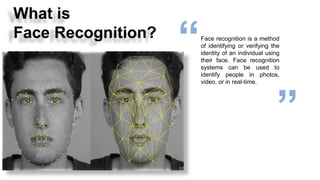
Face recognition is a method
of identifying or verifying the
identity of an individual using
their face. Face recognition
systems can be used to
identify people in photos,
video, or in real-time.
What is
Face Recognition?
?
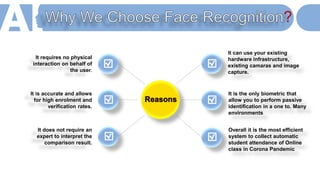
It can use your existing
hardware infrastructure,
existing camaras and image
capture.
It is the only biometric that
allow you to perform passive
identification in a one to. Many
environments
Overall it is the most efficient
system to collect automatic
student attendance of Online
class in Corona Pandemic
It requires no physical
interaction on behalf of
the user.
It is accurate and allows
for high enrolment and
verification rates.
It does not require an
expert to interpret the
comparison result.
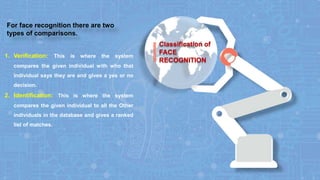
For face recognition there are two
types of comparisons.
Classification of
FACE
RECOGNITION
1. Verification: This is where the system
compares the given individual with who that
individual says they are and gives a yes or no
decision.
2. Identification: This is where the system
compares the given individual to all the Other
individuals in the database and gives a ranked
list of matches.
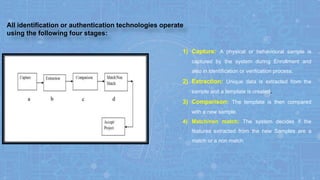
All identification or authentication technologies operate
using the following four stages:
1) Capture: A physical or behavioural sample is
captured by the system during Enrollment and
also in identification or verification process.
2) Extraction: Unique data is extracted from the
sample and a template is created.
3) Comparison: The template is then compared
with a new sample.
4) Match/non match: The system decides if the
features extracted from the new Samples are a
match or a non match
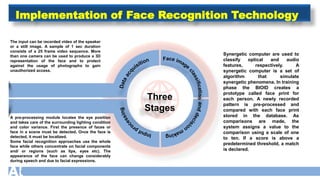
A pre-processing module locates the eye position
and takes care of the surrounding lighting condition
and color variance. First the presence of faces or
face in a scene must be detected. Once the face is
detected, it must be localized.
Some facial recognition approaches use the whole
face while others concentrate on facial components
and/ or regions (such as lips, eyes etc). The
appearance of the face can change considerably
during speech and due to facial expressions.
The input can be recorded video of the speaker
or a still image. A sample of 1 sec duration
consists of a 25 frame video sequence. More
than one camera can be used to produce a 3D
representation of the face and to protect
against the usage of photographs to gain
unauthorized access.
Synergetic computer are used to
classify optical and audio
features, respectively. A
synergetic computer is a set of
algorithm that simulate
synergetic phenomena. In training
phase the BIOID creates a
prototype called face print for
each person. A newly recorded
pattern is pre-processed and
compared with each face print
stored in the database. As
comparisons are made, the
system assigns a value to the
comparison using a scale of one
to ten. If a score is above a
predetermined threshold, a match
is declared.
Three
Stages
Implementation of Face Recognition Technology
How Face Recognition Systems
Work
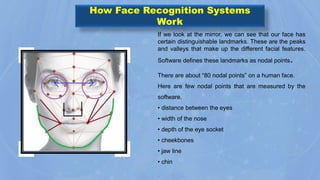
If we look at the mirror, we can see that our face has
certain distinguishable landmarks. These are the peaks
and valleys that make up the different facial features.
Software defines these landmarks as nodal points.
There are about “80 nodal points” on a human face.
Here are few nodal points that are measured by the
software.
• distance between the eyes
• width of the nose
• depth of the eye socket
• cheekbones
• jaw line
• chin
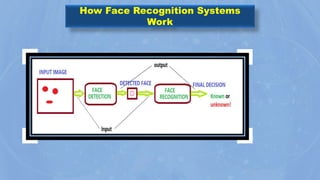
How Face Recognition Systems
Work
Face Bunch Graph
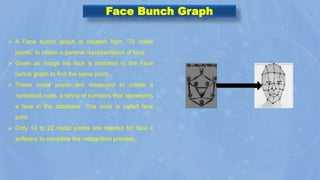
 A Face bunch graph is created from “70 nodal
points” to obtain a general representation of face.
 Given an image the face is matched to the Face
bunch graph to find the same point.
 These nodal points are measured to create a
numerical code, a string of numbers that represents
a face in the database. This code is called face
print.
 Only 14 to 22 nodal points are needed for face it
software to complete the recognition process.
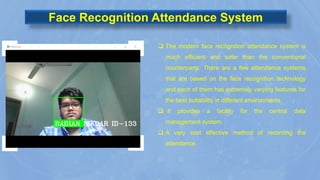
Face Recognition Attendance System
 The modern face recognition attendance system is
much efficient and safer than the conventional
counterparts. There are a few attendance systems
that are based on the face recognition technology
and each of them has extremely varying features for
the best suitability in different environments.
 It provides a facility for the central data
management system.
 A very cost effective method of recording the
attendance.
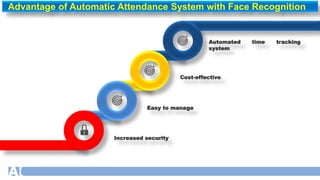
Easy to manage
Increased security
Cost-effective.
Automated time tracking
system
Advantage of Automatic Attendance System with Face Recognition
Physical
Description
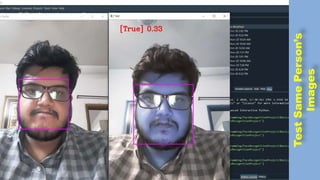
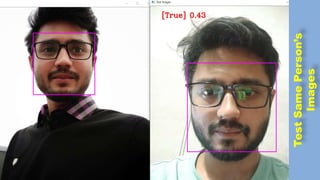
Test
Same
Person’s
Images
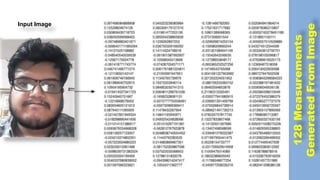
128
Measurements
Generated
From
Image
Input Image
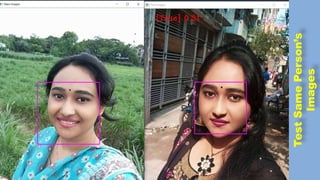
Test
Same
Person’s
Images
Test
Same
Person’s
Images
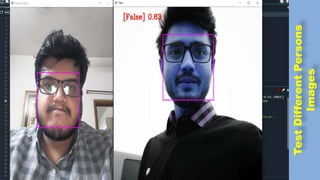
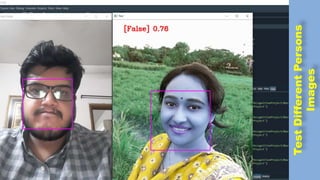
Test
Different
Persons
Images
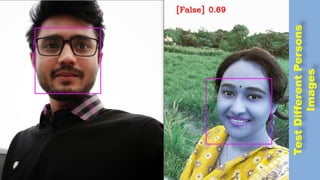
Test
Different
Persons
Images
Test
Different
Persons
Images
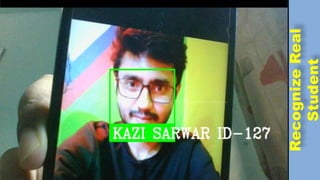
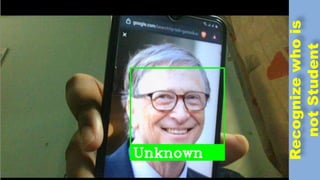
Recognize
Real
Student
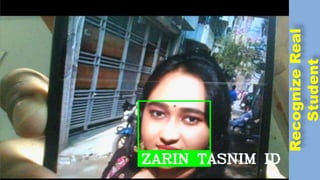
Recognize
Real
Student
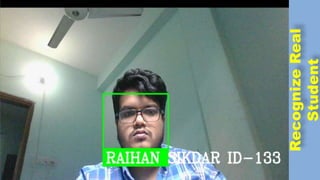
Recognize
Real
Student
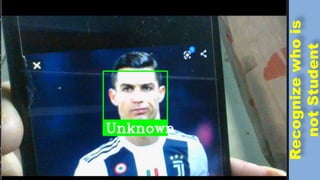
Recognize
who
is
not
Student
Recognize
who
is
not
Student
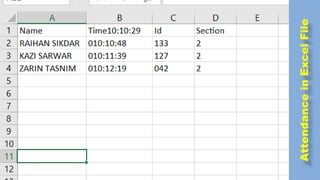
Attendance
File
Attendance
in
Excel
File
THANK YOU !

Attendance system based on face recognition using python by Raihan Sikdar

  • 2.
    Team Members Raihan Sikdar ID-17181103133 Kazi SarwarUddin ID-17181103127 Zarin Tasnim ID-17181103042
  • 3.
    Topic Cover  Introduction. What are Biometrics ?  What is Face Recognition?  Why we choose Face Recognition?  Classification of Face Recognition.  Implementation of face Recognition Technology.  How Face Recognition System work?  Face Bunch graph.  Face Recognition Attendance System.  Advantage of Automatic Attendance System with Face Recognition
  • 4.
    Introduction The information ageis quickly revolutionizing the way transactions are completed. Everyday actions are increasingly being handled electronically, instead of with pencil and paper or face to face. This growth in electronic transactions has resulted in a greater demand for fast and accurate user identification and authentication. Access codes for buildings, banks accounts and computer systems often use PIN's for identification and security clearances. Using the proper PIN gains access, but the user of the PIN is not verified. When credit and ATM cards are lost or stolen, an unauthorized user can often come up with the correct personal codes. Despite warning, many people continue to choose easily guessed PIN‟s and passwords: birthdays, phone numbers and social security numbers. Recent cases of identity theft have heighten the need for methods to prove that someone is truly who he/she claims to be. Face recognition technology may solve this problem since a face is undeniably connected to its owner expect in the case of identical twins. Its nontransferable. The system can then compare scans to records stored in a central or local database or even on a smart card.
  • 5.
    A biometric isa unique, measurable characteristic of a human being that can be used to automatically recognize an individual or verify an individual‟ s identity. Biometrics can measure both physiological and behavioral characteristics. Physiological biometrics (based on measurements and data derived from direct measurement of a part of the human body) include: a. Finger-scan b. Facial Recognition c. Iris-scan d. Retina-scan e. Hand-scan What are Biometrics ?
  • 6.
    Modern Portfolio Presentation Face recognitionis a method of identifying or verifying the identity of an individual using their face. Face recognition systems can be used to identify people in photos, video, or in real-time. What is Face Recognition?
  • 7.
    ? It can useyour existing hardware infrastructure, existing camaras and image capture. It is the only biometric that allow you to perform passive identification in a one to. Many environments Overall it is the most efficient system to collect automatic student attendance of Online class in Corona Pandemic It requires no physical interaction on behalf of the user. It is accurate and allows for high enrolment and verification rates. It does not require an expert to interpret the comparison result.
  • 8.
    For face recognitionthere are two types of comparisons. Classification of FACE RECOGNITION 1. Verification: This is where the system compares the given individual with who that individual says they are and gives a yes or no decision. 2. Identification: This is where the system compares the given individual to all the Other individuals in the database and gives a ranked list of matches.
  • 9.
    All identification orauthentication technologies operate using the following four stages: 1) Capture: A physical or behavioural sample is captured by the system during Enrollment and also in identification or verification process. 2) Extraction: Unique data is extracted from the sample and a template is created. 3) Comparison: The template is then compared with a new sample. 4) Match/non match: The system decides if the features extracted from the new Samples are a match or a non match
  • 10.
    A pre-processing modulelocates the eye position and takes care of the surrounding lighting condition and color variance. First the presence of faces or face in a scene must be detected. Once the face is detected, it must be localized. Some facial recognition approaches use the whole face while others concentrate on facial components and/ or regions (such as lips, eyes etc). The appearance of the face can change considerably during speech and due to facial expressions. The input can be recorded video of the speaker or a still image. A sample of 1 sec duration consists of a 25 frame video sequence. More than one camera can be used to produce a 3D representation of the face and to protect against the usage of photographs to gain unauthorized access. Synergetic computer are used to classify optical and audio features, respectively. A synergetic computer is a set of algorithm that simulate synergetic phenomena. In training phase the BIOID creates a prototype called face print for each person. A newly recorded pattern is pre-processed and compared with each face print stored in the database. As comparisons are made, the system assigns a value to the comparison using a scale of one to ten. If a score is above a predetermined threshold, a match is declared. Three Stages Implementation of Face Recognition Technology
  • 11.
    How Face RecognitionSystems Work If we look at the mirror, we can see that our face has certain distinguishable landmarks. These are the peaks and valleys that make up the different facial features. Software defines these landmarks as nodal points. There are about “80 nodal points” on a human face. Here are few nodal points that are measured by the software. • distance between the eyes • width of the nose • depth of the eye socket • cheekbones • jaw line • chin
  • 12.
  • 13.
    Face Bunch Graph A Face bunch graph is created from “70 nodal points” to obtain a general representation of face.  Given an image the face is matched to the Face bunch graph to find the same point.  These nodal points are measured to create a numerical code, a string of numbers that represents a face in the database. This code is called face print.  Only 14 to 22 nodal points are needed for face it software to complete the recognition process.
  • 14.
    Face Recognition AttendanceSystem  The modern face recognition attendance system is much efficient and safer than the conventional counterparts. There are a few attendance systems that are based on the face recognition technology and each of them has extremely varying features for the best suitability in different environments.  It provides a facility for the central data management system.  A very cost effective method of recording the attendance.
  • 15.
    Easy to manage Increasedsecurity Cost-effective. Automated time tracking system Advantage of Automatic Attendance System with Face Recognition
  • 16.
  • 17.
  • 18.
  • 19.
  • 20.
  • 21.
  • 22.
  • 23.
  • 24.
  • 25.
  • 26.
  • 27.
  • 28.
  • 29.
  • 30.
  • 32.