Thermal Infrared
Face Recognition
Submitted by-
Tarun Jaiswal
048
CSE (2K14)
Overview
 introduce the role of different IR spectrums,
 thermal face recognition,
 advantages of thermal images,
 their applications,
 some critical observations of thermal imaging,
 some interesting critical observations,
 sorting their limitations out.
 conclusion
Introduction
 Face of an individual is a biometric trait that can be used in
computer-based automatic security system for identification or
authentication of that individual.
 Not only the computer scientists, but the neuroscientists and
psychologists are also taking their interests in the field of development
and improvement of face recognition.
 challenge to accurately match the input human face with the face
image of the same person already stored in the face-database of the
system.
 Numerous applications of it relate mainly to the field of security.
 Face images may be of different types like visual, thermal, sketch and
fused images.
Introduction Continued…
 A face recognition system suffers from some typical problems. For
example, visual images result in poor performance with illumination
variations, such as indoor and outdoor lighting conditions, low lighting,
poses, aging, disguise etc.
 The main aim is to tackle all these problems to give an accurate
automatic face recognition.
 These problems can be solved using thermal images and also using
fused images of visual and thermal images.
Thermal face recognition
 Thermal face recognition deals with the face recognition system that
takes thermal face as an input.
 Thermal human face images are generated due to the body heat
pattern of the human being.
Thermal face recognition
 Different objects emit different range of Infra-red energy according to
their temperature and characteristics.
 The range of human face and body temperature nearly same and
quite uniform, varying from 35.5°C to 37.5°C providing a consistent
thermal signature.
 The thermal patterns of faces are derived from the pattern of
superficial blood vessels under the skin.
 The vein and tissue structure of the face is unique for each person and,
therefore, the IR images are also unique.
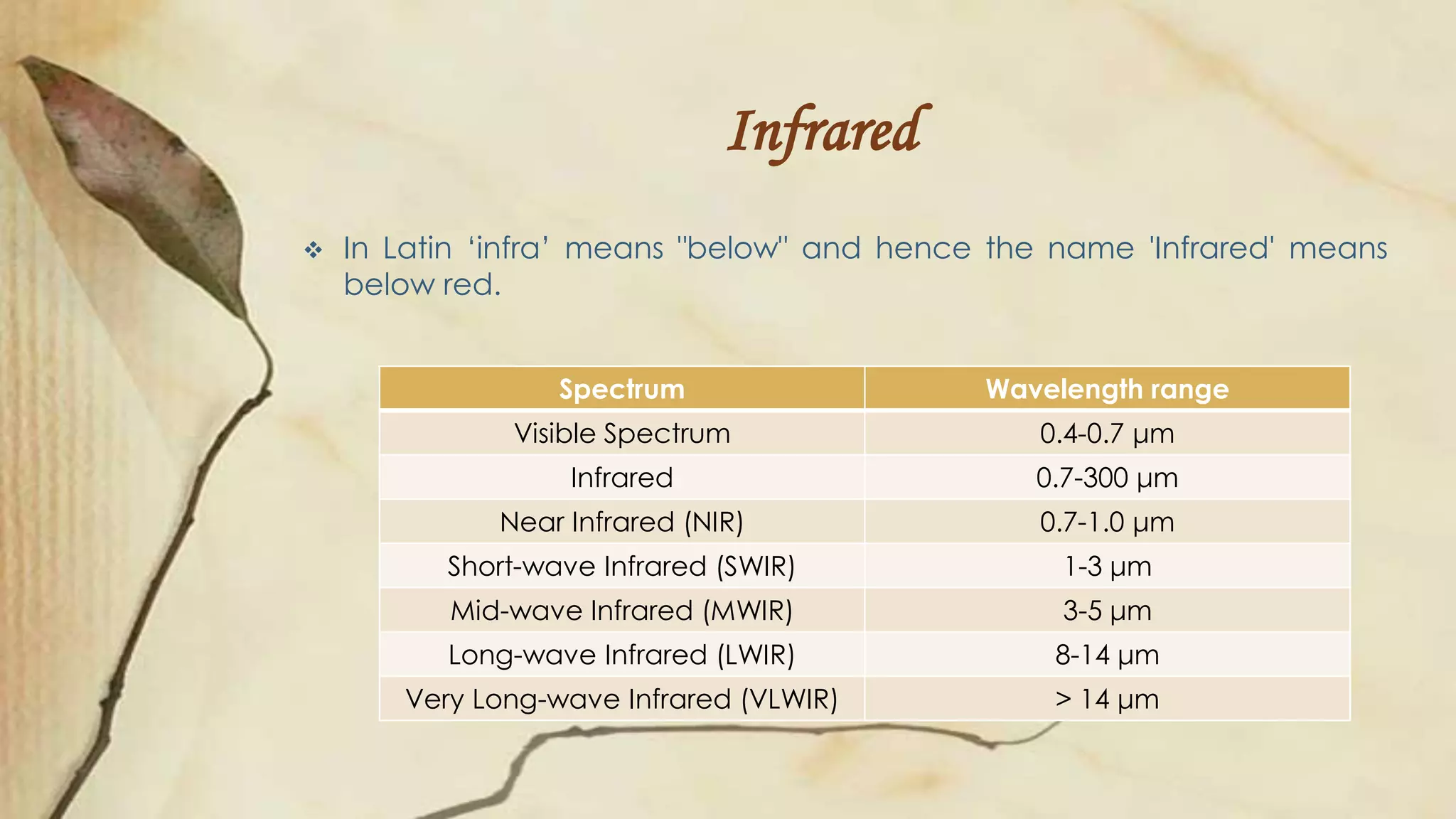
Infrared
 In Latin ‘infra’ means "below" and hence the name 'Infrared' means
below red.
Spectrum Wavelength range
Visible Spectrum 0.4-0.7 μm
Infrared 0.7-300 μm
Near Infrared (NIR) 0.7-1.0 μm
Short-wave Infrared (SWIR) 1-3 μm
Mid-wave Infrared (MWIR) 3-5 μm
Long-wave Infrared (LWIR) 8-14 μm
Very Long-wave Infrared (VLWIR) > 14 μm
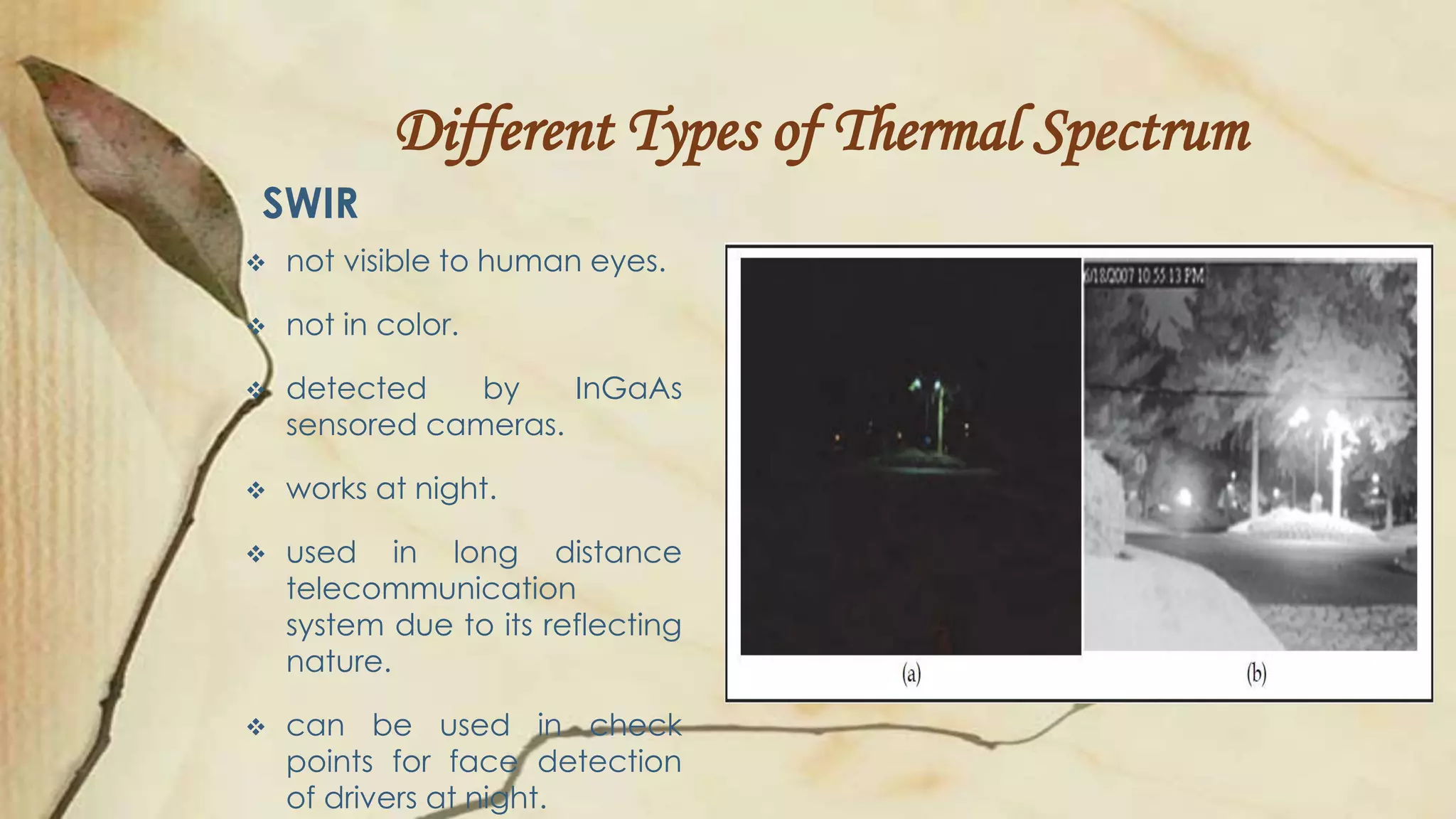
Different Types of Thermal Spectrum
 not visible to human eyes.
 not in color.
 detected by InGaAs
sensored cameras.
 works at night.
 used in long distance
telecommunication
system due to its reflecting
nature.
 can be used in check
points for face detection
of drivers at night.
SWIR
Different Types of Thermal Spectrum
Continued…
 NIR used in fibre optics
telecommunication and night vision
devices such as night vision camera
because of low attenuation loss.
 MWIR and LWIR used in thermal
imaging.
 MWIR used in heat-seeking in missiles,
homing on to the IR signature of
target aircraft.
 LWIR used in thermal imaging of
outside world.
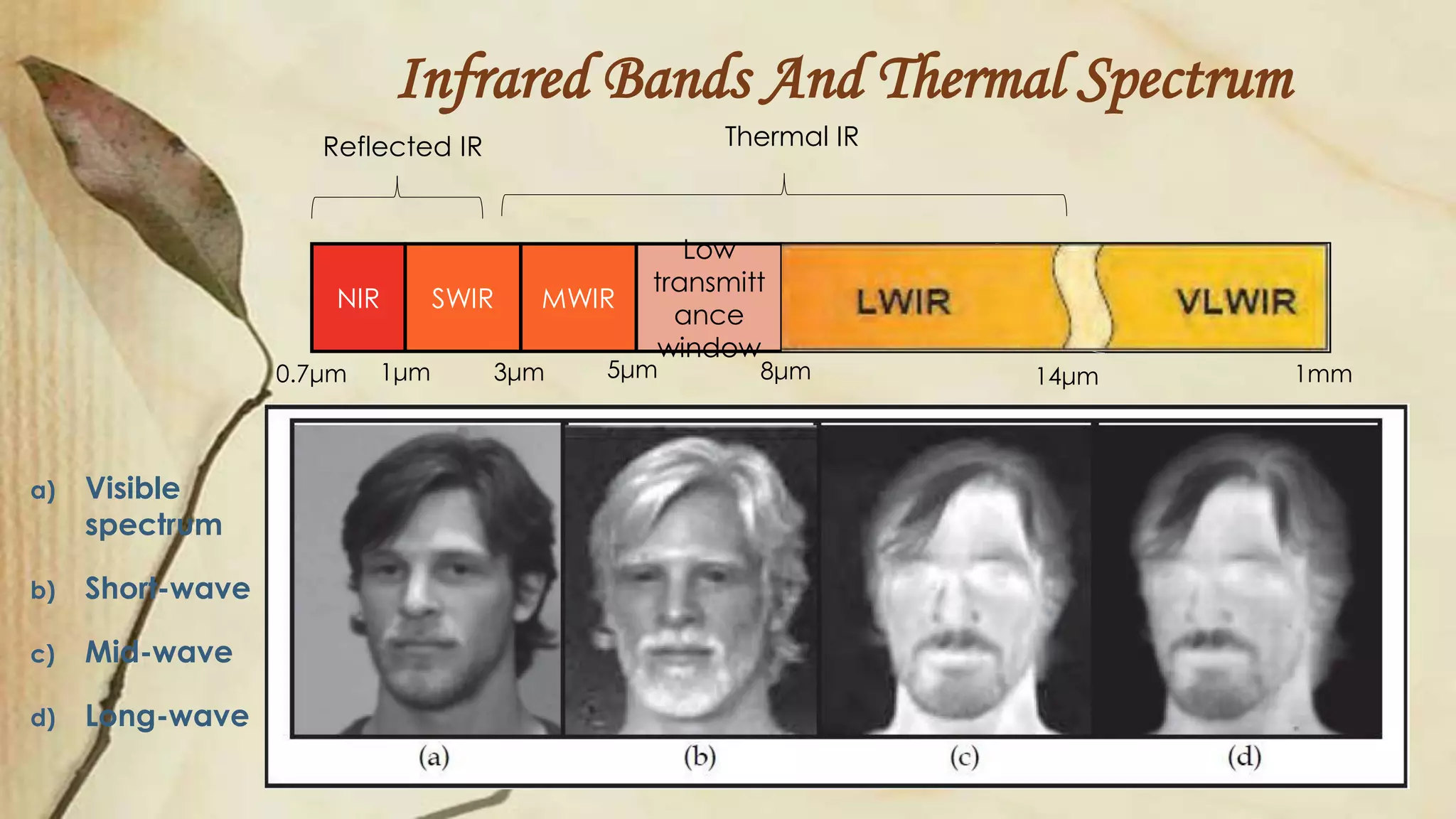
Infrared Bands And Thermal Spectrum
NIR SWIR MWIR
Low
transmitt
ance
window
0.7μm 1μm 3μm 5μm 8μm 14μm 1mm
Reflected IR Thermal IR
a) Visible
spectrum
b) Short-wave
c) Mid-wave
d) Long-wave
Advantages of Thermal Face Over Visual Face
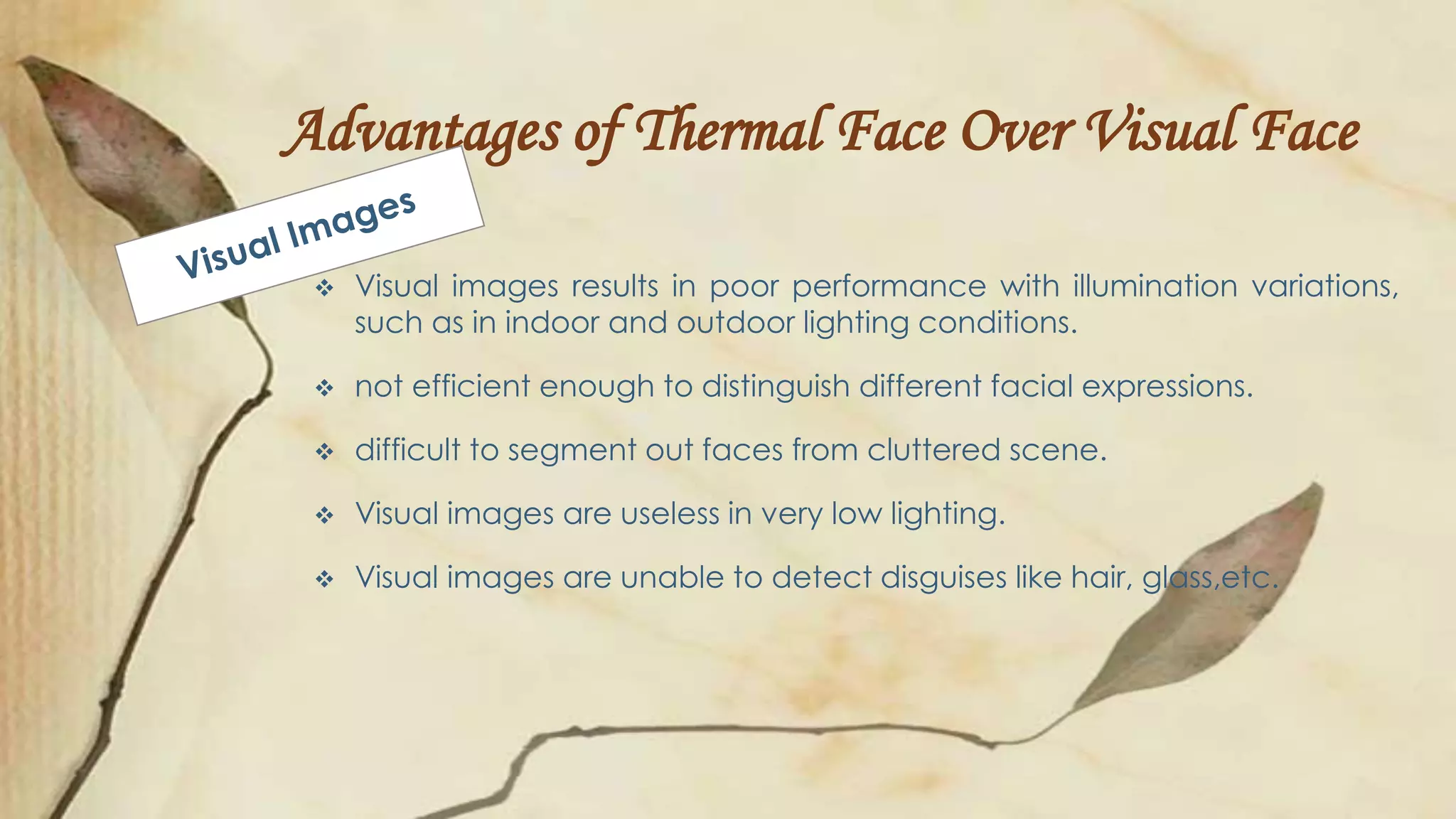
 Visual images results in poor performance with illumination variations,
such as in indoor and outdoor lighting conditions.
 not efficient enough to distinguish different facial expressions.
 difficult to segment out faces from cluttered scene.
 Visual images are useless in very low lighting.
 Visual images are unable to detect disguises like hair, glass,etc.
Advantages of Thermal Face Over Visual Face
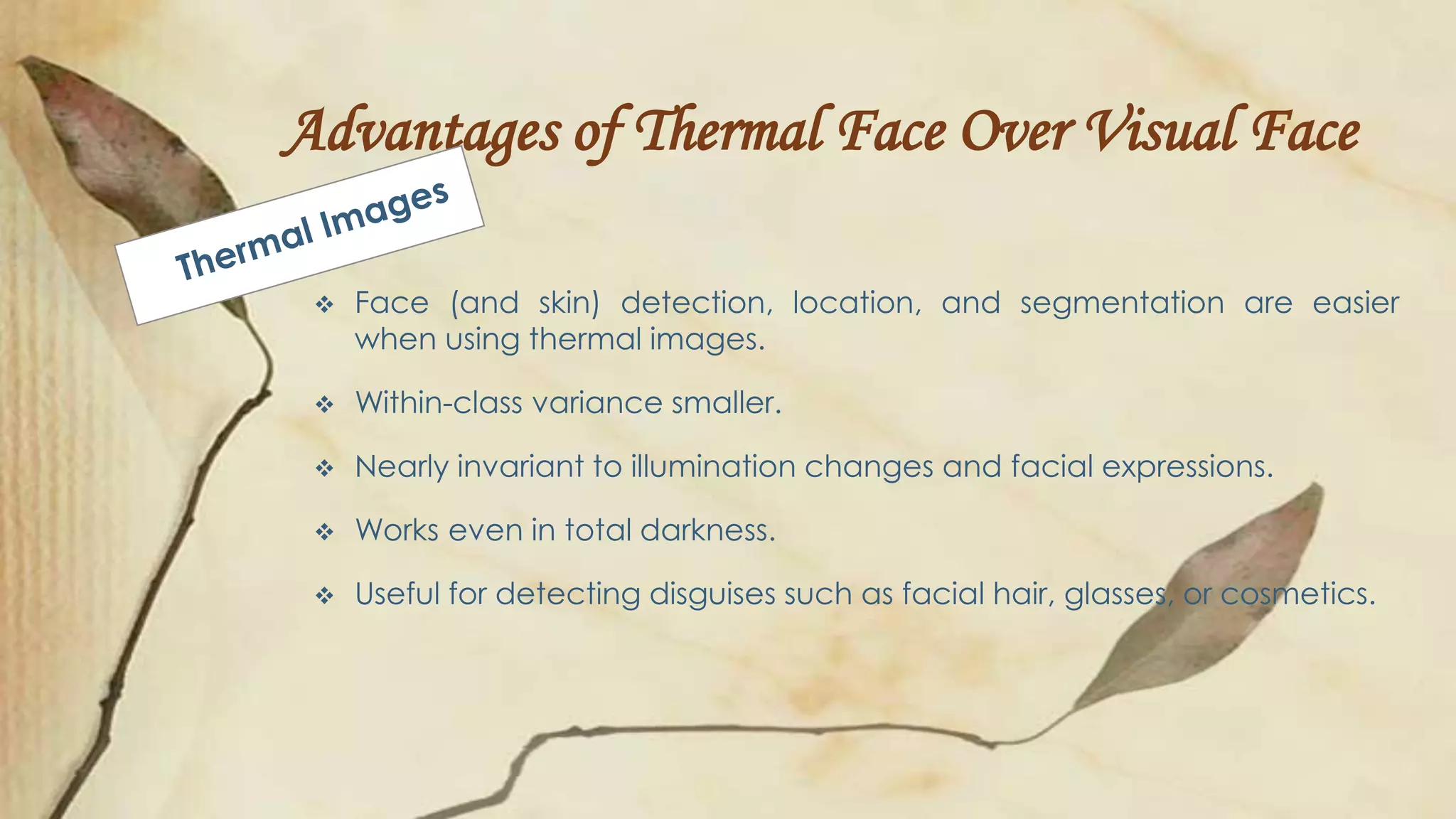
 Face (and skin) detection, location, and segmentation are easier
when using thermal images.
 Within-class variance smaller.
 Nearly invariant to illumination changes and facial expressions.
 Works even in total darkness.
 Useful for detecting disguises such as facial hair, glasses, or cosmetics.
Some Critical Observations on Thermal Face
 Identical twins
 Exhale-inhale effect
 Metabolism effect
 Effects of using glass
 Liveness solution
Drawbacks of Thermal Face
 may not detect face at the time of sickness.
 energetic physical activity, consumption of food, alcohol, caffeine
etc. may also affect the thermal characteristics.
 while breathing exhaling results big change in skin temperature.
 glasses block most of thermal energy.
 not appropriate for recognition of vehicle occupants (because of
speed, glass).
 Thermal images have low resolution.
 Thermal cameras are expensive.
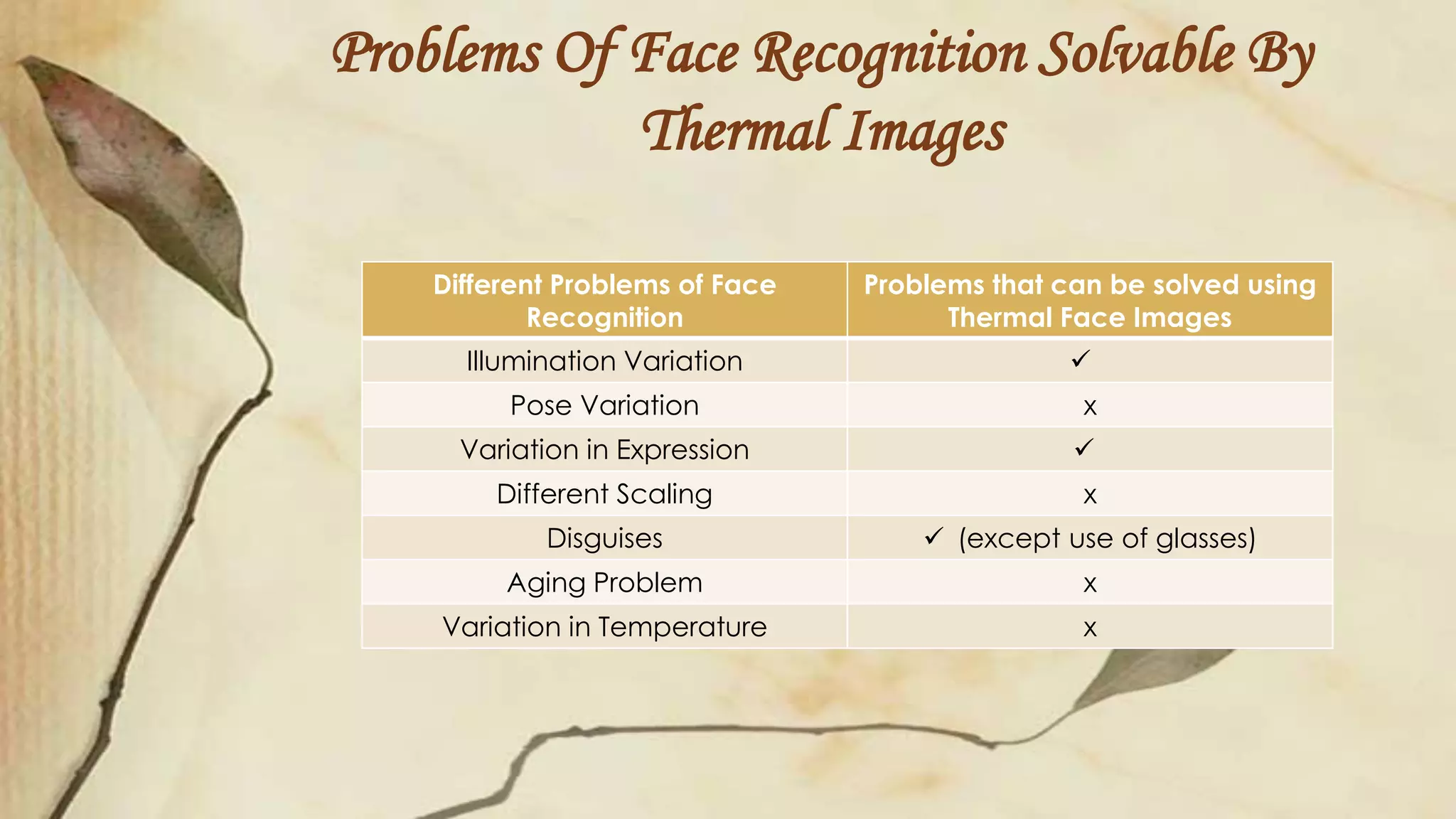
Problems Of Face Recognition Solvable By
Thermal Images
Different Problems of Face
Recognition
Problems that can be solved using
Thermal Face Images
Illumination Variation 
Pose Variation x
Variation in Expression 
Different Scaling x
Disguises  (except use of glasses)
Aging Problem x
Variation in Temperature x
Fused Images
 Fused image comprises of more than one image.
 Contains both thermal as well as visual faces.
 Resulted fused image is more informative than any of the
individual image.
An example of Fused Image
Different Levels Of Fusion Techniques
 Feature Level Fusion
 Decision Level Fusion
 Pixel / Data Level Fusion
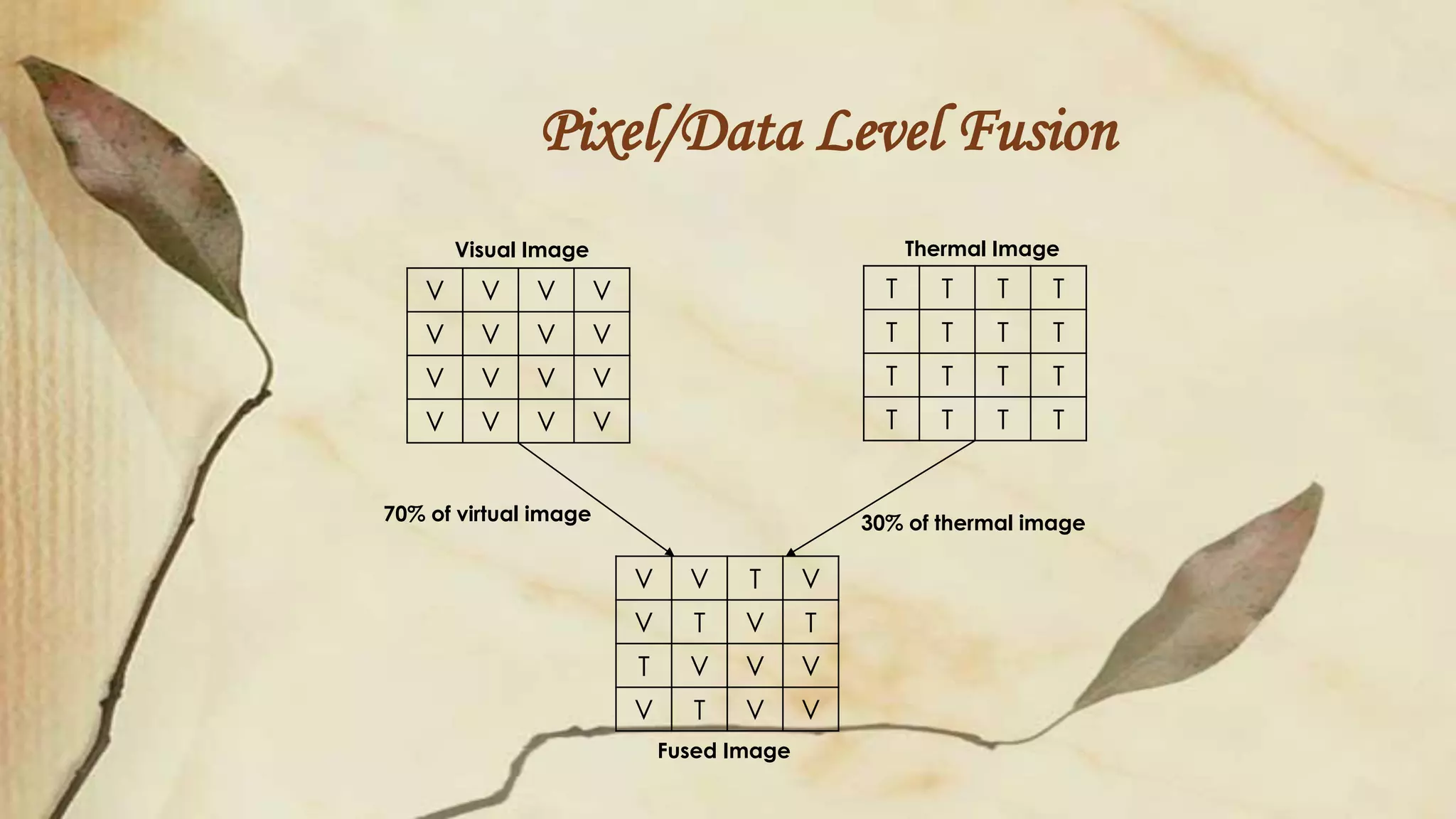
Pixel/Data Level Fusion
V V V V
V V V V
V V V V
V V V V
T T T T
T T T T
T T T T
T T T T
V V T V
V T V T
T V V V
V T V V
70% of virtual image 30% of thermal image
Visual Image Thermal Image
Fused Image
Conclusion
The problem of variation in temperature can be solved by visual images
which cannot be in case of thermals. Again, thermal images are best to
detect liveliness. So, we can apply the concept of fusion in face
recognition to get better result of person recognition. So, fusion of both
thermal and visual images will generate a new fused image that will store
the information of both thermal and visual faces.
Thank You…

Thermal Infrared Face Recognition

  • 1.
    Thermal Infrared Face Recognition Submittedby- Tarun Jaiswal 048 CSE (2K14)
  • 2.
    Overview  introduce therole of different IR spectrums,  thermal face recognition,  advantages of thermal images,  their applications,  some critical observations of thermal imaging,  some interesting critical observations,  sorting their limitations out.  conclusion
  • 3.
    Introduction  Face ofan individual is a biometric trait that can be used in computer-based automatic security system for identification or authentication of that individual.  Not only the computer scientists, but the neuroscientists and psychologists are also taking their interests in the field of development and improvement of face recognition.  challenge to accurately match the input human face with the face image of the same person already stored in the face-database of the system.  Numerous applications of it relate mainly to the field of security.  Face images may be of different types like visual, thermal, sketch and fused images.
  • 4.
    Introduction Continued…  Aface recognition system suffers from some typical problems. For example, visual images result in poor performance with illumination variations, such as indoor and outdoor lighting conditions, low lighting, poses, aging, disguise etc.  The main aim is to tackle all these problems to give an accurate automatic face recognition.  These problems can be solved using thermal images and also using fused images of visual and thermal images.
  • 5.
    Thermal face recognition Thermal face recognition deals with the face recognition system that takes thermal face as an input.  Thermal human face images are generated due to the body heat pattern of the human being.
  • 6.
    Thermal face recognition Different objects emit different range of Infra-red energy according to their temperature and characteristics.  The range of human face and body temperature nearly same and quite uniform, varying from 35.5°C to 37.5°C providing a consistent thermal signature.  The thermal patterns of faces are derived from the pattern of superficial blood vessels under the skin.  The vein and tissue structure of the face is unique for each person and, therefore, the IR images are also unique.
  • 7.
    Infrared  In Latin‘infra’ means "below" and hence the name 'Infrared' means below red. Spectrum Wavelength range Visible Spectrum 0.4-0.7 μm Infrared 0.7-300 μm Near Infrared (NIR) 0.7-1.0 μm Short-wave Infrared (SWIR) 1-3 μm Mid-wave Infrared (MWIR) 3-5 μm Long-wave Infrared (LWIR) 8-14 μm Very Long-wave Infrared (VLWIR) > 14 μm
  • 8.
    Different Types ofThermal Spectrum  not visible to human eyes.  not in color.  detected by InGaAs sensored cameras.  works at night.  used in long distance telecommunication system due to its reflecting nature.  can be used in check points for face detection of drivers at night. SWIR
  • 9.
    Different Types ofThermal Spectrum Continued…  NIR used in fibre optics telecommunication and night vision devices such as night vision camera because of low attenuation loss.  MWIR and LWIR used in thermal imaging.  MWIR used in heat-seeking in missiles, homing on to the IR signature of target aircraft.  LWIR used in thermal imaging of outside world.
  • 10.
    Infrared Bands AndThermal Spectrum NIR SWIR MWIR Low transmitt ance window 0.7μm 1μm 3μm 5μm 8μm 14μm 1mm Reflected IR Thermal IR a) Visible spectrum b) Short-wave c) Mid-wave d) Long-wave
  • 11.
    Advantages of ThermalFace Over Visual Face  Visual images results in poor performance with illumination variations, such as in indoor and outdoor lighting conditions.  not efficient enough to distinguish different facial expressions.  difficult to segment out faces from cluttered scene.  Visual images are useless in very low lighting.  Visual images are unable to detect disguises like hair, glass,etc.
  • 12.
    Advantages of ThermalFace Over Visual Face  Face (and skin) detection, location, and segmentation are easier when using thermal images.  Within-class variance smaller.  Nearly invariant to illumination changes and facial expressions.  Works even in total darkness.  Useful for detecting disguises such as facial hair, glasses, or cosmetics.
  • 13.
    Some Critical Observationson Thermal Face  Identical twins  Exhale-inhale effect  Metabolism effect  Effects of using glass  Liveness solution
  • 14.
    Drawbacks of ThermalFace  may not detect face at the time of sickness.  energetic physical activity, consumption of food, alcohol, caffeine etc. may also affect the thermal characteristics.  while breathing exhaling results big change in skin temperature.  glasses block most of thermal energy.  not appropriate for recognition of vehicle occupants (because of speed, glass).  Thermal images have low resolution.  Thermal cameras are expensive.
  • 15.
    Problems Of FaceRecognition Solvable By Thermal Images Different Problems of Face Recognition Problems that can be solved using Thermal Face Images Illumination Variation  Pose Variation x Variation in Expression  Different Scaling x Disguises  (except use of glasses) Aging Problem x Variation in Temperature x
  • 16.
    Fused Images  Fusedimage comprises of more than one image.  Contains both thermal as well as visual faces.  Resulted fused image is more informative than any of the individual image. An example of Fused Image
  • 17.
    Different Levels OfFusion Techniques  Feature Level Fusion  Decision Level Fusion  Pixel / Data Level Fusion
  • 18.
    Pixel/Data Level Fusion VV V V V V V V V V V V V V V V T T T T T T T T T T T T T T T T V V T V V T V T T V V V V T V V 70% of virtual image 30% of thermal image Visual Image Thermal Image Fused Image
  • 19.
    Conclusion The problem ofvariation in temperature can be solved by visual images which cannot be in case of thermals. Again, thermal images are best to detect liveliness. So, we can apply the concept of fusion in face recognition to get better result of person recognition. So, fusion of both thermal and visual images will generate a new fused image that will store the information of both thermal and visual faces.
  • 20.