ATM -Using Fingerprints
By—
 Piyali Das
 Shahrooque Ahmed
 Ankan Biswas
 Chytali Koley
 Falguni Mukherjee
 Indrajit Kundu
 MD. Irshad Quraishi
 Jyoti Kumari Choudhury
UNIVERSITY INSTITUTE OF TECHNOLOGY, BURDWAN UNIVERSITY
Definition of ATM
How ATM identifies customers
Issues In Current ATM Networks
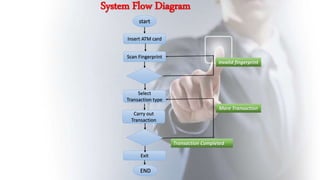
Biometric ATM Solve These Issues
What is Biometrics ?
Type of biometric
How Biometrics Works ?
Why Fingerprint Biometric
Fingerprint Pattern
Intro-fingerprint Authentication
Fingerprint Scanner
System Flow Diagram
Hardware Component
Software Components
Advantage & Disadvantage
Future Scope
Conclusion
References
Definition Of ATM
ATM (Automated Teller Machine) the three
letters themselves from quite a convenient term.
Now that these three letters have become an
inseparable part of modern economics.
ATM is an electronic device that
enables customers of financial instructions to
perform certain basic financial transactions like
cash withdrawal without the aid of a cashier or
clerk.
when customers use their ATM cards
for any financial transactions, they can access
their bank deposits or credit accounts to perform
the same. Through an ATM card, a customer
can perform transaction like cash withdrawal,
mobile recharge, online shopping etc.
How ATM identifies customers
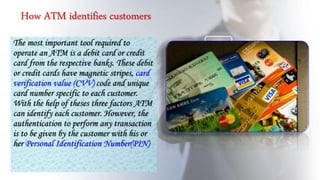
The most important tool required to
operate an ATM is a debit card or credit
card from the respective banks. These debit
or credit cards have magnetic stripes, card
verification value (CVV) code and unique
card number specific to each customer.
With the help of theses three factors ATM
can identify each customer. However, the
authentication to perform any transaction
is to be given by the customer with his or
her Personal Identification Number(PIN)
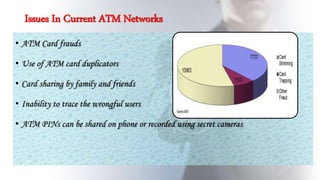
Issues In Current ATM Networks
• ATM Card frauds
• Use of ATM card duplicators
• Card sharing by family and friends
• Inability to trace the wrongful users
• ATM PINs can be shared on phone or recorded using secret cameras
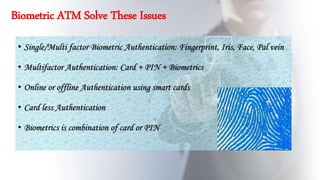
Biometric ATM Solve These Issues
• Single/Multi factor Biometric Authentication: Fingerprint, Iris, Face, Pal vein
• Multifactor Authentication: Card + PIN + Biometrics
• Online or offline Authentication using smart cards
• Card less Authentication
• Biometrics is combination of card or PIN
What is Biometrics ?
• The meaning of Biometrics comes from the Greeks.
Biometry = bio(life) + metry(to measure).
• Biometrics is the science and technology of measuring and analyzing biological data.
• The first known example of biometrics in practice was a form of finger printing being
used in China in the 14th century.
• Biometrics refers to technologies that measure and analyze human body
characteristics such as DNA, fingerprints, eye retinas and irises, voice patterns, facial
patterns and hand measurements for authentication pur5poses.
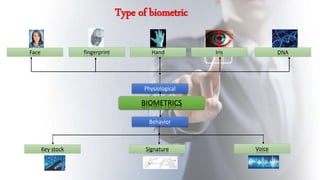
Type of biometric
Physiological
IrisHandfingerprintFace DNA
Behavior
Key stock Signature Voice
BIOMETRICS
How Biometrics Works ?
• Biometrics systems work by recording and comparing biometric characteristics.
• When an individual first uses a biometric system, their identifying features are
enrolled as a reference for future comparison. This reference may be stored in a
central database or on a card (or both) depending on the needs of the
application.
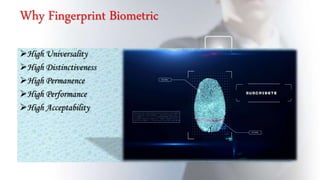
Why Fingerprint Biometric
High Universality
High Distinctiveness
High Permanence
High Performance
High Acceptability
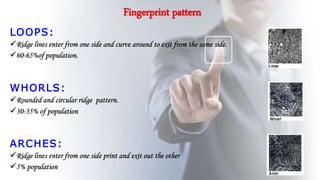
Fingerprint pattern
LOOPS:
Ridge lines enter from one side and curve around to exit from the same side.
60-65%of population.
WHORLS:
Rounded and circular ridge pattern.
30-35% of population.
ARCHES:
Ridge lines enter from one side print and exit out the other
5% population
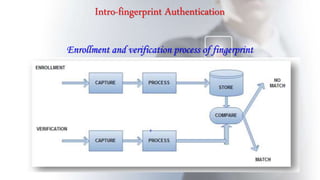
Intro-fingerprint Authentication
Enrollment and verification process of fingerprint
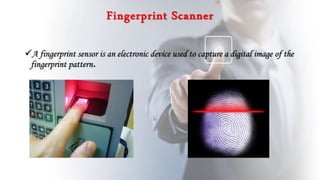
Fingerprint Scanner
A fingerprint sensor is an electronic device used to capture a digital image of the
fingerprint pattern.
System Flow Diagram
start
Insert ATM card
Exit
Select
Transaction type
Scan Fingerprint
Carry out
Transaction
END
Invalid fingerprint
More Transaction
Transaction Completed
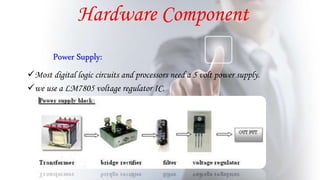
Power Supply:
Most digital logic circuits and processors need a 5 volt power supply.
we use a LM7805 voltage regulator IC.
Hardware Component
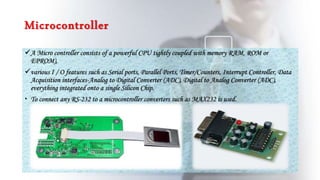
Microcontroller
A Micro controller consists of a powerful CPU tightly coupled with memory RAM, ROM or
EPROM),
various I / O features such as Serial ports, Parallel Ports, Timer/Counters, Interrupt Controller, Data
Acquisition interfaces-Analog to Digital Converter (ADC), Digital to Analog Converter (ADC),
everything integrated onto a single Silicon Chip.
 To connect any RS-232 to a microcontroller converters such as MAX232 is used.
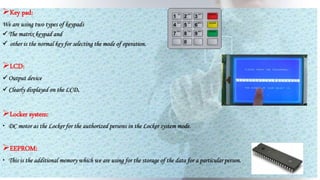
Key pad:
We are using two types of keypads
The matrix keypad and
 other is the normal key for selecting the mode of operation.
LCD:
Output device
Clearly displayed on the LCD.
Locker system:
 DC motor as the Locker for the authorized persons in the Locker system mode.
EEPROM:
 This is the additional memory which we are using for the storage of the data for a particular person.
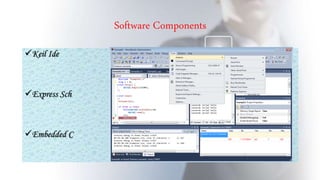
Software Components
Keil Ide
Express Sch
Embedded C
Advantage
• While a criminal might be able to obtain a password illegally, getting a user's
fingerprints would be much more complicated.
• In addition, contrary to traditional id cards or badges, you can't actually lose
physical features, making maintenance more cost efficient for the business or
organization, and the technology more convenient for users.
Disadvantage
• Biometric identification machines are traditionally more expensive to buy than
traditional ones.
• Biometric identification machines are not always entirely accurate. For example,
an individual with a cold may not be able to identify himself using a voice
identification device.
Future Scope
Performance can be increased in terms of speed and memory.
A speaking voice alarm can be used to indicate unauthorized person
accessing the ATM.
The system can be made to communicate with modems or mobile
phones
Conclusion
Biometric tokens are the safest means of preventing ATM frauds.
• The main reason for introducing biometric systems is to increase overall security.
• Biometrics offers greater security and convenience than traditional methods of
personal recognition.
• In some applications, biometrics can replace or supplement the existing technology. In
others, it is the only viable approach.
• The biometric system is only one part of an overall identification or authentication
process, and the other parts of that process will play an equal role in determining its
effectiveness
References
http://www.en.wikipedia.org
https://www.google.co.in/imghp
http://nevonprojects.com
www.ijeir.org/Download/conference/20.pdf
Finger print ATM

Finger print ATM

  • 1.
    ATM -Using Fingerprints By— Piyali Das  Shahrooque Ahmed  Ankan Biswas  Chytali Koley  Falguni Mukherjee  Indrajit Kundu  MD. Irshad Quraishi  Jyoti Kumari Choudhury UNIVERSITY INSTITUTE OF TECHNOLOGY, BURDWAN UNIVERSITY
  • 2.
    Definition of ATM HowATM identifies customers Issues In Current ATM Networks Biometric ATM Solve These Issues What is Biometrics ? Type of biometric How Biometrics Works ? Why Fingerprint Biometric Fingerprint Pattern Intro-fingerprint Authentication Fingerprint Scanner System Flow Diagram Hardware Component Software Components Advantage & Disadvantage Future Scope Conclusion References
  • 3.
    Definition Of ATM ATM(Automated Teller Machine) the three letters themselves from quite a convenient term. Now that these three letters have become an inseparable part of modern economics. ATM is an electronic device that enables customers of financial instructions to perform certain basic financial transactions like cash withdrawal without the aid of a cashier or clerk. when customers use their ATM cards for any financial transactions, they can access their bank deposits or credit accounts to perform the same. Through an ATM card, a customer can perform transaction like cash withdrawal, mobile recharge, online shopping etc.
  • 4.
    How ATM identifiescustomers The most important tool required to operate an ATM is a debit card or credit card from the respective banks. These debit or credit cards have magnetic stripes, card verification value (CVV) code and unique card number specific to each customer. With the help of theses three factors ATM can identify each customer. However, the authentication to perform any transaction is to be given by the customer with his or her Personal Identification Number(PIN)
  • 5.
    Issues In CurrentATM Networks • ATM Card frauds • Use of ATM card duplicators • Card sharing by family and friends • Inability to trace the wrongful users • ATM PINs can be shared on phone or recorded using secret cameras
  • 6.
    Biometric ATM SolveThese Issues • Single/Multi factor Biometric Authentication: Fingerprint, Iris, Face, Pal vein • Multifactor Authentication: Card + PIN + Biometrics • Online or offline Authentication using smart cards • Card less Authentication • Biometrics is combination of card or PIN
  • 7.
    What is Biometrics? • The meaning of Biometrics comes from the Greeks. Biometry = bio(life) + metry(to measure). • Biometrics is the science and technology of measuring and analyzing biological data. • The first known example of biometrics in practice was a form of finger printing being used in China in the 14th century. • Biometrics refers to technologies that measure and analyze human body characteristics such as DNA, fingerprints, eye retinas and irises, voice patterns, facial patterns and hand measurements for authentication pur5poses.
  • 8.
    Type of biometric Physiological IrisHandfingerprintFaceDNA Behavior Key stock Signature Voice BIOMETRICS
  • 9.
    How Biometrics Works? • Biometrics systems work by recording and comparing biometric characteristics. • When an individual first uses a biometric system, their identifying features are enrolled as a reference for future comparison. This reference may be stored in a central database or on a card (or both) depending on the needs of the application.
  • 10.
    Why Fingerprint Biometric HighUniversality High Distinctiveness High Permanence High Performance High Acceptability
  • 11.
    Fingerprint pattern LOOPS: Ridge linesenter from one side and curve around to exit from the same side. 60-65%of population. WHORLS: Rounded and circular ridge pattern. 30-35% of population. ARCHES: Ridge lines enter from one side print and exit out the other 5% population
  • 12.
    Intro-fingerprint Authentication Enrollment andverification process of fingerprint
  • 13.
    Fingerprint Scanner A fingerprintsensor is an electronic device used to capture a digital image of the fingerprint pattern.
  • 14.
    System Flow Diagram start InsertATM card Exit Select Transaction type Scan Fingerprint Carry out Transaction END Invalid fingerprint More Transaction Transaction Completed
  • 15.
    Power Supply: Most digitallogic circuits and processors need a 5 volt power supply. we use a LM7805 voltage regulator IC. Hardware Component
  • 16.
    Microcontroller A Micro controllerconsists of a powerful CPU tightly coupled with memory RAM, ROM or EPROM), various I / O features such as Serial ports, Parallel Ports, Timer/Counters, Interrupt Controller, Data Acquisition interfaces-Analog to Digital Converter (ADC), Digital to Analog Converter (ADC), everything integrated onto a single Silicon Chip.  To connect any RS-232 to a microcontroller converters such as MAX232 is used.
  • 17.
    Key pad: We areusing two types of keypads The matrix keypad and  other is the normal key for selecting the mode of operation. LCD: Output device Clearly displayed on the LCD. Locker system:  DC motor as the Locker for the authorized persons in the Locker system mode. EEPROM:  This is the additional memory which we are using for the storage of the data for a particular person.
  • 18.
  • 20.
    Advantage • While acriminal might be able to obtain a password illegally, getting a user's fingerprints would be much more complicated. • In addition, contrary to traditional id cards or badges, you can't actually lose physical features, making maintenance more cost efficient for the business or organization, and the technology more convenient for users.
  • 21.
    Disadvantage • Biometric identificationmachines are traditionally more expensive to buy than traditional ones. • Biometric identification machines are not always entirely accurate. For example, an individual with a cold may not be able to identify himself using a voice identification device.
  • 22.
    Future Scope Performance canbe increased in terms of speed and memory. A speaking voice alarm can be used to indicate unauthorized person accessing the ATM. The system can be made to communicate with modems or mobile phones
  • 23.
    Conclusion Biometric tokens arethe safest means of preventing ATM frauds. • The main reason for introducing biometric systems is to increase overall security. • Biometrics offers greater security and convenience than traditional methods of personal recognition. • In some applications, biometrics can replace or supplement the existing technology. In others, it is the only viable approach. • The biometric system is only one part of an overall identification or authentication process, and the other parts of that process will play an equal role in determining its effectiveness
  • 24.