ELECTROMAGNETIC FIELD
THEORY
BY: G SAMBASIVA RAO
ASST.PROF/ECE DEPT.
UNIT – I
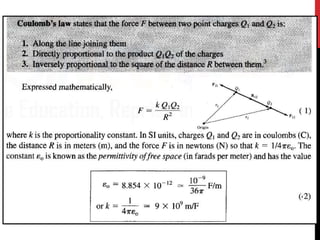
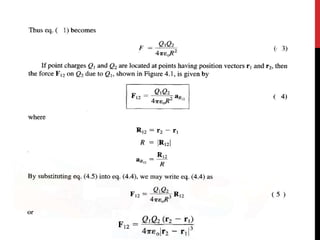
Electrostatics-I: Coulomb’s Law, Electric Field Intensity - Electric
Fields due to Continuous Charge Distributions – Line Charge, Surface
Charge, Volume Charge - Electric Flux Density - Gauss Law –
Applications of Gauss Law – Point Charge, Infinite Line Charge,
Infinite Sheet Charge - Electric Potential -Relations Between E and V.
Syllabus
UNIT – II
Electrostatics-II: The nature of dielectric materials, boundary
conditions for perfect dielectric materials. Capacitance, Several
capacitance examples: Parallel Plate Capacitor, Capacitance of a
Coaxial Cable, Spherical Capacitor. Derivations of Poisson’s and
Laplace’s equations. Current and current density, Energy density,
continuity of current.
UNIT – III
The Steady Magnetic Field: Biot-Savart’s Law, Ampere’s Circuital
Law, Magnetic Flux and Magnetic Flux Density, The scalar and vector
magnetic potentials. Magnetic Forces and Materials: Force on a
moving charge, force on a differential current element, force between
differential current elements, Magnetic Energy, the nature of magnetic
materials, magnetization and permeability, magnetic boundary
UNIT – IV
Time Varying Fields and Maxwell’s Equations: Faraday’s Law -
Transformer and Motional EMFs –Stationary Loop in Time Varying B
Field, Moving Loop in Static B Field, Moving Loop in Time
VaryingField - Displacement Current – Maxwell’s Equations in
Different Final Forms.
UNIT – V
Wave Equations: Waves equations for: a conducting medium, free
space – Relation between E and H in a Uniform plane wave - Wave
propagation: Lossless medium, Conducting medium, Good
Dielectric, Good Conductor - Poynting Vector and Poynting theorm -
Reflection of a Plane wave at Normal Incidence - Reflection of a
Plane wave at Oblique.
TEXTBOOKS:
1. Matthew N.O. Sadiku, Elements of Electromagnetics, Oxford University
Press, 3rd edition, 2008.
2. William H. Hayt Jr. and John A. Buck, Engineering Electromagnetics, Tata
McGraw-Hill publications,7th edition, 2006.
3. G S N Raju, Electromagnetic Field Theory and transmission lines, 1st
Edition, Pearson Education India, 2005.
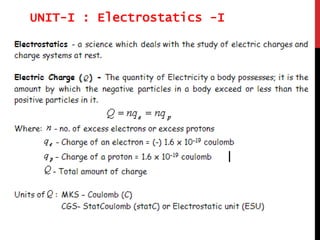
UNIT-I : Electrostatics -I
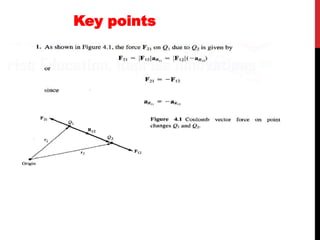
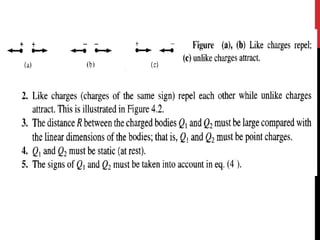
Key points
TWO ELECTRONS ARE PLACED 1M
APART.WHAT IS THE FORCE BETWEEN
THEM?
•Electric Fields have a magnitude and
direction
•Vector Quantities
•Lines go away from positive
•Lines go toward negative
Electric Field Intensity
Electric Fields due to Continuous
Charge Distributions
Electric Field Strength due to Infinite Line Charge
Electric Field Strength due to Surface Charge
Density
FIELD DUE TO VOLUME CHARGE DENSITY,
ELECTRIC
FLUX
SALIENT FEATURES OF
ELECTRIC FLUX
1. It is independent of the medium.
2. The electric field creates a force on a charge and hence the
charge moves along a certain path. This path is called the flux
line.
3. The force between two charges acts along a certain path. This
path is also called the flux line.
4. Magnitude of flux depends only on the charge from which it
originates.
5. The flux lines are equal to the charge in Coulombs.
6. Flux line is only an imaginary line.
7. Its direction is the same as that of the electric field.
ELECTRIC FLUX DENSITY
Problem: If an electric field in free space is given by E = ax +
2ay + 5az V/m,
find the electric flux density.
Problem 2.A point charge, Q = 10nC is at the origin in
free space. Find
the electric field at P (1, 0, 1). Also find the electric flux
density at P.
GAUSS LAW
Gauss’s law It states that the net flux passing through
any closed surface is equal to the charge enclosed by
that surface, that is,
Consider a spherical surface which encloses
a charge Q at its centre (Fig.)
GAUSS LAW IN POINT FORM
Gauss’s law in point form states that the divergence of electric flux
density is equal to the volume charge density, that is,
Emft

Emft

  • 1.
    ELECTROMAGNETIC FIELD THEORY BY: GSAMBASIVA RAO ASST.PROF/ECE DEPT.
  • 2.
    UNIT – I Electrostatics-I:Coulomb’s Law, Electric Field Intensity - Electric Fields due to Continuous Charge Distributions – Line Charge, Surface Charge, Volume Charge - Electric Flux Density - Gauss Law – Applications of Gauss Law – Point Charge, Infinite Line Charge, Infinite Sheet Charge - Electric Potential -Relations Between E and V. Syllabus UNIT – II Electrostatics-II: The nature of dielectric materials, boundary conditions for perfect dielectric materials. Capacitance, Several capacitance examples: Parallel Plate Capacitor, Capacitance of a Coaxial Cable, Spherical Capacitor. Derivations of Poisson’s and Laplace’s equations. Current and current density, Energy density, continuity of current. UNIT – III The Steady Magnetic Field: Biot-Savart’s Law, Ampere’s Circuital Law, Magnetic Flux and Magnetic Flux Density, The scalar and vector magnetic potentials. Magnetic Forces and Materials: Force on a moving charge, force on a differential current element, force between differential current elements, Magnetic Energy, the nature of magnetic materials, magnetization and permeability, magnetic boundary
  • 3.
    UNIT – IV TimeVarying Fields and Maxwell’s Equations: Faraday’s Law - Transformer and Motional EMFs –Stationary Loop in Time Varying B Field, Moving Loop in Static B Field, Moving Loop in Time VaryingField - Displacement Current – Maxwell’s Equations in Different Final Forms. UNIT – V Wave Equations: Waves equations for: a conducting medium, free space – Relation between E and H in a Uniform plane wave - Wave propagation: Lossless medium, Conducting medium, Good Dielectric, Good Conductor - Poynting Vector and Poynting theorm - Reflection of a Plane wave at Normal Incidence - Reflection of a Plane wave at Oblique. TEXTBOOKS: 1. Matthew N.O. Sadiku, Elements of Electromagnetics, Oxford University Press, 3rd edition, 2008. 2. William H. Hayt Jr. and John A. Buck, Engineering Electromagnetics, Tata McGraw-Hill publications,7th edition, 2006. 3. G S N Raju, Electromagnetic Field Theory and transmission lines, 1st Edition, Pearson Education India, 2005.
  • 4.
  • 7.
  • 10.
    TWO ELECTRONS AREPLACED 1M APART.WHAT IS THE FORCE BETWEEN THEM?
  • 13.
    •Electric Fields havea magnitude and direction •Vector Quantities •Lines go away from positive •Lines go toward negative
  • 16.
  • 18.
    Electric Fields dueto Continuous Charge Distributions
  • 20.
    Electric Field Strengthdue to Infinite Line Charge
  • 23.
    Electric Field Strengthdue to Surface Charge Density
  • 29.
    FIELD DUE TOVOLUME CHARGE DENSITY,
  • 32.
  • 33.
    SALIENT FEATURES OF ELECTRICFLUX 1. It is independent of the medium. 2. The electric field creates a force on a charge and hence the charge moves along a certain path. This path is called the flux line. 3. The force between two charges acts along a certain path. This path is also called the flux line. 4. Magnitude of flux depends only on the charge from which it originates. 5. The flux lines are equal to the charge in Coulombs. 6. Flux line is only an imaginary line. 7. Its direction is the same as that of the electric field.
  • 34.
  • 35.
    Problem: If anelectric field in free space is given by E = ax + 2ay + 5az V/m, find the electric flux density.
  • 36.
    Problem 2.A pointcharge, Q = 10nC is at the origin in free space. Find the electric field at P (1, 0, 1). Also find the electric flux density at P.
  • 40.
    GAUSS LAW Gauss’s lawIt states that the net flux passing through any closed surface is equal to the charge enclosed by that surface, that is, Consider a spherical surface which encloses a charge Q at its centre (Fig.)
  • 43.
    GAUSS LAW INPOINT FORM Gauss’s law in point form states that the divergence of electric flux density is equal to the volume charge density, that is,