This document summarizes a student project presentation on CE, CB, and CC transistor amplifiers. It includes introductions to diodes, transistors, and the three basic transistor amplifier configurations. For each amplifier type, it provides a brief description of the configuration and key features, along with experimental output waveforms. It also includes Protel circuit design diagrams and software simulations of the three amplifier circuits on Proteus. The project aims to explain the basic workings and characteristics of common emitter, common base, and common collector transistor amplifier circuits.
This slide introduces the project on CE, CB, and CC amplifiers, along with team member names and guide.
This slide outlines the main topics to be discussed, including Introduction, Diodes, Transistors, Amplifiers, and Software Diagrams.
This slide defines amplifiers as devices that increase signal power, voltage, or current, mentioning four types: voltage, current, transconductance, and transresistance.
This slide describes diodes as unidirectional semiconductor devices with exponential I-V characteristics, highlighting their manufacturing process.
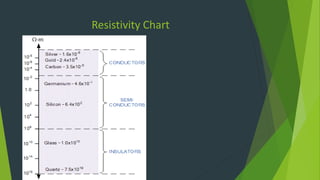
This slide presents a resistivity chart, although its content isn't detailed in the transcript.
The power supply converts 230V AC to 5V DC using a step-down transformer, bridge rectifier, smoothing circuit, and RPS.
This slide lists components: step-down transformer, rectifier, filter, and voltage regulator (7805) for stable voltage.
This slide explains a bridge rectifier's functionality to convert AC to DC using four or more diodes.
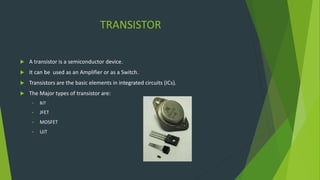
Transistors are semiconductor devices functioning as amplifiers or switches, key components in ICs, with types listed: BJT, JFET, MOSFET, UJT.
This slide describes bipolar junction transistors, their structure, and the three terminals: Emitter, Base, Collector.
It details the three configurations (Common Emitter, Common Base, and Common Collector) and operation regions of bipolar transistors.
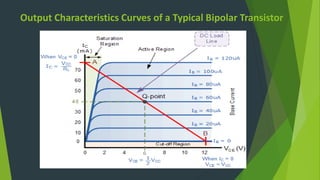
This slide features the output characteristics curves for a typical bipolar transistor.
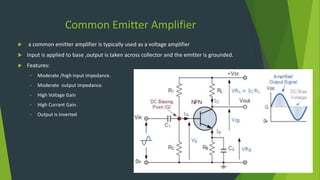
This slide describes the common emitter amplifier as a voltage amplifier with specific features like high voltage and current gain.
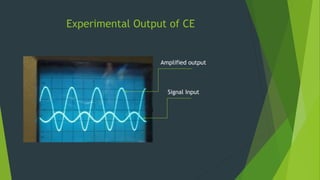
Experimental data showing plotted input and amplified output signals for the common emitter amplifier.
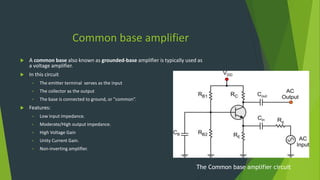
This slide outlines the common base amplifier's features, with details on input and output terminal configuration.
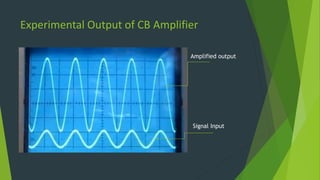
Experimental data showing input and amplified output signals for the common base amplifier.
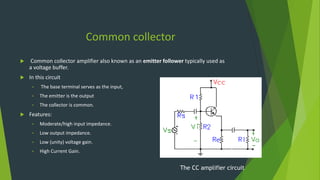
The common collector amplifier serves as a voltage buffer with features including low output impedance and high current gain.
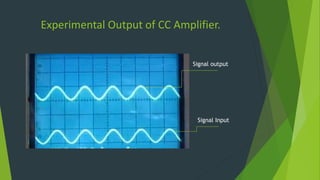
Experimental data showing input and output signals for the common collector amplifier.
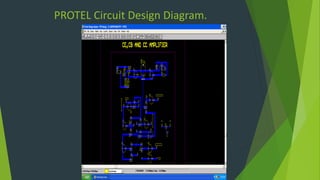
This slide presents a circuit design diagram created using PROTEL software.
Overview of software circuits designed using PROTEUS platform.
This slide focuses on configurations specific to the common emitter amplifier.
This slide focuses on configurations specific to the common base amplifier.
This slide focuses on configurations specific to the common collector amplifier.
Visual display or outline of the completed circuit board from the project.
Slide dedicated to thanking the audience for their attention.
MINI PROJECT PRESENTATIONON
CE, CB, CC AMPLIFIERS
Guide: Mr. S.Sravana Kumar
Asst. Professor
Adithya.R ………………..….11E31A0401[ECE-A IV Year]
A.Sindhu Reddy………….…11E31A0402[ECE-A IV Year]
Anirudh Kulkarni…………..11E31A0403[ECE-A IV Year]
A.Bhanuteja………………….11E31A0404[ECE-A IV Year]
B.Bharath Kumar Reddy…11E31A0405[ECE-A IV Year]
2.
CONTENTS
INTRODUCTION
DIODE
POWER SUPPLY
COMPONENTS OF POWER SUPPLY
TRANSISTOR
BIPOLAR TRANSISTOR
CE APMLIFIER
CB AMPLIFIER
CC AMPLIFIER
SOFTWARE DIAGRAMS
3.
INTRODUCTION
An amplifieris an electronic device that increases the voltage, current, or power of a
signal.
There are four basic types of electronic amplifier:
• Voltage amplifier
• Current amplifier
• Transconductance amplifier
• Transresistance amplifier
4.
Diode
Diodes arebasic unidirectional Semiconductor Devices.
It has an exponential I-V relationship.
Diodes are manufactured using Doping Technique
POWER SUPPLY
Themain aim of this power supply is to convert the 230V AC into 5V DC.
In this process we are using a step down transformer, a bridge rectifier, a smoothing
circuit and the RPS.
Functional block diagram
7.
Components in Powersupply
1.Step-down Transformer- To step down 230V A.C to 5V A.C .
2.Rectifier- used to convert A.C to pulsating D.C.
3.Filter- Converts Pulsating DC into Pure D.C.
4.Voltage Regulator-7805-used to supply a stable voltage.
8.
Bridge rectifier
Abridge rectifier is an arrangement of four or more diodes in a bridge circuit
configuration which provides the same output polarity for either input polarity.
It is used for converting an alternating current (AC) input into a direct current (DC)
output.
9.
TRANSISTOR
A transistoris a semiconductor device.
It can be used as an Amplifier or as a Switch.
Transistors are the basic elements in integrated circuits (ICs).
The Major types of transistor are:
• BJT
• JFET
• MOSFET
• UJT
10.
Bipolar Junction Transistor
Two junction, three terminal device formed by joining together two individual signal
diodes back-to-back.
The three terminals are known as
• The Emitter ( E )
• The Base ( B )
• The Collector ( C )
11.
Transistor hasThree basic configurations:
• Common Emitter Configuration – has both Current and Voltage Gain.
• Common Base Configuration – has Voltage Gain but no Current Gain.
• Common Collector Configuration – has Current Gain but no Voltage Gain.
Bipolar Transistors have the ability to operate within three different regions:
• Active Region – the transistor operates as an amplifier and Ic = β.Ib
• Saturation – the transistor is “Fully-ON” operating as a switch
• Cut-off – the transistor is “Fully-OFF” operating as a switch
Common Emitter Amplifier
a common emitter amplifier is typically used as a voltage amplifier
Input is applied to base ,output is taken across collector and the emitter is grounded.
Features:
• Moderate /high input impedance.
• Moderate output impedance.
• High Voltage Gain
• High Currant Gain.
• Output is Inverted
Common base amplifier
A common base also known as grounded-base amplifier is typically used as
a voltage amplifier.
In this circuit
• The emitter terminal serves as the input
• The collector as the output
• The base is connected to ground, or "common”.
Features:
• Low input impedance.
• Moderate/High output impedance.
• High Voltage Gain
• Unity Current Gain.
• Non-inverting amplifier.
The Common base amplifier circuit
Common collector
Commoncollector amplifier also known as an emitter follower typically used as
a voltage buffer.
In this circuit
• The base terminal serves as the input,
• The emitter is the output
• The collector is common.
Features:
• Moderate/high input impedance.
• Low output impedance.
• Low (unity) voltage gain.
• High Current Gain.
The CC amplifier circuit