POWER QUALITY
Presenting by:
G.Sowmya
DEFINITION
POWER QUALITY is defined as the ability
of a system or an equipment to function
satisfactorily in its electromagnetic
environment without introducing
intolerable electromagnetic disturbances
to anything in that environment.
PQ mainly deals with
1. Continuity of the supply.
2.”Quality” of the voltage.
SCOPE
 For economic operation of power systems
 Power system design
 Future growth
 For optimization and reliable operation
 To meet the growing needs for standardization
and performance criteria
Power Quality Events
 Voltage surges
 Voltage spikes
 Voltage sag
 Voltage swell
 Voltage fluctuations
&flickering
 Voltage unbalance
 Harmonic distortion
 Noise
 Short interruptions
 Long interruptions
VOLTAGE SURGES
It is a voltage rise that endangers the insulation of
electric equipment.
Causes:
• Shutdown of heavily loaded circuits.
• Switching events such as the connection or disconnection
of a current and short-circuiting to ground.
Effects:
• Computers and other sensitive electronic equipment can
seriously be damaged by such an over-voltage surge.
• Temporal fluctuations produce parity errors and interrupts
protection systems.
VOLTAGE SPIKES
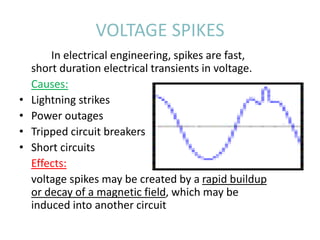
In electrical engineering, spikes are fast,
short duration electrical transients in voltage.
Causes:
• Lightning strikes
• Power outages
• Tripped circuit breakers
• Short circuits
Effects:
voltage spikes may be created by a rapid buildup
or decay of a magnetic field, which may be
induced into another circuit
VOLTAGE SAG (DIP)
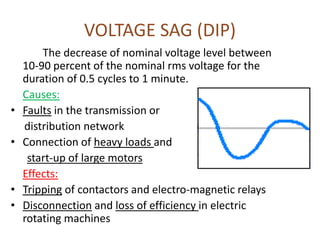
The decrease of nominal voltage level between
10-90 percent of the nominal rms voltage for the
duration of 0.5 cycles to 1 minute.
Causes:
• Faults in the transmission or
distribution network
• Connection of heavy loads and
start-up of large motors
Effects:
• Tripping of contactors and electro-magnetic relays
• Disconnection and loss of efficiency in electric
rotating machines
VOLTAGE SWELL
Momentary increase of the voltage, at the power
frequency, outside the normal tolerances, with the
duration of more than one cycle and typically less than
few seconds.
Causes:
Start/stop of heavy loads, badly dimensioned power
sources, badly regulated transformers (mainly during
off-peak hours).
Effects:
Data loss, flickering of lighting and screens, stoppage or
damage of sensitive equipment, if the voltage values
are too high.
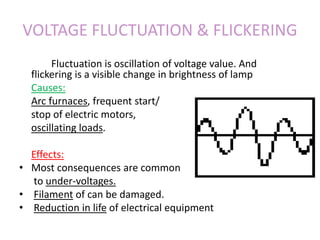
VOLTAGE FLUCTUATION & FLICKERING
Fluctuation is oscillation of voltage value. And
flickering is a visible change in brightness of lamp
Causes:
Arc furnaces, frequent start/
stop of electric motors,
oscillating loads.
Effects:
• Most consequences are common
to under-voltages.
• Filament of can be damaged.
• Reduction in life of electrical equipment
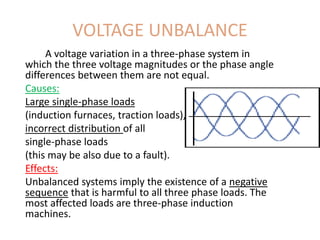
VOLTAGE UNBALANCE
A voltage variation in a three-phase system in
which the three voltage magnitudes or the phase angle
differences between them are not equal.
Causes:
Large single-phase loads
(induction furnaces, traction loads),
incorrect distribution of all
single-phase loads
(this may be also due to a fault).
Effects:
Unbalanced systems imply the existence of a negative
sequence that is harmful to all three phase loads. The
most affected loads are three-phase induction
machines.
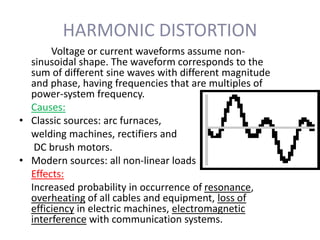
HARMONIC DISTORTION
Voltage or current waveforms assume non-
sinusoidal shape. The waveform corresponds to the
sum of different sine waves with different magnitude
and phase, having frequencies that are multiples of
power-system frequency.
Causes:
• Classic sources: arc furnaces,
welding machines, rectifiers and
DC brush motors.
• Modern sources: all non-linear loads
Effects:
Increased probability in occurrence of resonance,
overheating of all cables and equipment, loss of
efficiency in electric machines, electromagnetic
interference with communication systems.
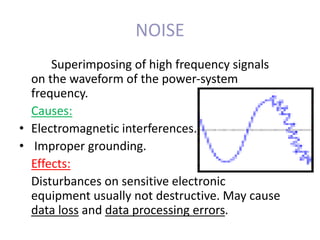
NOISE
Superimposing of high frequency signals
on the waveform of the power-system
frequency.
Causes:
• Electromagnetic interferences.
• Improper grounding.
Effects:
Disturbances on sensitive electronic
equipment usually not destructive. May cause
data loss and data processing errors.
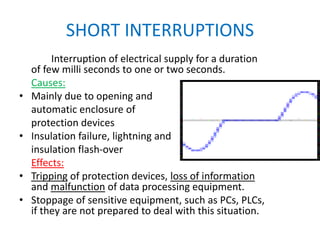
SHORT INTERRUPTIONS
Interruption of electrical supply for a duration
of few milli seconds to one or two seconds.
Causes:
• Mainly due to opening and
automatic enclosure of
protection devices
• Insulation failure, lightning and
insulation flash-over
Effects:
• Tripping of protection devices, loss of information
and malfunction of data processing equipment.
• Stoppage of sensitive equipment, such as PCs, PLCs,
if they are not prepared to deal with this situation.
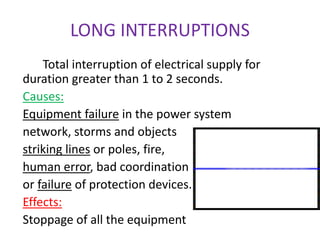
LONG INTERRUPTIONS
Total interruption of electrical supply for
duration greater than 1 to 2 seconds.
Causes:
Equipment failure in the power system
network, storms and objects
striking lines or poles, fire,
human error, bad coordination
or failure of protection devices.
Effects:
Stoppage of all the equipment
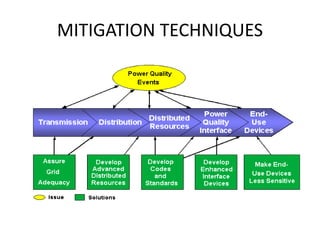
MITIGATION TECHNIQUES
MITIGATING DEVICES
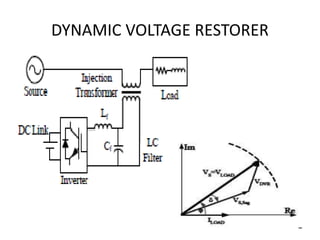
Dynamic voltage restorer
Distribution static compensators
Static VAR compensators
Harmonic filters
Noise filters
Transient voltage suppressors
Unified power quality conditioning
DYNAMIC VOLTAGE RESTORER
2
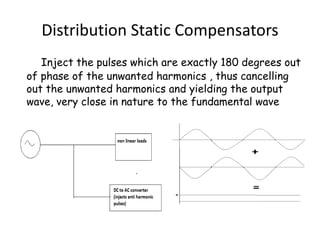
Distribution Static Compensators
Inject the pulses which are exactly 180 degrees out
of phase of the unwanted harmonics , thus cancelling
out the unwanted harmonics and yielding the output
wave, very close in nature to the fundamental wave
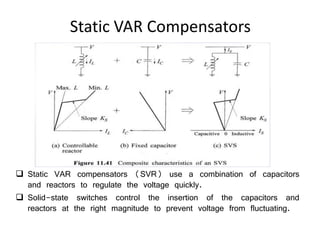
Static VAR Compensators
 Static VAR compensators (SVR) use a combination of capacitors
and reactors to regulate the voltage quickly.
 Solid-state switches control the insertion of the capacitors and
reactors at the right magnitude to prevent voltage from fluctuating.
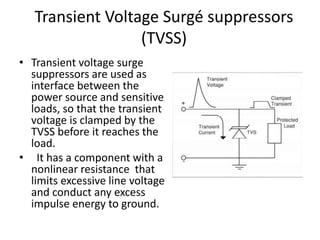
Transient Voltage Surgé suppressors
(TVSS)
• Transient voltage surge
suppressors are used as
interface between the
power source and sensitive
loads, so that the transient
voltage is clamped by the
TVSS before it reaches the
load.
• It has a component with a
nonlinear resistance that
limits excessive line voltage
and conduct any excess
impulse energy to ground.
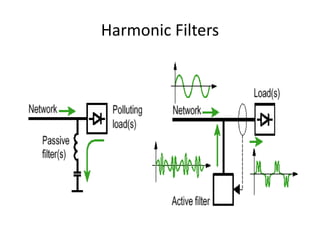
Harmonic Filters
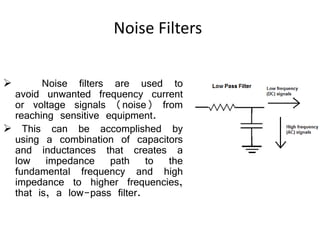
Noise Filters
 Noise filters are used to
avoid unwanted frequency current
or voltage signals (noise) from
reaching sensitive equipment.
 This can be accomplished by
using a combination of capacitors
and inductances that creates a
low impedance path to the
fundamental frequency and high
impedance to higher frequencies,
that is, a low-pass filter.
Unified Power Quality Conditioning
• It is the combination of DVR and DSTATCOM
•Shunt active filters eliminate the harmonics,
•Series active filters allow the passage of only the
fundamental wave.
IMPACT ON SOCIETY AND ENVIRONMENT
 The mitigation of all the power quality related issues leads
to the economic operation of the power system.
 A technically sound quality of power will be supplied to the
equipments, thereby leading to their smooth operation and
ensuring a long life for them.
 The elimination of harmonics and other issues leads to the
proper operation of the system, thereby eliminating the
unwanted vibrations and keeping the system stable.
 The reactive power is compensated at an acceptable and
affordable cost and thus, the system efficiency improves.
 The power factor is improved; this leads to a heavy savage
in the costs of electricity bills.
Above all, the problem of power pollution is eliminated.
Conclusion
• POWERQUALITY maintenanceis an important aspect for
theeconomic operation of a system.
• So, Proper mitigationdevices can be used to maintainthe
level of power quality as desired.

Power quality

  • 1.
  • 2.
    DEFINITION POWER QUALITY isdefined as the ability of a system or an equipment to function satisfactorily in its electromagnetic environment without introducing intolerable electromagnetic disturbances to anything in that environment. PQ mainly deals with 1. Continuity of the supply. 2.”Quality” of the voltage.
  • 3.
    SCOPE  For economicoperation of power systems  Power system design  Future growth  For optimization and reliable operation  To meet the growing needs for standardization and performance criteria
  • 4.
    Power Quality Events Voltage surges  Voltage spikes  Voltage sag  Voltage swell  Voltage fluctuations &flickering  Voltage unbalance  Harmonic distortion  Noise  Short interruptions  Long interruptions
  • 5.
    VOLTAGE SURGES It isa voltage rise that endangers the insulation of electric equipment. Causes: • Shutdown of heavily loaded circuits. • Switching events such as the connection or disconnection of a current and short-circuiting to ground. Effects: • Computers and other sensitive electronic equipment can seriously be damaged by such an over-voltage surge. • Temporal fluctuations produce parity errors and interrupts protection systems.
  • 6.
    VOLTAGE SPIKES In electricalengineering, spikes are fast, short duration electrical transients in voltage. Causes: • Lightning strikes • Power outages • Tripped circuit breakers • Short circuits Effects: voltage spikes may be created by a rapid buildup or decay of a magnetic field, which may be induced into another circuit
  • 7.
    VOLTAGE SAG (DIP) Thedecrease of nominal voltage level between 10-90 percent of the nominal rms voltage for the duration of 0.5 cycles to 1 minute. Causes: • Faults in the transmission or distribution network • Connection of heavy loads and start-up of large motors Effects: • Tripping of contactors and electro-magnetic relays • Disconnection and loss of efficiency in electric rotating machines
  • 8.
    VOLTAGE SWELL Momentary increaseof the voltage, at the power frequency, outside the normal tolerances, with the duration of more than one cycle and typically less than few seconds. Causes: Start/stop of heavy loads, badly dimensioned power sources, badly regulated transformers (mainly during off-peak hours). Effects: Data loss, flickering of lighting and screens, stoppage or damage of sensitive equipment, if the voltage values are too high.
  • 9.
    VOLTAGE FLUCTUATION &FLICKERING Fluctuation is oscillation of voltage value. And flickering is a visible change in brightness of lamp Causes: Arc furnaces, frequent start/ stop of electric motors, oscillating loads. Effects: • Most consequences are common to under-voltages. • Filament of can be damaged. • Reduction in life of electrical equipment
  • 10.
    VOLTAGE UNBALANCE A voltagevariation in a three-phase system in which the three voltage magnitudes or the phase angle differences between them are not equal. Causes: Large single-phase loads (induction furnaces, traction loads), incorrect distribution of all single-phase loads (this may be also due to a fault). Effects: Unbalanced systems imply the existence of a negative sequence that is harmful to all three phase loads. The most affected loads are three-phase induction machines.
  • 11.
    HARMONIC DISTORTION Voltage orcurrent waveforms assume non- sinusoidal shape. The waveform corresponds to the sum of different sine waves with different magnitude and phase, having frequencies that are multiples of power-system frequency. Causes: • Classic sources: arc furnaces, welding machines, rectifiers and DC brush motors. • Modern sources: all non-linear loads Effects: Increased probability in occurrence of resonance, overheating of all cables and equipment, loss of efficiency in electric machines, electromagnetic interference with communication systems.
  • 12.
    NOISE Superimposing of highfrequency signals on the waveform of the power-system frequency. Causes: • Electromagnetic interferences. • Improper grounding. Effects: Disturbances on sensitive electronic equipment usually not destructive. May cause data loss and data processing errors.
  • 13.
    SHORT INTERRUPTIONS Interruption ofelectrical supply for a duration of few milli seconds to one or two seconds. Causes: • Mainly due to opening and automatic enclosure of protection devices • Insulation failure, lightning and insulation flash-over Effects: • Tripping of protection devices, loss of information and malfunction of data processing equipment. • Stoppage of sensitive equipment, such as PCs, PLCs, if they are not prepared to deal with this situation.
  • 14.
    LONG INTERRUPTIONS Total interruptionof electrical supply for duration greater than 1 to 2 seconds. Causes: Equipment failure in the power system network, storms and objects striking lines or poles, fire, human error, bad coordination or failure of protection devices. Effects: Stoppage of all the equipment
  • 15.
  • 16.
    MITIGATING DEVICES Dynamic voltagerestorer Distribution static compensators Static VAR compensators Harmonic filters Noise filters Transient voltage suppressors Unified power quality conditioning
  • 17.
  • 18.
    Distribution Static Compensators Injectthe pulses which are exactly 180 degrees out of phase of the unwanted harmonics , thus cancelling out the unwanted harmonics and yielding the output wave, very close in nature to the fundamental wave
  • 19.
    Static VAR Compensators Static VAR compensators (SVR) use a combination of capacitors and reactors to regulate the voltage quickly.  Solid-state switches control the insertion of the capacitors and reactors at the right magnitude to prevent voltage from fluctuating.
  • 20.
    Transient Voltage Surgésuppressors (TVSS) • Transient voltage surge suppressors are used as interface between the power source and sensitive loads, so that the transient voltage is clamped by the TVSS before it reaches the load. • It has a component with a nonlinear resistance that limits excessive line voltage and conduct any excess impulse energy to ground.
  • 21.
  • 22.
    Noise Filters  Noisefilters are used to avoid unwanted frequency current or voltage signals (noise) from reaching sensitive equipment.  This can be accomplished by using a combination of capacitors and inductances that creates a low impedance path to the fundamental frequency and high impedance to higher frequencies, that is, a low-pass filter.
  • 23.
    Unified Power QualityConditioning • It is the combination of DVR and DSTATCOM •Shunt active filters eliminate the harmonics, •Series active filters allow the passage of only the fundamental wave.
  • 24.
    IMPACT ON SOCIETYAND ENVIRONMENT  The mitigation of all the power quality related issues leads to the economic operation of the power system.  A technically sound quality of power will be supplied to the equipments, thereby leading to their smooth operation and ensuring a long life for them.  The elimination of harmonics and other issues leads to the proper operation of the system, thereby eliminating the unwanted vibrations and keeping the system stable.  The reactive power is compensated at an acceptable and affordable cost and thus, the system efficiency improves.  The power factor is improved; this leads to a heavy savage in the costs of electricity bills. Above all, the problem of power pollution is eliminated.
  • 25.
    Conclusion • POWERQUALITY maintenanceisan important aspect for theeconomic operation of a system. • So, Proper mitigationdevices can be used to maintainthe level of power quality as desired.