Defining and Measuring Poverty 
• Absolute Poverty 
• Relative Poverty 
• Multi-Dimensional Poverty Index
Defining Poverty 
“Fundamentally, poverty is a denial of choices and opportunities, a violation of 
human dignity. It means lack of basic capacity to participate effectively in 
society. It means not having enough to feed and cloth a family, not having a 
school or clinic to go to, not having the land on which to grow one’s food or a 
job to earn one’s living, not having access to credit. It means insecurity, 
powerlessness and exclusion of individuals, households and communities. It 
means susceptibility to violence, and it often implies living on marginal or fragile 
environments, without access to clean water or sanitation” 
(UN Statement, June 1998 – signed by the heads of all UN agencies)
Have a think about that definition: 
Q1. Which countries in the world have no poverty 
whatsoever by this definition?
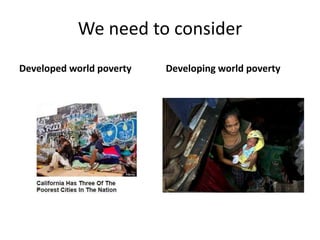
We need to consider 
Developed world poverty Developing world poverty
Two ways to think about poverty 
Absolute Poverty 
Absolute poverty refers to a set 
standard which is consistent over 
time and between countries. 
Relative Poverty 
Relative poverty views poverty as 
socially defined and dependent 
on social context, hence relative 
poverty is a measure of income 
inequality. Usually, relative 
poverty is measured as the 
percentage of population with 
income less than some fixed 
proportion of median income.
Poverty is……. 
A very complicated 
phenomenon that is inherently 
problematic to measure
Defining Absolute Poverty 
World Summit on Social Development in 
Copenhagen in 1995, 
Absolute poverty was defined as 
"a condition characterized by severe deprivation 
of basic human needs, including food, safe 
drinking water, sanitation facilities, health, 
shelter, education and information. It depends not 
only on income but also on access to services."
Measuring Absolute Poverty 
Absolute poverty is often measured in very simplistic ways (such as the number of 
people living on less than $2 a day) in order to allow easy comparisons between 
countries and to see trends over time. However such measurements are of little practical use in 
MEDC countries and do not measure absolute poverty as defined by World Summit on Social 
Development on the previous slide. 
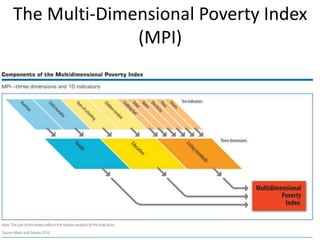
In an attempt to develop a more robust and relevant measure of absolute poverty the UN 
created the Multi Dimensional Poverty Index in 2010. 
This measurement of poverty is in principal far superior to less sophisticated measures but 
seriously handicapped by a lack of data
The Multi-Dimensional Poverty Index 
(MPI)
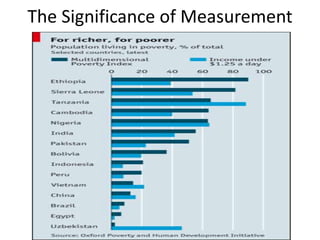
The Significance of Measurement
The Significance of Measurement 
Poor places can have less poverty and rich places can have more 
poverty 
Poverty and marginalization are products of both economic 
and societal factors
Summary 
• Marginalization is the process of being relegated to an unimportant or 
powerless position within society or a group. 
• This is effectively relegating them to the periphery of society 
• People in poverty are marginalized 
• Poverty is hard to define and even harder to measure 
• Nations are probably less inclined to measure poverty than 
development 
• Every country in the world has people in poverty.

Poverty and marginalization

  • 1.
    Defining and MeasuringPoverty • Absolute Poverty • Relative Poverty • Multi-Dimensional Poverty Index
  • 2.
    Defining Poverty “Fundamentally,poverty is a denial of choices and opportunities, a violation of human dignity. It means lack of basic capacity to participate effectively in society. It means not having enough to feed and cloth a family, not having a school or clinic to go to, not having the land on which to grow one’s food or a job to earn one’s living, not having access to credit. It means insecurity, powerlessness and exclusion of individuals, households and communities. It means susceptibility to violence, and it often implies living on marginal or fragile environments, without access to clean water or sanitation” (UN Statement, June 1998 – signed by the heads of all UN agencies)
  • 3.
    Have a thinkabout that definition: Q1. Which countries in the world have no poverty whatsoever by this definition?
  • 4.
    We need toconsider Developed world poverty Developing world poverty
  • 5.
    Two ways tothink about poverty Absolute Poverty Absolute poverty refers to a set standard which is consistent over time and between countries. Relative Poverty Relative poverty views poverty as socially defined and dependent on social context, hence relative poverty is a measure of income inequality. Usually, relative poverty is measured as the percentage of population with income less than some fixed proportion of median income.
  • 6.
    Poverty is……. Avery complicated phenomenon that is inherently problematic to measure
  • 7.
    Defining Absolute Poverty World Summit on Social Development in Copenhagen in 1995, Absolute poverty was defined as "a condition characterized by severe deprivation of basic human needs, including food, safe drinking water, sanitation facilities, health, shelter, education and information. It depends not only on income but also on access to services."
  • 8.
    Measuring Absolute Poverty Absolute poverty is often measured in very simplistic ways (such as the number of people living on less than $2 a day) in order to allow easy comparisons between countries and to see trends over time. However such measurements are of little practical use in MEDC countries and do not measure absolute poverty as defined by World Summit on Social Development on the previous slide. In an attempt to develop a more robust and relevant measure of absolute poverty the UN created the Multi Dimensional Poverty Index in 2010. This measurement of poverty is in principal far superior to less sophisticated measures but seriously handicapped by a lack of data
  • 9.
  • 10.
  • 11.
    The Significance ofMeasurement Poor places can have less poverty and rich places can have more poverty Poverty and marginalization are products of both economic and societal factors
  • 12.
    Summary • Marginalizationis the process of being relegated to an unimportant or powerless position within society or a group. • This is effectively relegating them to the periphery of society • People in poverty are marginalized • Poverty is hard to define and even harder to measure • Nations are probably less inclined to measure poverty than development • Every country in the world has people in poverty.