Defining and Measuring Poverty

          • Absolute Poverty
           • Relative Poverty
       • Human Poverty Index
    • Multi-Dimensional Poverty Index
Defining Poverty
“Fundamentally, poverty is a denial of choices and opportunities, a violation of

human dignity. It means lack of basic capacity to participate effectively in

society. It means not having enough to feed and cloth a family, not having a

school or clinic to go to, not having the land on which to grow one’s food or a

job to earn one’s living, not having access to credit. It means insecurity,

powerlessness and exclusion of individuals, households and communities. It

means susceptibility to violence, and it often implies living on marginal or fragile

environments, without access to clean water or sanitation”


(UN Statement, June 1998 – signed by the heads of all UN agencies)
Have a think about that definition:


Q1. Which countries in the world have no poverty
whatsoever by this definition?
We need to consider
Developed world poverty   Developing world poverty
Two ways to think about poverty
Absolute Poverty                    Relative Poverty
Absolute poverty refers to a set    Relative poverty views poverty as
standard which is consistent over   socially defined and dependent
time and between countries.         on social context, hence relative
                                    poverty is a measure of income
                                    inequality. Usually, relative
                                    poverty is measured as the
                                    percentage of population with
                                    income less than some fixed
                                    proportion of median income.
Poverty is…….

A very complicated
phenomenon that is inherently
problematic to measure
Defining Absolute Poverty
Absolute poverty was defined as


"a condition characterized by severe deprivation
of basic human needs, including food, safe
drinking water, sanitation facilities, health,
shelter, education and information. It depends not
only on income but also on access to services."


                                  World Summit on Social Development in
                                  Copenhagen in 1995,
Measuring Absolute/Relative? Poverty
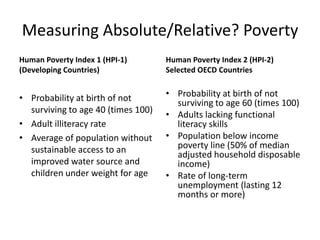
Human Poverty Index 1 (HPI-1)       Human Poverty Index 2 (HPI-2)
(Developing Countries)              Selected OECD Countries


• Probability at birth of not       • Probability at birth of not
                                      surviving to age 60 (times 100)
  surviving to age 40 (times 100)
                                    • Adults lacking functional
• Adult illiteracy rate               literacy skills
• Average of population without     • Population below income
  sustainable access to an            poverty line (50% of median
                                      adjusted household disposable
  improved water source and           income)
  children under weight for age     • Rate of long-term
                                      unemployment (lasting 12
                                      months or more)
And so………


‘The UN is attempting to create absolute measures of poverty in the developed world context
and in the developing world context.’


This is, of course, relativism but it does set out absolute measures that can be used for a basis
of comparison.
HPI-2 UK
The HPI-2 ranks 22 OECD (high levels of development )
countries
HPI-2 South Korea


Q2. Is there no poverty in South Korea or no data?

Q3. If either question is true how can we explain this?
HPI-1 China, DRC and South Africa
Q4. Input this data into Excel and create an appropriate chart to display it


China


DRC

South
Africa
The HPI was dropped by the UN as a
         measure of poverty in 2010

Q5. What reasons do you think the UN had for dropping the HPI?


Q6. How would you replace the HPI?
The Multi-Dimensional Poverty Index
              (MPI)
The Multi-Dimensional Poverty Index
                 (MPI)


Q6. In what ways do you think this measure is:

a) Better than the HPI?

b) Worse than the HPI?
The Multi-Dimensional Poverty Index
                    (MPI)


Q7. Present this data in a more meaningful way and then describe what it shows.
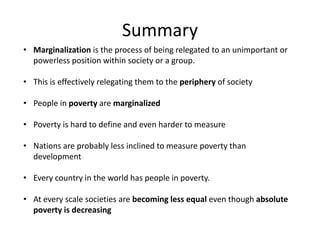
Summary
• Marginalization is the process of being relegated to an unimportant or
  powerless position within society or a group.

• This is effectively relegating them to the periphery of society

• People in poverty are marginalized

• Poverty is hard to define and even harder to measure

• Nations are probably less inclined to measure poverty than
  development

• Every country in the world has people in poverty.

• At every scale societies are becoming less equal even though absolute
  poverty is decreasing

Defining and measuring poverty

  • 1.
    Defining and MeasuringPoverty • Absolute Poverty • Relative Poverty • Human Poverty Index • Multi-Dimensional Poverty Index
  • 2.
    Defining Poverty “Fundamentally, povertyis a denial of choices and opportunities, a violation of human dignity. It means lack of basic capacity to participate effectively in society. It means not having enough to feed and cloth a family, not having a school or clinic to go to, not having the land on which to grow one’s food or a job to earn one’s living, not having access to credit. It means insecurity, powerlessness and exclusion of individuals, households and communities. It means susceptibility to violence, and it often implies living on marginal or fragile environments, without access to clean water or sanitation” (UN Statement, June 1998 – signed by the heads of all UN agencies)
  • 3.
    Have a thinkabout that definition: Q1. Which countries in the world have no poverty whatsoever by this definition?
  • 4.
    We need toconsider Developed world poverty Developing world poverty
  • 5.
    Two ways tothink about poverty Absolute Poverty Relative Poverty Absolute poverty refers to a set Relative poverty views poverty as standard which is consistent over socially defined and dependent time and between countries. on social context, hence relative poverty is a measure of income inequality. Usually, relative poverty is measured as the percentage of population with income less than some fixed proportion of median income.
  • 6.
    Poverty is……. A verycomplicated phenomenon that is inherently problematic to measure
  • 7.
    Defining Absolute Poverty Absolutepoverty was defined as "a condition characterized by severe deprivation of basic human needs, including food, safe drinking water, sanitation facilities, health, shelter, education and information. It depends not only on income but also on access to services." World Summit on Social Development in Copenhagen in 1995,
  • 8.
    Measuring Absolute/Relative? Poverty HumanPoverty Index 1 (HPI-1) Human Poverty Index 2 (HPI-2) (Developing Countries) Selected OECD Countries • Probability at birth of not • Probability at birth of not surviving to age 60 (times 100) surviving to age 40 (times 100) • Adults lacking functional • Adult illiteracy rate literacy skills • Average of population without • Population below income sustainable access to an poverty line (50% of median adjusted household disposable improved water source and income) children under weight for age • Rate of long-term unemployment (lasting 12 months or more)
  • 9.
    And so……… ‘The UNis attempting to create absolute measures of poverty in the developed world context and in the developing world context.’ This is, of course, relativism but it does set out absolute measures that can be used for a basis of comparison.
  • 10.
    HPI-2 UK The HPI-2ranks 22 OECD (high levels of development ) countries
  • 11.
    HPI-2 South Korea Q2.Is there no poverty in South Korea or no data? Q3. If either question is true how can we explain this?
  • 12.
    HPI-1 China, DRCand South Africa Q4. Input this data into Excel and create an appropriate chart to display it China DRC South Africa
  • 13.
    The HPI wasdropped by the UN as a measure of poverty in 2010 Q5. What reasons do you think the UN had for dropping the HPI? Q6. How would you replace the HPI?
  • 14.
  • 15.
    The Multi-Dimensional PovertyIndex (MPI) Q6. In what ways do you think this measure is: a) Better than the HPI? b) Worse than the HPI?
  • 16.
    The Multi-Dimensional PovertyIndex (MPI) Q7. Present this data in a more meaningful way and then describe what it shows.
  • 17.
    Summary • Marginalization isthe process of being relegated to an unimportant or powerless position within society or a group. • This is effectively relegating them to the periphery of society • People in poverty are marginalized • Poverty is hard to define and even harder to measure • Nations are probably less inclined to measure poverty than development • Every country in the world has people in poverty. • At every scale societies are becoming less equal even though absolute poverty is decreasing