TOPIC:
Prof. S.C. Das
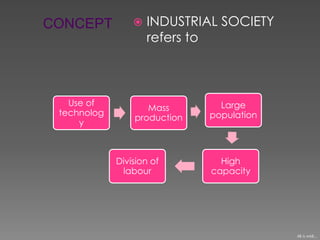
CONCEPT  INDUSTRIAL SOCIETY
refers to
Use of
technolog
y
Mass
production
Large
population
High
capacity
Division of
labour
All is well...
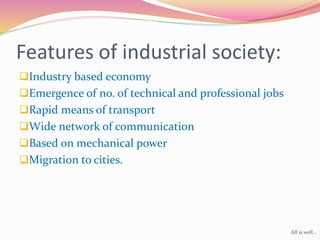
Features of industrial society:
Industry based economy
Emergence of no. of technical and professional jobs
Rapid means of transport
Wide network of communication
Based on mechanical power
Migration to cities.
All is well...
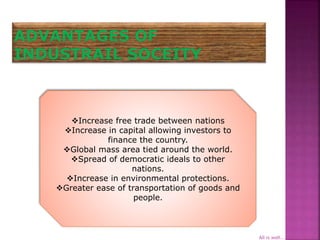
Increase free trade between nations
Increase in capital allowing investors to
finance the country.
Global mass area tied around the world.
Spread of democratic ideals to other
nations.
Increase in environmental protections.
Greater ease of transportation of goods and
people.
All is well...
 Norms and values take a backseat.
 Turns human being into alienated beings.
 Social distance between the people within a
society and diminishing impact on the
primary relation.
 Increase in problem of unemployment.
 Increase gap between poor and rich people
will lead to social inequalities.
 Will effect the relation between the people
within the society.
All is well...
•Less high powered machinery
•Limited production
•Less variation of social classes
•Complexity of surplus production
FEATURES OF PRE-
INDUSTRIAL SOCIETY
All is well...
 Pre- industrial lifestyle worked with the
resources of the earth and within the
bounds of natural ecosystem.
 No desire to over use earth resource and
nature coula recover from the
environmental impact of mankind’s
economic activities unaided.
All is well...
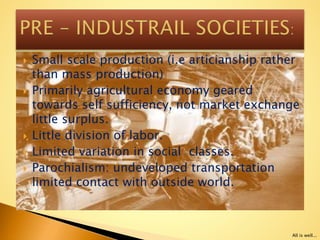
 Small scale production (i.e articianship rather
than mass production)
 Primarily agricultural economy geared
towards self sufficiency, not market exchange
little surplus.
 Little division of labor.
 Limited variation in social classes.
 Parochialism: undeveloped transportation
limited contact with outside world.
All is well...
 Demography
 Production
 Commerce
 Capital
 Redistribution of health
 Culture ,ethics , and moral value
All is well...
A POST INDUSTRIAL SOCEITY IS BASICALLY A INFORMATION SOCEITY
DANEIL BELL
All is well...
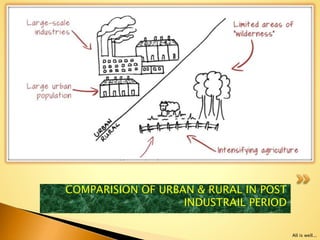
COMPARISION OF URBAN & RURAL IN POST
INDUSTRAIL PERIOD
All is well...
POST INDUSTRIALSOCIETY
 The post-industrial societyis the stage
of society's development when the service sector generates
more wealth than the manufacturing sector of the economy.
All is well...
People work with other people to deliver a service
Transformation of working class to professional
middle class
Emergence of knowledge elites
Growth of multiple networks
Divide in society
Majority sell labour at cheap rates Post-industrial
turn
 Towards social and economic polarization:
Knowledge and information
All is well...
POST INDUSTRIAL SOCIETY
Change happened with industrial revolution
Organic solidarity- social interdependence
based on a web of specialized roles.
These specialized roles makes members of
society rely on each other foe goods and
services.
All is well...
All is well...
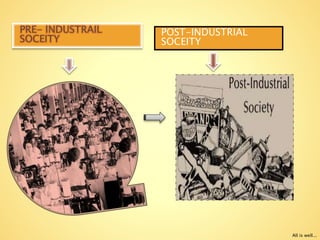
PRE- INDUSTRAIL
SOCEITY
POST-INDUSTRIAL
SOCEITY
All is well...
EFFECTS OF INDUSTRIAL
REVOLUTION ON SOCIETY
 It led to globalization and world economic connectivity.
 It led to the massive rise of the corporation.
 It led to the rise of unions and collective bargaining.
 It led to government oversight and the creation of such
traditions as the 40-hour work week, safe working conditions,
and the idea of benefits.
 It led to worldwide pollution, all sorts of related diseases
(especially cancer), and global warming
 It led to an exponential rise in human technology.
All is well...
CONCLUSION:
 Industrial societies are characterized by the
emergence of industrialization as the primary
means of labor, business, and commerce.
 Industrial societies differ markedly from
agricultural societies, wherein members are
primarily involved in plant cultivation for their
own subsistence.
 With improved technology, labor in industrial
societies has become more specialized. In
addition, better working conditions and higher
wages have resulted in improved standards of
living for highly skilled or educated workers.
All is well...
o Rise of industrial societies.
oSpread of industrialization.
oIncrease in manufacturing capabilities
oUrbanization
oSocial organization
oChanges in family life
oIncreased opportunities for women
oChild labour
All is well...
ACKNOWLEDMENT
We are fortunate to have the
opportunity to prepare our
presentation entitled “INDUSTRIAL
SOCIETY” under the guidance of our
learned teacher Prof. S.C. Das having
a long experience in the field of
OB&HR .
We are grateful to Prof. S . C. Das for
providing moral support,
encouragement, kind cooperation and
suggestions during the preparation of
the entire talk. All is well...
https://answers.yahoo.com/question/index?qid=20110
330075552AAbJNYf
http://en.wikipedia.org/wiki/Industrial_society
http://web.econ.unito.it/allio/cap/cap1.htm
http://www.preservearticles.com/201107058902
http://www.answers.com/
All is well...
All is well...

industrial society

  • 1.
  • 2.
    CONCEPT  INDUSTRIALSOCIETY refers to Use of technolog y Mass production Large population High capacity Division of labour All is well...
  • 3.
    Features of industrialsociety: Industry based economy Emergence of no. of technical and professional jobs Rapid means of transport Wide network of communication Based on mechanical power Migration to cities. All is well...
  • 4.
    Increase free tradebetween nations Increase in capital allowing investors to finance the country. Global mass area tied around the world. Spread of democratic ideals to other nations. Increase in environmental protections. Greater ease of transportation of goods and people. All is well...
  • 5.
     Norms andvalues take a backseat.  Turns human being into alienated beings.  Social distance between the people within a society and diminishing impact on the primary relation.  Increase in problem of unemployment.  Increase gap between poor and rich people will lead to social inequalities.  Will effect the relation between the people within the society. All is well...
  • 6.
    •Less high poweredmachinery •Limited production •Less variation of social classes •Complexity of surplus production FEATURES OF PRE- INDUSTRIAL SOCIETY All is well...
  • 7.
     Pre- industriallifestyle worked with the resources of the earth and within the bounds of natural ecosystem.  No desire to over use earth resource and nature coula recover from the environmental impact of mankind’s economic activities unaided. All is well...
  • 8.
     Small scaleproduction (i.e articianship rather than mass production)  Primarily agricultural economy geared towards self sufficiency, not market exchange little surplus.  Little division of labor.  Limited variation in social classes.  Parochialism: undeveloped transportation limited contact with outside world. All is well...
  • 9.
     Demography  Production Commerce  Capital  Redistribution of health  Culture ,ethics , and moral value All is well...
  • 10.
    A POST INDUSTRIALSOCEITY IS BASICALLY A INFORMATION SOCEITY DANEIL BELL All is well...
  • 11.
    COMPARISION OF URBAN& RURAL IN POST INDUSTRAIL PERIOD All is well...
  • 12.
    POST INDUSTRIALSOCIETY  Thepost-industrial societyis the stage of society's development when the service sector generates more wealth than the manufacturing sector of the economy. All is well...
  • 13.
    People work withother people to deliver a service Transformation of working class to professional middle class Emergence of knowledge elites Growth of multiple networks Divide in society Majority sell labour at cheap rates Post-industrial turn  Towards social and economic polarization: Knowledge and information All is well...
  • 14.
    POST INDUSTRIAL SOCIETY Changehappened with industrial revolution Organic solidarity- social interdependence based on a web of specialized roles. These specialized roles makes members of society rely on each other foe goods and services. All is well...
  • 15.
  • 16.
  • 17.
    EFFECTS OF INDUSTRIAL REVOLUTIONON SOCIETY  It led to globalization and world economic connectivity.  It led to the massive rise of the corporation.  It led to the rise of unions and collective bargaining.  It led to government oversight and the creation of such traditions as the 40-hour work week, safe working conditions, and the idea of benefits.  It led to worldwide pollution, all sorts of related diseases (especially cancer), and global warming  It led to an exponential rise in human technology. All is well...
  • 18.
    CONCLUSION:  Industrial societiesare characterized by the emergence of industrialization as the primary means of labor, business, and commerce.  Industrial societies differ markedly from agricultural societies, wherein members are primarily involved in plant cultivation for their own subsistence.  With improved technology, labor in industrial societies has become more specialized. In addition, better working conditions and higher wages have resulted in improved standards of living for highly skilled or educated workers. All is well...
  • 19.
    o Rise ofindustrial societies. oSpread of industrialization. oIncrease in manufacturing capabilities oUrbanization oSocial organization oChanges in family life oIncreased opportunities for women oChild labour All is well...
  • 20.
    ACKNOWLEDMENT We are fortunateto have the opportunity to prepare our presentation entitled “INDUSTRIAL SOCIETY” under the guidance of our learned teacher Prof. S.C. Das having a long experience in the field of OB&HR . We are grateful to Prof. S . C. Das for providing moral support, encouragement, kind cooperation and suggestions during the preparation of the entire talk. All is well...
  • 21.
  • 22.

Editor's Notes