Poverty & Underdevelopment: Edwin B. R.Gbargaye Graduate Student, MDM Presented to a MDM Forum
What is poverty? The  shortage of common things  such as food, clothing, shelter and safe drinking water, all of which determine the quality of life.  It may also include the  lack of access to opportunities  such as education and employment which aid the escape from poverty It could be  lack of choice :  “Beggars cannot be choosers.”
What is poverty? It could also mean  deprivation : According to Mollie Orshansky who developed the poverty measurements used by the U.S. government,  "to be poor is to be  deprived  of those goods and services and pleasures which others around us take for granted.“ It could mean  social exclusion : process through w/c individuals or groups are wholly or partially excluded from full participation in the society in w/c they live.
What is poverty? Or if David Korten is to be believed, poverty also involves  social disintegration  and  environmental degradation ,  which he describes as forming the  threefold human crisis  in the world today.
Caveat: The definition of poverty may differ relative to the norms of each particular society “ The poor of different times & places differ between themselves in virtually every aspect of their conditions, just like the societies of w/c they are part. Who is cast in this way depends not on how the poor live, but on the way society as whole lives .”     — Bauman 1999
The World Bank's "Voices of the Poor," based on research with over 20,000 poor people in 23 countries, identifies a range of factors which poor people identify as part of poverty. These include: Precarious livelihoods  Excluded locations  Physical limitations  Gender relationships  Problems in social relationships Lack of security  Abuse by those in power  Dis-empowering institutions  Limited capabilities  Weak community organizations
What is poverty? Not only income, but also entitlements (related to human rights & as asserted by Amartya Sen) Social exclusion Multi-dimensional aspects of poverty
Who are the poor? Republic Act No. 8425 -  Social Reform and Poverty Alleviation Act,  passed by Congress in December 1997: The  poor  refers to individuals and families whose incomes fall below the official poverty threshold as defined by the government and/or cannot afford to provide in a sustained manner for their minimum basic needs for food, health, education, housing, and other social amenities of life.
Causes of Poverty: Economic Historical factors—colonialism & neo-colonialism; post-communism (political economy) Economic inequality/socio-economic stratification Recession Shock to food prices
Causes of Poverty: Governance Lack of democracy Governance incompetence & corruption Weak rule of law Lack of peace & order
Contributory Factors Overpopulation Educational attainment & employable skills Brain drain Cultural causes: pre-scientific beliefs Social discrimination: gender, caste, race/ethnicity, age, disability, religious/political beliefs Matthew Effect
The Matthew Effect It describes the phenomenon that  "the rich get richer and the poor get poorer".  Those who possess power and economic or social capital can leverage those resources to gain more power or capital.  The Matthew effect results in a power law distribution of resources. The term was first coined by sociologist Robert K. Merton and takes its name from a line in the biblical Gospel of Matthew: “ For to all those who have, more will be given, and they will have an abundance; but from those who have nothing, even what they have will be taken away.” — Matthew 25:29, New Revised Standard Version. Phenomenon that the middle classes tend to be the main beneficiaries of social benefits and services, even if these are primarily targeted at the poor.
Environmental factors Erosion Desertification & overgrazing Deforestation Geographic & natural resource factors Drought & water crisis Climate change
Effects of poverty The effects of poverty may also be causes, thus creating a  "poverty cycle"  operating across multiple levels, individual, household, local, national and global  "set of factors or events by which poverty, once started, is likely to continue unless there is outside intervention."  Sometimes called the  “Poverty trap”
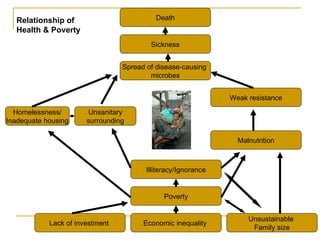
Economic inequality  Poverty Illiteracy/Ignorance Malnutrition Weak resistance Unsanitary surrounding Spread of disease-causing  microbes Sickness Death Unsustainable  Family size Lack of investment  Homelessness/ Inadequate housing Relationship of Health & Poverty
Dr. Ruby K. Payne distinguishes between Situational poverty , which can generally be traced to a specific incident within the lifetimes of the person or family members in poverty;  Generational poverty , which is a cycle that passes from generation to generation, and goes on to argue that generational poverty has its own distinct culture and belief patterns.
Gelia Castillo distinguished  poverty according to the ff:   Stage-in-the-Family-Life-Cycle —poverty for those starting  from scratch or those who are in their sunset years have become unemployed Lifetime poverty —poor from cradle to grave but their children might manage to be better off Acquired poverty —those who became poor because accident, illness, abuse, abandonment, gambling, alcoholism, etc. Intergenerational poverty —passing on poverty to the next generation Situational Poverty
Measuring Poverty:  Absolute Poverty A set standard which is consistent over time and between locations. An example of an absolute measurement would be the  percentage of the population eating less food than is required to sustain the human body  (approximately 2000-2500 calories per day for an adult male).  Put another way, it quantifies the number of people below a poverty threshold. Notice that if everyone's real income in an economy increases, and the  income distribution  does not change, absolute poverty will decline .  Furthermore, the rate of absolute poverty can decline even though inequality is increasing – as long as the poorest get a higher real income than they had before
Measuring Poverty:  Relative  Poverty Views poverty as socially defined and dependent on social context, hence relative poverty is a measure of income inequality. Usually measured as the  percentage of population with income less than some fixed proportion of median income .  Or put another way, it classify individuals or families as "poor" not by comparing them to a fixed cutoff point, but by comparing them to others in the population under study Notice that if everyone's real income in an economy increases, but the  income distribution  stays the same, relative poverty will also stay the same There are several other different income inequality metrics, for example the Gini coefficient or the Theil Index.
What is food threshold? Also referred to as the  subsistence threshold  or the  food poverty line Refers to the minimum income/expenditure required for a family/individual to meet the basic food needs, which satisfies the nutritional requirements for economically necessary and socially desirable physical activities
What is poverty threshold? Refers to the cost of minimum basic needs: food + non-food Refers to the minimum income/expenditure required for a family/individual to meet the basic food and non-food requirements
What is subsistence incidence? Refers to the proportion of families/individuals with per capita income/expenditure less than the per capita  food  threshold to the total number of families/ individuals
What is poverty incidence? Refers to the proportion of families/individuals with per capita income/expenditure less than the per capita  poverty  threshold to the total number of families/individuals
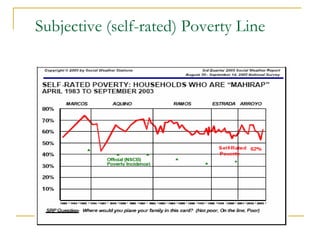
Subjective (self-rated) Poverty Line Poverty measurement is done by the people themselves called as “bottom-up approach” by Mahar Mangahas. In principle, people who don’t feel poor should not be counted as such, including those whose level may appear miserable to outsiders; & those who feel poor should be accepted as such including those whom outsiders may regard as well to do. The difference between bottom-up & top-down approach are not “errors of measurement” but simply difference between the subjective norms of people.
Subjective (self-rated) Poverty Line
Advantages (Mangahas) Simple & inexpensive, making frequent poverty monitoring possible Does not depend on pre-determined poverty line. Sufficient in itself to estimate poverty incidence Can include other variables related to public opinion Extensive data “cleaning” not required
Limitations (Gaurav Datt, WB) Self-rated poverty lines are higher than “top-down approach” Self-rated poverty line has risen rapidly overtime (volatile); no trend is established in the long run Self-rated poverty line given by poor HH is only slightly lower than non-poor HH.
Gross National Product &  Gross Domestic Product GNP—total income available for private & public spending in a country; total domestic & foreign output claimed by residents of a country.  What they claim is income, thus GNP is a measure of national income. GNP per capita is average income of each member of the population. GDP—measures the size of the economy; total final output of goods & services produced by an economy
Limitations Tells nothing about income distribution Cannot be used to compare poverty across countries because the wage represented by the average GNP per capita in local currency doesn’t have the same purchasing power for commodities at local prices—but if necessary, use  Purchasing Power Parity (PPP) dollars. Well-being is not totally about purchasing power
What is PPP? Purchasing power  parity (PPP) is an economic technique used when attempting to determine the relative values of two currencies.  It is useful because often the amount of goods a currency can purchase within two nations varies drastically, based on availability of goods, demand for the goods, and a number of other, difficult to determine factors.  PPP solves this problem by taking some international measure and determining the cost for that measure in each of the two currencies, then comparing that amount.
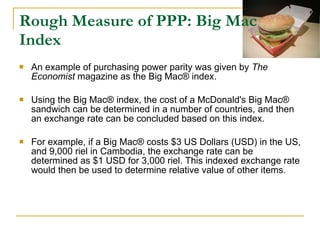
Rough Measure of PPP: Big Mac Index An example of purchasing power parity was given by  The Economist  magazine as the Big Mac® index. Using the Big Mac® index, the cost of a McDonald's Big Mac® sandwich can be determined in a number of countries, and then an exchange rate can be concluded based on this index.  For example, if a Big Mac® costs $3 US Dollars (USD) in the US, and 9,000 riel in Cambodia, the exchange rate can be determined as $1 USD for 3,000 riel. This indexed exchange rate would then be used to determine relative value of other items.
Computing Big Mac Index The Big Mac PPP exchange rate between two countries is obtained by dividing the price of a Big Mac in one country (in its currency) by the price of a Big Mac in another country (in its currency). This value is then compared with the actual exchange rate; if it is lower, then the first currency is under-valued (according to PPP theory) compared with the second, and conversely, if it is higher, then the first currency is over-valued. For example, using figures in July 2008: the price of a Big Mac was $3.57 in the United States  the price of a Big Mac was £2.29 in the United Kingdom (Britain) (Varies by region)  the implied purchasing power parity was $1.56 to £1, that is $3.57/£2.29 = 1.56  this compares with an actual exchange rate of $2.00 to £1 at the time  [(1.56-2.00)/2.00]*100= -22%  the pound was thus overvalued against the dollar by 22%
Human Development Index (HDI) An index used to rank countries by level of "human development", which usually also implies whether a country is a  developed ,  developing , or  underdeveloped country . It is claimed as a standard means of measuring  human development —a concept that, according to the  United Nations Development Program  (UNDP), refers to the process of widening the options of persons, giving them greater opportunities for education, health care, income, employment, etc.
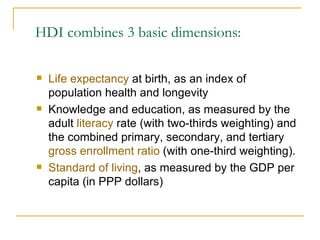
HDI combines 3 basic dimensions: Life expectancy  at birth, as an index of population health and longevity Knowledge and education, as measured by the adult  literacy  rate (with two-thirds weighting) and the combined primary, secondary, and tertiary  gross enrollment ratio  (with one-third weighting). Standard of living , as measured by the GDP per capita (in PPP dollars)
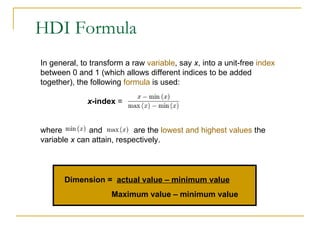
HDI Formula In general, to transform a raw  variable , say  x , into a unit-free  index  between 0 and 1 (which allows different indices to be added together), the following  formula  is used: x -index  = where  and  are the  lowest and highest values  the variable  x  can attain, respectively. Dimension =  actual value – minimum value Maximum value – minimum value
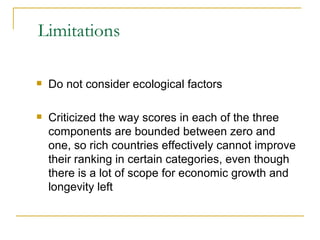
Limitations Do not consider ecological factors Criticized the way scores in each of the three components are bounded between zero and one, so rich countries effectively cannot improve their ranking in certain categories, even though there is a lot of scope for economic growth and longevity left
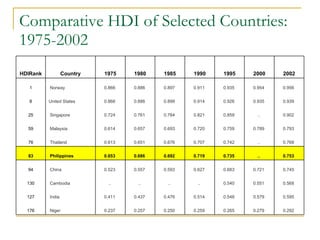
Comparative HDI of Selected Countries: 1975-2002 HDIRank Country 1975 1980 1985 1990 1995 2000 2002 1 Norway  0.866  0.886  0.897  0.911  0.935  0.954  0.956  8 United States  0.866  0.886  0.899  0.914  0.926  0.935  0.939  25 Singapore  0.724  0.761  0.784  0.821  0.859  ..  0.902  59 Malaysia  0.614  0.657  0.693  0.720  0.759  0.789  0.793  76 Thailand  0.613  0.651  0.676  0.707  0.742  ..  0.768  83 Philippines  0.653  0.686  0.692  0.719  0.735  ..  0.753  94 China  0.523  0.557  0.593  0.627  0.683  0.721  0.745  130 Cambodia  ..  ..  ..  ..  0.540  0.551  0.568  127 India  0.411  0.437  0.476  0.514  0.548  0.579  0.595  176 Niger  0.237  0.257  0.250  0.259  0.265  0.279  0.292
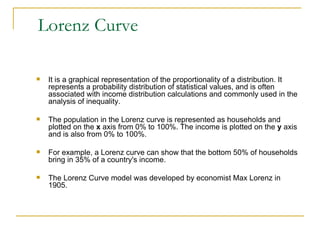
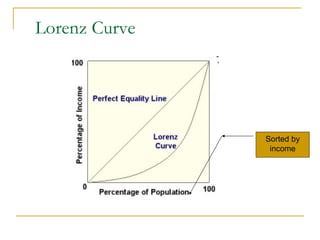
Lorenz Curve It is a graphical representation of the proportionality of a distribution. It represents a probability distribution of statistical values, and is often associated with income distribution calculations and commonly used in the analysis of inequality. The population in the Lorenz curve is represented as households and plotted on the  x  axis from 0% to 100%. The income is plotted on the  y  axis and is also from 0% to 100%. For example, a Lorenz curve can show that the bottom 50% of households bring in 35% of a country's income. The Lorenz Curve model was developed by economist Max Lorenz in 1905.
Lorenz Curve Sorted by income
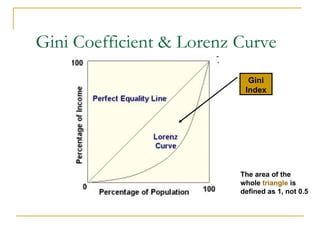
Gini Coefficient The  Gini coefficient  is another way to measure equity and is derived from the Lorenz curve. It is defined graphically as a ratio of two surfaces involving the  summation of all vertical deviations between the Lorenz curve and the perfect equality line  (A)  divided by the difference between the perfect equality and perfect inequality lines  (A+B) . If the area between the line of perfect equality and Lorenz curve is  A,  and the area under the Lorenz curve is  B , then the Gini coefficient is  A/(A + B). It is defined as a  ratio  with values between 0 and 1: A low Gini coefficient indicates more equal income or wealth distribution, while a high Gini coefficient indicates more unequal distribution
Gini Coefficient & Lorenz Curve The area of the whole  triangle  is defined as 1, not 0.5 Gini Index
Advantages It is a measure of inequality by means of a  ratio analysis , rather than a variable unrepresentative of most of the population, such as  per capita income  or  gross domestic product . Can be used to compare income distributions across different population sectors as well as countries, for example the Gini coefficient for urban areas differs from that of rural areas in many countries. It is simple that it can be compared across countries and be easily interpreted. GDP statistics are often criticized as they do not represent changes for the whole population; the Gini coefficient demonstrates how income has changed for poor and rich. If the Gini coefficient is rising as well as GDP, poverty may not be improving for the majority of the population. The Gini coefficient can be used to indicate how the distribution of income has changed within a country over a period of time, thus it is possible to see if inequality is increasing or decreasing.
T H A N K Y O U

Poverty & Underdevelopment

  • 1.
    Poverty & Underdevelopment:Edwin B. R.Gbargaye Graduate Student, MDM Presented to a MDM Forum
  • 2.
    What is poverty?The shortage of common things such as food, clothing, shelter and safe drinking water, all of which determine the quality of life. It may also include the lack of access to opportunities such as education and employment which aid the escape from poverty It could be lack of choice : “Beggars cannot be choosers.”
  • 3.
    What is poverty?It could also mean deprivation : According to Mollie Orshansky who developed the poverty measurements used by the U.S. government, "to be poor is to be deprived of those goods and services and pleasures which others around us take for granted.“ It could mean social exclusion : process through w/c individuals or groups are wholly or partially excluded from full participation in the society in w/c they live.
  • 4.
    What is poverty?Or if David Korten is to be believed, poverty also involves social disintegration and environmental degradation , which he describes as forming the threefold human crisis in the world today.
  • 5.
    Caveat: The definitionof poverty may differ relative to the norms of each particular society “ The poor of different times & places differ between themselves in virtually every aspect of their conditions, just like the societies of w/c they are part. Who is cast in this way depends not on how the poor live, but on the way society as whole lives .” — Bauman 1999
  • 6.
    The World Bank's"Voices of the Poor," based on research with over 20,000 poor people in 23 countries, identifies a range of factors which poor people identify as part of poverty. These include: Precarious livelihoods Excluded locations Physical limitations Gender relationships Problems in social relationships Lack of security Abuse by those in power Dis-empowering institutions Limited capabilities Weak community organizations
  • 7.
    What is poverty?Not only income, but also entitlements (related to human rights & as asserted by Amartya Sen) Social exclusion Multi-dimensional aspects of poverty
  • 8.
    Who are thepoor? Republic Act No. 8425 - Social Reform and Poverty Alleviation Act, passed by Congress in December 1997: The poor refers to individuals and families whose incomes fall below the official poverty threshold as defined by the government and/or cannot afford to provide in a sustained manner for their minimum basic needs for food, health, education, housing, and other social amenities of life.
  • 9.
    Causes of Poverty:Economic Historical factors—colonialism & neo-colonialism; post-communism (political economy) Economic inequality/socio-economic stratification Recession Shock to food prices
  • 10.
    Causes of Poverty:Governance Lack of democracy Governance incompetence & corruption Weak rule of law Lack of peace & order
  • 11.
    Contributory Factors OverpopulationEducational attainment & employable skills Brain drain Cultural causes: pre-scientific beliefs Social discrimination: gender, caste, race/ethnicity, age, disability, religious/political beliefs Matthew Effect
  • 12.
    The Matthew EffectIt describes the phenomenon that "the rich get richer and the poor get poorer". Those who possess power and economic or social capital can leverage those resources to gain more power or capital. The Matthew effect results in a power law distribution of resources. The term was first coined by sociologist Robert K. Merton and takes its name from a line in the biblical Gospel of Matthew: “ For to all those who have, more will be given, and they will have an abundance; but from those who have nothing, even what they have will be taken away.” — Matthew 25:29, New Revised Standard Version. Phenomenon that the middle classes tend to be the main beneficiaries of social benefits and services, even if these are primarily targeted at the poor.
  • 13.
    Environmental factors ErosionDesertification & overgrazing Deforestation Geographic & natural resource factors Drought & water crisis Climate change
  • 14.
    Effects of povertyThe effects of poverty may also be causes, thus creating a "poverty cycle" operating across multiple levels, individual, household, local, national and global "set of factors or events by which poverty, once started, is likely to continue unless there is outside intervention." Sometimes called the “Poverty trap”
  • 15.
    Economic inequality Poverty Illiteracy/Ignorance Malnutrition Weak resistance Unsanitary surrounding Spread of disease-causing microbes Sickness Death Unsustainable Family size Lack of investment Homelessness/ Inadequate housing Relationship of Health & Poverty
  • 16.
    Dr. Ruby K.Payne distinguishes between Situational poverty , which can generally be traced to a specific incident within the lifetimes of the person or family members in poverty; Generational poverty , which is a cycle that passes from generation to generation, and goes on to argue that generational poverty has its own distinct culture and belief patterns.
  • 17.
    Gelia Castillo distinguished poverty according to the ff: Stage-in-the-Family-Life-Cycle —poverty for those starting from scratch or those who are in their sunset years have become unemployed Lifetime poverty —poor from cradle to grave but their children might manage to be better off Acquired poverty —those who became poor because accident, illness, abuse, abandonment, gambling, alcoholism, etc. Intergenerational poverty —passing on poverty to the next generation Situational Poverty
  • 18.
    Measuring Poverty: Absolute Poverty A set standard which is consistent over time and between locations. An example of an absolute measurement would be the percentage of the population eating less food than is required to sustain the human body (approximately 2000-2500 calories per day for an adult male). Put another way, it quantifies the number of people below a poverty threshold. Notice that if everyone's real income in an economy increases, and the income distribution does not change, absolute poverty will decline . Furthermore, the rate of absolute poverty can decline even though inequality is increasing – as long as the poorest get a higher real income than they had before
  • 19.
    Measuring Poverty: Relative Poverty Views poverty as socially defined and dependent on social context, hence relative poverty is a measure of income inequality. Usually measured as the percentage of population with income less than some fixed proportion of median income . Or put another way, it classify individuals or families as "poor" not by comparing them to a fixed cutoff point, but by comparing them to others in the population under study Notice that if everyone's real income in an economy increases, but the income distribution stays the same, relative poverty will also stay the same There are several other different income inequality metrics, for example the Gini coefficient or the Theil Index.
  • 20.
    What is foodthreshold? Also referred to as the subsistence threshold or the food poverty line Refers to the minimum income/expenditure required for a family/individual to meet the basic food needs, which satisfies the nutritional requirements for economically necessary and socially desirable physical activities
  • 21.
    What is povertythreshold? Refers to the cost of minimum basic needs: food + non-food Refers to the minimum income/expenditure required for a family/individual to meet the basic food and non-food requirements
  • 22.
    What is subsistenceincidence? Refers to the proportion of families/individuals with per capita income/expenditure less than the per capita food threshold to the total number of families/ individuals
  • 23.
    What is povertyincidence? Refers to the proportion of families/individuals with per capita income/expenditure less than the per capita poverty threshold to the total number of families/individuals
  • 24.
    Subjective (self-rated) PovertyLine Poverty measurement is done by the people themselves called as “bottom-up approach” by Mahar Mangahas. In principle, people who don’t feel poor should not be counted as such, including those whose level may appear miserable to outsiders; & those who feel poor should be accepted as such including those whom outsiders may regard as well to do. The difference between bottom-up & top-down approach are not “errors of measurement” but simply difference between the subjective norms of people.
  • 25.
  • 26.
    Advantages (Mangahas) Simple& inexpensive, making frequent poverty monitoring possible Does not depend on pre-determined poverty line. Sufficient in itself to estimate poverty incidence Can include other variables related to public opinion Extensive data “cleaning” not required
  • 27.
    Limitations (Gaurav Datt,WB) Self-rated poverty lines are higher than “top-down approach” Self-rated poverty line has risen rapidly overtime (volatile); no trend is established in the long run Self-rated poverty line given by poor HH is only slightly lower than non-poor HH.
  • 28.
    Gross National Product& Gross Domestic Product GNP—total income available for private & public spending in a country; total domestic & foreign output claimed by residents of a country. What they claim is income, thus GNP is a measure of national income. GNP per capita is average income of each member of the population. GDP—measures the size of the economy; total final output of goods & services produced by an economy
  • 29.
    Limitations Tells nothingabout income distribution Cannot be used to compare poverty across countries because the wage represented by the average GNP per capita in local currency doesn’t have the same purchasing power for commodities at local prices—but if necessary, use Purchasing Power Parity (PPP) dollars. Well-being is not totally about purchasing power
  • 30.
    What is PPP?Purchasing power parity (PPP) is an economic technique used when attempting to determine the relative values of two currencies. It is useful because often the amount of goods a currency can purchase within two nations varies drastically, based on availability of goods, demand for the goods, and a number of other, difficult to determine factors. PPP solves this problem by taking some international measure and determining the cost for that measure in each of the two currencies, then comparing that amount.
  • 31.
    Rough Measure ofPPP: Big Mac Index An example of purchasing power parity was given by The Economist magazine as the Big Mac® index. Using the Big Mac® index, the cost of a McDonald's Big Mac® sandwich can be determined in a number of countries, and then an exchange rate can be concluded based on this index. For example, if a Big Mac® costs $3 US Dollars (USD) in the US, and 9,000 riel in Cambodia, the exchange rate can be determined as $1 USD for 3,000 riel. This indexed exchange rate would then be used to determine relative value of other items.
  • 32.
    Computing Big MacIndex The Big Mac PPP exchange rate between two countries is obtained by dividing the price of a Big Mac in one country (in its currency) by the price of a Big Mac in another country (in its currency). This value is then compared with the actual exchange rate; if it is lower, then the first currency is under-valued (according to PPP theory) compared with the second, and conversely, if it is higher, then the first currency is over-valued. For example, using figures in July 2008: the price of a Big Mac was $3.57 in the United States the price of a Big Mac was £2.29 in the United Kingdom (Britain) (Varies by region) the implied purchasing power parity was $1.56 to £1, that is $3.57/£2.29 = 1.56 this compares with an actual exchange rate of $2.00 to £1 at the time [(1.56-2.00)/2.00]*100= -22% the pound was thus overvalued against the dollar by 22%
  • 33.
    Human Development Index(HDI) An index used to rank countries by level of "human development", which usually also implies whether a country is a developed , developing , or underdeveloped country . It is claimed as a standard means of measuring human development —a concept that, according to the United Nations Development Program (UNDP), refers to the process of widening the options of persons, giving them greater opportunities for education, health care, income, employment, etc.
  • 34.
    HDI combines 3basic dimensions: Life expectancy at birth, as an index of population health and longevity Knowledge and education, as measured by the adult literacy rate (with two-thirds weighting) and the combined primary, secondary, and tertiary gross enrollment ratio (with one-third weighting). Standard of living , as measured by the GDP per capita (in PPP dollars)
  • 35.
    HDI Formula Ingeneral, to transform a raw variable , say x , into a unit-free index between 0 and 1 (which allows different indices to be added together), the following formula is used: x -index = where and are the lowest and highest values the variable x can attain, respectively. Dimension = actual value – minimum value Maximum value – minimum value
  • 36.
    Limitations Do notconsider ecological factors Criticized the way scores in each of the three components are bounded between zero and one, so rich countries effectively cannot improve their ranking in certain categories, even though there is a lot of scope for economic growth and longevity left
  • 37.
    Comparative HDI ofSelected Countries: 1975-2002 HDIRank Country 1975 1980 1985 1990 1995 2000 2002 1 Norway 0.866 0.886 0.897 0.911 0.935 0.954 0.956 8 United States 0.866 0.886 0.899 0.914 0.926 0.935 0.939 25 Singapore 0.724 0.761 0.784 0.821 0.859 .. 0.902 59 Malaysia 0.614 0.657 0.693 0.720 0.759 0.789 0.793 76 Thailand 0.613 0.651 0.676 0.707 0.742 .. 0.768 83 Philippines 0.653 0.686 0.692 0.719 0.735 .. 0.753 94 China 0.523 0.557 0.593 0.627 0.683 0.721 0.745 130 Cambodia .. .. .. .. 0.540 0.551 0.568 127 India 0.411 0.437 0.476 0.514 0.548 0.579 0.595 176 Niger 0.237 0.257 0.250 0.259 0.265 0.279 0.292
  • 38.
    Lorenz Curve Itis a graphical representation of the proportionality of a distribution. It represents a probability distribution of statistical values, and is often associated with income distribution calculations and commonly used in the analysis of inequality. The population in the Lorenz curve is represented as households and plotted on the x axis from 0% to 100%. The income is plotted on the y axis and is also from 0% to 100%. For example, a Lorenz curve can show that the bottom 50% of households bring in 35% of a country's income. The Lorenz Curve model was developed by economist Max Lorenz in 1905.
  • 39.
  • 40.
    Gini Coefficient The Gini coefficient is another way to measure equity and is derived from the Lorenz curve. It is defined graphically as a ratio of two surfaces involving the summation of all vertical deviations between the Lorenz curve and the perfect equality line (A) divided by the difference between the perfect equality and perfect inequality lines (A+B) . If the area between the line of perfect equality and Lorenz curve is A, and the area under the Lorenz curve is B , then the Gini coefficient is A/(A + B). It is defined as a ratio with values between 0 and 1: A low Gini coefficient indicates more equal income or wealth distribution, while a high Gini coefficient indicates more unequal distribution
  • 41.
    Gini Coefficient &Lorenz Curve The area of the whole triangle is defined as 1, not 0.5 Gini Index
  • 42.
    Advantages It isa measure of inequality by means of a ratio analysis , rather than a variable unrepresentative of most of the population, such as per capita income or gross domestic product . Can be used to compare income distributions across different population sectors as well as countries, for example the Gini coefficient for urban areas differs from that of rural areas in many countries. It is simple that it can be compared across countries and be easily interpreted. GDP statistics are often criticized as they do not represent changes for the whole population; the Gini coefficient demonstrates how income has changed for poor and rich. If the Gini coefficient is rising as well as GDP, poverty may not be improving for the majority of the population. The Gini coefficient can be used to indicate how the distribution of income has changed within a country over a period of time, thus it is possible to see if inequality is increasing or decreasing.
  • 43.
    T H AN K Y O U