Márton Zsolt
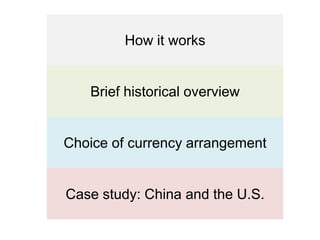
How it works


   Brief historical overview


Choice of currency arrangement


Case study: China and the U.S.
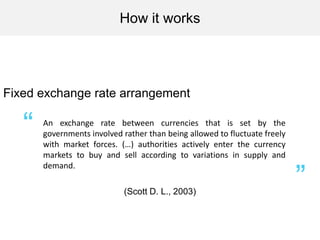
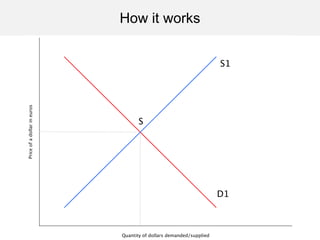
How it works


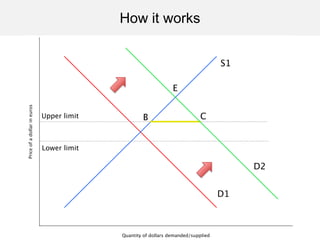
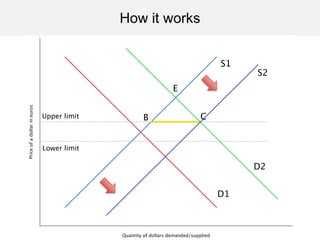
Fixed exchange rate arrangement


   “   An exchange rate between currencies that is set by the
       governments involved rather than being allowed to fluctuate freely
       with market forces. (…) authorities actively enter the currency
       markets to buy and sell according to variations in supply and


                                                                            ”
       demand.

                             (Scott D. L., 2003)
How it works
How it works
How it works
Brief historical overview


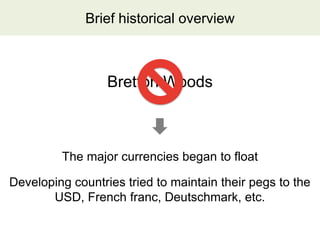
                  Bretton Woods


         The major currencies began to float

Developing countries tried to maintain their pegs to the
       USD, French franc, Deutschmark, etc.
Brief historical overview


+ Appreciation of the USD

+ Massive inflation

+ Monetary shocks

+ Globalization


Transition from fixed to more flexible arrangements
Brief historical overview


In 1975, 87% of the world’s currencies were fixed.

Since then, this number has fallen well below   50%.
Choice of currency arrangement


        Why do we need fixed rates in the first place?


•   Gives small central banks more credibility

•   Reduces volatility and sharp fluctuations in relative prices

•   Eliminates exchange rate risk

•   Good for exports
Choice of currency arrangement


               Some disadvantages of fixed rates:


•   Under-/overvaluation can build up and eventually lead to currency crises

•   Can be expensive or even impossible to hold

•   Black markets will emerge

•   Does not reflect the true value of the currency
Choice of currency arrangement


Economists disagree on whether the exchange rate has
        a long-term effect on growth or not

There is no “best answer” in all cases, every country is
            unique and has different needs

     Factors that influence the choice are: level of
  development, size, openness, trading partners, etc.
Choice of currency arrangement
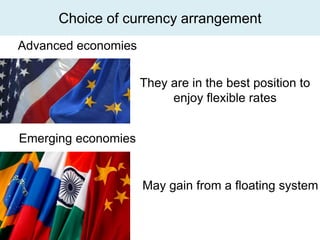
Advanced economies

                     They are in the best position to
                          enjoy flexible rates


Emerging economies


                     May gain from a floating system
Choice of currency arrangement


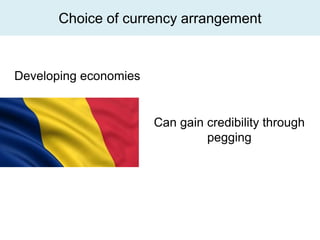
Developing economies


                       Can gain credibility through
                                pegging
Choice of currency arrangement


              Essential conditions for a fixed rate:


•   Small and open economy

•   The pegged currency belongs to a large trading partner (>50% of trade)

•   The country wishes to pursue a macroeconomic policy that will result in an
    inflation rate consistent with that in the country

•   The country is prepared to adopt institutional arrangements that will assure
    continued credibility of the fixed rate commitment

                             (Williamson, J., 1998)
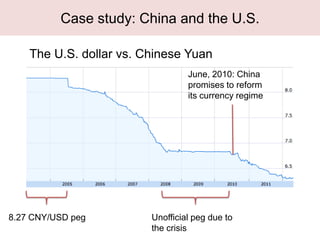
Case study: China and the U.S.

    The U.S. dollar vs. Chinese Yuan
                                  June, 2010: China
                                  promises to reform
                                  its currency regime


8.27 CNY/USD peg         Unofficial peg due to
                         the crisis

Fixed versus flexible exchange rate arrangements

  • 1.
  • 2.
    How it works Brief historical overview Choice of currency arrangement Case study: China and the U.S.
  • 3.
    How it works Fixedexchange rate arrangement “ An exchange rate between currencies that is set by the governments involved rather than being allowed to fluctuate freely with market forces. (…) authorities actively enter the currency markets to buy and sell according to variations in supply and ” demand. (Scott D. L., 2003)
  • 4.
  • 5.
  • 6.
  • 7.
    Brief historical overview Bretton Woods The major currencies began to float Developing countries tried to maintain their pegs to the USD, French franc, Deutschmark, etc.
  • 8.
    Brief historical overview +Appreciation of the USD + Massive inflation + Monetary shocks + Globalization Transition from fixed to more flexible arrangements
  • 9.
    Brief historical overview In1975, 87% of the world’s currencies were fixed. Since then, this number has fallen well below 50%.
  • 10.
    Choice of currencyarrangement Why do we need fixed rates in the first place? • Gives small central banks more credibility • Reduces volatility and sharp fluctuations in relative prices • Eliminates exchange rate risk • Good for exports
  • 11.
    Choice of currencyarrangement Some disadvantages of fixed rates: • Under-/overvaluation can build up and eventually lead to currency crises • Can be expensive or even impossible to hold • Black markets will emerge • Does not reflect the true value of the currency
  • 12.
    Choice of currencyarrangement Economists disagree on whether the exchange rate has a long-term effect on growth or not There is no “best answer” in all cases, every country is unique and has different needs Factors that influence the choice are: level of development, size, openness, trading partners, etc.
  • 13.
    Choice of currencyarrangement Advanced economies They are in the best position to enjoy flexible rates Emerging economies May gain from a floating system
  • 14.
    Choice of currencyarrangement Developing economies Can gain credibility through pegging
  • 15.
    Choice of currencyarrangement Essential conditions for a fixed rate: • Small and open economy • The pegged currency belongs to a large trading partner (>50% of trade) • The country wishes to pursue a macroeconomic policy that will result in an inflation rate consistent with that in the country • The country is prepared to adopt institutional arrangements that will assure continued credibility of the fixed rate commitment (Williamson, J., 1998)
  • 16.
    Case study: Chinaand the U.S. The U.S. dollar vs. Chinese Yuan June, 2010: China promises to reform its currency regime 8.27 CNY/USD peg Unofficial peg due to the crisis