1
Assignment for class discussion
1. Give three reasons why the Bill of Rights in your
country’s constitution is important to social justice
2. Identify groups in your society whose rights are
violated or not defended. Suggest reasons why.
Suggest ways of correcting this problem.
3. How does social justice affect the development of a
country?
4. Do you believe that the Caribbean Court of Justice
would improve social justice in the region?
2
What is Social Justice?
• It is a complex issue.
• Social justice is based on the premise
that all people are entitled to the same
basic rights and freedoms as
everybody else.
• Social justice is connected with issues
of equality and equity.
3
What is Social Justice?
• It refers to an ideal of society, where
"justice" refers to economic status rather
than to the administration of laws.
• It is based on the idea of a society which
gives individuals and groups fair treatment
and a just share of the benefits of society
4
What is Social Justice?
• It is giving people their due, what they
deserve.
• It is equal participation of all groups in a
society that is mutually shaped to meet their
needs
5
Equality and equity
• Equality: efforts to treat everyone in a
similar way.
• Equity: attempts to ascertain that
treatment is just and fair.
• Equity refers to how fair the system is
to persons who pass through it.
6
The development of social justice in the
Caribbean
• Slavery and forced labour were not regarded
as wrong by the colonialists.
• Slaves were regarded as both people and
property.
• The fundamental principles of the colonial
state were exploitation, inequality and
injustice.
7
The development of social justice in the
Caribbean
• The principle of equality did not apply to the
colonial state.
• After emancipation in 1834, Caribbean people
were no longer regarded as property.
• In 1944 and 1946 respectively, universal adult
suffrage was introduced in Jamaica and
Trinidad. Other countries followed suit later.
8
The development of social justice in the
Caribbean
• In 1962, Jamaica and Trinidad became
independent. A Bill of Rights was included in the
constitutions of both countries.
• The Bill of Rights is a chapter in the constitution
which outlines and protects the fundamental rights
and freedoms of individuals in society.
9
The development of social justice in the
Caribbean
• All independent countries of the Commonwealth
Caribbean have a Bill of Rights which is
enshrined/entrenched and protected in their
constitutions.
• The Bill of Rights is designed to perpetuate and
uphold equality and social justice
• Citizens have the power to redress any
infringement of his/her constitutional rights in
the courts.
10
Excerpt from Antigua and
Barbuda Bill of Rights
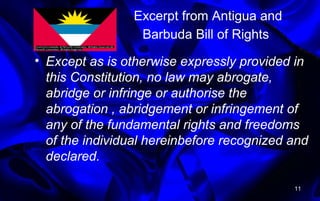
• Except as is otherwise expressly provided in
this Constitution, no law may abrogate,
abridge or infringe or authorise the
abrogation , abridgement or infringement of
any of the fundamental rights and freedoms
of the individual hereinbefore recognized and
declared.
11
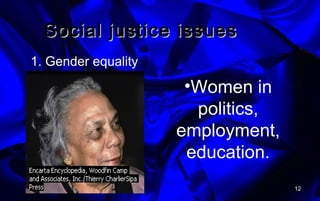
•Women in
politics,
employment,
education.
1. Gender equality
12
Social justice issuesSocial justice issues
Social justice issues
2. Class discrimination (employment,
education, justice)
3. Racial discrimination. (Racial groups:
White, Afro Caribbean, Indian,
Chinese)
13
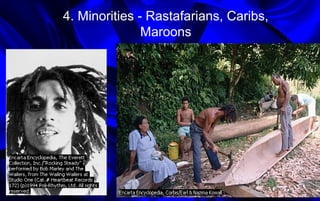
4. Minorities - Rastafarians, Caribs,
Maroons
14
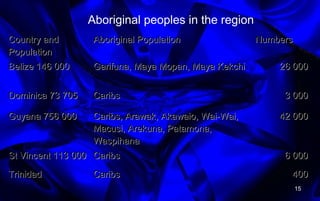
Aboriginal peoples in the region
Country andCountry and
PopulationPopulation
Aboriginal PopulationAboriginal Population NumbersNumbers
Belize 146 000Belize 146 000 Garifuna, Maya Mopan, Maya KekchiGarifuna, Maya Mopan, Maya Kekchi 26 00026 000
Dominica 73 705Dominica 73 705 CaribsCaribs 3 0003 000
Guyana 756 000Guyana 756 000 Caribs, Arawak, Akawaio, Wai-Wai,Caribs, Arawak, Akawaio, Wai-Wai,
Macusi, Arekuna, Patamona,Macusi, Arekuna, Patamona,
WaspihanaWaspihana
42 00042 000
St Vincent 113 000St Vincent 113 000 CaribsCaribs 6 0006 000
TrinidadTrinidad CaribsCaribs 400400
15
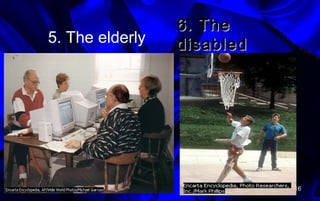
5. The elderly
16
6. The6. The
disableddisabled
Social justice issues
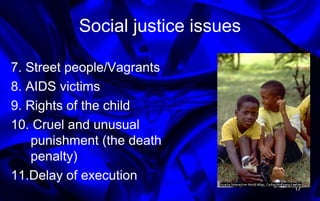
7. Street people/Vagrants
8. AIDS victims
9. Rights of the child
10. Cruel and unusual
punishment (the death
penalty)
11.Delay of execution
17
Social justice and development
• The human development model of
development emphasizes that people are the
means and end of development.
• Development cannot be considered to be
true development unless someone
experienced good from it and not at the
expense of others.
18
Social justice and development
• Social justice is a non material indicator of
human development
• Human development is predicated on
equity and inclusiveness
19
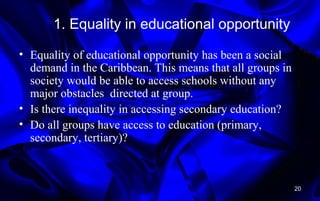
1. Equality in educational opportunity
• Equality of educational opportunity has been a social
demand in the Caribbean. This means that all groups in
society would be able to access schools without any
major obstacles directed at group.
• Is there inequality in accessing secondary education?
• Do all groups have access to education (primary,
secondary, tertiary)?
20
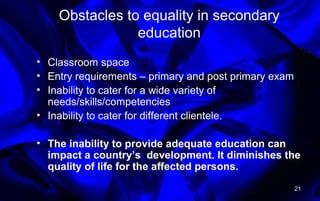
Obstacles to equality in secondary
education
• Classroom space
• Entry requirements – primary and post primary exam
• Inability to cater for a wide variety of
needs/skills/competencies
• Inability to cater for different clientele.
• The inability to provide adequate education can
impact a country’s development. It diminishes the
quality of life for the affected persons.
21
2. Social Justice and productivity
Individual rights may be infringed in the following
situations:
• Supercession in the Civil Service (workers with
less experience are promoted ahead of those with
more experience)
• Less pay for women doing the same job as men
• Wage level below the minimum wage
22
Effects on productivity
• The worker who is promoted may not be able
to perform the task. The aggrieved worker
may refuse to cooperate or may resort to
strike action, a ‘sickout’, go slow.
• Women may become demotivated
• Workers may resort to stealing, sabotage or
go slows
23
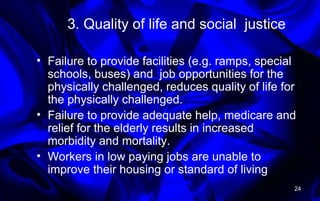
3. Quality of life and social justice
• Failure to provide facilities (e.g. ramps, special
schools, buses) and job opportunities for the
physically challenged, reduces quality of life for
the physically challenged.
• Failure to provide adequate help, medicare and
relief for the elderly results in increased
morbidity and mortality.
• Workers in low paying jobs are unable to
improve their housing or standard of living
24

Social justice

  • 1.
  • 2.
    Assignment for classdiscussion 1. Give three reasons why the Bill of Rights in your country’s constitution is important to social justice 2. Identify groups in your society whose rights are violated or not defended. Suggest reasons why. Suggest ways of correcting this problem. 3. How does social justice affect the development of a country? 4. Do you believe that the Caribbean Court of Justice would improve social justice in the region? 2
  • 3.
    What is SocialJustice? • It is a complex issue. • Social justice is based on the premise that all people are entitled to the same basic rights and freedoms as everybody else. • Social justice is connected with issues of equality and equity. 3
  • 4.
    What is SocialJustice? • It refers to an ideal of society, where "justice" refers to economic status rather than to the administration of laws. • It is based on the idea of a society which gives individuals and groups fair treatment and a just share of the benefits of society 4
  • 5.
    What is SocialJustice? • It is giving people their due, what they deserve. • It is equal participation of all groups in a society that is mutually shaped to meet their needs 5
  • 6.
    Equality and equity •Equality: efforts to treat everyone in a similar way. • Equity: attempts to ascertain that treatment is just and fair. • Equity refers to how fair the system is to persons who pass through it. 6
  • 7.
    The development ofsocial justice in the Caribbean • Slavery and forced labour were not regarded as wrong by the colonialists. • Slaves were regarded as both people and property. • The fundamental principles of the colonial state were exploitation, inequality and injustice. 7
  • 8.
    The development ofsocial justice in the Caribbean • The principle of equality did not apply to the colonial state. • After emancipation in 1834, Caribbean people were no longer regarded as property. • In 1944 and 1946 respectively, universal adult suffrage was introduced in Jamaica and Trinidad. Other countries followed suit later. 8
  • 9.
    The development ofsocial justice in the Caribbean • In 1962, Jamaica and Trinidad became independent. A Bill of Rights was included in the constitutions of both countries. • The Bill of Rights is a chapter in the constitution which outlines and protects the fundamental rights and freedoms of individuals in society. 9
  • 10.
    The development ofsocial justice in the Caribbean • All independent countries of the Commonwealth Caribbean have a Bill of Rights which is enshrined/entrenched and protected in their constitutions. • The Bill of Rights is designed to perpetuate and uphold equality and social justice • Citizens have the power to redress any infringement of his/her constitutional rights in the courts. 10
  • 11.
    Excerpt from Antiguaand Barbuda Bill of Rights • Except as is otherwise expressly provided in this Constitution, no law may abrogate, abridge or infringe or authorise the abrogation , abridgement or infringement of any of the fundamental rights and freedoms of the individual hereinbefore recognized and declared. 11
  • 12.
    •Women in politics, employment, education. 1. Genderequality 12 Social justice issuesSocial justice issues
  • 13.
    Social justice issues 2.Class discrimination (employment, education, justice) 3. Racial discrimination. (Racial groups: White, Afro Caribbean, Indian, Chinese) 13
  • 14.
    4. Minorities -Rastafarians, Caribs, Maroons 14
  • 15.
    Aboriginal peoples inthe region Country andCountry and PopulationPopulation Aboriginal PopulationAboriginal Population NumbersNumbers Belize 146 000Belize 146 000 Garifuna, Maya Mopan, Maya KekchiGarifuna, Maya Mopan, Maya Kekchi 26 00026 000 Dominica 73 705Dominica 73 705 CaribsCaribs 3 0003 000 Guyana 756 000Guyana 756 000 Caribs, Arawak, Akawaio, Wai-Wai,Caribs, Arawak, Akawaio, Wai-Wai, Macusi, Arekuna, Patamona,Macusi, Arekuna, Patamona, WaspihanaWaspihana 42 00042 000 St Vincent 113 000St Vincent 113 000 CaribsCaribs 6 0006 000 TrinidadTrinidad CaribsCaribs 400400 15
  • 16.
    5. The elderly 16 6.The6. The disableddisabled
  • 17.
    Social justice issues 7.Street people/Vagrants 8. AIDS victims 9. Rights of the child 10. Cruel and unusual punishment (the death penalty) 11.Delay of execution 17
  • 18.
    Social justice anddevelopment • The human development model of development emphasizes that people are the means and end of development. • Development cannot be considered to be true development unless someone experienced good from it and not at the expense of others. 18
  • 19.
    Social justice anddevelopment • Social justice is a non material indicator of human development • Human development is predicated on equity and inclusiveness 19
  • 20.
    1. Equality ineducational opportunity • Equality of educational opportunity has been a social demand in the Caribbean. This means that all groups in society would be able to access schools without any major obstacles directed at group. • Is there inequality in accessing secondary education? • Do all groups have access to education (primary, secondary, tertiary)? 20
  • 21.
    Obstacles to equalityin secondary education • Classroom space • Entry requirements – primary and post primary exam • Inability to cater for a wide variety of needs/skills/competencies • Inability to cater for different clientele. • The inability to provide adequate education can impact a country’s development. It diminishes the quality of life for the affected persons. 21
  • 22.
    2. Social Justiceand productivity Individual rights may be infringed in the following situations: • Supercession in the Civil Service (workers with less experience are promoted ahead of those with more experience) • Less pay for women doing the same job as men • Wage level below the minimum wage 22
  • 23.
    Effects on productivity •The worker who is promoted may not be able to perform the task. The aggrieved worker may refuse to cooperate or may resort to strike action, a ‘sickout’, go slow. • Women may become demotivated • Workers may resort to stealing, sabotage or go slows 23
  • 24.
    3. Quality oflife and social justice • Failure to provide facilities (e.g. ramps, special schools, buses) and job opportunities for the physically challenged, reduces quality of life for the physically challenged. • Failure to provide adequate help, medicare and relief for the elderly results in increased morbidity and mortality. • Workers in low paying jobs are unable to improve their housing or standard of living 24