Social
Exclusion
Linda Moss
PUPP 2171
Social Exclusion
 The  term „social exclusion‟ first originated
  in Europe, where there has tended to be
  a greater emphasis on spatial exclusion.
 There is also a policy focus on those living
  in „deprived areas‟, where poor
  housing, inadequate social services, weak
  political voice and lack of decent work
 all combine to create an experience of
  marginalisation.
Social Inclusion
   Social integration has been defined as “the
    process of promoting the values, relations and
    institutions that enable all people to
    participate in social, economic and political
    life on the basis of equality of rights, equity
    and dignity” (UN Expert Group Meeting on
    Promoting Social Integration: Draft Summary,
    Finland, July 8-10 2008, p.2).
   However, social integration can also imply
    integration on poor terms (like adverse
    incorporation), and cultural homogenisation.
Voluntary exclusion
 Some   minority groups voluntarily exclude
  themselves from wider society.
 This phenomenon should be distinguished
  from social exclusion, which occurs for
  reasons that are beyond the control of
  those subject to it.
 http://www.youtube.com/watch?v=bJC4
  V_8S24M&feature=related
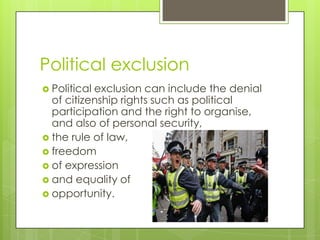
Political exclusion
 Politicalexclusion can include the denial
  of citizenship rights such as political
  participation and the right to organise,
  and also of personal security,
 the rule of law,
 freedom
 of expression
 and equality of
 opportunity.
Social Exclusion
 Social exclusion may take the form of
  discrimination along a number of
  dimensions including
 gender, ethnicity and age,
 which reduce the opportunity for such
  groups to gain access to social services
  and limits their participation in the labour
  market
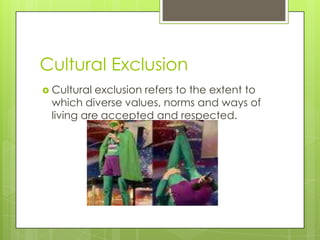
Cultural Exclusion
 Culturalexclusion refers to the extent to
 which diverse values, norms and ways of
 living are accepted and respected.
Inequality and exclusion
   People may be excluded because of
    deliberate action on the part of others (e.g.
    discrimination by employers);
   as a result of processes in society which do
    not involve deliberate action; or even by
    choice.
   However, more generally, the causes of social
    exclusion that lead to poverty, suffering and
    sometimes death, can be attributed to the
    operations of unequal power relations.
Citizenship and exclusion
 Social   exclusion addresses the political
  nature of deprivation, in that it examines
  the links between people‟s lack of
  citizenship status and their levels of
  poverty.
 Citizenship is centred on the capability of
  exercising individual and collective rights,
  and inequalities in this capability can
  generate a social hierarchy, made up of
  first- and second-class citizens.
Inequality
   This often means that not all individuals are
    equal before the law, and that they do not all
    have the same access to public goods
    supplied by the state.
   Political aspects of exclusion can include the
    lack of political rights, such as political
    participation and the right to organise;
    alienation from or lack of confidence in
    political processes; and lack of freedom of
    expression and equality of opportunity.
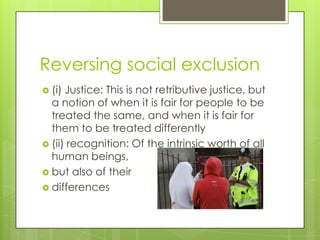
Reversing social exclusion
 (i) Justice: This is not retributive justice, but
  a notion of when it is fair for people to be
  treated the same, and when it is fair for
  them to be treated differently
 (ii) recognition: Of the intrinsic worth of all
  human beings,
 but also of their
 differences
 (iii)
      self-determination: People‟s ability to
  exercise some degree of control over
  their own lives
 (iv) solidarity: The capacity to identify with
  others and to act with them in their claims
  for justice and recognition.
Rights issues
 Individual  versus collective rights: Liberal
  individualism, despite claiming
  universality, is a product of the history of
  industrialisation in the West.
 Individualism has little place in many
  societies, which have a strong sense of kin
  and community ties. These societies strive
  to balance individual rights with collective
  rights, putting a strong emphasis on the
  latter
Political issues and exclusion
 Rights and duties: The rise of neo-
  conservative thinking has argued that
  people‟s reliance on the state to fulfil their
  basic needs breeds dependency.
 This has led to duties being regarded as
  the condition for rights.
 The accompanying vision of social service
  provision by the third sector has led to the
  co-optation of civil society groups.
Effects of exclusion
 The greater poverty of socially excluded
  groups often translates into poorer levels
  of health and education, particularly
  when their poverty is combined with
  remoteness and lack of infrastructure and
  social services.
 Cultural exclusion can also result in
  ambivalence towards education, further
  entrenching income inequality
 Social exclusion can lead to and result
  from disparities in income distribution,
 with the wealthiest segments of a
  country‟s population receiving the
  greatest proportion of its national income.
 Income inequality arises from inequities in
  the distribution of assets such as land,
  credit and education.
 The inequalities that arise from social
  exclusion are self-reinforcing.
 Recent research has demonstrated how
  income inequalities persist because of
  two „inequality traps‟, which relate to
 human capabilities and access to capital.
Inclusion?
 Associal and cultural capital inequalities
 cannot be eliminated by policy, strong
 affirmative action in other areas such as
 education and employment is justified.
References
 StewartF., 2009, 'Horizontal Inequality: Two
 Types of Trap', Journal of Human
 Development and Capabilities, vol. 10,
 no. 3, pp.315-340
 Helen Pinnock et. al., 2008, 'Making
 Schools Inclusive: How Change Can
 Happen', Save the Children UK, London
 http://www.gsdrc.org/go/topic-
 guides/social-exclusion/introduction

Social exclusion

  • 1.
  • 2.
    Social Exclusion  The term „social exclusion‟ first originated in Europe, where there has tended to be a greater emphasis on spatial exclusion.  There is also a policy focus on those living in „deprived areas‟, where poor housing, inadequate social services, weak political voice and lack of decent work  all combine to create an experience of marginalisation.
  • 3.
    Social Inclusion  Social integration has been defined as “the process of promoting the values, relations and institutions that enable all people to participate in social, economic and political life on the basis of equality of rights, equity and dignity” (UN Expert Group Meeting on Promoting Social Integration: Draft Summary, Finland, July 8-10 2008, p.2).  However, social integration can also imply integration on poor terms (like adverse incorporation), and cultural homogenisation.
  • 4.
    Voluntary exclusion  Some minority groups voluntarily exclude themselves from wider society.  This phenomenon should be distinguished from social exclusion, which occurs for reasons that are beyond the control of those subject to it.  http://www.youtube.com/watch?v=bJC4 V_8S24M&feature=related
  • 5.
    Political exclusion  Politicalexclusioncan include the denial of citizenship rights such as political participation and the right to organise, and also of personal security,  the rule of law,  freedom  of expression  and equality of  opportunity.
  • 6.
    Social Exclusion  Socialexclusion may take the form of discrimination along a number of dimensions including  gender, ethnicity and age,  which reduce the opportunity for such groups to gain access to social services and limits their participation in the labour market
  • 7.
    Cultural Exclusion  Culturalexclusionrefers to the extent to which diverse values, norms and ways of living are accepted and respected.
  • 8.
    Inequality and exclusion  People may be excluded because of deliberate action on the part of others (e.g. discrimination by employers);  as a result of processes in society which do not involve deliberate action; or even by choice.  However, more generally, the causes of social exclusion that lead to poverty, suffering and sometimes death, can be attributed to the operations of unequal power relations.
  • 9.
    Citizenship and exclusion Social exclusion addresses the political nature of deprivation, in that it examines the links between people‟s lack of citizenship status and their levels of poverty.  Citizenship is centred on the capability of exercising individual and collective rights, and inequalities in this capability can generate a social hierarchy, made up of first- and second-class citizens.
  • 10.
    Inequality  This often means that not all individuals are equal before the law, and that they do not all have the same access to public goods supplied by the state.  Political aspects of exclusion can include the lack of political rights, such as political participation and the right to organise;  alienation from or lack of confidence in political processes; and lack of freedom of expression and equality of opportunity.
  • 11.
    Reversing social exclusion (i) Justice: This is not retributive justice, but a notion of when it is fair for people to be treated the same, and when it is fair for them to be treated differently  (ii) recognition: Of the intrinsic worth of all human beings,  but also of their  differences
  • 12.
     (iii) self-determination: People‟s ability to exercise some degree of control over their own lives  (iv) solidarity: The capacity to identify with others and to act with them in their claims for justice and recognition.
  • 13.
    Rights issues  Individual versus collective rights: Liberal individualism, despite claiming universality, is a product of the history of industrialisation in the West.  Individualism has little place in many societies, which have a strong sense of kin and community ties. These societies strive to balance individual rights with collective rights, putting a strong emphasis on the latter
  • 14.
    Political issues andexclusion  Rights and duties: The rise of neo- conservative thinking has argued that people‟s reliance on the state to fulfil their basic needs breeds dependency.  This has led to duties being regarded as the condition for rights.  The accompanying vision of social service provision by the third sector has led to the co-optation of civil society groups.
  • 15.
    Effects of exclusion The greater poverty of socially excluded groups often translates into poorer levels of health and education, particularly when their poverty is combined with remoteness and lack of infrastructure and social services.  Cultural exclusion can also result in ambivalence towards education, further entrenching income inequality
  • 16.
     Social exclusioncan lead to and result from disparities in income distribution,  with the wealthiest segments of a country‟s population receiving the greatest proportion of its national income.  Income inequality arises from inequities in the distribution of assets such as land, credit and education.
  • 17.
     The inequalitiesthat arise from social exclusion are self-reinforcing.  Recent research has demonstrated how income inequalities persist because of two „inequality traps‟, which relate to  human capabilities and access to capital.
  • 18.
    Inclusion?  Associal andcultural capital inequalities cannot be eliminated by policy, strong affirmative action in other areas such as education and employment is justified.
  • 19.
    References  StewartF., 2009,'Horizontal Inequality: Two Types of Trap', Journal of Human Development and Capabilities, vol. 10, no. 3, pp.315-340 Helen Pinnock et. al., 2008, 'Making Schools Inclusive: How Change Can Happen', Save the Children UK, London http://www.gsdrc.org/go/topic- guides/social-exclusion/introduction