Potentiometery
Presented To : Dr. Sumaira Naeem
Presented By : Kinza Qayyum
Roll:No: 21017107-040
6th Semester (D)
1
Table of contents
• Potentiometery
• Principle
• Electrode potential
1. Reference electrode
Primary SHE
Silver /silver chloride
2. Indicator electrode
Metallic electrode
Membrane
Ion selective electrode
◦ Applications
◦ References
2
Potentiometery
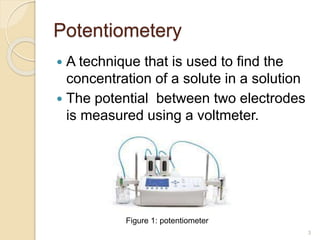
 A technique that is used to find the
concentration of a solute in a solution
 The potential between two electrodes
is measured using a voltmeter.
Figure 1: potentiometer
3
Principle
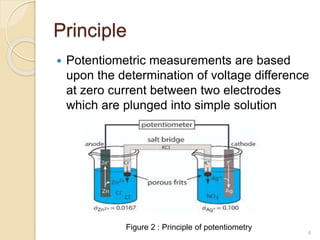
 Potentiometric measurements are based
upon the determination of voltage difference
at zero current between two electrodes
which are plunged into simple solution
Figure 2 : Principle of potentiometry
4
Each of the two electrodes
constitues a half cell.
The external reference electrode
(ERE), is the
electrochemical reference half cell
for which the potential is constant
with respect to that of sample
solution.
The indicator electrode(IE) ,also
known as working electrode.
5
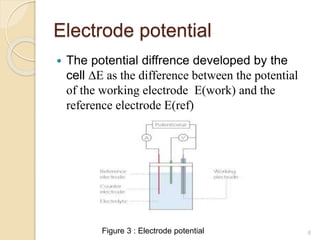
Electrode potential
 The potential diffrence developed by the
cell ∆E as the difference between the potential
of the working electrode E(work) and the
reference electrode E(ref)
Figure 3 : Electrode potential 6
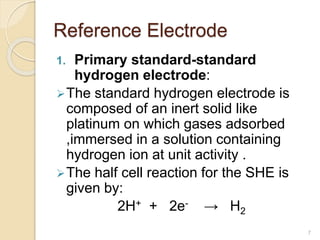
Reference Electrode
1. Primary standard-standard
hydrogen electrode:
The standard hydrogen electrode is
composed of an inert solid like
platinum on which gases adsorbed
,immersed in a solution containing
hydrogen ion at unit activity .
The half cell reaction for the SHE is
given by:
2H+ + 2e- → H2
7
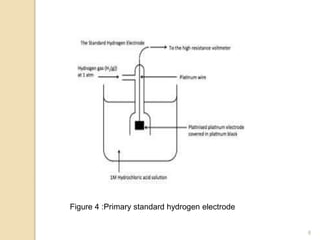
Figure 4 :Primary standard hydrogen electrode
8
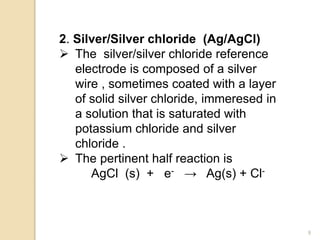
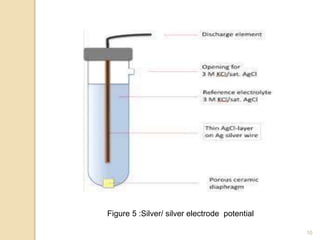
2. Silver/Silver chloride (Ag/AgCl)
 The silver/silver chloride reference
electrode is composed of a silver
wire , sometimes coated with a layer
of solid silver chloride, immeresed in
a solution that is saturated with
potassium chloride and silver
chloride .
 The pertinent half reaction is
AgCl (s) + e- → Ag(s) + Cl-
9
Figure 5 :Silver/ silver electrode potential
10
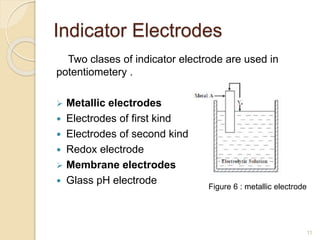
Indicator Electrodes
Two clases of indicator electrode are used in
potentiometery .
 Metallic electrodes
 Electrodes of first kind
 Electrodes of second kind
 Redox electrode
 Membrane electrodes
 Glass pH electrode
Figure 6 : metallic electrode
11
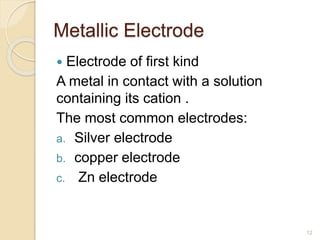
Metallic Electrode
 Electrode of first kind
A metal in contact with a solution
containing its cation .
The most common electrodes:
a. Silver electrode
b. copper electrode
c. Zn electrode
12
Metallic Electrodes
 Electrodes of second kind
 A metal wire that coated with one of its salts
precipitate
 Respond to change in ion activity through
formation of complex
 A common example is silver electrode and
AgCl as its salt precipitate
 Electrodes of third kind
 A metal can respond to the concentraton of
another metal ion in which it is in contact.
 These electrodes are rarely used
13
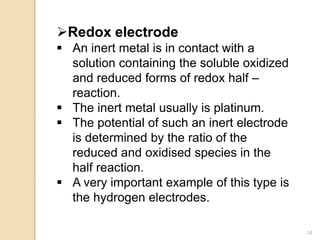
Redox electrode
 An inert metal is in contact with a
solution containing the soluble oxidized
and reduced forms of redox half –
reaction.
 The inert metal usually is platinum.
 The potential of such an inert electrode
is determined by the ratio of the
reduced and oxidised species in the
half reaction.
 A very important example of this type is
the hydrogen electrodes.
14
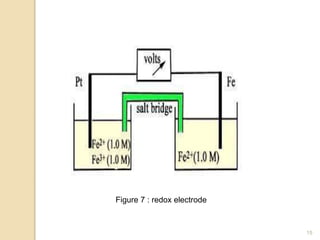
Figure 7 : redox electrode
15
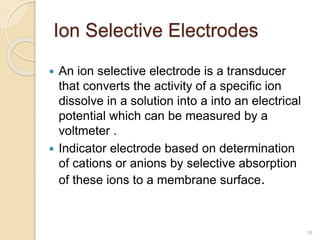
Ion Selective Electrodes
 An ion selective electrode is a transducer
that converts the activity of a specific ion
dissolve in a solution into a into an electrical
potential which can be measured by a
voltmeter .
 Indicator electrode based on determination
of cations or anions by selective absorption
of these ions to a membrane surface.
16
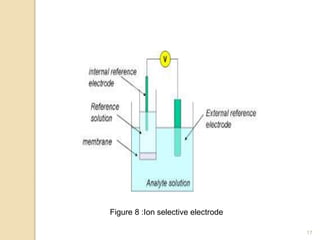
Figure 8 :Ion selective electrode
17
Types of ion selective electrode
 Glass membrane electrode
 Solid state electrode
 Liquid membrane electrode
 Gas sensing electrode
18
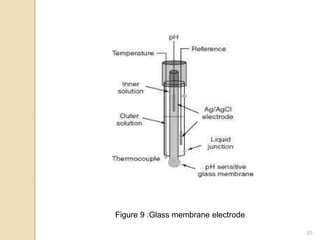
Glass membrane electrode
 Responsive to univalent cations
 Glass electrodes available for Na+,K+,Li+,Ag+ by
varying glass composition.
 The selectivity for this cation by varying the
composition of ion sensitive glass membrane.
 Glass membrane manufactured from SiO2w ith
negatively charged oxygen atom.
 The electrode is immersed in the solution and pH is
measured.
19
Figure 9 :Glass membrane electrode
20
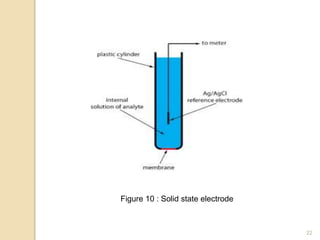
Solid state electrode
 Solid state electrode are selective primarily by
anions.
 It may be a homogenous membrane electrode and
heterogeneous membrane electrode.
 Homogenous membrane electrode :ion selective
electrodes in which the membrane is a crystalline
material.
 Heterogeneous membrane electrode : ion selective
electrodes prepared of an active substance , or
mixture of active substances.
21
Figure 10 : Solid state electrode
22
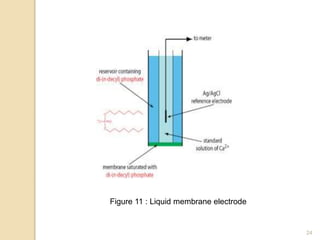
Liquid membrane electrode
 Liquid membrane is a type of ISE based on water-
immescible liquid substances produced in a
polymeric membrane used for direct potentiometric
measurement.
 Used for direct measurement of several polyvalent
cations as well as certain anions.
 Inner compartment of electrode contains reference
electrode and aqueous reference solution.
 Outer compartment – organic liquid ion exchanger
23
Figure 11 : Liquid membrane electrode
24
Applications of potentiometry
 Clinical chemistry
Ion selective electrodes are important sensors for
clinical samples because of their selectivity for
analytes.
Environmental Chemistry
For the analysis of cyanide,fluoride in water and
fresh water.
Agriculture
Chloride, potassium, iodide ,cyanide in soils, plant
material, fertilizers.
Detergent Manufacture
Ca,Ba,F for studying effects on water quality.
25
References
 Ion-Selective Electrodes in Analytical Chemistry
By Henry Freiser
 Potentiometry and ion selective electrodes
A.Evans,Wiley,21-july-1987-Science-304
pages.
 Potentiometry and potentiometric titrations
E.p. Serjeant .Wiley,29 –jun-1984-Science-725
pages
 https://www.britannica.com/science/potentiometry
26
27

Potentiometry presentation ppt physical chemistry

  • 1.
    Potentiometery Presented To :Dr. Sumaira Naeem Presented By : Kinza Qayyum Roll:No: 21017107-040 6th Semester (D) 1
  • 2.
    Table of contents •Potentiometery • Principle • Electrode potential 1. Reference electrode Primary SHE Silver /silver chloride 2. Indicator electrode Metallic electrode Membrane Ion selective electrode ◦ Applications ◦ References 2
  • 3.
    Potentiometery  A techniquethat is used to find the concentration of a solute in a solution  The potential between two electrodes is measured using a voltmeter. Figure 1: potentiometer 3
  • 4.
    Principle  Potentiometric measurementsare based upon the determination of voltage difference at zero current between two electrodes which are plunged into simple solution Figure 2 : Principle of potentiometry 4
  • 5.
    Each of thetwo electrodes constitues a half cell. The external reference electrode (ERE), is the electrochemical reference half cell for which the potential is constant with respect to that of sample solution. The indicator electrode(IE) ,also known as working electrode. 5
  • 6.
    Electrode potential  Thepotential diffrence developed by the cell ∆E as the difference between the potential of the working electrode E(work) and the reference electrode E(ref) Figure 3 : Electrode potential 6
  • 7.
    Reference Electrode 1. Primarystandard-standard hydrogen electrode: The standard hydrogen electrode is composed of an inert solid like platinum on which gases adsorbed ,immersed in a solution containing hydrogen ion at unit activity . The half cell reaction for the SHE is given by: 2H+ + 2e- → H2 7
  • 8.
    Figure 4 :Primarystandard hydrogen electrode 8
  • 9.
    2. Silver/Silver chloride(Ag/AgCl)  The silver/silver chloride reference electrode is composed of a silver wire , sometimes coated with a layer of solid silver chloride, immeresed in a solution that is saturated with potassium chloride and silver chloride .  The pertinent half reaction is AgCl (s) + e- → Ag(s) + Cl- 9
  • 10.
    Figure 5 :Silver/silver electrode potential 10
  • 11.
    Indicator Electrodes Two clasesof indicator electrode are used in potentiometery .  Metallic electrodes  Electrodes of first kind  Electrodes of second kind  Redox electrode  Membrane electrodes  Glass pH electrode Figure 6 : metallic electrode 11
  • 12.
    Metallic Electrode  Electrodeof first kind A metal in contact with a solution containing its cation . The most common electrodes: a. Silver electrode b. copper electrode c. Zn electrode 12
  • 13.
    Metallic Electrodes  Electrodesof second kind  A metal wire that coated with one of its salts precipitate  Respond to change in ion activity through formation of complex  A common example is silver electrode and AgCl as its salt precipitate  Electrodes of third kind  A metal can respond to the concentraton of another metal ion in which it is in contact.  These electrodes are rarely used 13
  • 14.
    Redox electrode  Aninert metal is in contact with a solution containing the soluble oxidized and reduced forms of redox half – reaction.  The inert metal usually is platinum.  The potential of such an inert electrode is determined by the ratio of the reduced and oxidised species in the half reaction.  A very important example of this type is the hydrogen electrodes. 14
  • 15.
    Figure 7 :redox electrode 15
  • 16.
    Ion Selective Electrodes An ion selective electrode is a transducer that converts the activity of a specific ion dissolve in a solution into a into an electrical potential which can be measured by a voltmeter .  Indicator electrode based on determination of cations or anions by selective absorption of these ions to a membrane surface. 16
  • 17.
    Figure 8 :Ionselective electrode 17
  • 18.
    Types of ionselective electrode  Glass membrane electrode  Solid state electrode  Liquid membrane electrode  Gas sensing electrode 18
  • 19.
    Glass membrane electrode Responsive to univalent cations  Glass electrodes available for Na+,K+,Li+,Ag+ by varying glass composition.  The selectivity for this cation by varying the composition of ion sensitive glass membrane.  Glass membrane manufactured from SiO2w ith negatively charged oxygen atom.  The electrode is immersed in the solution and pH is measured. 19
  • 20.
    Figure 9 :Glassmembrane electrode 20
  • 21.
    Solid state electrode Solid state electrode are selective primarily by anions.  It may be a homogenous membrane electrode and heterogeneous membrane electrode.  Homogenous membrane electrode :ion selective electrodes in which the membrane is a crystalline material.  Heterogeneous membrane electrode : ion selective electrodes prepared of an active substance , or mixture of active substances. 21
  • 22.
    Figure 10 :Solid state electrode 22
  • 23.
    Liquid membrane electrode Liquid membrane is a type of ISE based on water- immescible liquid substances produced in a polymeric membrane used for direct potentiometric measurement.  Used for direct measurement of several polyvalent cations as well as certain anions.  Inner compartment of electrode contains reference electrode and aqueous reference solution.  Outer compartment – organic liquid ion exchanger 23
  • 24.
    Figure 11 :Liquid membrane electrode 24
  • 25.
    Applications of potentiometry Clinical chemistry Ion selective electrodes are important sensors for clinical samples because of their selectivity for analytes. Environmental Chemistry For the analysis of cyanide,fluoride in water and fresh water. Agriculture Chloride, potassium, iodide ,cyanide in soils, plant material, fertilizers. Detergent Manufacture Ca,Ba,F for studying effects on water quality. 25
  • 26.
    References  Ion-Selective Electrodesin Analytical Chemistry By Henry Freiser  Potentiometry and ion selective electrodes A.Evans,Wiley,21-july-1987-Science-304 pages.  Potentiometry and potentiometric titrations E.p. Serjeant .Wiley,29 –jun-1984-Science-725 pages  https://www.britannica.com/science/potentiometry 26
  • 27.