POTENTIOMETERY
HISTORY
1. CHARLES J. PATRISSI and RUSSELL
citizens of the United States of America, invented certain
new and useful improvements like potentiometry.
 The slide-wire potentiometer was invented by Johann
Christian Poggendorff (1796-1877) in 1841.
 Leeds and Northrup Type K model was a standard piece of
apparatus in most college and university electrical
measurements laboratories for the first half of the 20th
century
FOUR BASIC ELECTROANALYTICAL
METHODS OF ANALYSIS
1) Potentiometric
2) Voltametric, Polarographic, Amperometric
3) Electrolysis: Electrogravimetric and coulometric
4) Conductometric
Definition :
Potentiometry : Field of electro analytical chemistry in which
potential is measured under the condition of no current flow.
OR
Potentiometry is the method used in electroanalytical chemistry
usually to find the concentration of solute in solution by
measuring the potential between two electrode.
PRINCIPLE
 When a metal strip is placed in a solution of its own ions
there are two possibilities or tendencies:
 Metal atoms may dissolve in the solution as positive ions
leaving electrons on the electrode.
 Metal ions may take up electrons from electrode and get
deposited as neutral atoms
 In this way A POTENTIAL DIFFERENCE is setup b/w
electrode and solution.
PROCEDURE
 Potentiometer instrument is used to determine the potential
differences between a reference electrode and an indicator
electrode. These two electrodes form electro chemical cell
that are dipped in solution to be analyzed.
 Measured potential can be used to determine the quantity of
analyte in terms of concentration.
Electrode potential
 Tendency of electrode to lose or gain electrons
Standard Potential
 Potential of pure metal when it is dipped in 1 Molar
solution of its own ions at 25°C (298K) is known as
standard Electrode potential.
Oxidation Potential
 The potential of substance to get oxidized is called
oxidation potential.
Reduction Potential
 The potential of substance to get reduced is called
reduction potential.
CONSTRUCTION
 Potentiometric cell has following parts :
 Electrodes
 Salt bridge
 Analytical solution
 Galvanometer
WORKING
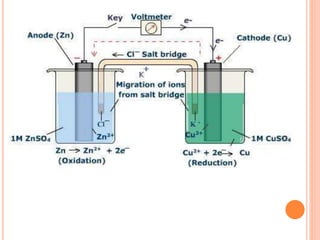
 A potentiometer consists of two electrodes, whose
reduction potentials differ, inserted in a test solution.
 The voltmeter is attached to the electrodes to measure the
potential difference between them.
 One of the electrodes is a reference electrode, whose
electrode potential is known.
 The other electrode is the INDICATOR (test) electrode.
 The test electrode is usually either a metal immersed in a
solution of its own ions, whose concentration is to be
determined.
1. Oxidation take place at anode.
For example on zinc electrode
Zn → Zn2+ + 2e-
2. Reduction take place at cathode.
For example on copper electrode
Cu2+ + 2e-→ Cu
When redox reaction take place, potential develops which is
measured by galvanometer.
 Electrode Potential is the potential of electrochemical cell and
can be represented as :
E cell = E indicator - E reference +E j
Ej= potential develops across the liquid junction at each end
of salt bridge it is negligible .
ELECTRODES
Reference Electrode
1. Standard Hydrogen electrode
2. Calomel electrode
3. Silver-Silver Chloride electrode
Indicator Electrode
1. Metal Electrode
2. Hydrogen electrode
3. Quinhydrone electrode
4. Glass Membrane Electrode
REFERENCE ELECTRODE
 The standard H2 electrode potential is defined as the
potential that is developed between the H2 gas adsorbed
on the pt metal and H+ of the solution when the H2 gas at a
pressure of 760 mm of Hg is in equilibrium with H+ of unit
concentration.
Working:
 Pt foil : coated with black pt
 1 molar HCl solution
 Pure H2 gas bubbled continuously at 1 atm.
 Pt act as conductor, inert and facilitate in attaining
equilibrium
 Electrode Potential is 0.00 volts
 H2 (gas) ↔ 2H+ (ions) + 2e- (electrons)
LIMITATIONS
1. Can’t be used in solution containing strong oxidizing
agents.
2. Difficult and expensive to maintain.
3. Excess of H2 bubbling out carries little HCl with it and
hence the H + concentration decreases. In such a system,
it is difficult to maintain the concentration of HCl at 1M.
CALOMEL ELECTRODE
CALOMEL ELECTRODE COMMONLY USED
 Tube 5-15cm long, 0.5-1 cm in diameter.
 Slurry of mercury & mercurous chloride with saturated soln of KCl
 Connected by a small opening with saturated solution of KCl.
 Pt metal is placed inside the slurry
 Ceramic fiber act as salt bridge
 2Hg +2Cl¯ → Hg2Cl2 + 2e¯ E = 0.2444 at 25°C
Advantages
 Concentration of chloride ions don’t change even some of the
solvent get evaporated.
 Generates small junction potential so more accurate
 Limitations
 Mostly saturated solution of KCl is used, temperature dependent.
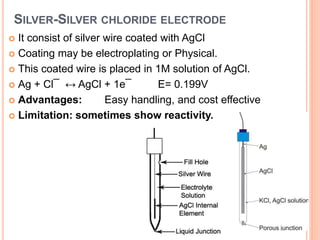
SILVER-SILVER CHLORIDE ELECTRODE
 It consist of silver wire coated with AgCl
 Coating may be electroplating or Physical.
 This coated wire is placed in 1M solution of AgCl.
 Ag + Cl¯ ↔ AgCl + 1e¯ E= 0.199V
 Advantages: Easy handling, and cost effective
 Limitation: sometimes show reactivity.
INDICATOR ELECTRODES
 Metal Indicator Electrodes
Metal electrode develops electric potential as a result of redox
reaction at its surface.
1. First Order Electrode
 A first order electrode involves the metal in contact with its own
ions, such as Ag, Ag+ Or Zn, Zn++.
Ag⁺ + e¯ ↔ Ag (s) E= 0.800
 Limitation:
 metallic indicator electrodes are not very selective and respond
not only to their own cations but also to other more easily
reduced cations.
 Many metal electrodes can be used only in neutral or basic
solutions because they dissolve in the presence of acids
2.Second order Electrode
 A second-order electrode is one that responds to the presence
of precipitating or complexing ions. For example, silver wire
could serve as the indicator electrode for chloride.
 Ag +Cl¯ ↔ AgCl + e¯ E= 0.199
3. Inert Electrode
The most commonly used indicator electrodes are known as
inert. These electrodes are not involved in the half-cell
reactions of the electrochemical species. Typical inert
electrodes are platinum, gold, and carbon. Inert electrodes are
responsive to any reversible redox system; these are widely
used in potentiometric work.
GLASS MEMBRANE ELECTRODE
 Its most commonly used indicator electrode
 It involves Ion Exchange reaction
 Membrane is made up of chemically bonded Na2O, SiO2 and
Al2O3
 The Glass bulb is filled with solution of HCl & KCl, silver
acetate coated with AgCl, is inserted as Electrode.
 First glass absorb water, Then H ⁺ can move in the direction of
lesser concentration and replace Na ⁺and others in the glass
membrane.
 SiO2-Na⁺ + H⁺ → SiO- H⁺ + Na⁺
 As a result of diffusion and exchange process a potential
develops on each side of glass membrane
Applications
It’s potential is not effected by the presence of strong
reducing and oxidizing agents.
It operates over a wide pH range
It respond fast and function well in physiological systems
Used in pH meter.
 Hydrogen Electrode
 Used in acid base titration but very limited application because
many organic substances directly react with hydrogen gas.
Quinhydrone Electrode:
 Contain a solution of Quinones and Hydroquinones prepared from
Quinhydrone
 2QH → Q+H2Q
 Simple and easily attains equilibrium
 employed in the presence of mild ox. and red agents at pH8
 Sensitive to high conc of salts and oxi & red agents.
 The electrode consists of an inert metal electrode (usually a
platinum wire) in contact with quinhydrone crystals and a water-
based solution.
 Quinhydrone is slightly soluble in water, dissolving to form a
mixture of two substances, quinone and hydroquinone, with the two
substances present at equal concentration. Each one of the two
substances can easily be oxidised or reduced to the other.
 The potential at the inert electrode depends on the ratio of the activity of
two substances (quinone-hydroquinone), and also the hydrogen ion
concentration. The electrode half-reaction is:
 Hydroquinone ↔ Quinone + 2H+ + 2e-
 For practical pH measurement, a second pH independent reference
electrode (such as a silver chloride electrode) is also used. This reference
electrode does not respond to the pH. The difference between the
potential of the two electrodes depends (primarily) on the activity of H+
in the solution. It is this potential difference which is measured and
converted to a pH value.
 The quinhydrone electrode is not reliable above pH 8. It is also
unreliable in the presence of strong oxidising or reducing agents, which
would disturb the equilibrium between hydroquinone and quinone. It is
also subjected to errors in solutions containing proteins or high
concentrations of salts.
 Other electrodes commonly used for measuring pH are the glass
electrode, the hydrogen electrode, the antimony – antimony oxide
electrode, and the ion-sensitive field effect transistor ISFET electrode.
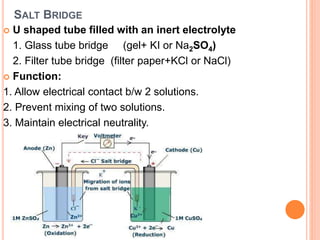
SALT BRIDGE
 U shaped tube filled with an inert electrolyte
1. Glass tube bridge (gel+ KI or Na2SO4)
2. Filter tube bridge (filter paper+KCl or NaCl)
 Function:
1. Allow electrical contact b/w 2 solutions.
2. Prevent mixing of two solutions.
3. Maintain electrical neutrality.
TITRATION
 Quantitative measuring procedure in which a liquid solution
is added to a mixture until some distinctive feature, signal or
end point is observed.
Potentiometric Titration
It’s a volumetric method in which potential between two
electrodes (reference & indicator) is measured as a function
of added reagent volume.
Types
1. Precipitation titration
2. Complex formation Titration
3. Neutralization titration
4. Oxidation – reduction
titration
PRECIPITATION TITRATION
Volumetric methods based upon the formation of slightly
soluble precipitate are called " precipitation titration " .
Because of the precipitating titration based upon utilizing
silver nitrate (AgNO3) as a precipitating agent, then it’s
called as " argentimetric processes "
Precipitation titration is a very important , because it is a
perfect method for determine halogens and some metal ions
Complex formation Titration
 Complex ions ( coordination compounds) are produced from
reaction of many metal ions (electrons accepter) with electron pair
donors .
 The donor species (or called ligands) must have at least one pair of
unshared electrons for bond formation.
Neutralization Titration
 Neutralization titrations are performed with standard solutions of
strong acids or bases. While a single solution (of either acid or
base) is sufficient for the titration of a given type of analyte, it is
convenient to have standard solutions of both acid and base
available in case back-titration is needed to locate the end point
more exactly.
 The concentration of one solution is established by titration
against a primary standard; the concentration of the other is then
determined from the acid/ base ratio (that is, the volume of acid
needed to neutralize 1.000 mL of the base).
OXIDATION-REDUCTION TITRATION
 A redox titration is a type of titration based on a redox
reaction between the analyte and titrant.
 Redox titration may involve the use of a redox indicator
and/or a potentiometer. Common examples of a redox
titration is treating a solution of iodine with a reducing
agent and using starch as an indicator. Iodine forms an
intensely blue complex with starch. Iodine (I2) can be
reduced to iodide(I-) by
 e.g. thiosulphate (S2O3
2-), and when all iodine is spent the
blue colour disappears. This is called an iodometric titration
 Add 1-2 cm3 of 0.1 N NaOH solution from the burette
 operate the magnetic stirrer for 2 minutes, stop it, wait for 1
minute and measure the E.M.F.
 Repeat the above step, each time adding one or two more
cm3 of NaOH at a time and go on noting the EMF after each
addition.
 When the volume reached near about 1 cm3 of the expected
equivalence point. (approximate), add the solution from the
burette in 0.5 cm 3 instalments and note the potential each
time.
 Continue adding these instalments even after the equivalence
point (This can be easily observed from the change in the
measured potentials). The change becomes very small.
Continue for another 3-4 additions & note the potential
readings.
TITRATION OBSERVATION TABLE
SN Vol. NaoH (ml)
A
EMF(E)
B
ΔV
C
ΔE/ΔV
D
ΔV2
E
ΔE2/ΔV2
F
(A2+A1)/2 (B2-B1)/
(A2-A1)
(C2+C1)/2 (D2-D1)/
(E2-E1)
1 1.5 394 2.0 5.6 2.4 0.4
2 2.4 399 2.9 6.0 3.4 1.2
3 3.4 405 3.95 7.3 4.5 -1.8
4 4.5 413 5.05 5.5 5.5 -1.8
5 5.6 419 6 3.8 6.5 1.7
6 6.4 422 6.95 5.5 7.5 1.5
7 7.5 428 8 7.0 8.5 1.2
8 8.5 435 9.05 8.2 9.6 -1.6
9 9.6 444 10.05 6.7 10.5 0.4
10 10.5 450 11 7.0 11.5 -0.3
11 11.5 457 11.95 6.7 12.5 0.6
12 12.4 463 12.95 7.3 13.5 2.5
13 13.5 471 14.05 10.0 14.6 -1.0
0
200
400
600
800
1000
1200
0 5 10 15 20 25 30
EMF
0.0
100.0
200.0
300.0
400.0
500.0
600.0
700.0
800.0
900.0
1000.0
0.0 5.0 10.0 15.0 20.0 25.0 30.0
DEMF
-3000.0
-2000.0
-1000.0
0.0
1000.0
2000.0
3000.0
4000.0
0.0 5.0 10.0 15.0 20.0 25.0 30.0
D2EMF
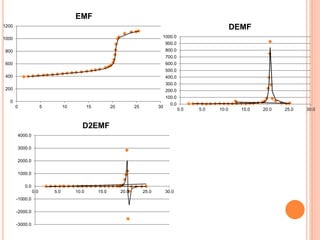
From the plotted graph, the volume of alkali used
corresponding to the equivalence point = ……………V
cm3
Applying the molarity equation M1V1 = M2V2
(Hydrochloric acid) (Sodium hydroxide)
Molarity of sodium hydroxide solution will be
M2 = M1 V1/V2 mol dm-3
APPLICATIONS OF POTENTIOMETRY
 Analysis of pollutants in water
 Drug Analysis in Pharmaceutical industry
 Food industry for analysis of quality
 Biochemical and biological Assay or analysis
 To check the quality of cosmetics
 Also used as analytical tool in Textile, paper, paints,
explosive energy and more .

POTENTIOMETERY.pptx notes in short .....

  • 1.
  • 2.
    HISTORY 1. CHARLES J.PATRISSI and RUSSELL citizens of the United States of America, invented certain new and useful improvements like potentiometry.  The slide-wire potentiometer was invented by Johann Christian Poggendorff (1796-1877) in 1841.  Leeds and Northrup Type K model was a standard piece of apparatus in most college and university electrical measurements laboratories for the first half of the 20th century
  • 3.
    FOUR BASIC ELECTROANALYTICAL METHODSOF ANALYSIS 1) Potentiometric 2) Voltametric, Polarographic, Amperometric 3) Electrolysis: Electrogravimetric and coulometric 4) Conductometric Definition : Potentiometry : Field of electro analytical chemistry in which potential is measured under the condition of no current flow. OR Potentiometry is the method used in electroanalytical chemistry usually to find the concentration of solute in solution by measuring the potential between two electrode.
  • 4.
    PRINCIPLE  When ametal strip is placed in a solution of its own ions there are two possibilities or tendencies:  Metal atoms may dissolve in the solution as positive ions leaving electrons on the electrode.  Metal ions may take up electrons from electrode and get deposited as neutral atoms  In this way A POTENTIAL DIFFERENCE is setup b/w electrode and solution.
  • 5.
    PROCEDURE  Potentiometer instrumentis used to determine the potential differences between a reference electrode and an indicator electrode. These two electrodes form electro chemical cell that are dipped in solution to be analyzed.  Measured potential can be used to determine the quantity of analyte in terms of concentration.
  • 6.
    Electrode potential  Tendencyof electrode to lose or gain electrons Standard Potential  Potential of pure metal when it is dipped in 1 Molar solution of its own ions at 25°C (298K) is known as standard Electrode potential. Oxidation Potential  The potential of substance to get oxidized is called oxidation potential. Reduction Potential  The potential of substance to get reduced is called reduction potential.
  • 7.
    CONSTRUCTION  Potentiometric cellhas following parts :  Electrodes  Salt bridge  Analytical solution  Galvanometer
  • 8.
    WORKING  A potentiometerconsists of two electrodes, whose reduction potentials differ, inserted in a test solution.  The voltmeter is attached to the electrodes to measure the potential difference between them.  One of the electrodes is a reference electrode, whose electrode potential is known.  The other electrode is the INDICATOR (test) electrode.  The test electrode is usually either a metal immersed in a solution of its own ions, whose concentration is to be determined.
  • 9.
    1. Oxidation takeplace at anode. For example on zinc electrode Zn → Zn2+ + 2e- 2. Reduction take place at cathode. For example on copper electrode Cu2+ + 2e-→ Cu When redox reaction take place, potential develops which is measured by galvanometer.  Electrode Potential is the potential of electrochemical cell and can be represented as : E cell = E indicator - E reference +E j Ej= potential develops across the liquid junction at each end of salt bridge it is negligible .
  • 11.
    ELECTRODES Reference Electrode 1. StandardHydrogen electrode 2. Calomel electrode 3. Silver-Silver Chloride electrode Indicator Electrode 1. Metal Electrode 2. Hydrogen electrode 3. Quinhydrone electrode 4. Glass Membrane Electrode
  • 12.
    REFERENCE ELECTRODE  Thestandard H2 electrode potential is defined as the potential that is developed between the H2 gas adsorbed on the pt metal and H+ of the solution when the H2 gas at a pressure of 760 mm of Hg is in equilibrium with H+ of unit concentration. Working:  Pt foil : coated with black pt  1 molar HCl solution  Pure H2 gas bubbled continuously at 1 atm.  Pt act as conductor, inert and facilitate in attaining equilibrium  Electrode Potential is 0.00 volts  H2 (gas) ↔ 2H+ (ions) + 2e- (electrons)
  • 14.
    LIMITATIONS 1. Can’t beused in solution containing strong oxidizing agents. 2. Difficult and expensive to maintain. 3. Excess of H2 bubbling out carries little HCl with it and hence the H + concentration decreases. In such a system, it is difficult to maintain the concentration of HCl at 1M.
  • 15.
  • 16.
    CALOMEL ELECTRODE COMMONLYUSED  Tube 5-15cm long, 0.5-1 cm in diameter.  Slurry of mercury & mercurous chloride with saturated soln of KCl  Connected by a small opening with saturated solution of KCl.  Pt metal is placed inside the slurry  Ceramic fiber act as salt bridge  2Hg +2Cl¯ → Hg2Cl2 + 2e¯ E = 0.2444 at 25°C Advantages  Concentration of chloride ions don’t change even some of the solvent get evaporated.  Generates small junction potential so more accurate  Limitations  Mostly saturated solution of KCl is used, temperature dependent.
  • 17.
    SILVER-SILVER CHLORIDE ELECTRODE It consist of silver wire coated with AgCl  Coating may be electroplating or Physical.  This coated wire is placed in 1M solution of AgCl.  Ag + Cl¯ ↔ AgCl + 1e¯ E= 0.199V  Advantages: Easy handling, and cost effective  Limitation: sometimes show reactivity.
  • 18.
    INDICATOR ELECTRODES  MetalIndicator Electrodes Metal electrode develops electric potential as a result of redox reaction at its surface. 1. First Order Electrode  A first order electrode involves the metal in contact with its own ions, such as Ag, Ag+ Or Zn, Zn++. Ag⁺ + e¯ ↔ Ag (s) E= 0.800  Limitation:  metallic indicator electrodes are not very selective and respond not only to their own cations but also to other more easily reduced cations.  Many metal electrodes can be used only in neutral or basic solutions because they dissolve in the presence of acids
  • 19.
    2.Second order Electrode A second-order electrode is one that responds to the presence of precipitating or complexing ions. For example, silver wire could serve as the indicator electrode for chloride.  Ag +Cl¯ ↔ AgCl + e¯ E= 0.199 3. Inert Electrode The most commonly used indicator electrodes are known as inert. These electrodes are not involved in the half-cell reactions of the electrochemical species. Typical inert electrodes are platinum, gold, and carbon. Inert electrodes are responsive to any reversible redox system; these are widely used in potentiometric work.
  • 20.
    GLASS MEMBRANE ELECTRODE Its most commonly used indicator electrode  It involves Ion Exchange reaction  Membrane is made up of chemically bonded Na2O, SiO2 and Al2O3  The Glass bulb is filled with solution of HCl & KCl, silver acetate coated with AgCl, is inserted as Electrode.  First glass absorb water, Then H ⁺ can move in the direction of lesser concentration and replace Na ⁺and others in the glass membrane.  SiO2-Na⁺ + H⁺ → SiO- H⁺ + Na⁺  As a result of diffusion and exchange process a potential develops on each side of glass membrane
  • 21.
    Applications It’s potential isnot effected by the presence of strong reducing and oxidizing agents. It operates over a wide pH range It respond fast and function well in physiological systems Used in pH meter.
  • 22.
     Hydrogen Electrode Used in acid base titration but very limited application because many organic substances directly react with hydrogen gas. Quinhydrone Electrode:  Contain a solution of Quinones and Hydroquinones prepared from Quinhydrone  2QH → Q+H2Q  Simple and easily attains equilibrium  employed in the presence of mild ox. and red agents at pH8  Sensitive to high conc of salts and oxi & red agents.  The electrode consists of an inert metal electrode (usually a platinum wire) in contact with quinhydrone crystals and a water- based solution.  Quinhydrone is slightly soluble in water, dissolving to form a mixture of two substances, quinone and hydroquinone, with the two substances present at equal concentration. Each one of the two substances can easily be oxidised or reduced to the other.
  • 23.
     The potentialat the inert electrode depends on the ratio of the activity of two substances (quinone-hydroquinone), and also the hydrogen ion concentration. The electrode half-reaction is:  Hydroquinone ↔ Quinone + 2H+ + 2e-  For practical pH measurement, a second pH independent reference electrode (such as a silver chloride electrode) is also used. This reference electrode does not respond to the pH. The difference between the potential of the two electrodes depends (primarily) on the activity of H+ in the solution. It is this potential difference which is measured and converted to a pH value.  The quinhydrone electrode is not reliable above pH 8. It is also unreliable in the presence of strong oxidising or reducing agents, which would disturb the equilibrium between hydroquinone and quinone. It is also subjected to errors in solutions containing proteins or high concentrations of salts.  Other electrodes commonly used for measuring pH are the glass electrode, the hydrogen electrode, the antimony – antimony oxide electrode, and the ion-sensitive field effect transistor ISFET electrode.
  • 24.
    SALT BRIDGE  Ushaped tube filled with an inert electrolyte 1. Glass tube bridge (gel+ KI or Na2SO4) 2. Filter tube bridge (filter paper+KCl or NaCl)  Function: 1. Allow electrical contact b/w 2 solutions. 2. Prevent mixing of two solutions. 3. Maintain electrical neutrality.
  • 25.
    TITRATION  Quantitative measuringprocedure in which a liquid solution is added to a mixture until some distinctive feature, signal or end point is observed. Potentiometric Titration It’s a volumetric method in which potential between two electrodes (reference & indicator) is measured as a function of added reagent volume. Types 1. Precipitation titration 2. Complex formation Titration 3. Neutralization titration 4. Oxidation – reduction titration
  • 26.
    PRECIPITATION TITRATION Volumetric methodsbased upon the formation of slightly soluble precipitate are called " precipitation titration " . Because of the precipitating titration based upon utilizing silver nitrate (AgNO3) as a precipitating agent, then it’s called as " argentimetric processes " Precipitation titration is a very important , because it is a perfect method for determine halogens and some metal ions
  • 27.
    Complex formation Titration Complex ions ( coordination compounds) are produced from reaction of many metal ions (electrons accepter) with electron pair donors .  The donor species (or called ligands) must have at least one pair of unshared electrons for bond formation. Neutralization Titration  Neutralization titrations are performed with standard solutions of strong acids or bases. While a single solution (of either acid or base) is sufficient for the titration of a given type of analyte, it is convenient to have standard solutions of both acid and base available in case back-titration is needed to locate the end point more exactly.  The concentration of one solution is established by titration against a primary standard; the concentration of the other is then determined from the acid/ base ratio (that is, the volume of acid needed to neutralize 1.000 mL of the base).
  • 28.
    OXIDATION-REDUCTION TITRATION  Aredox titration is a type of titration based on a redox reaction between the analyte and titrant.  Redox titration may involve the use of a redox indicator and/or a potentiometer. Common examples of a redox titration is treating a solution of iodine with a reducing agent and using starch as an indicator. Iodine forms an intensely blue complex with starch. Iodine (I2) can be reduced to iodide(I-) by  e.g. thiosulphate (S2O3 2-), and when all iodine is spent the blue colour disappears. This is called an iodometric titration
  • 29.
     Add 1-2cm3 of 0.1 N NaOH solution from the burette  operate the magnetic stirrer for 2 minutes, stop it, wait for 1 minute and measure the E.M.F.  Repeat the above step, each time adding one or two more cm3 of NaOH at a time and go on noting the EMF after each addition.  When the volume reached near about 1 cm3 of the expected equivalence point. (approximate), add the solution from the burette in 0.5 cm 3 instalments and note the potential each time.  Continue adding these instalments even after the equivalence point (This can be easily observed from the change in the measured potentials). The change becomes very small. Continue for another 3-4 additions & note the potential readings.
  • 30.
    TITRATION OBSERVATION TABLE SNVol. NaoH (ml) A EMF(E) B ΔV C ΔE/ΔV D ΔV2 E ΔE2/ΔV2 F (A2+A1)/2 (B2-B1)/ (A2-A1) (C2+C1)/2 (D2-D1)/ (E2-E1) 1 1.5 394 2.0 5.6 2.4 0.4 2 2.4 399 2.9 6.0 3.4 1.2 3 3.4 405 3.95 7.3 4.5 -1.8 4 4.5 413 5.05 5.5 5.5 -1.8 5 5.6 419 6 3.8 6.5 1.7 6 6.4 422 6.95 5.5 7.5 1.5 7 7.5 428 8 7.0 8.5 1.2 8 8.5 435 9.05 8.2 9.6 -1.6 9 9.6 444 10.05 6.7 10.5 0.4 10 10.5 450 11 7.0 11.5 -0.3 11 11.5 457 11.95 6.7 12.5 0.6 12 12.4 463 12.95 7.3 13.5 2.5 13 13.5 471 14.05 10.0 14.6 -1.0
  • 31.
    0 200 400 600 800 1000 1200 0 5 1015 20 25 30 EMF 0.0 100.0 200.0 300.0 400.0 500.0 600.0 700.0 800.0 900.0 1000.0 0.0 5.0 10.0 15.0 20.0 25.0 30.0 DEMF -3000.0 -2000.0 -1000.0 0.0 1000.0 2000.0 3000.0 4000.0 0.0 5.0 10.0 15.0 20.0 25.0 30.0 D2EMF
  • 32.
    From the plottedgraph, the volume of alkali used corresponding to the equivalence point = ……………V cm3 Applying the molarity equation M1V1 = M2V2 (Hydrochloric acid) (Sodium hydroxide) Molarity of sodium hydroxide solution will be M2 = M1 V1/V2 mol dm-3
  • 33.
    APPLICATIONS OF POTENTIOMETRY Analysis of pollutants in water  Drug Analysis in Pharmaceutical industry  Food industry for analysis of quality  Biochemical and biological Assay or analysis  To check the quality of cosmetics  Also used as analytical tool in Textile, paper, paints, explosive energy and more .