Acute Kidney Injury
Hamza Obaid
6th year medical student
Cairo University
45%
147mEq/L
5.2 mEq/L
70 mg/dl
1.8 mg/dl
A 70-year-old woman is brought to the emergency department by her daughter because
of altered mental status. She lives alone and is able to perform all daily activities. She
experienced a minor febrile illness with decreased appetite several days ago, but has
otherwise been in good health. She takes no medications. Her temperature is 37.2° C
(99° F), blood pressure is 92/50 mm Hg, pulse is 100/min, and respirations are 18/min.
Physical examination shows dry oral mucosa. Laboratory studies show:
Hematocrit
Serum sodium
Serum potassium
BUN
Serum creatinine
Definition of AKI
 Abrupt decrease in kidney function, resulting in the retention of
urea and other nitrogenous waste products and in the
dysregulation of extracellular volume and electrolytes.
 Term AKI
DIAGNOSTIC CRITERIA
 The Kidney Disease: Improving Global Outcomes (KDIGO) definition and
staging system is the most recent and preferred definition
 RIFLE criteria and a subsequent modification proposed by the Acute
Kidney Injury Network (AKIN)
The KDIGO guidelines define AKI as follows:
●Increase in serum creatinine by ≥0.3 mg/dL within 48 hours
●Increase in serum creatinine to ≥1.5 times baseline, which is known or presumed to
have occurred within the prior seven days
●Urine volume <0.5 mL/kg/hour for six hours
Using the Kidney Disease: Improving Global Outcomes
(KDIGO) criteria, AKI is staged as follows
Stage 1
• ++serum creatinine to1.5
to 1.9 times baseline or
++ serum creatinine by
≥0.3 mg/dL
• reduction in urine output
to <0.5 mL/kg/hour for 6
to 12 hours.
Stage 2
• to 2.0 to 2.9 times
baseline
• reduction in urine output
to <0.5 mL/kg/hour for
≥12 hours.
Stage 3
• to 3.0 times baseline or
serum creatinine by
≥4.0 mg/dL
• or reduction in urine
output to
<0.3 mL/kg/hour for ≥24
hours,
• or anuria for ≥12 hours
• the initiation of renal
replacement therapy, or,
• in patients <18 years,
decrease in estimated
Prerenal disease
Decreased kidney function due to prerenal disease occurs in two settings
1. When renal ischemia is part of a generalized decrease in tissue perfusion
2. When there is selective renal ischemia
Prerenal disease:
Pathophysiologymean arterial
pressure is reduced
activation of cardiac
and arterial
receptors
•The arteriolar vasoconstriction occurs
primarily in the renal, splanchnic, and
musculocutaneous circulations
increases
sympathetic neural
tone and the
release of both
renin and
antidiuretic
hormone
ensuing VC and
stimulation of
cardiac function
the relative
preservation of
blood flow to the
heart and brain
Prerenal Casuses
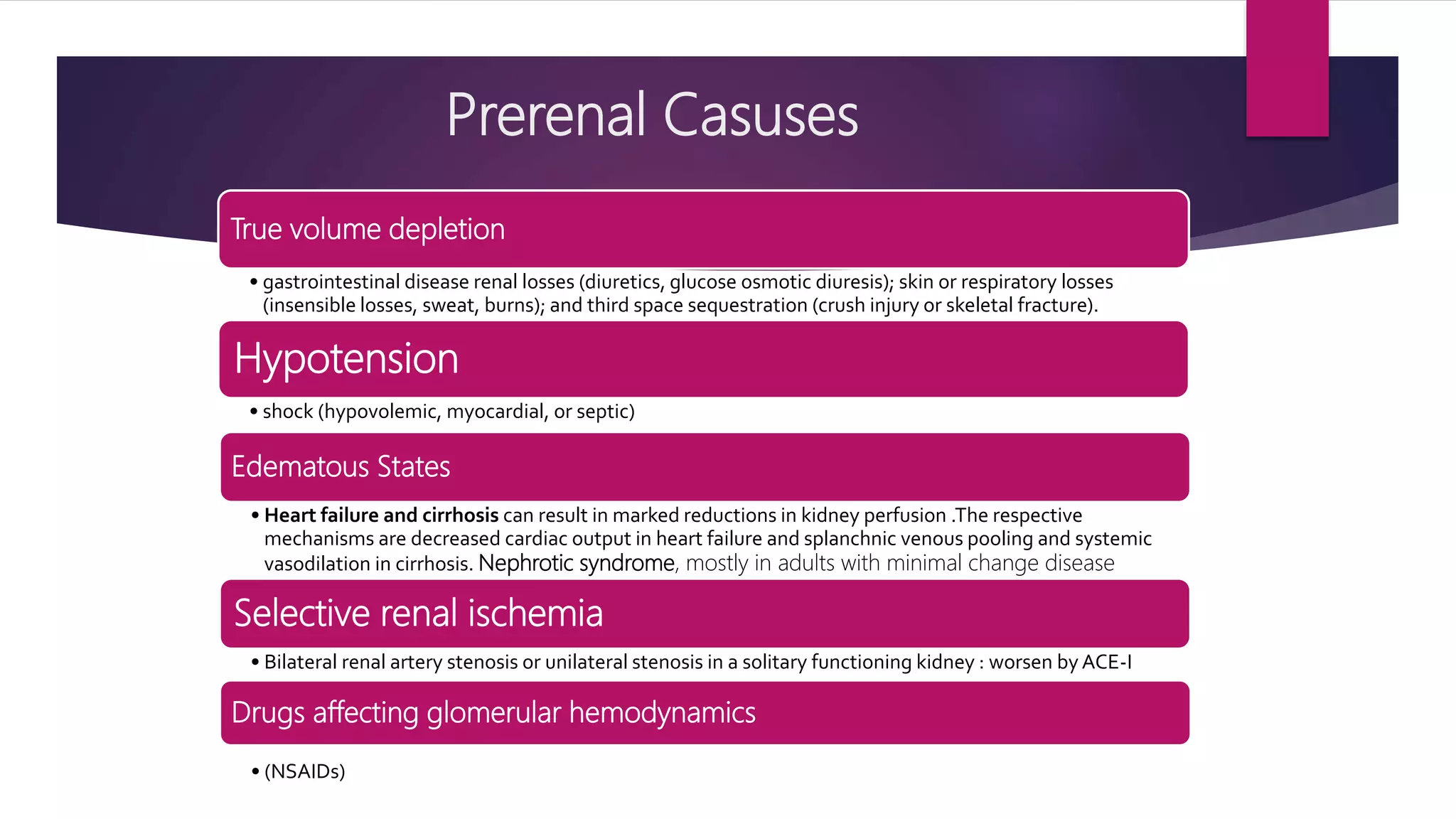
True volume depletion
• gastrointestinal disease renal losses (diuretics, glucose osmotic diuresis); skin or respiratory losses
(insensible losses, sweat, burns); and third space sequestration (crush injury or skeletal fracture).
Hypotension
• shock (hypovolemic, myocardial, or septic)
Edematous States
• Heart failure and cirrhosis can result in marked reductions in kidney perfusion .The respective
mechanisms are decreased cardiac output in heart failure and splanchnic venous pooling and systemic
vasodilation in cirrhosis. Nephrotic syndrome, mostly in adults with minimal change disease
Selective renal ischemia
• Bilateral renal artery stenosis or unilateral stenosis in a solitary functioning kidney : worsen by ACE-I
Drugs affecting glomerular hemodynamics
• (NSAIDs)
 The effect of nonsteroidal antiinflammatory drugs is
primarily seen in patients with underlying renal
hypoperfusion due to true volume depletion, heart failure,
or cirrhosis, in which prostaglandin synthesis within or near
the glomerulus is increased by vasoconstrictors such as
angiotensin II and norepinephrine and vasodilator
prostaglandins help preserve renal reperfusion and
glomerular filtration.
 ACE-I ??
Drugs affecting glomerular hemodynamics
Prerenal Casuses
Prerenal disease
The glomeruli, kidney tubules, and interstitium are intact.
The appropriate treatment is to increase renal perfusion, as with volume repletion in
patients with true volume depletion
A 57-year-old woman is admitted to the ICU after being involved in a highway motor vehicle accident. She
was hypotensive at the scene and received 7 liters of fluids, which included crystalloids, blood, and fresh
frozen plasma. She apparently had significant external blood loss from multiple fractures and skin loss. She
undergoes surgery, after which she is transferred to the ICU and receives continuous IV fluids and
vasopressors. Her laboratory studies 24 hours after the accident show the following:
Hb 9.5 g/dl
WBC 15,000/cmm
Platelets 130,000/cmm
BUN 34 mg/dl
Serum Creatinine 2.2 mg/dl
 Which of the following is the most likely microscopic finding on urinalysis?
A Broad cast
B. Muddy brown cast
C. RBC casts
D. WBC casts
E. Fatty casts
F. Eosinophils
Acute tubular necrosis
severe prerenal disease
Renal ischemia
• particularly if accompanied by hypotension, surgery, and/or sepsis, can cause ischemic ATN.
• ATN is an unusual complication of heart failure
.
Sepsis
• prerenal factors such as decreased renal perfusion and systemic hypotension.
• Other, release of cytokines and activation of neutrophils by cytokines
Nephrotoxins
• Aminoglycosides - Heme pigments- Cisplatin - Radiocontrast media- ntravenous
immunoglobulin (sucrose)- Hetastarch ,also called hydroxyethyl starch(icu)- urate
Allergic interstitial
nephritis
FREQUENCY OF PRERENAL DISEASE AND ACUTE TUBULAR NECROSIS
AS A CAUSE OF AKI
- 9 % of hospitalized patients
* Approximately 65 to 75 % of cases of AKI in the hospital are due to either prerenal disease or ATN.
* The most frequent causes were:
●ATN – 45 percent
●Prerenal disease – 21 percent
●Acute on chronic renal failure – 13 percent (mostly due to ATN or prerenal disease)
●Urinary tract obstruction – 10 percent
●Glomerulonephritis or vasculitis – 4 percent
●Acute interstitial nephritis – 2 percent
●Atheroemboli – 1 percent
- More than 50 % of patients in the ICU
Post-renal : Urinary outflow tract
obstruction
Post-renal
Intrinsic
Intra-luminal
Intra-mural
Extrinsic
- Pelvic malignancies
- Prolapsed uterus
- Retroperitoneal fibrosis
•Stone,
•Blood clots,
•Papillary necrosis
•Urethral stricture,
•BPH,
•Carcinoma prostate,
• Bladder tumour
Crystals
 Urate crystals – acute urate nephropathy
 Oxalate crystals – ethylene glycol ingestion /Crohns disease
 Definitive diagnosis is obtained by examination of histology obtained by biopsy. In general,
however, a biopsy is not indicated in patients who present with AKI in the setting of starting a
drug that is known to cause crystal-induced AKI, unless atypical features (such as significant
proteinuria in a patient who does not have underlying proteinuric kidney disease) are present
Acute renal injury in pregnancy
Acute renal injury in pregnancy EPIDEMIOLOGY :
 AKI during pregnancy is uncommon in the developed world.
 Incidence has been decreasing in UK and increasing in
INDIA and africa
Acute renal injury in pregnancy
ETIOLOGIES
IN EARLY PREGNANCY (BEFORE 20
WEEKS)
IN LATE PREGNANCY ( after 20 weeks
)
Acute renal injury in pregnancy
ETIOLOGIES
• Prerenal disease or prerenal azotemia: which
the most common cause of AKI during
pregnancy due to hyperemesis gravidarum
or vomiting from acute pyelonephritis.
• (ATN) : resulting from a septic abortion or
other bacteria or viral infection .
IN EARLY
PREGNANCY
(BEFORE 20 WEEKS)
• PREECLAMPSIA
• TTP
• HUS
• AFLP
• ATN OR ACUTE CORTICAL NECROSIS
• ACUTE PYELONEPHRITIS
• NSADS
IN LATE PREGNANCY (
AFTER 20 WEEKS )
EVALUATION AND DIAGNOSIS
of Acute Renal Failure
EVALUATION AND DIAGNOSIS
 The initial step in the evaluation of patients with AKI is a careful history
and physical examination. When appropriate, prerenal disease must be
distinguished from postischemic ATN
History and physical examination
 The history may reveal a cause of decreased tissue perfusion (eg, vomiting, diarrhea,
bleeding, or sepsis).
 In addition, in hospitalized patients, a close examination of the clinical setting may help
identify the underlying cause of AKI (eg, hypotension, sepsis, intraoperative events,
aminoglycoside therapy, or the administration of radiocontrast media)
 Among patients who develop AKI in the hospital, the day of onset can be determined if the
serum creatinine concentration has been measured daily
History and physical examination
 Hypovolemia: tachycardia, dry mucous membranes, decreased skin turgor, cool
extremities, supine and/or orthostatic hypotension, and, particularly in older adults,
sunken eyes.
 Heart failure and cirrhosis
 Abdominal distension leading to intra-abdominal hypertension and abdominal
compartment syndrome may be a complication of abdominal surgery
 Blue toes suggest cholesterol emboli
Distinction of prerenal disease from acute tubular necrosis
Distinguishing ATN from prerenal disease should be considered in patients who
have a suggestive history and physical examination (as described in the preceding
section) and no evidence for another cause of AKI such as
 aminoglycoside therapy
 Glomerulonephritis (which is typically associated with hematuria and dysmorphic
red cells (picture 1 and picture 2) with or without red cell casts (picture 3) and
variable degrees of proteinuria)
 Acute interstitial nephritis (which is often drug induced and typically associated
with pyuria with or without white cell casts (picture 4 and picture 5 and picture 6)
or hematuria, but not red cell casts)
 Urinary tract obstruction (which is diagnosed by imaging studies)
Distinction of prerenal disease from acute tubular necrosis
There are three major diagnostic approaches that, in the appropriate clinical setting
● Urinalysis.
● Fractional excretion of sodium (FENa) and, to a lesser degree, the urine sodium
concentration
● Response to fluid repletion in patients who have evidence of volume depletion,
which is the gold standard for the diagnosis of prerenal disease.
N.B: heart failure (cardiorenal syndrome) or cirrhosis (hepatorenal syndrome).
Distinction of prerenal disease from acute tubular necrosis
Pre-renal
• Normal or near normal, unless it is
superimposed on another cause of renal
disease
• Below 1 %
• Return of the serum creatinine to the
previous baseline within 24 to 72 hours
=correction of prerenal disease,
ATN
• Muddy brown granular, epithelial cell
casts, and free renal tubular epithelial
cells
• above 2 %
• Below 1 % ATN superimposed upon a
chronic prerenal state such as cirrhosis
• Persistent AKI
Urine analysis
FeNa
Response to fluid
repletion
Acute tubular necrosis
A 57-year-old woman is admitted to the ICU after being involved in a highway motor vehicle accident. She
was hypotensive at the scene and received 7 liters of fluids, which included crystalloids, blood, and fresh
frozen plasma. She apparently had significant external blood loss from multiple fractures and skin loss. She
undergoes surgery, after which she is transferred to the ICU and receives continuous IV fluids and
vasopressors. Her laboratory studies 24 hours after the accident show the following:
Hb 9.5 g/dl
WBC 15,000/cmm
Platelets 130,000/cmm
BUN 34 mg/dl
SerumCreatinine 2.2 mg/dl
 Which of the following is the most likely microscopic finding on urinalysis?
A Broad cast
B. Muddy brown cast
C. RBC casts
D. WBC casts
E. Fatty casts
F. Eosinophils
Distinction of prerenal disease from acute tubular necrosis
The absence of these urinary findings does not exclude ATN, and their presence does not
always establish the diagnosis of ATN, as illustrated by the following examples:
●Cell sloughing and cast formation : less prominent in
patients with less severe disease and nonoliguric ATN
●Marked hyperbilirubinemia alone can, lead to the formation
of granular and epithelial cell casts in the absence of overt
tubular injury
+
-
Distinction of prerenal disease from acute tubular necrosis
 The FENa, which includes the urine-sodium concentration, is the better than Na in urin , in
patients with AKI since it only measures sodium handling (the fraction of the filtered sodium
load that is excreted
 UNa x V
FENa, percent = —————————————————— x 100
SNa x [(UCr x V) ÷ SCr]
Where UNa and SNa are the urine and serum sodium concentrations, UCr and SCr are the urine
and serum creatinine concentrations, and [(UCr x V) ÷ SCr] represents the creatinine clearance
Distinction of prerenal disease from acute tubular necrosis
Other parameters that may be helpful in selected patients include:
●Blood urea nitrogen (BUN)/serum creatinine ratio
●Rate of rise of serum creatinine concentration
●Urine osmolality
●Urine volume
Investigational biomarkers
 Serum creatinine concentration: does not permit early diagnosis of ATN since
tubular injury precedes a significant rise in serum creatinine.
 Investigational biomarkers have been evaluated in patients with possible ATN in
an attempt to detect tubular injury at an earlier stage. None have been
approved for clinical use in the United States
Post-renal : Urinary outflow tract
obstruction
Exclude obstruction :Urological evaluation
 Renal stones,
 Symptoms of bladder outflow obstruction- Prostate enlargement
 Prolapsed uterus
 A palpable bladder.
Post-renal : Urinary outflow tract
obstruction
 X-ray KUB
 Renal ultrasonography – detect dilatation of the renal
pelvis and calyces
 CT Scan
INVESTIGATION OF (AKI) IN
PREGNANCY :
 AKI is generally identified by laboratory evaluation showing an increased serum Creatinine above
baseline .
 In addition to a careful history, physical examination and medication review, we obtain the following
tests :
 Dipstick urinalysis and microscopic analysis of sediment.
 Quantitation of protein excretion by either 24-h urine collection or by protein to creatinine ratio .
 Urine culture .
 Hb level and platelet count with peripheral blood smear to evaluate for microangiopathic hemolysis
and thrombocytopenia.
 Total direct and indirect bilirubin concentration : haptoglobin and (LDH) to evaluate for hemolysis
 Serum of ( AST ) and or (ALT) .
 Renal Ultrasound .
 Renal biopsy may indicated is rarely to distinguish between preeclampsia with or with out HELLP
syndrome , AFLP, and TTP or HUS.
Management of AKI
Volume overload
 Diuretics
* Loop diuretics V.S Thiazides
* Assessment of urine output
* No increase in urine output = Dialysis
- We often start with 40 to 80 mg of intravenous furosemide.
- If unresponsive within 30 minutes to one hour, we double the dose
- If refractory to high doses of loop diuretics, concomitant administration of a
thiazide diuretic may achieve effective diuresis
Hyperkalemia
 The treatment of hyperkalemia is determined by severity and presence of any
associated signs, such as electrocardiographic changes or peripheral
neuromuscular abnormalities.
 It is especially prevalent in oliguric patients who are catabolic or have evidence
of active cellular breakdown, such as rhabdomyolysis and tumor lysis syndrome.
Hyperkalemia
 All patients with AKI and hyperkalemia that is refractory to medical therapy
should be dialyzed unless hyperkalemia is mild and the cause of AKI is known to
be easily reversed (such as prerenal AKI due to volume depletion or
angiotensin-converting enzyme [ACE] inhibitors).
 ECG changes: require dialysis and medical therapy, regardless of the degree of
hyperkalemia
 In all patients with AKI, potassium in infusions and medications should be
avoided as much as possible. Dietary potassium intake should be restricted to
approximately 2 grams daily
Metabolic acidosis
 In general, we dialyze patients with AKI who are volume overloaded and have a
pH <7.1 mEq/L.
 Dialysis is preferred to the administration of bicarbonate (+Na loades )
 If there is no volume overload and no other indication for acute dialysis,
bicarbonate may be used in the setting of a non-anion gap acidosis related to
diarrhea or in patients with a severe organic acidosis while awaiting dialysis.
Hyperphosphatemia and hypocalcemia
 Mild hyperphosphatemia that is due to AKI : not treated
 Moderately to severely elevated serum phosphate concentrations(>6 mg/dL) :
treat with dietary phosphate binders
 severe hyperphosphatemia : generally dialyzed (defined as >12 mg/dL
 We dialyze patients with less severe hyperphosphatemia (serum phosphorus
levels defined as >8 to 10 mg/dL [2.6 to 3.2 mmol/L]) who have symptomatic
hypocalcemia.
 Dialysis may also be used in patients who are unable to take oral medication
Treatment OF (AKI) IN PREGNANCY :
 The specific treatment for pregnancy-associated AKI depends on the underlying
etiology :
A. Preeclampsia-associated AKI is an indication for delivery .
B. TTP or HUS-associated AKI is primarily treated with plasma exchange .
C. AFLAP-associated AKI includes the treatment of (DIC) and delivery of fetus .
Early versus late initiation of renal replacement therapy in
critical care patients with AKI
 Early initiation of RRT in critical illness complicated by AKI does not improve
patient survival or confer reductions in ICU
Crit Care. 2016 May 6;20(1):122
OR of 0.665
(95 % CI 0.384–1.153,
p = 0.146)
Thank You

Acute kidney Injury

  • 1.
    Acute Kidney Injury HamzaObaid 6th year medical student Cairo University
  • 2.
    45% 147mEq/L 5.2 mEq/L 70 mg/dl 1.8mg/dl A 70-year-old woman is brought to the emergency department by her daughter because of altered mental status. She lives alone and is able to perform all daily activities. She experienced a minor febrile illness with decreased appetite several days ago, but has otherwise been in good health. She takes no medications. Her temperature is 37.2° C (99° F), blood pressure is 92/50 mm Hg, pulse is 100/min, and respirations are 18/min. Physical examination shows dry oral mucosa. Laboratory studies show: Hematocrit Serum sodium Serum potassium BUN Serum creatinine
  • 3.
    Definition of AKI Abrupt decrease in kidney function, resulting in the retention of urea and other nitrogenous waste products and in the dysregulation of extracellular volume and electrolytes.  Term AKI
  • 4.
    DIAGNOSTIC CRITERIA  TheKidney Disease: Improving Global Outcomes (KDIGO) definition and staging system is the most recent and preferred definition  RIFLE criteria and a subsequent modification proposed by the Acute Kidney Injury Network (AKIN)
  • 5.
    The KDIGO guidelinesdefine AKI as follows: ●Increase in serum creatinine by ≥0.3 mg/dL within 48 hours ●Increase in serum creatinine to ≥1.5 times baseline, which is known or presumed to have occurred within the prior seven days ●Urine volume <0.5 mL/kg/hour for six hours
  • 6.
    Using the KidneyDisease: Improving Global Outcomes (KDIGO) criteria, AKI is staged as follows Stage 1 • ++serum creatinine to1.5 to 1.9 times baseline or ++ serum creatinine by ≥0.3 mg/dL • reduction in urine output to <0.5 mL/kg/hour for 6 to 12 hours. Stage 2 • to 2.0 to 2.9 times baseline • reduction in urine output to <0.5 mL/kg/hour for ≥12 hours. Stage 3 • to 3.0 times baseline or serum creatinine by ≥4.0 mg/dL • or reduction in urine output to <0.3 mL/kg/hour for ≥24 hours, • or anuria for ≥12 hours • the initiation of renal replacement therapy, or, • in patients <18 years, decrease in estimated
  • 7.
    Prerenal disease Decreased kidneyfunction due to prerenal disease occurs in two settings 1. When renal ischemia is part of a generalized decrease in tissue perfusion 2. When there is selective renal ischemia
  • 8.
    Prerenal disease: Pathophysiologymean arterial pressureis reduced activation of cardiac and arterial receptors •The arteriolar vasoconstriction occurs primarily in the renal, splanchnic, and musculocutaneous circulations increases sympathetic neural tone and the release of both renin and antidiuretic hormone ensuing VC and stimulation of cardiac function the relative preservation of blood flow to the heart and brain
  • 9.
    Prerenal Casuses True volumedepletion • gastrointestinal disease renal losses (diuretics, glucose osmotic diuresis); skin or respiratory losses (insensible losses, sweat, burns); and third space sequestration (crush injury or skeletal fracture). Hypotension • shock (hypovolemic, myocardial, or septic) Edematous States • Heart failure and cirrhosis can result in marked reductions in kidney perfusion .The respective mechanisms are decreased cardiac output in heart failure and splanchnic venous pooling and systemic vasodilation in cirrhosis. Nephrotic syndrome, mostly in adults with minimal change disease Selective renal ischemia • Bilateral renal artery stenosis or unilateral stenosis in a solitary functioning kidney : worsen by ACE-I Drugs affecting glomerular hemodynamics • (NSAIDs)
  • 10.
     The effectof nonsteroidal antiinflammatory drugs is primarily seen in patients with underlying renal hypoperfusion due to true volume depletion, heart failure, or cirrhosis, in which prostaglandin synthesis within or near the glomerulus is increased by vasoconstrictors such as angiotensin II and norepinephrine and vasodilator prostaglandins help preserve renal reperfusion and glomerular filtration.  ACE-I ?? Drugs affecting glomerular hemodynamics Prerenal Casuses
  • 11.
    Prerenal disease The glomeruli,kidney tubules, and interstitium are intact. The appropriate treatment is to increase renal perfusion, as with volume repletion in patients with true volume depletion
  • 12.
    A 57-year-old womanis admitted to the ICU after being involved in a highway motor vehicle accident. She was hypotensive at the scene and received 7 liters of fluids, which included crystalloids, blood, and fresh frozen plasma. She apparently had significant external blood loss from multiple fractures and skin loss. She undergoes surgery, after which she is transferred to the ICU and receives continuous IV fluids and vasopressors. Her laboratory studies 24 hours after the accident show the following: Hb 9.5 g/dl WBC 15,000/cmm Platelets 130,000/cmm BUN 34 mg/dl Serum Creatinine 2.2 mg/dl  Which of the following is the most likely microscopic finding on urinalysis? A Broad cast B. Muddy brown cast C. RBC casts D. WBC casts E. Fatty casts F. Eosinophils
  • 13.
    Acute tubular necrosis severeprerenal disease Renal ischemia • particularly if accompanied by hypotension, surgery, and/or sepsis, can cause ischemic ATN. • ATN is an unusual complication of heart failure . Sepsis • prerenal factors such as decreased renal perfusion and systemic hypotension. • Other, release of cytokines and activation of neutrophils by cytokines Nephrotoxins • Aminoglycosides - Heme pigments- Cisplatin - Radiocontrast media- ntravenous immunoglobulin (sucrose)- Hetastarch ,also called hydroxyethyl starch(icu)- urate Allergic interstitial nephritis
  • 14.
    FREQUENCY OF PRERENALDISEASE AND ACUTE TUBULAR NECROSIS AS A CAUSE OF AKI - 9 % of hospitalized patients * Approximately 65 to 75 % of cases of AKI in the hospital are due to either prerenal disease or ATN. * The most frequent causes were: ●ATN – 45 percent ●Prerenal disease – 21 percent ●Acute on chronic renal failure – 13 percent (mostly due to ATN or prerenal disease) ●Urinary tract obstruction – 10 percent ●Glomerulonephritis or vasculitis – 4 percent ●Acute interstitial nephritis – 2 percent ●Atheroemboli – 1 percent - More than 50 % of patients in the ICU
  • 15.
    Post-renal : Urinaryoutflow tract obstruction Post-renal Intrinsic Intra-luminal Intra-mural Extrinsic - Pelvic malignancies - Prolapsed uterus - Retroperitoneal fibrosis •Stone, •Blood clots, •Papillary necrosis •Urethral stricture, •BPH, •Carcinoma prostate, • Bladder tumour
  • 16.
    Crystals  Urate crystals– acute urate nephropathy  Oxalate crystals – ethylene glycol ingestion /Crohns disease  Definitive diagnosis is obtained by examination of histology obtained by biopsy. In general, however, a biopsy is not indicated in patients who present with AKI in the setting of starting a drug that is known to cause crystal-induced AKI, unless atypical features (such as significant proteinuria in a patient who does not have underlying proteinuric kidney disease) are present
  • 17.
    Acute renal injuryin pregnancy
  • 18.
    Acute renal injuryin pregnancy EPIDEMIOLOGY :  AKI during pregnancy is uncommon in the developed world.  Incidence has been decreasing in UK and increasing in INDIA and africa
  • 19.
    Acute renal injuryin pregnancy ETIOLOGIES IN EARLY PREGNANCY (BEFORE 20 WEEKS) IN LATE PREGNANCY ( after 20 weeks )
  • 20.
    Acute renal injuryin pregnancy ETIOLOGIES • Prerenal disease or prerenal azotemia: which the most common cause of AKI during pregnancy due to hyperemesis gravidarum or vomiting from acute pyelonephritis. • (ATN) : resulting from a septic abortion or other bacteria or viral infection . IN EARLY PREGNANCY (BEFORE 20 WEEKS) • PREECLAMPSIA • TTP • HUS • AFLP • ATN OR ACUTE CORTICAL NECROSIS • ACUTE PYELONEPHRITIS • NSADS IN LATE PREGNANCY ( AFTER 20 WEEKS )
  • 21.
    EVALUATION AND DIAGNOSIS ofAcute Renal Failure
  • 22.
    EVALUATION AND DIAGNOSIS The initial step in the evaluation of patients with AKI is a careful history and physical examination. When appropriate, prerenal disease must be distinguished from postischemic ATN
  • 23.
    History and physicalexamination  The history may reveal a cause of decreased tissue perfusion (eg, vomiting, diarrhea, bleeding, or sepsis).  In addition, in hospitalized patients, a close examination of the clinical setting may help identify the underlying cause of AKI (eg, hypotension, sepsis, intraoperative events, aminoglycoside therapy, or the administration of radiocontrast media)  Among patients who develop AKI in the hospital, the day of onset can be determined if the serum creatinine concentration has been measured daily
  • 24.
    History and physicalexamination  Hypovolemia: tachycardia, dry mucous membranes, decreased skin turgor, cool extremities, supine and/or orthostatic hypotension, and, particularly in older adults, sunken eyes.  Heart failure and cirrhosis  Abdominal distension leading to intra-abdominal hypertension and abdominal compartment syndrome may be a complication of abdominal surgery  Blue toes suggest cholesterol emboli
  • 25.
    Distinction of prerenaldisease from acute tubular necrosis Distinguishing ATN from prerenal disease should be considered in patients who have a suggestive history and physical examination (as described in the preceding section) and no evidence for another cause of AKI such as  aminoglycoside therapy  Glomerulonephritis (which is typically associated with hematuria and dysmorphic red cells (picture 1 and picture 2) with or without red cell casts (picture 3) and variable degrees of proteinuria)  Acute interstitial nephritis (which is often drug induced and typically associated with pyuria with or without white cell casts (picture 4 and picture 5 and picture 6) or hematuria, but not red cell casts)  Urinary tract obstruction (which is diagnosed by imaging studies)
  • 26.
    Distinction of prerenaldisease from acute tubular necrosis There are three major diagnostic approaches that, in the appropriate clinical setting ● Urinalysis. ● Fractional excretion of sodium (FENa) and, to a lesser degree, the urine sodium concentration ● Response to fluid repletion in patients who have evidence of volume depletion, which is the gold standard for the diagnosis of prerenal disease. N.B: heart failure (cardiorenal syndrome) or cirrhosis (hepatorenal syndrome).
  • 27.
    Distinction of prerenaldisease from acute tubular necrosis Pre-renal • Normal or near normal, unless it is superimposed on another cause of renal disease • Below 1 % • Return of the serum creatinine to the previous baseline within 24 to 72 hours =correction of prerenal disease, ATN • Muddy brown granular, epithelial cell casts, and free renal tubular epithelial cells • above 2 % • Below 1 % ATN superimposed upon a chronic prerenal state such as cirrhosis • Persistent AKI Urine analysis FeNa Response to fluid repletion
  • 28.
    Acute tubular necrosis A57-year-old woman is admitted to the ICU after being involved in a highway motor vehicle accident. She was hypotensive at the scene and received 7 liters of fluids, which included crystalloids, blood, and fresh frozen plasma. She apparently had significant external blood loss from multiple fractures and skin loss. She undergoes surgery, after which she is transferred to the ICU and receives continuous IV fluids and vasopressors. Her laboratory studies 24 hours after the accident show the following: Hb 9.5 g/dl WBC 15,000/cmm Platelets 130,000/cmm BUN 34 mg/dl SerumCreatinine 2.2 mg/dl  Which of the following is the most likely microscopic finding on urinalysis? A Broad cast B. Muddy brown cast C. RBC casts D. WBC casts E. Fatty casts F. Eosinophils
  • 29.
    Distinction of prerenaldisease from acute tubular necrosis The absence of these urinary findings does not exclude ATN, and their presence does not always establish the diagnosis of ATN, as illustrated by the following examples: ●Cell sloughing and cast formation : less prominent in patients with less severe disease and nonoliguric ATN ●Marked hyperbilirubinemia alone can, lead to the formation of granular and epithelial cell casts in the absence of overt tubular injury + -
  • 30.
    Distinction of prerenaldisease from acute tubular necrosis  The FENa, which includes the urine-sodium concentration, is the better than Na in urin , in patients with AKI since it only measures sodium handling (the fraction of the filtered sodium load that is excreted  UNa x V FENa, percent = —————————————————— x 100 SNa x [(UCr x V) ÷ SCr] Where UNa and SNa are the urine and serum sodium concentrations, UCr and SCr are the urine and serum creatinine concentrations, and [(UCr x V) ÷ SCr] represents the creatinine clearance
  • 31.
    Distinction of prerenaldisease from acute tubular necrosis Other parameters that may be helpful in selected patients include: ●Blood urea nitrogen (BUN)/serum creatinine ratio ●Rate of rise of serum creatinine concentration ●Urine osmolality ●Urine volume
  • 32.
    Investigational biomarkers  Serumcreatinine concentration: does not permit early diagnosis of ATN since tubular injury precedes a significant rise in serum creatinine.  Investigational biomarkers have been evaluated in patients with possible ATN in an attempt to detect tubular injury at an earlier stage. None have been approved for clinical use in the United States
  • 33.
    Post-renal : Urinaryoutflow tract obstruction Exclude obstruction :Urological evaluation  Renal stones,  Symptoms of bladder outflow obstruction- Prostate enlargement  Prolapsed uterus  A palpable bladder.
  • 34.
    Post-renal : Urinaryoutflow tract obstruction  X-ray KUB  Renal ultrasonography – detect dilatation of the renal pelvis and calyces  CT Scan
  • 35.
    INVESTIGATION OF (AKI)IN PREGNANCY :  AKI is generally identified by laboratory evaluation showing an increased serum Creatinine above baseline .  In addition to a careful history, physical examination and medication review, we obtain the following tests :  Dipstick urinalysis and microscopic analysis of sediment.  Quantitation of protein excretion by either 24-h urine collection or by protein to creatinine ratio .  Urine culture .  Hb level and platelet count with peripheral blood smear to evaluate for microangiopathic hemolysis and thrombocytopenia.  Total direct and indirect bilirubin concentration : haptoglobin and (LDH) to evaluate for hemolysis  Serum of ( AST ) and or (ALT) .  Renal Ultrasound .  Renal biopsy may indicated is rarely to distinguish between preeclampsia with or with out HELLP syndrome , AFLP, and TTP or HUS.
  • 36.
  • 37.
    Volume overload  Diuretics *Loop diuretics V.S Thiazides * Assessment of urine output * No increase in urine output = Dialysis - We often start with 40 to 80 mg of intravenous furosemide. - If unresponsive within 30 minutes to one hour, we double the dose - If refractory to high doses of loop diuretics, concomitant administration of a thiazide diuretic may achieve effective diuresis
  • 38.
    Hyperkalemia  The treatmentof hyperkalemia is determined by severity and presence of any associated signs, such as electrocardiographic changes or peripheral neuromuscular abnormalities.  It is especially prevalent in oliguric patients who are catabolic or have evidence of active cellular breakdown, such as rhabdomyolysis and tumor lysis syndrome.
  • 39.
    Hyperkalemia  All patientswith AKI and hyperkalemia that is refractory to medical therapy should be dialyzed unless hyperkalemia is mild and the cause of AKI is known to be easily reversed (such as prerenal AKI due to volume depletion or angiotensin-converting enzyme [ACE] inhibitors).  ECG changes: require dialysis and medical therapy, regardless of the degree of hyperkalemia  In all patients with AKI, potassium in infusions and medications should be avoided as much as possible. Dietary potassium intake should be restricted to approximately 2 grams daily
  • 40.
    Metabolic acidosis  Ingeneral, we dialyze patients with AKI who are volume overloaded and have a pH <7.1 mEq/L.  Dialysis is preferred to the administration of bicarbonate (+Na loades )  If there is no volume overload and no other indication for acute dialysis, bicarbonate may be used in the setting of a non-anion gap acidosis related to diarrhea or in patients with a severe organic acidosis while awaiting dialysis.
  • 41.
    Hyperphosphatemia and hypocalcemia Mild hyperphosphatemia that is due to AKI : not treated  Moderately to severely elevated serum phosphate concentrations(>6 mg/dL) : treat with dietary phosphate binders  severe hyperphosphatemia : generally dialyzed (defined as >12 mg/dL  We dialyze patients with less severe hyperphosphatemia (serum phosphorus levels defined as >8 to 10 mg/dL [2.6 to 3.2 mmol/L]) who have symptomatic hypocalcemia.  Dialysis may also be used in patients who are unable to take oral medication
  • 42.
    Treatment OF (AKI)IN PREGNANCY :  The specific treatment for pregnancy-associated AKI depends on the underlying etiology : A. Preeclampsia-associated AKI is an indication for delivery . B. TTP or HUS-associated AKI is primarily treated with plasma exchange . C. AFLAP-associated AKI includes the treatment of (DIC) and delivery of fetus .
  • 44.
    Early versus lateinitiation of renal replacement therapy in critical care patients with AKI  Early initiation of RRT in critical illness complicated by AKI does not improve patient survival or confer reductions in ICU Crit Care. 2016 May 6;20(1):122 OR of 0.665 (95 % CI 0.384–1.153, p = 0.146)
  • 45.