
APPROACH TO
HYPOKALEMIA
KKKKKK
Dr AJMAL N M
Dr. V Jaswanth reddy
General medicine pg 1st year
PHYSIOLOGY OF POTASSIUM
• Major intracellular cation
. 1 mmol =1meq=40mg of k+
.Total body stores=50meq x BW
=3000meq
=2500meq stores in muscles
.Intracellular K+=120-140meq per lit
. The function of intracellualar k+ is for cell growth
and protein synthesis
. On an average daily 100 meq of k+ is required for
the body
.ECF ICF ratio of potassium is important in
maintaining the resting membrane potential
. 90-95% of k+ excreted by kidneys ( chief ion)
.buffering extra cellular pool by a much large
intracellular pool even on infusing 40meq after
1 hr sr. K+can raise only by 0.5meq per lit
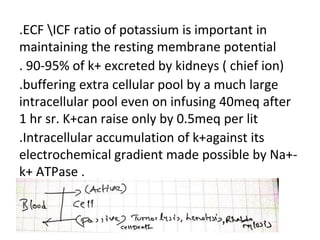
.Intracellular accumulation of k+against its
electrochemical gradient made possible by Na+-
k+ ATPase .
.
.Digoxin and K+ compete for same binding site
on
Na+k+ATPase , so digoxin inhibits Na+k+ATPase
as a result K+ cannot come inside the cell and
causes hyperkalemia.
.Muscle-2500meq, RBC -250meq,Liver-250meq
Bone -300meq: BODY K+DISTRIBUTION
. K+shifts from blood to the cell (active)by insulin,
B2agonists , alkalosis,alphaantagonists,
Theophylline, barium , chloroquine,
hypokalemic periodic paralysis (ca2+
channelopathy)
Hypokalemic periodic paralysis
. It is a genetic thing , AD
. Classic paralysis/ severe muscle weakness
. Recurrent episodes
. PPT by carbohydrate meal / rest /stress
.k+ shifts from cell to blood(passive)
By:1) cell destruction ( hemolysis,
rhabdomylosis, rumor lysis)
2)Non selective B blockers
3) alpha agonists
4) acidosis
5) exercise
6) mannitol(water enters from cell to blood ,
which leads to shrinkage of the cell, and K+ moves
out and leads to hyperkalemia)
Renal handling of K+
• 90% of K+ is excreted by kidney
• 65-70% of K+ is reabsorbed by PCT(passive transport)
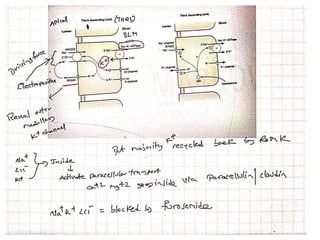
• ThAL reabsorb K+ via Na-K-2Cl symporter
• Principal cells of cortical collecting duct with the help
of aldosteron-reabsorb salt and water and excrete
out K+ and H+
• Alpha intercalated cells of cortical collecting duct has
H+-K+ atpase which excrete H+ and reabsorb K+
When to Suspect
• Muscle weakness- Flaccid paralysis with no sensory
involvement.
• Smooth muscle- constipation(paralytic ileus) and Bladder
dysfunction.
• Cardiac-Arrythmias
• Nephrogenic DI
• Rhabdomyolysis
• Respiratory failure
ECG changes
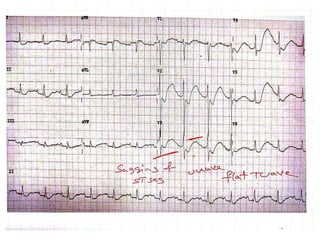
• 3-3.5meq/l: Flattening of T waves, Prominent
U waves and prolongation of QT or QU
interval
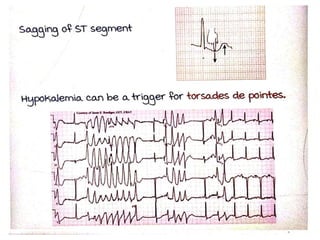
• <3meq/l: sagging of ST segment
• <2.5meq/l: widening of QRS, Prolongation of
PR interval,risk of arrythmias
.Normal sr. k+3.5-4.5 meq
<3.5=hypokalemia
<2 is significant almost due to renal
Loss
. Any hypokalemia un responsive to k+ think of
mg deficiency
Step wise Approach
Step:1
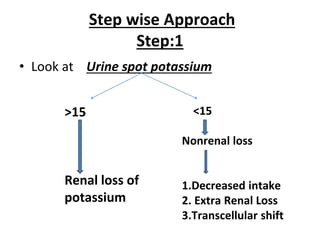
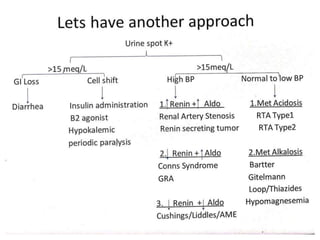
• Look at Urine spot potassium
>15
Renal loss of
potassium
<15
Nonrenal loss
1.Decreased intake
2. Extra Renal Loss
3.Transcellular shift
• Decreased Intake: 15meq/day K+ will be
excreted even in response to a K+ free diet.
• Eg: Anorexia nervosa,Alcoholism, Intestinal
malabsorption.
• Extra Renal Loss : 1) Sweating in large
amount, occuring as a part of exercise in hot
humid condition.
• 2) GI loss : Diarrhea and vomiting
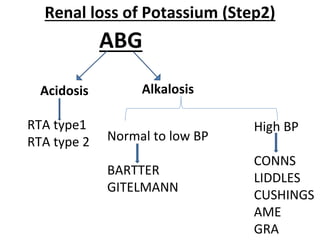
Renal loss of Potassium (Step2)
ABG
Acidosis
RTA type1
RTA type 2
Alkalosis
Normal to low BP
BARTTER
GITELMANN
High BP
CONNS
LIDDLES
CUSHINGS
AME
GRA
Renal Potassium Wasting
• There is always a balanced reciprocal relationship
between distal load of Na and circulating
aldosterone which is the most important
mechanism for maintaining normal S.K+.
RENAL TUBULAR ACIDOSIS
• Group of disorders having defect in acidification
of urine due to tubular defect.
• Metabolic acidosis with alkaline urine.
• Normal anion gap metabolic acidosis with
high/+ve urine anion gap.
TYPES OF RTA
• Type 1 RTA: (Distal RTA): defect in alpha
intercalated cells of cortical collecting duct.
• Defect is in H+ ATPase or H+-K+ ATPase .
• Hence it is an H+ secretion defect.
• It is the most severe form of RTA
• Severe metabolic acidosis with alkaline urine of
pH>5.5
• Severe metabolic acidosis cause calcium
resorption from bone.
• Hence Hypercalcemia, hypercalcuria and renal
stones.
• Severe bone changes like short stature can also
occur.
• Severe Metabolic acidosis will decrease the
capacity of PCT to reabsorb salt and water
resulting in severe volume depletion – RAAS
activation - Worsen hypokalemia.
Causes
• Type 1 RTA: 1)Idiopathic (most common type)
2)Genetic(AR defect in H+ atpase).
3)Acquired causes: Sjogren syndrome, SLE,
Drugs (Ampho B)
Type 2 RTA (Proximal RTA)
• Type 2 RTA: Defect is in proximal convoluted tubule.
• Generalised proximal tubular dysfunction.
• Defect in bicarbonate reabsorption
• Less severe form of RTA.
• Since it is a generalised tubular dysfunction there will
be Glycosuria, Aminoaciduria and Phosphaturia.
(Fanconi syndrome).
• Less severe metabolic acidosis-hence less
bone resorption- hence less chance of stones.
• There will be loss of vit D through urine -
hence vit D deficiency/ Rickets/ osteomalacia.
• Less metabolisc acidosis- less volume
depletion – less RAAS activation - less
hypokalemia
• M/c cause : Fanconi Syndrome
• Fanconi syndrome can be Genetic or sporadic
or acquired.
• Genetic causes : Cystinosis, Wilsons disease
• Acquired causes: Multiple myeloma,
Hyperparathyroidism, drugs (outdated
tetracycline), Aminoglycoside,
topiramate,cyclofosfamide)
Causes of Type 2 RTA
• Type 3 RTA: Carbonic anhydrase 2 gene defect
• Rare form of RTA.
• Type 4RTA: RTA associated with
Hyperkalemia.
• Aldosterone defect: Aldosteron act on eNaC,
cause Na and water reabsorption and H+ & K+
excretion.
• Defect in this mechanism will cause metabolic
acidosis with hyperkalemia.
BARTTER SYNDROME
• Severe form of Inherited channelopathy
• AR mode of inheritance.
• Defect lies in ThAL : Inhibitory defect of Na-K-2Cl
channel.
• Simulating an aldosterone exess state.
• Presenting as Hypokalemia ,Alkalosis and high urine
chloride.
• Same channel is present in the ear for maintaining
endolymph concentration.
• Hence many have associated SNHL.
• Chronic use of loop diuretic can mimic Bartter.
• Other association is a paracellular pathway defect
where there is hypercalcuria and
hypermagnesuria hence can present as stone
disease.
• Serum Ca and Mg are normal because intestinal
absorption of Ca and Mg is normal.
GITELMANN SYNDROME
• Less severe form of inherited channelopathy.
• AR mode of inheritance.
• Defect is in DCT : inhibitory defect of Na-Cl symporter.
• Can simulate aldosterone excess state, Hence cause
Hypokalemia, Alkalosis and high urine Chloride.
• Chronic Thiazide use can mimic Gitelmann.
• Whenever there is volume depletion body try
to conserve more calcium, hence
Hypercalcemia and hypocalcuria.
• Same channel in intestine is also defective
hence absorption of Mg from intestine is
defective and hence Hypomagnesemia.
LIDDLES SYNDROME
• AD mode of inheritance
• Stimulatory defect of eNaC
• Hence called as PSEUDOHYPERALDOSTERONISM
• Chronic steroid usage can mimic Liddle.
• Treatment : Amiloride
Hypomagnesemia
• Think of hypomagnesemia when you have persistant
hypokalemia.
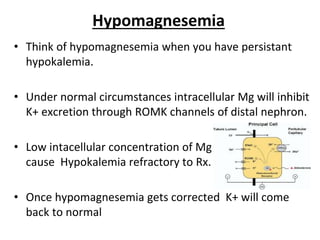
• Under normal circumstances intracellular Mg will inhibit
K+ excretion through ROMK channels of distal nephron.
• Low intacellular concentration of Mg
cause Hypokalemia refractory to Rx.
• Once hypomagnesemia gets corrected K+ will come
back to normal
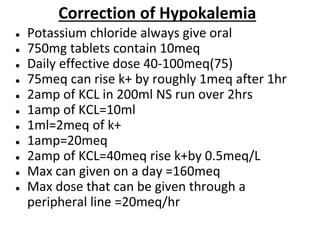
● Potassium chloride always give oral
● 750mg tablets contain 10meq
● Daily effective dose 40-100meq(75)
● 75meq can rise k+ by roughly 1meq after 1hr
● 2amp of KCL in 200ml NS run over 2hrs
● 1amp of KCL=10ml
● 1ml=2meq of k+
● 1amp=20meq
● 2amp of KCL=40meq rise k+by 0.5meq/L
● Max can given on a day =160meq
● Max dose that can be given through a
peripheral line =20meq/hr
Correction of Hypokalemia
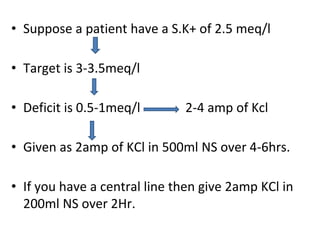
• Suppose a patient have a S.K+ of 2.5 meq/l
• Target is 3-3.5meq/l
• Deficit is 0.5-1meq/l 2-4 amp of Kcl
• Given as 2amp of KCl in 500ml NS over 4-6hrs.
• If you have a central line then give 2amp KCl in
200ml NS over 2Hr.
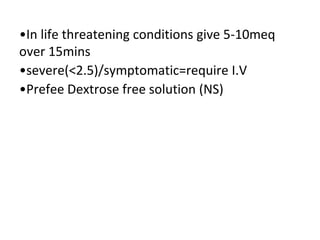
•In life threatening conditions give 5-10meq
over 15mins
•severe(<2.5)/symptomatic=require I.V
•Prefee Dextrose free solution (NS)
HYPOKALEMIA .pptx

HYPOKALEMIA .pptx

  • 1.
    APPROACH TO HYPOKALEMIA KKKKKK Dr AJMALN M Dr. V Jaswanth reddy General medicine pg 1st year
  • 2.
    PHYSIOLOGY OF POTASSIUM •Major intracellular cation . 1 mmol =1meq=40mg of k+ .Total body stores=50meq x BW =3000meq =2500meq stores in muscles .Intracellular K+=120-140meq per lit . The function of intracellualar k+ is for cell growth and protein synthesis . On an average daily 100 meq of k+ is required for the body
  • 3.
    .ECF ICF ratioof potassium is important in maintaining the resting membrane potential . 90-95% of k+ excreted by kidneys ( chief ion) .buffering extra cellular pool by a much large intracellular pool even on infusing 40meq after 1 hr sr. K+can raise only by 0.5meq per lit .Intracellular accumulation of k+against its electrochemical gradient made possible by Na+- k+ ATPase . .
  • 4.
    .Digoxin and K+compete for same binding site on Na+k+ATPase , so digoxin inhibits Na+k+ATPase as a result K+ cannot come inside the cell and causes hyperkalemia. .Muscle-2500meq, RBC -250meq,Liver-250meq Bone -300meq: BODY K+DISTRIBUTION . K+shifts from blood to the cell (active)by insulin, B2agonists , alkalosis,alphaantagonists, Theophylline, barium , chloroquine, hypokalemic periodic paralysis (ca2+ channelopathy)
  • 5.
    Hypokalemic periodic paralysis .It is a genetic thing , AD . Classic paralysis/ severe muscle weakness . Recurrent episodes . PPT by carbohydrate meal / rest /stress
  • 6.
    .k+ shifts fromcell to blood(passive) By:1) cell destruction ( hemolysis, rhabdomylosis, rumor lysis) 2)Non selective B blockers 3) alpha agonists 4) acidosis 5) exercise 6) mannitol(water enters from cell to blood , which leads to shrinkage of the cell, and K+ moves out and leads to hyperkalemia)
  • 7.
    Renal handling ofK+ • 90% of K+ is excreted by kidney • 65-70% of K+ is reabsorbed by PCT(passive transport) • ThAL reabsorb K+ via Na-K-2Cl symporter • Principal cells of cortical collecting duct with the help of aldosteron-reabsorb salt and water and excrete out K+ and H+ • Alpha intercalated cells of cortical collecting duct has H+-K+ atpase which excrete H+ and reabsorb K+
  • 9.
    When to Suspect •Muscle weakness- Flaccid paralysis with no sensory involvement. • Smooth muscle- constipation(paralytic ileus) and Bladder dysfunction. • Cardiac-Arrythmias • Nephrogenic DI • Rhabdomyolysis • Respiratory failure
  • 10.
    ECG changes • 3-3.5meq/l:Flattening of T waves, Prominent U waves and prolongation of QT or QU interval • <3meq/l: sagging of ST segment • <2.5meq/l: widening of QRS, Prolongation of PR interval,risk of arrythmias
  • 13.
    .Normal sr. k+3.5-4.5meq <3.5=hypokalemia <2 is significant almost due to renal Loss . Any hypokalemia un responsive to k+ think of mg deficiency
  • 14.
    Step wise Approach Step:1 •Look at Urine spot potassium >15 Renal loss of potassium <15 Nonrenal loss 1.Decreased intake 2. Extra Renal Loss 3.Transcellular shift
  • 15.
    • Decreased Intake:15meq/day K+ will be excreted even in response to a K+ free diet. • Eg: Anorexia nervosa,Alcoholism, Intestinal malabsorption. • Extra Renal Loss : 1) Sweating in large amount, occuring as a part of exercise in hot humid condition. • 2) GI loss : Diarrhea and vomiting
  • 16.
    Renal loss ofPotassium (Step2) ABG Acidosis RTA type1 RTA type 2 Alkalosis Normal to low BP BARTTER GITELMANN High BP CONNS LIDDLES CUSHINGS AME GRA
  • 17.
    Renal Potassium Wasting •There is always a balanced reciprocal relationship between distal load of Na and circulating aldosterone which is the most important mechanism for maintaining normal S.K+.
  • 18.
    RENAL TUBULAR ACIDOSIS •Group of disorders having defect in acidification of urine due to tubular defect. • Metabolic acidosis with alkaline urine. • Normal anion gap metabolic acidosis with high/+ve urine anion gap.
  • 19.
    TYPES OF RTA •Type 1 RTA: (Distal RTA): defect in alpha intercalated cells of cortical collecting duct. • Defect is in H+ ATPase or H+-K+ ATPase . • Hence it is an H+ secretion defect. • It is the most severe form of RTA • Severe metabolic acidosis with alkaline urine of pH>5.5
  • 20.
    • Severe metabolicacidosis cause calcium resorption from bone. • Hence Hypercalcemia, hypercalcuria and renal stones. • Severe bone changes like short stature can also occur. • Severe Metabolic acidosis will decrease the capacity of PCT to reabsorb salt and water resulting in severe volume depletion – RAAS activation - Worsen hypokalemia.
  • 21.
    Causes • Type 1RTA: 1)Idiopathic (most common type) 2)Genetic(AR defect in H+ atpase). 3)Acquired causes: Sjogren syndrome, SLE, Drugs (Ampho B)
  • 22.
    Type 2 RTA(Proximal RTA) • Type 2 RTA: Defect is in proximal convoluted tubule. • Generalised proximal tubular dysfunction. • Defect in bicarbonate reabsorption • Less severe form of RTA. • Since it is a generalised tubular dysfunction there will be Glycosuria, Aminoaciduria and Phosphaturia. (Fanconi syndrome).
  • 23.
    • Less severemetabolic acidosis-hence less bone resorption- hence less chance of stones. • There will be loss of vit D through urine - hence vit D deficiency/ Rickets/ osteomalacia. • Less metabolisc acidosis- less volume depletion – less RAAS activation - less hypokalemia
  • 24.
    • M/c cause: Fanconi Syndrome • Fanconi syndrome can be Genetic or sporadic or acquired. • Genetic causes : Cystinosis, Wilsons disease • Acquired causes: Multiple myeloma, Hyperparathyroidism, drugs (outdated tetracycline), Aminoglycoside, topiramate,cyclofosfamide) Causes of Type 2 RTA
  • 25.
    • Type 3RTA: Carbonic anhydrase 2 gene defect • Rare form of RTA. • Type 4RTA: RTA associated with Hyperkalemia. • Aldosterone defect: Aldosteron act on eNaC, cause Na and water reabsorption and H+ & K+ excretion. • Defect in this mechanism will cause metabolic acidosis with hyperkalemia.
  • 26.
    BARTTER SYNDROME • Severeform of Inherited channelopathy • AR mode of inheritance. • Defect lies in ThAL : Inhibitory defect of Na-K-2Cl channel. • Simulating an aldosterone exess state. • Presenting as Hypokalemia ,Alkalosis and high urine chloride.
  • 27.
    • Same channelis present in the ear for maintaining endolymph concentration. • Hence many have associated SNHL. • Chronic use of loop diuretic can mimic Bartter. • Other association is a paracellular pathway defect where there is hypercalcuria and hypermagnesuria hence can present as stone disease. • Serum Ca and Mg are normal because intestinal absorption of Ca and Mg is normal.
  • 28.
    GITELMANN SYNDROME • Lesssevere form of inherited channelopathy. • AR mode of inheritance. • Defect is in DCT : inhibitory defect of Na-Cl symporter. • Can simulate aldosterone excess state, Hence cause Hypokalemia, Alkalosis and high urine Chloride. • Chronic Thiazide use can mimic Gitelmann.
  • 29.
    • Whenever thereis volume depletion body try to conserve more calcium, hence Hypercalcemia and hypocalcuria. • Same channel in intestine is also defective hence absorption of Mg from intestine is defective and hence Hypomagnesemia.
  • 30.
    LIDDLES SYNDROME • ADmode of inheritance • Stimulatory defect of eNaC • Hence called as PSEUDOHYPERALDOSTERONISM • Chronic steroid usage can mimic Liddle. • Treatment : Amiloride
  • 31.
    Hypomagnesemia • Think ofhypomagnesemia when you have persistant hypokalemia. • Under normal circumstances intracellular Mg will inhibit K+ excretion through ROMK channels of distal nephron. • Low intacellular concentration of Mg cause Hypokalemia refractory to Rx. • Once hypomagnesemia gets corrected K+ will come back to normal
  • 33.
    ● Potassium chloridealways give oral ● 750mg tablets contain 10meq ● Daily effective dose 40-100meq(75) ● 75meq can rise k+ by roughly 1meq after 1hr ● 2amp of KCL in 200ml NS run over 2hrs ● 1amp of KCL=10ml ● 1ml=2meq of k+ ● 1amp=20meq ● 2amp of KCL=40meq rise k+by 0.5meq/L ● Max can given on a day =160meq ● Max dose that can be given through a peripheral line =20meq/hr Correction of Hypokalemia
  • 34.
    • Suppose apatient have a S.K+ of 2.5 meq/l • Target is 3-3.5meq/l • Deficit is 0.5-1meq/l 2-4 amp of Kcl • Given as 2amp of KCl in 500ml NS over 4-6hrs. • If you have a central line then give 2amp KCl in 200ml NS over 2Hr.
  • 35.
    •In life threateningconditions give 5-10meq over 15mins •severe(<2.5)/symptomatic=require I.V •Prefee Dextrose free solution (NS)