Potassium Management
     Marica A. Lazo, MD
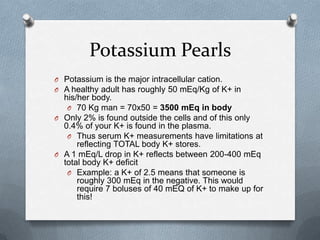
Potassium Pearls
O Potassium is the major intracellular cation.
O A healthy adult has roughly 50 mEq/Kg of K+ in
  his/her body.
   O 70 Kg man = 70x50 = 3500 mEq in body
O Only 2% is found outside the cells and of this only
  0.4% of your K+ is found in the plasma.
   O Thus serum K+ measurements have limitations at
      reflecting TOTAL body K+ stores.
O A 1 mEq/L drop in K+ reflects between 200-400 mEq
  total body K+ deficit
   O Example: a K+ of 2.5 means that someone is
      roughly 300 mEq in the negative. This would
      require 7 boluses of 40 mEQ of K+ to make up for
      this!
Hypokalemia
O Clinical consequences of hypokalemia
  usually goes unnoticed.
O Common findings include weakness,
  fatigue, constipation, ileus, and respiratory
  muscle dysfunction.
O Symptoms seldom occur unless plasma
  K+ is less than 3.0 mmol/L.
ECG changes
O ST depressions with prominent U waves
 and prolonged repolarization
ECG changes
Hypokalemia - Causes
O Spurious - i.e. K+ is falsely low
O Diminished intake
O Redistribution – i.e. movement into cells
O Extrarenal loss – usually associated with
  preservation of renal K+
O Renal loss – often associated with acid-
  base disturbances.
Spurious Hypokalemia
O Marked leukocytosis and blood tube that
  has been sitting at room temp too long
  gives time for K+ to enter the white blood
  cells and thus falsely lower K+ value.
O Insulin given just prior to blood draw
  allows a small amount (about 0.3 mEq) to
  shift into cells in the blood tube.
Redistribution Hypokalemia
O Transcellular shift
O Alkalosis (response H+ out K+ in) – a key
  point is that alkalosis disorders are usually
  involved in depletion of total body K+ in
  addition to redistribution.
O Increased B adrenergic effect – increases
  Na/K ATPase activity. Think of both
  medications or increased sympathetic
  tone like MI, head trauma, DTs, and
  theophylline toxicity.
Redistribution Hypokalemia
O Other causes of hypokalemia due to cell
 entry include risperidone, quetiapine, and
 cesium, hypothermia, barium intoxication,
 chloroquine intoxication.
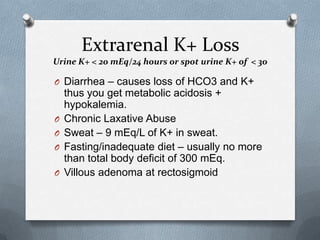
Extrarenal K+ Loss
Urine K+ < 20 mEq/24 hours or spot urine K+ of < 30

O Diarrhea – causes loss of HCO3 and K+
    thus you get metabolic acidosis +
    hypokalemia.
O   Chronic Laxative Abuse
O   Sweat – 9 mEq/L of K+ in sweat.
O   Fasting/inadequate diet – usually no more
    than total body deficit of 300 mEq.
O   Villous adenoma at rectosigmoid
Renal K+ Loss
Urine K+ >20 mEq/24 hours or spot urine K+ of > 30

O Renal hypokalemia with metabolic
  acidosis
   O RTA type I (distal) and type II (proximal)
   O DKA
   O Carbonic anhydrase inhibitor therapy
   O ureterosigmoidostomy
Renal K+ Loss
Urine K+ >20 mEq/24 hours or spot urine K+ of > 30

O Renal hypokalemia with metabolic
  alkalosis:
   O Almost always occurs with hypokalemia
     because virtually every cause of metabolic
     alkalosis also causes hypokalemia.
   O The excess HCO3 acts as a poorly
     reabsorbable anion and carries more Na+
     to the collecting tubules leading to
     increased Na-K exchange and urinary K
     loss.
Renal K+ Loss
Urine K+ >20 mEq/24 hours or spot urine K+ of > 30

O Renal hypokalemia with no acid-base
  disorder:
   O Recovery from ARF, postobstructive
     diuresis, and osmotic diuresis, PCNs all
     increase Na delivery to collecting tubules
     resulting in increased K excretion.
   O Low magnesium- think of with resistant
     cases. Hypomagnesemia is present in up
     to 40% of patients with hypokalemia
Renal Vs Extra renal loss
 Urinary K+: > 20 mEq/L – Renal loss

 Urinary K + : < 20 mEq/L – Extrarenal loss

 TTKG : Transtubular Potassium Gradient
            ( Urine K+ / Plasma K+ )
           ( Urine Osm / Plasma Osm )

 TTKG : Renal loss : > 4
          Extra renal loss : < 4
Treatment
O Therapeutic goals
  O Prevent life-threatening complications
    (arrhythmias, respiratory failure, hepatic
    encephalopathy)
  O Correct the K+ deficit
  O Minimize ongoing losses
  O Treat the underlying cause
Treatment
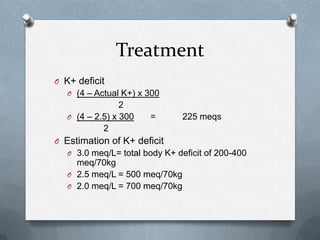
O K+ deficit
   O (4 – Actual K+) x 300
                 2
   O (4 – 2.5) x 300   =        225 meqs
            2
O Estimation of K+ deficit
   O 3.0 meq/L= total body K+ deficit of 200-400
     meq/70kg
   O 2.5 meq/L = 500 meq/70kg
   O 2.0 meq/L = 700 meq/70kg
Treatment
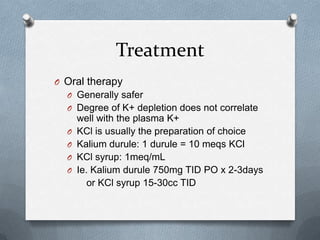
O Oral therapy
  O Generally safer
  O Degree of K+ depletion does not correlate
      well with the plasma K+
  O   KCl is usually the preparation of choice
  O   Kalium durule: 1 durule = 10 meqs KCl
  O   KCl syrup: 1meq/mL
  O   Ie. Kalium durule 750mg TID PO x 2-3days
         or KCl syrup 15-30cc TID
Treatment
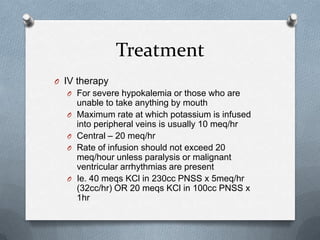
O IV therapy
  O For severe hypokalemia or those who are
      unable to take anything by mouth
  O   Maximum rate at which potassium is infused
      into peripheral veins is usually 10 meq/hr
  O   Central – 20 meq/hr
  O   Rate of infusion should not exceed 20
      meq/hour unless paralysis or malignant
      ventricular arrhythmias are present
  O   Ie. 40 meqs KCl in 230cc PNSS x 5meq/hr
      (32cc/hr) OR 20 meqs KCl in 100cc PNSS x
      1hr
Hyperkalemia
O Remember that total body K+ is roughly
  50 mEq/kg and only a small fraction if
  found outside the cells.
O Contrary to struggling to try to replace a
  low K+ with mEq after mEq and watching
  it slowly climb into the normal range; only
  a small shift of intracellular K+ to the
  extracellular space or a small amount of
  K+ given to a person with a bad kidney
  can cause quick problems.
O To get a serum K+ rise by 1 meq/L you
  only need to give 100-200 meq of extra
  K+.
Hyperkalemia
O The most serious effect of hyperkalemia is
  cardiac toxicity
O Hyperkalemia partially depolarizes the cell
  membrane, which impairs membrane
  excitability and is manifest as weakness
  that may progress to flaccid paralysis and
  hypoventilation if the respiratory muscles
  are involved
Hyperkalemia - Causes
O Increased K+ intake
  O Rarely the sole cause
  O Iatrogenic hyperkalemia may result from
    overzealous parenteral K+ replacement or
    in patients with renal insufficiency
O Pseudohyperkalemia
  O Artificially elevated plasma K+ due to K+
    movement out of the cells immediately
    before or following venipuncture
Hyperkalemia - Causes
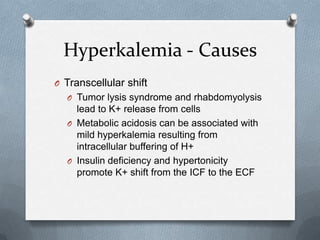
O Transcellular shift
  O Tumor lysis syndrome and rhabdomyolysis
    lead to K+ release from cells
  O Metabolic acidosis can be associated with
    mild hyperkalemia resulting from
    intracellular buffering of H+
  O Insulin deficiency and hypertonicity
    promote K+ shift from the ICF to the ECF
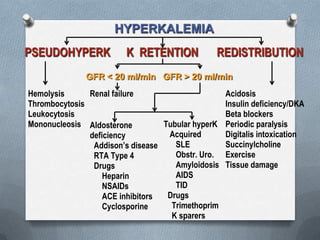
HYPERKALEMIA
PSEUDOHYPERK            K RETENTION            REDISTRIBUTION
              GFR < 20 ml/min GFR > 20 ml/min
Hemolysis      Renal failure                       Acidosis
Thrombocytosis                                     Insulin deficiency/DKA
Leukocytosis                                       Beta blockers
Mononucleosis Aldosterone         Tubular hyperK   Periodic paralysis
               deficiency          Acquired        Digitalis intoxication
                Addison’s disease    SLE           Succinylcholine
                RTA Type 4           Obstr. Uro.   Exercise
                Drugs                Amyloidosis   Tissue damage
                   Heparin           AIDS
                   NSAIDs            TID
                   ACE inhibitors  Drugs
                   Cyclosporine     Trimethoprim
                                    K sparers
EKG Changes
Note the ―tented‖ or ―pinched‖ shape to
                 Twaves
Acute Treatment
O Calcium Gluconate 10 ml of 10% solution
 (1gram) IV slowly over 5-10 min.
  O Decreases membrane excitability
  O Temporarily (1 hour) antagonizes cardiac
    effects of hyperkalemia while more
    definitive therapy is begun.
  O Warning: may induce Digitalis toxicity!
  O May precipitate if given with NaHCO3.
  O May repeat after 5 min. if ECG does not
    improve.
Acute Treatment
O Glucose/Insulin – 100 ml of 25% glucose
  solution with 10 units of Regular insulin.
  Infuse over 15-30 minutes.
  O Insulin stimulates cellular uptake of K+ by
    activating Na+K+ATPase ( decreasing plasma
    K+ )
  O Temporarily translocates K+ into cells.
  O Effect occurs w/in 30-60 min and lasts about 1
    hr.
  O May induce hyperglycemia, thus if already
    hyperglycemic just use insulin.
Acute Treatment
O Beta 2 agonists (Albuterol) - 10-20 mg
  over 15 minutes via nebulizer.
  O Promotes cellular uptake of K+
  O Onset 30 minutes.
  O Lowers plasma K+ by 0.5-1.5 mmol/L and
    the effect lasts for 2-4 hours
  O Potentially dangerous in patients with
    coronary artery disease!
Acute Treatment
O Lasix – 40 to 80 mg IV.
  O Especially helpful in aldosterone deficiency
    states and renal failure.
O NaHCO3 – 1 standard amp (50mEq) IV
  over 5-10 min.
  O Can shift K+ into the cells.
  O Mostly used with acidemic states.
  O Will precipitate with Calcium!!!! Thus don’t
    give while using calcium gluconate.
Acute Treatment
O Kayexalate (Sodium Polystyrene
 Sulfonate) – 15 g ORALLY 1 to 4 times
 daily as a slurry in water or syrup.
  O Onset 1-2 hours with duration of 4-6 hours.
  O Effect—In the intestine (mostly the large
    intestine), Na ions are released and are
    replaced by K+ and other cations before
    the resin is passed from the body.
  O Each gram may remove 1 mEq K+ in
    exchange for 1-2 mEq Na+ thus may
    cause ECF volume overload.
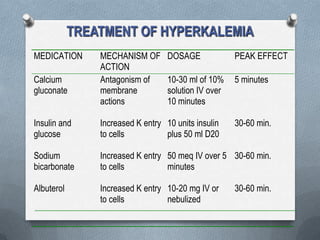
TREATMENT OF HYPERKALEMIA
MEDICATION      MECHANISM OF       DOSAGE             PEAK EFFECT
                ACTION
Calcium         Antagonism of      10-30 ml of 10%    5 minutes
gluconate       membrane           solution IV over
                actions            10 minutes

Insulin and     Increased K entry 10 units insulin    30-60 min.
glucose         to cells          plus 50 ml D20

Sodium          Increased K entry 50 meq IV over 5 30-60 min.
bicarbonate     to cells          minutes

Albuterol       Increased K entry 10-20 mg IV or      30-60 min.
                to cells          nebulized
Potassium Management

Potassium Management

  • 1.
    Potassium Management Marica A. Lazo, MD
  • 2.
    Potassium Pearls O Potassiumis the major intracellular cation. O A healthy adult has roughly 50 mEq/Kg of K+ in his/her body. O 70 Kg man = 70x50 = 3500 mEq in body O Only 2% is found outside the cells and of this only 0.4% of your K+ is found in the plasma. O Thus serum K+ measurements have limitations at reflecting TOTAL body K+ stores. O A 1 mEq/L drop in K+ reflects between 200-400 mEq total body K+ deficit O Example: a K+ of 2.5 means that someone is roughly 300 mEq in the negative. This would require 7 boluses of 40 mEQ of K+ to make up for this!
  • 3.
    Hypokalemia O Clinical consequencesof hypokalemia usually goes unnoticed. O Common findings include weakness, fatigue, constipation, ileus, and respiratory muscle dysfunction. O Symptoms seldom occur unless plasma K+ is less than 3.0 mmol/L.
  • 4.
    ECG changes O STdepressions with prominent U waves and prolonged repolarization
  • 5.
  • 6.
    Hypokalemia - Causes OSpurious - i.e. K+ is falsely low O Diminished intake O Redistribution – i.e. movement into cells O Extrarenal loss – usually associated with preservation of renal K+ O Renal loss – often associated with acid- base disturbances.
  • 7.
    Spurious Hypokalemia O Markedleukocytosis and blood tube that has been sitting at room temp too long gives time for K+ to enter the white blood cells and thus falsely lower K+ value. O Insulin given just prior to blood draw allows a small amount (about 0.3 mEq) to shift into cells in the blood tube.
  • 8.
    Redistribution Hypokalemia O Transcellularshift O Alkalosis (response H+ out K+ in) – a key point is that alkalosis disorders are usually involved in depletion of total body K+ in addition to redistribution. O Increased B adrenergic effect – increases Na/K ATPase activity. Think of both medications or increased sympathetic tone like MI, head trauma, DTs, and theophylline toxicity.
  • 9.
    Redistribution Hypokalemia O Othercauses of hypokalemia due to cell entry include risperidone, quetiapine, and cesium, hypothermia, barium intoxication, chloroquine intoxication.
  • 10.
    Extrarenal K+ Loss UrineK+ < 20 mEq/24 hours or spot urine K+ of < 30 O Diarrhea – causes loss of HCO3 and K+ thus you get metabolic acidosis + hypokalemia. O Chronic Laxative Abuse O Sweat – 9 mEq/L of K+ in sweat. O Fasting/inadequate diet – usually no more than total body deficit of 300 mEq. O Villous adenoma at rectosigmoid
  • 11.
    Renal K+ Loss UrineK+ >20 mEq/24 hours or spot urine K+ of > 30 O Renal hypokalemia with metabolic acidosis O RTA type I (distal) and type II (proximal) O DKA O Carbonic anhydrase inhibitor therapy O ureterosigmoidostomy
  • 12.
    Renal K+ Loss UrineK+ >20 mEq/24 hours or spot urine K+ of > 30 O Renal hypokalemia with metabolic alkalosis: O Almost always occurs with hypokalemia because virtually every cause of metabolic alkalosis also causes hypokalemia. O The excess HCO3 acts as a poorly reabsorbable anion and carries more Na+ to the collecting tubules leading to increased Na-K exchange and urinary K loss.
  • 13.
    Renal K+ Loss UrineK+ >20 mEq/24 hours or spot urine K+ of > 30 O Renal hypokalemia with no acid-base disorder: O Recovery from ARF, postobstructive diuresis, and osmotic diuresis, PCNs all increase Na delivery to collecting tubules resulting in increased K excretion. O Low magnesium- think of with resistant cases. Hypomagnesemia is present in up to 40% of patients with hypokalemia
  • 15.
    Renal Vs Extrarenal loss  Urinary K+: > 20 mEq/L – Renal loss  Urinary K + : < 20 mEq/L – Extrarenal loss  TTKG : Transtubular Potassium Gradient ( Urine K+ / Plasma K+ ) ( Urine Osm / Plasma Osm )  TTKG : Renal loss : > 4 Extra renal loss : < 4
  • 16.
    Treatment O Therapeutic goals O Prevent life-threatening complications (arrhythmias, respiratory failure, hepatic encephalopathy) O Correct the K+ deficit O Minimize ongoing losses O Treat the underlying cause
  • 17.
    Treatment O K+ deficit O (4 – Actual K+) x 300 2 O (4 – 2.5) x 300 = 225 meqs 2 O Estimation of K+ deficit O 3.0 meq/L= total body K+ deficit of 200-400 meq/70kg O 2.5 meq/L = 500 meq/70kg O 2.0 meq/L = 700 meq/70kg
  • 18.
    Treatment O Oral therapy O Generally safer O Degree of K+ depletion does not correlate well with the plasma K+ O KCl is usually the preparation of choice O Kalium durule: 1 durule = 10 meqs KCl O KCl syrup: 1meq/mL O Ie. Kalium durule 750mg TID PO x 2-3days or KCl syrup 15-30cc TID
  • 19.
    Treatment O IV therapy O For severe hypokalemia or those who are unable to take anything by mouth O Maximum rate at which potassium is infused into peripheral veins is usually 10 meq/hr O Central – 20 meq/hr O Rate of infusion should not exceed 20 meq/hour unless paralysis or malignant ventricular arrhythmias are present O Ie. 40 meqs KCl in 230cc PNSS x 5meq/hr (32cc/hr) OR 20 meqs KCl in 100cc PNSS x 1hr
  • 20.
    Hyperkalemia O Remember thattotal body K+ is roughly 50 mEq/kg and only a small fraction if found outside the cells. O Contrary to struggling to try to replace a low K+ with mEq after mEq and watching it slowly climb into the normal range; only a small shift of intracellular K+ to the extracellular space or a small amount of K+ given to a person with a bad kidney can cause quick problems. O To get a serum K+ rise by 1 meq/L you only need to give 100-200 meq of extra K+.
  • 21.
    Hyperkalemia O The mostserious effect of hyperkalemia is cardiac toxicity O Hyperkalemia partially depolarizes the cell membrane, which impairs membrane excitability and is manifest as weakness that may progress to flaccid paralysis and hypoventilation if the respiratory muscles are involved
  • 22.
    Hyperkalemia - Causes OIncreased K+ intake O Rarely the sole cause O Iatrogenic hyperkalemia may result from overzealous parenteral K+ replacement or in patients with renal insufficiency O Pseudohyperkalemia O Artificially elevated plasma K+ due to K+ movement out of the cells immediately before or following venipuncture
  • 23.
    Hyperkalemia - Causes OTranscellular shift O Tumor lysis syndrome and rhabdomyolysis lead to K+ release from cells O Metabolic acidosis can be associated with mild hyperkalemia resulting from intracellular buffering of H+ O Insulin deficiency and hypertonicity promote K+ shift from the ICF to the ECF
  • 24.
    HYPERKALEMIA PSEUDOHYPERK K RETENTION REDISTRIBUTION GFR < 20 ml/min GFR > 20 ml/min Hemolysis Renal failure Acidosis Thrombocytosis Insulin deficiency/DKA Leukocytosis Beta blockers Mononucleosis Aldosterone Tubular hyperK Periodic paralysis deficiency Acquired Digitalis intoxication Addison’s disease SLE Succinylcholine RTA Type 4 Obstr. Uro. Exercise Drugs Amyloidosis Tissue damage Heparin AIDS NSAIDs TID ACE inhibitors Drugs Cyclosporine Trimethoprim K sparers
  • 25.
    EKG Changes Note the―tented‖ or ―pinched‖ shape to Twaves
  • 26.
    Acute Treatment O CalciumGluconate 10 ml of 10% solution (1gram) IV slowly over 5-10 min. O Decreases membrane excitability O Temporarily (1 hour) antagonizes cardiac effects of hyperkalemia while more definitive therapy is begun. O Warning: may induce Digitalis toxicity! O May precipitate if given with NaHCO3. O May repeat after 5 min. if ECG does not improve.
  • 27.
    Acute Treatment O Glucose/Insulin– 100 ml of 25% glucose solution with 10 units of Regular insulin. Infuse over 15-30 minutes. O Insulin stimulates cellular uptake of K+ by activating Na+K+ATPase ( decreasing plasma K+ ) O Temporarily translocates K+ into cells. O Effect occurs w/in 30-60 min and lasts about 1 hr. O May induce hyperglycemia, thus if already hyperglycemic just use insulin.
  • 28.
    Acute Treatment O Beta2 agonists (Albuterol) - 10-20 mg over 15 minutes via nebulizer. O Promotes cellular uptake of K+ O Onset 30 minutes. O Lowers plasma K+ by 0.5-1.5 mmol/L and the effect lasts for 2-4 hours O Potentially dangerous in patients with coronary artery disease!
  • 29.
    Acute Treatment O Lasix– 40 to 80 mg IV. O Especially helpful in aldosterone deficiency states and renal failure. O NaHCO3 – 1 standard amp (50mEq) IV over 5-10 min. O Can shift K+ into the cells. O Mostly used with acidemic states. O Will precipitate with Calcium!!!! Thus don’t give while using calcium gluconate.
  • 30.
    Acute Treatment O Kayexalate(Sodium Polystyrene Sulfonate) – 15 g ORALLY 1 to 4 times daily as a slurry in water or syrup. O Onset 1-2 hours with duration of 4-6 hours. O Effect—In the intestine (mostly the large intestine), Na ions are released and are replaced by K+ and other cations before the resin is passed from the body. O Each gram may remove 1 mEq K+ in exchange for 1-2 mEq Na+ thus may cause ECF volume overload.
  • 31.
    TREATMENT OF HYPERKALEMIA MEDICATION MECHANISM OF DOSAGE PEAK EFFECT ACTION Calcium Antagonism of 10-30 ml of 10% 5 minutes gluconate membrane solution IV over actions 10 minutes Insulin and Increased K entry 10 units insulin 30-60 min. glucose to cells plus 50 ml D20 Sodium Increased K entry 50 meq IV over 5 30-60 min. bicarbonate to cells minutes Albuterol Increased K entry 10-20 mg IV or 30-60 min. to cells nebulized