Electrolytes
Disturbances
DR/ Shafiq .A. Al-imad
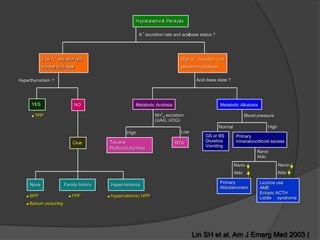
Hypokalemia
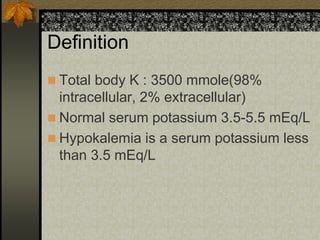
Definition
 Total body K : 3500 mmole(98%
intracellular, 2% extracellular)
 Normal serum potassium 3.5-5.5 mEq/L
 Hypokalemia is a serum potassium less
than 3.5 mEq/L
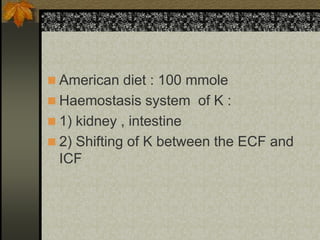
 American diet : 100 mmole
 Haemostasis system of K :
 1) kidney , intestine
 2) Shifting of K between the ECF and
ICF
Blood pressure
Renin
Renin
Aldo
K+
excretion rate and acid
-base status ?
H
Hy
yp
po
ok
ka
al
le
em
mi
ia
a &
& P
Pa
ar
ra
al
ly
ys
si
is
s
L
L o
ow
w K
K+
+
e
ex
xc
cr
re
et
ti
io
on
n a
an
nd
d
n
no
or
r m
ma
al
l a
ac
ci
id
d-
-b
ba
as
se
e
l SPP
l Barium poisoning
l FPP l Hypernatremic HPP
None Family history Hypernatremia
High K+
excretion and
abnormal acid
-base
Acid-base state ?
Clue
Hyperthyroidism ?
l TPP
YES NO Metabolic Acidosis
NH
+
4 excretion
(UAG, UOG)
Low
High
Toluene
Profound diarrhea
RTA
Metabolic Alkalosis
Renin
Normal
GS or BS
Diuretics
Vomiting
High
Primary
mineralocorticoid excess
Aldo
Aldo
Primary
Aldosteronism
Licorice use
AME
Ectopic ACTH
Liddle syndrome
Lin SH et al. Am J Emerg Med 2003 (
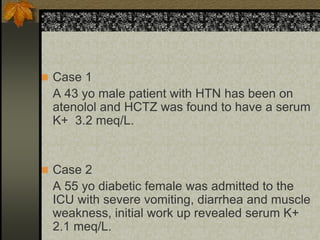
 Case 1
A 43 yo male patient with HTN has been on
atenolol and HCTZ was found to have a serum
K+ 3.2 meq/L.
 Case 2
A 55 yo diabetic female was admitted to the
ICU with severe vomiting, diarrhea and muscle
weakness, initial work up revealed serum K+
2.1 meq/L.
Symptoms
Mild to moderate hypokalemia
 3 and 3.5 meq/L; this degree of
potassium depletion usually produces
no symptoms, except for
 patients with heart disease ( taking digitalis
or undergoing cardiac surgery or
 advanced cirrhosis.
Treatment of mild to moderate
hypokalemia
 . In general, the loss of 200 to 400 meq
of potassium is required to lower the
plasma potassium concentration from
4.0 to 3.0 meq/L
 Repletion as oral potassium chloride in
divided doses over few days
 Treat the underlying cause
Treatment of mild to moderate
hypokalemia
For patients who can’t tolerate oral KCL
 I.V KCL where 20 to 40 meq of
potassium is added to each liter of fluid.
A saline rather than a dextrose solution
is preferred for initial therapy, since the
administration of dextrose can lead to a
transient 0.2 to 1.4 meq/L reduction in
the plasma potassium concentration
SEVERE HYPOKALEMIA
Symptoms
 Muscle weakness and paralysis
 Renal dysfunction
 ECG changes and arrhythmias
ECG changes
 depression of the ST segment,
 decrease in the amplitude of the T wave,
and
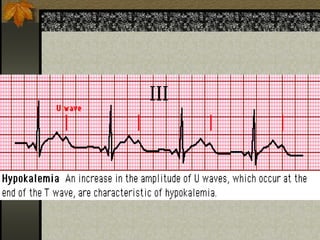
 increase in the amplitude of U waves
which occur at the end of the T wave. U
waves are often seen in the lateral
precordial leads V4-V6.
Treatment of severe
hypokalemia
 . A patient with a plasma potassium
concentration of 2 meq/L, for example, may
have a 400 to 800 meq potassium deficit
 The maximum rate of intravenous potassium
administration is 10(peripheral line) to
20(central line) meq/h, although higher rates
have been given to selected patients with
paralysis or life-threatening arrhythmias
Treatment of severe
hypokalemia
 In this setting, solutions containing as
much as 200 meq of potassium per liter
(20 meq in 100 mL of isotonic saline)
have been used. These solutions
should be infused into a large vein (
femoral vein, subclavian vein, or internal
jugular vein)
Treatment of severe
hypokalemia
 Accidental administration of very large
quantities of intravenous potassium can
be avoided by limiting the amount of
potassium per container (eg, 20 meq in
100 mL of isotonic saline)
Treatment of severe
hypokalemia
 Careful monitoring of the physiologic
effects of severe hypokalemia (ECG
abnormalities, muscle weakness or
paralysis) is essential .
 Once these problems are no longer
severe, the rate of potassium repletion
should be slowed (to 10 meq/h) even
though there is persistent hypokalemia.
 If patient had refractory hypokalemia in
spite of adequate replacement so could
be :
 1/ persistent cause like vomiting or
diuretics
 2/ hypomagnesaemia
 3/ dextrose containing solutions
Hyperkalemia
Definition
 Normal serum potassium 3.5-5.5 mEq/L
 Hyperkalemia is a serum potassium
greater than 5.5 mEq/L
Case 1
A 63 yo male patient with DM, HTN, CHF
has been on digoxin, captopril and
aspirin. Routine work up showed creat.
2.5 mg/dL and K+ 6.5 meq/L.
Q) What are the possible causes of the
hyperkalemia.
Q) How to treat.
symptoms
 severe symptoms of hyperkalemia
usually do not occur until the plasma
potassium concentration is above 7.0
meq/L (unless the rise has been very
rapid).
 severe muscle weakness, or
 marked electrocardiographic changes
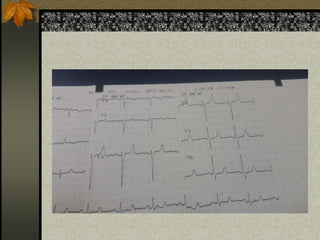
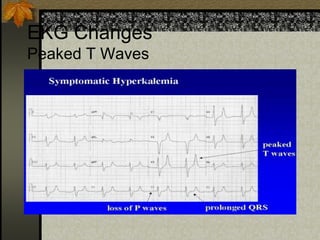
ECG changes
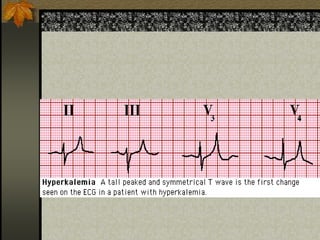
 Tall peaked and symmetrical T
wave.(early)
 Progressive slowing of impulse
conduction causing the PR interval to
lengthen and the QRS duration to
increase.
 The P wave may disappear as a result
of atrial standstill or arrest.
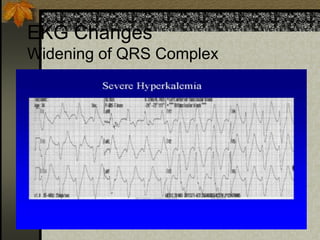
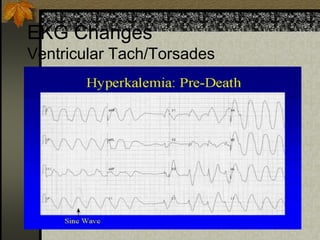
ECG changes
 Ultimately the QRS widens further due
to a severe conduction delay and may
become "sine wave," resulting in
ventricular standstill and a flat line
EKG Changes
Peaked T Waves
EKG Changes
Widening of QRS Complex
EKG Changes
Ventricular Tach/Torsades
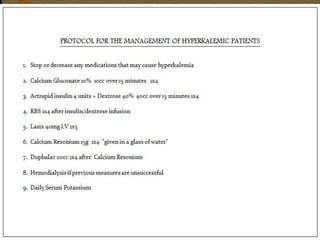
Treatment of hyperkalemia
 Is the value accurate??
 Are there EKG changes??
 Is there evidence of Hemolysis on lab
specimen??
 Recheck blood
Treatment
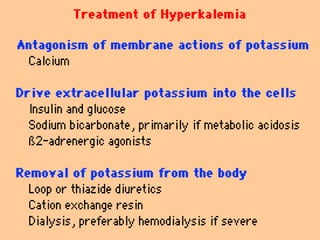
 1- Stabilize myocardial membrane
 2- Drive extracellular potassium into the
cells
 3- Removal of Potassium from the body
Case 2
A 35 yo male patient with CRF presented
to the ER with rapid shallow breathing
hypotension and bradycardia found to
have K+ 8.5 meq/L
Q) Which of the following does not affect
K level
Q)which does actually remove K from the
body
1) Ca gluconate 2) NaHCO3
3) Glucose / insulin 4) B-agonists
5)CER (kayexalate) 6) Dialysis
Treatment of hyperkalemia
 Asymptomatic patient with serum K+ of
6.5 meq/L & no ECG changes can be
treated only with a cation exchange
resin (Kayexalate®),
 Patients with a value below 6 meq/L can
often be treated with
 a low potassium diet and
 diuretics.
Treatment of severe
hyperkalemia
Calcium
 Calcium directly antagonizes the
membrane actions of hyperkalemia.
 The protective effect of calcium begins
within minutes, but is relatively short-
lived
Treatment of severe
hyperkalemia
 The usual dose is 10 mL (1 ampul) of a 10
percent calcium gluconate solution infused
slowly over 2 to 3 minutes with constant
cardiac monitoring.
 This dose can be repeated after 5 minutes if
the ECG changes persist.(no maximum dose)
 Calcium should not be given in bicarbonate-
containing solutions (leads to calcium
carbonate precipitation).
Treatment of severe
hyperkalemia
Insulin and glucose
 Lowers the plasma K+ concentration by
driving potassium into the cells, by
enhancing the activity of the Na-K-
ATPase pump in skeletal muscle
 10 U plus 50 mL of a 50 percent
glucose solution as a bolus followed by
a glucose infusion to prevent
hypoglycemia
Treatment of severe
hyperkalemia
 Effective therapy usually leads to a 0.5
to 1.5 meq/L fall in the plasma
potassium concentration, an effect that
begins in 15 minutes, peaks at 60
minutes, and lasts for several hours
Treatment of severe
hyperkalemia
Sodium bicarbonate
 Raising the systemic pH with sodium
bicarbonate results in hydrogen ion
release from the cells (as part of the
buffering reaction).
 This change is accompanied by
potassium movement into the cells to
maintain electroneutrality
Treatment of severe
hyperkalemia
 The potassium-lowering action of
sodium bicarbonate is most prominent
in patients with metabolic acidosis.
 It begins within 30 to 60 minutes and
persists for several hours
 is 45 meq (1 ampul of a 7.5 percent
sodium bicarbonate solution) infused
slowly over 5 minutes, repeat in 30
minutes if necessary
Treatment of severe
hyperkalemia
Beta2-adrenergic agonists
 Drive potassium into the cells by
increasing Na-K-ATPase activity.
 Albuterol (10 to 20 mg in 4 mL of saline
by nasal inhalation over 10 minutes
Treatment of severe
hyperkalemia
Cation exchange resin
 sodium polystyrene sulfonate (Kayexalate®).
Takes up potassium and releases sodium.
 Each gram of resin may bind1 meq of K+
and release 1 to 2 meq of sodium.
 The oral dose is usually 20 grams given with
100 mL of a 20 percent sorbitol solution to
prevent constipation, repeat every 4 to 6
hours as necessary.
Treatment of severe
hyperkalemia
 When given as an enema, 50 grams of resin
is mixed with 50 mL of 70 percent sorbitol
plus 100 to 150 mL of tap water.
 This solution should be kept in the colon for
at least 30 to 60 minutes and preferably two
to four hours.
 Each enema can lower the plasma potassium
concentration by as much as 0.5 to 1 meq/L
and can be repeated every two to four hours.
Treatment of refractory
hyperkalemia
Hemodialysis can be used if
 The conservative measures listed
above are ineffective
 Refractory hyperkalemia usually such
patient had very low GFR.
 The patient has marked tissue
breakdown and is releasing large
amounts of potassium from the injured
cells
Case 2
A 35 yo male patient with CRF presented
to the ER with rapid shallow breathing
hypotension and bradycardia found to
have K+ 8.5 meq/L
Q) Which of the following does not affect
K level
Q)which does actually remove K from the
body
1) Ca gluconate 2) NaHCO3
3) Glucose / insulin 4) B-agonists
5)CER (kayexalate) 6) Dialysis
Thanks, any question

elect rolyte.ppt

  • 1.
  • 2.
  • 3.
    Definition  Total bodyK : 3500 mmole(98% intracellular, 2% extracellular)  Normal serum potassium 3.5-5.5 mEq/L  Hypokalemia is a serum potassium less than 3.5 mEq/L
  • 4.
     American diet: 100 mmole  Haemostasis system of K :  1) kidney , intestine  2) Shifting of K between the ECF and ICF
  • 5.
    Blood pressure Renin Renin Aldo K+ excretion rateand acid -base status ? H Hy yp po ok ka al le em mi ia a & & P Pa ar ra al ly ys si is s L L o ow w K K+ + e ex xc cr re et ti io on n a an nd d n no or r m ma al l a ac ci id d- -b ba as se e l SPP l Barium poisoning l FPP l Hypernatremic HPP None Family history Hypernatremia High K+ excretion and abnormal acid -base Acid-base state ? Clue Hyperthyroidism ? l TPP YES NO Metabolic Acidosis NH + 4 excretion (UAG, UOG) Low High Toluene Profound diarrhea RTA Metabolic Alkalosis Renin Normal GS or BS Diuretics Vomiting High Primary mineralocorticoid excess Aldo Aldo Primary Aldosteronism Licorice use AME Ectopic ACTH Liddle syndrome Lin SH et al. Am J Emerg Med 2003 (
  • 7.
     Case 1 A43 yo male patient with HTN has been on atenolol and HCTZ was found to have a serum K+ 3.2 meq/L.  Case 2 A 55 yo diabetic female was admitted to the ICU with severe vomiting, diarrhea and muscle weakness, initial work up revealed serum K+ 2.1 meq/L.
  • 8.
    Symptoms Mild to moderatehypokalemia  3 and 3.5 meq/L; this degree of potassium depletion usually produces no symptoms, except for  patients with heart disease ( taking digitalis or undergoing cardiac surgery or  advanced cirrhosis.
  • 9.
    Treatment of mildto moderate hypokalemia  . In general, the loss of 200 to 400 meq of potassium is required to lower the plasma potassium concentration from 4.0 to 3.0 meq/L  Repletion as oral potassium chloride in divided doses over few days  Treat the underlying cause
  • 10.
    Treatment of mildto moderate hypokalemia For patients who can’t tolerate oral KCL  I.V KCL where 20 to 40 meq of potassium is added to each liter of fluid. A saline rather than a dextrose solution is preferred for initial therapy, since the administration of dextrose can lead to a transient 0.2 to 1.4 meq/L reduction in the plasma potassium concentration
  • 11.
    SEVERE HYPOKALEMIA Symptoms  Muscleweakness and paralysis  Renal dysfunction  ECG changes and arrhythmias
  • 12.
    ECG changes  depressionof the ST segment,  decrease in the amplitude of the T wave, and  increase in the amplitude of U waves which occur at the end of the T wave. U waves are often seen in the lateral precordial leads V4-V6.
  • 14.
    Treatment of severe hypokalemia . A patient with a plasma potassium concentration of 2 meq/L, for example, may have a 400 to 800 meq potassium deficit  The maximum rate of intravenous potassium administration is 10(peripheral line) to 20(central line) meq/h, although higher rates have been given to selected patients with paralysis or life-threatening arrhythmias
  • 15.
    Treatment of severe hypokalemia In this setting, solutions containing as much as 200 meq of potassium per liter (20 meq in 100 mL of isotonic saline) have been used. These solutions should be infused into a large vein ( femoral vein, subclavian vein, or internal jugular vein)
  • 16.
    Treatment of severe hypokalemia Accidental administration of very large quantities of intravenous potassium can be avoided by limiting the amount of potassium per container (eg, 20 meq in 100 mL of isotonic saline)
  • 17.
    Treatment of severe hypokalemia Careful monitoring of the physiologic effects of severe hypokalemia (ECG abnormalities, muscle weakness or paralysis) is essential .  Once these problems are no longer severe, the rate of potassium repletion should be slowed (to 10 meq/h) even though there is persistent hypokalemia.
  • 18.
     If patienthad refractory hypokalemia in spite of adequate replacement so could be :  1/ persistent cause like vomiting or diuretics  2/ hypomagnesaemia  3/ dextrose containing solutions
  • 19.
  • 20.
    Definition  Normal serumpotassium 3.5-5.5 mEq/L  Hyperkalemia is a serum potassium greater than 5.5 mEq/L
  • 21.
    Case 1 A 63yo male patient with DM, HTN, CHF has been on digoxin, captopril and aspirin. Routine work up showed creat. 2.5 mg/dL and K+ 6.5 meq/L. Q) What are the possible causes of the hyperkalemia. Q) How to treat.
  • 23.
    symptoms  severe symptomsof hyperkalemia usually do not occur until the plasma potassium concentration is above 7.0 meq/L (unless the rise has been very rapid).  severe muscle weakness, or  marked electrocardiographic changes
  • 24.
    ECG changes  Tallpeaked and symmetrical T wave.(early)  Progressive slowing of impulse conduction causing the PR interval to lengthen and the QRS duration to increase.  The P wave may disappear as a result of atrial standstill or arrest.
  • 26.
    ECG changes  Ultimatelythe QRS widens further due to a severe conduction delay and may become "sine wave," resulting in ventricular standstill and a flat line
  • 28.
  • 29.
  • 30.
  • 31.
    Treatment of hyperkalemia Is the value accurate??  Are there EKG changes??  Is there evidence of Hemolysis on lab specimen??  Recheck blood
  • 32.
    Treatment  1- Stabilizemyocardial membrane  2- Drive extracellular potassium into the cells  3- Removal of Potassium from the body
  • 33.
    Case 2 A 35yo male patient with CRF presented to the ER with rapid shallow breathing hypotension and bradycardia found to have K+ 8.5 meq/L Q) Which of the following does not affect K level Q)which does actually remove K from the body 1) Ca gluconate 2) NaHCO3 3) Glucose / insulin 4) B-agonists 5)CER (kayexalate) 6) Dialysis
  • 35.
    Treatment of hyperkalemia Asymptomatic patient with serum K+ of 6.5 meq/L & no ECG changes can be treated only with a cation exchange resin (Kayexalate®),  Patients with a value below 6 meq/L can often be treated with  a low potassium diet and  diuretics.
  • 36.
    Treatment of severe hyperkalemia Calcium Calcium directly antagonizes the membrane actions of hyperkalemia.  The protective effect of calcium begins within minutes, but is relatively short- lived
  • 37.
    Treatment of severe hyperkalemia The usual dose is 10 mL (1 ampul) of a 10 percent calcium gluconate solution infused slowly over 2 to 3 minutes with constant cardiac monitoring.  This dose can be repeated after 5 minutes if the ECG changes persist.(no maximum dose)  Calcium should not be given in bicarbonate- containing solutions (leads to calcium carbonate precipitation).
  • 38.
    Treatment of severe hyperkalemia Insulinand glucose  Lowers the plasma K+ concentration by driving potassium into the cells, by enhancing the activity of the Na-K- ATPase pump in skeletal muscle  10 U plus 50 mL of a 50 percent glucose solution as a bolus followed by a glucose infusion to prevent hypoglycemia
  • 39.
    Treatment of severe hyperkalemia Effective therapy usually leads to a 0.5 to 1.5 meq/L fall in the plasma potassium concentration, an effect that begins in 15 minutes, peaks at 60 minutes, and lasts for several hours
  • 40.
    Treatment of severe hyperkalemia Sodiumbicarbonate  Raising the systemic pH with sodium bicarbonate results in hydrogen ion release from the cells (as part of the buffering reaction).  This change is accompanied by potassium movement into the cells to maintain electroneutrality
  • 41.
    Treatment of severe hyperkalemia The potassium-lowering action of sodium bicarbonate is most prominent in patients with metabolic acidosis.  It begins within 30 to 60 minutes and persists for several hours  is 45 meq (1 ampul of a 7.5 percent sodium bicarbonate solution) infused slowly over 5 minutes, repeat in 30 minutes if necessary
  • 42.
    Treatment of severe hyperkalemia Beta2-adrenergicagonists  Drive potassium into the cells by increasing Na-K-ATPase activity.  Albuterol (10 to 20 mg in 4 mL of saline by nasal inhalation over 10 minutes
  • 43.
    Treatment of severe hyperkalemia Cationexchange resin  sodium polystyrene sulfonate (Kayexalate®). Takes up potassium and releases sodium.  Each gram of resin may bind1 meq of K+ and release 1 to 2 meq of sodium.  The oral dose is usually 20 grams given with 100 mL of a 20 percent sorbitol solution to prevent constipation, repeat every 4 to 6 hours as necessary.
  • 44.
    Treatment of severe hyperkalemia When given as an enema, 50 grams of resin is mixed with 50 mL of 70 percent sorbitol plus 100 to 150 mL of tap water.  This solution should be kept in the colon for at least 30 to 60 minutes and preferably two to four hours.  Each enema can lower the plasma potassium concentration by as much as 0.5 to 1 meq/L and can be repeated every two to four hours.
  • 45.
    Treatment of refractory hyperkalemia Hemodialysiscan be used if  The conservative measures listed above are ineffective  Refractory hyperkalemia usually such patient had very low GFR.  The patient has marked tissue breakdown and is releasing large amounts of potassium from the injured cells
  • 46.
    Case 2 A 35yo male patient with CRF presented to the ER with rapid shallow breathing hypotension and bradycardia found to have K+ 8.5 meq/L Q) Which of the following does not affect K level Q)which does actually remove K from the body 1) Ca gluconate 2) NaHCO3 3) Glucose / insulin 4) B-agonists 5)CER (kayexalate) 6) Dialysis
  • 48.