NEO-IMPRESSIONISM AND
   POST-IMPRESSIONISM
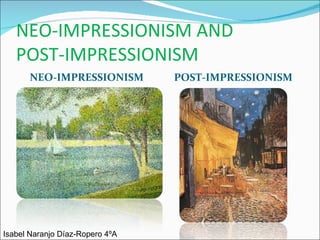
       NEO-IMPRESSIONISM         POST-IMPRESSIONISM


Isabel Naranjo Díaz-Ropero 4ºA
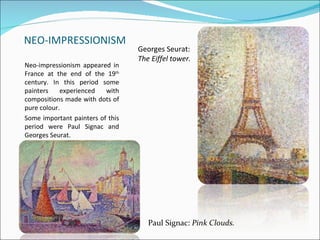
NEO-IMPRESSIONISM
                                  Georges Seurat:
                                  The Eiffel tower.
Neo-impressionism appeared in
France at the end of the 19th
century. In this period some
painters    experienced   with
compositions made with dots of
pure colour.
Some important painters of this
period were Paul Signac and
Georges Seurat.


                                     Paul Signac: Pink Clouds.
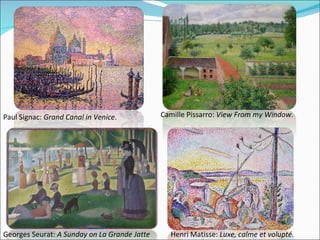
Paul Signac: Grand Canal in Venice.           Camille Pissarro: View From my Window.


Georges Seurat: A Sunday on La Grande Jatte     Henri Matisse: Luxe, calme et volupté.
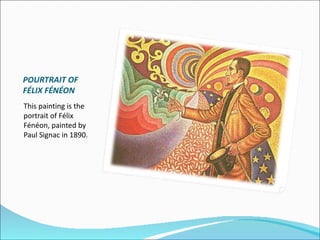
POURTRAIT OF
FÉLIX FÉNÉON
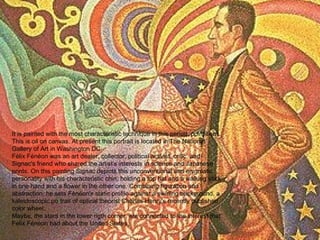
This painting is the
portrait of Félix
Fénéon, painted by
Paul Signac in 1890.
It is painted with the most characteristic technique in this period, pointillism.
This is oil on canvas. At present this portrait is located in The National
Gallery of Art in Washington DC
Félix Fénéon was an art dealer, collector, political activist, critic, and
Signac's friend who shared the artist's interests in science and Japanese
prints. On this painting Signac depicts this unconventional and enigmatic
personality with his characteristic chin, holding a top hat and a walking stick
in one hand and a flower in the other one. Combining figuration and
abstraction, he sets Fénéon's static profile against a swirling background, a
kaleidoscopic portrait of optical theorist Charles Henry's recently published
color wheel.
Maybe, the stars in the lower rigth corner, are connected to the interest that
Felix Fénéon had about the United States.
POST-IMPRESSIONISM
Post-impressionism is a term
used to express the artistic period
that appeared after Neo-
impressionism. It developed in the
last decades of the 19th century.
Post-impressionism was an
extension of impressionism and at
the same time it was a rejection of
its limitations. In this period they
still used very colorful paints,
peculiar brushwork and realistic
themes, but they tried to transmit
more emotions.
Some of the most famous
painters of this period were: Paul
Gauguin, Henry de Toulouse-
Lautrec, Vincent Van Gogh and
Paul Cézanne.

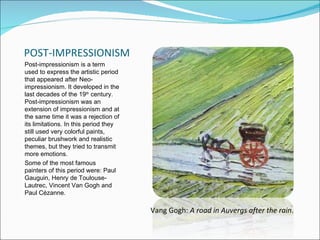
                                       Vang Gogh: A road in Auvergs after the rain.
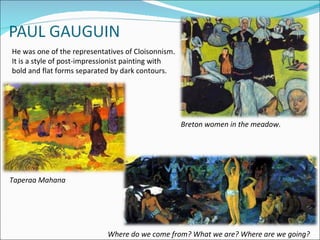
He was one of the representatives of Cloisonnism.
It is a style of post-impressionist painting with
bold and flat forms separated by dark contours.


                                                    Breton women in the meadow.


Taperaa Mahana


                            Where do we come from? What we are? Where are we going?
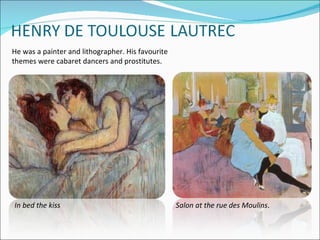
He was a painter and lithographer. His favourite
themes were cabaret dancers and prostitutes.


In bed the kiss                                    Salon at the rue des Moulins.
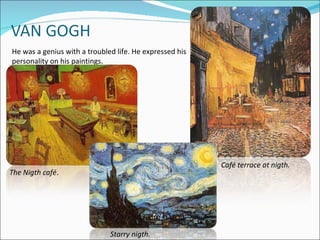
He was a genius with a troubled life. He expressed his
personality on his paintings.


                                                         Café terrace at nigth.
The Nigth café.


                              Starry nigth.
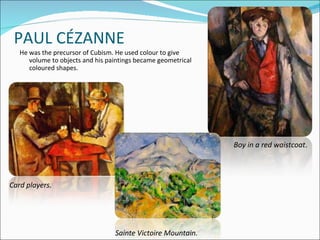
PAUL CÉZANNE
   He was the precursor of Cubism. He used colour to give
      volume to objects and his paintings became geometrical
      coloured shapes.


                                                               Boy in a red waistcoat.


Card players.


                                  Sainte Victoire Mountain.
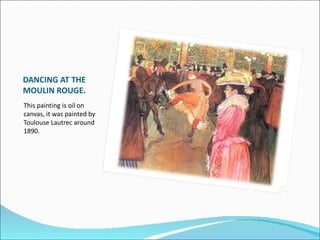
DANCING AT THE
MOULIN ROUGE.
This painting is oil on
canvas, it was painted by
Toulouse Lautrec around
1890.
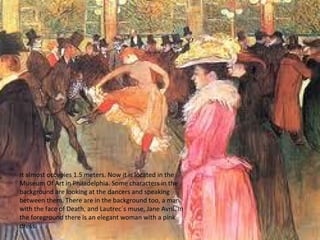
It almost occupies 1.5 meters. Now it is located in the
Museum Of Art in Philadelphia. Some characters in the
background are looking at the dancers and speaking
between them. There are in the background too, a man
with the face of Death, and Lautrec´s muse, Jane Avril. In
the foreground there is an elegant woman with a pink
dress.
SOURCES:
 http://www.moma.org/collection/browse_results.php?criteria
 http://translate.google.es/translate?hl=es&sl=en&tl=es&u=htt
 http://
  todacultura.com/movimientosartisticos/neoimpresionismo.ht

 Wikipedia.
 Paqui Pérez Fons, (2011). Social Sciences Book 4th Year
  ESO, Campo de Criptana.

Neoimpressionism and postimpressionism

  • 1.
    NEO-IMPRESSIONISM AND POST-IMPRESSIONISM NEO-IMPRESSIONISM POST-IMPRESSIONISM Isabel Naranjo Díaz-Ropero 4ºA
  • 2.
    NEO-IMPRESSIONISM Georges Seurat: The Eiffel tower. Neo-impressionism appeared in France at the end of the 19th century. In this period some painters experienced with compositions made with dots of pure colour. Some important painters of this period were Paul Signac and Georges Seurat. Paul Signac: Pink Clouds.
  • 3.
    Paul Signac: GrandCanal in Venice. Camille Pissarro: View From my Window. Georges Seurat: A Sunday on La Grande Jatte Henri Matisse: Luxe, calme et volupté.
  • 4.
    POURTRAIT OF FÉLIX FÉNÉON Thispainting is the portrait of Félix Fénéon, painted by Paul Signac in 1890.
  • 5.
    It is paintedwith the most characteristic technique in this period, pointillism. This is oil on canvas. At present this portrait is located in The National Gallery of Art in Washington DC Félix Fénéon was an art dealer, collector, political activist, critic, and Signac's friend who shared the artist's interests in science and Japanese prints. On this painting Signac depicts this unconventional and enigmatic personality with his characteristic chin, holding a top hat and a walking stick in one hand and a flower in the other one. Combining figuration and abstraction, he sets Fénéon's static profile against a swirling background, a kaleidoscopic portrait of optical theorist Charles Henry's recently published color wheel. Maybe, the stars in the lower rigth corner, are connected to the interest that Felix Fénéon had about the United States.
  • 6.
    POST-IMPRESSIONISM Post-impressionism is aterm used to express the artistic period that appeared after Neo- impressionism. It developed in the last decades of the 19th century. Post-impressionism was an extension of impressionism and at the same time it was a rejection of its limitations. In this period they still used very colorful paints, peculiar brushwork and realistic themes, but they tried to transmit more emotions. Some of the most famous painters of this period were: Paul Gauguin, Henry de Toulouse- Lautrec, Vincent Van Gogh and Paul Cézanne. Vang Gogh: A road in Auvergs after the rain.
  • 7.
    He was oneof the representatives of Cloisonnism. It is a style of post-impressionist painting with bold and flat forms separated by dark contours. Breton women in the meadow. Taperaa Mahana Where do we come from? What we are? Where are we going?
  • 8.
    He was apainter and lithographer. His favourite themes were cabaret dancers and prostitutes. In bed the kiss Salon at the rue des Moulins.
  • 9.
    He was agenius with a troubled life. He expressed his personality on his paintings. Café terrace at nigth. The Nigth café. Starry nigth.
  • 10.
    PAUL CÉZANNE He was the precursor of Cubism. He used colour to give volume to objects and his paintings became geometrical coloured shapes. Boy in a red waistcoat. Card players. Sainte Victoire Mountain.
  • 11.
    DANCING AT THE MOULINROUGE. This painting is oil on canvas, it was painted by Toulouse Lautrec around 1890.
  • 12.
    It almost occupies1.5 meters. Now it is located in the Museum Of Art in Philadelphia. Some characters in the background are looking at the dancers and speaking between them. There are in the background too, a man with the face of Death, and Lautrec´s muse, Jane Avril. In the foreground there is an elegant woman with a pink dress.
  • 13.
    SOURCES:  http://www.moma.org/collection/browse_results.php?criteria  http://translate.google.es/translate?hl=es&sl=en&tl=es&u=htt http:// todacultura.com/movimientosartisticos/neoimpresionismo.ht  Wikipedia.  Paqui Pérez Fons, (2011). Social Sciences Book 4th Year ESO, Campo de Criptana.