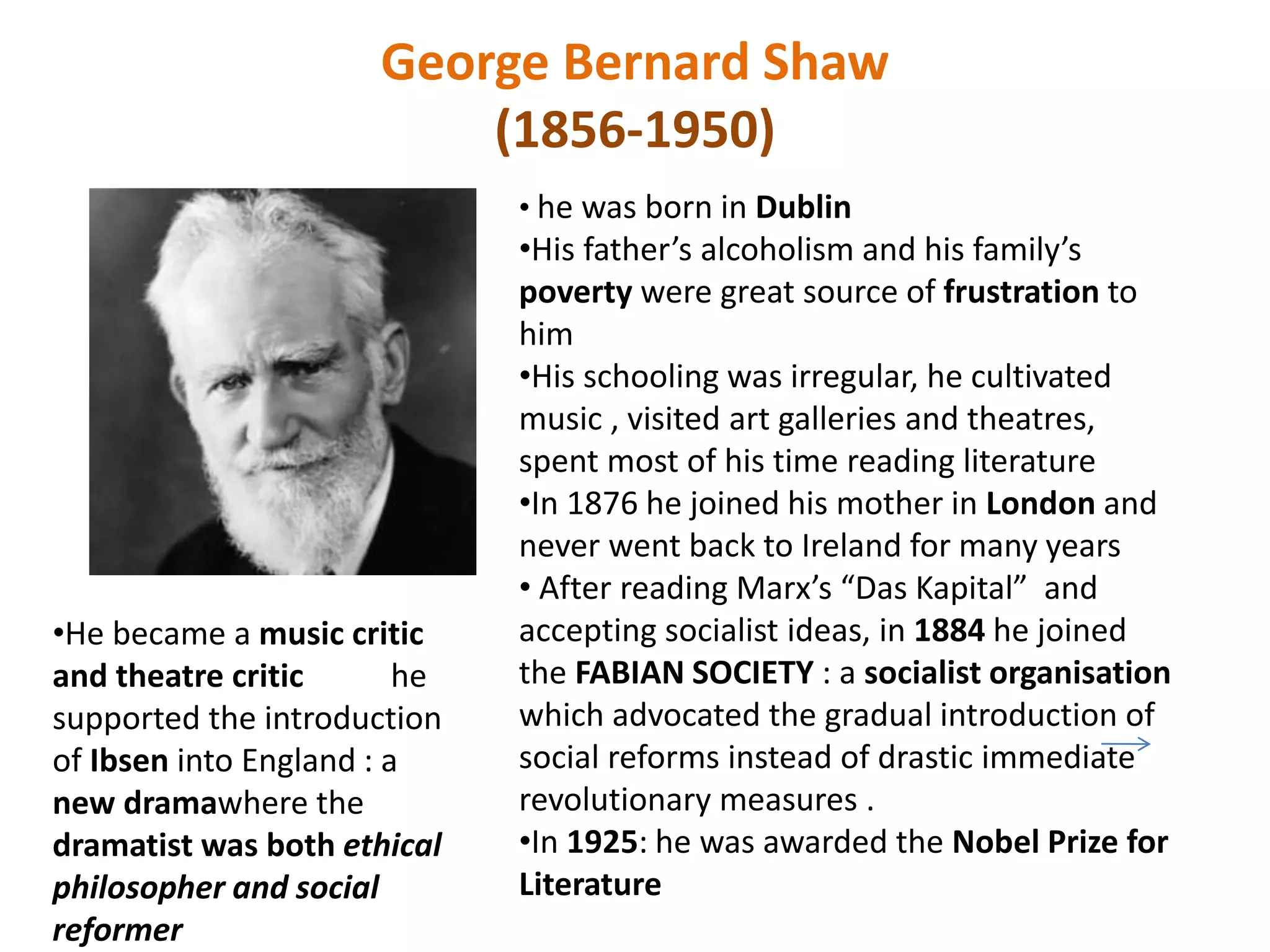
George Bernard Shaw
(1856-1950)
• he was born in Dublin
•His father’s alcoholism and his family’s
poverty were great source of frustration to
him
•His schooling was irregular, he cultivated
music , visited art galleries and theatres,
spent most of his time reading literature
•In 1876 he joined his mother in London and
never went back to Ireland for many years
• After reading Marx’s “Das Kapital” and
accepting socialist ideas, in 1884 he joined
the FABIAN SOCIETY : a socialist organisation
which advocated the gradual introduction of
social reforms instead of drastic immediate
revolutionary measures .
•In 1925: he was awarded the Nobel Prize for
Literature
•He became a music critic
and theatre critic he
supported the introduction
of Ibsen into England : a
new dramawhere the
dramatist was both ethical
philosopher and social
reformer
Shaw: The Freethinker
• Playwright, literary critic , a socialist
spokesman and a leading figure in the 20 th
century theatre
• He was a defender of women’s rights and
advocated equality of income
• He supported abolition of private property,
radical change in the voting system,
campaigned for the simplification of spelling
and the reform of the English alphabet
The influence of Ibsen
Henrik Ibsen: a Norwegian playwright (1828-1906)
exposed the hypocrisy and corruption of the middle class +
art: seen as an instrument of moral propaganda = anti
romantic theatre
Shaw shared Ibsen’s idea about the stage as a powerful
force for awakening people’s social conscience
THEATRE OF IDEAS: Shaw wanted to force his audience to
face the reality of unpleasant events
“SHAVIAN” DRAMA: (refers to “Shaw”) type of
politically and socially committed drama also known
as “discussion plays” made popular by him and
others.
Shaw’s plays…
Shaw wrote more than sixty plays, which were grouped into
small collections. In 1898 he wrote two volumes of plays:
Plays Pleasant
• “Arms and the
Man” 1894 –
parody of
military heroism
•“You Never Can
Tell” 1897 – on
the authority of
parents
•…
PlaysUnpleasant
• “Widowers’ Houses”
1892- on the problem
of slums
• “Mrs Warren’s
Profession” 1893 –
on the economic
basis of modern
prostitution
•…
Features of Shaw’s plays
• The purpose was not so much to make people laugh but
to make them realize the hypocrisy and absurdity of
some prejudices and attitudes
• Debate is one main feature “discussion plays” – this
gives mental and intellectual action
• Conflict of passions is deliberatly replaced by conflict of
thoughts and ideas
• Dialogues are vigorous and brilliant, rich in wit,
paradoxes, nonsense, puns
• Problems are often faced from various viewpoints:
dialectic of confrontation technique
• Characters: not always lifelike
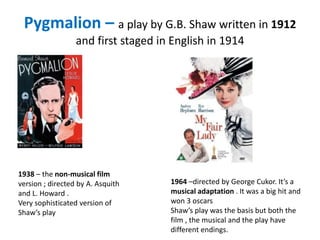
Pygmalion – a play by G.B. Shaw written in 1912
and first staged in English in 1914
1938 – the non-musical film
version ; directed by A. Asquith
and L. Howard .
Very sophisticated version of
Shaw’s play
1964 –directed by George Cukor. It’s a
musical adaptation . It was a big hit and
won 3 oscars
Shaw’s play was the basis but both the
film , the musical and the play have
different endings.
Pygmalion (1912) a play in 5 Acts
Plot overview
(Act 1) Covent Garden – London – rainy evening. Professor Higgins, a
professor of phonetics, is taking notes about the dialect spoken in
that area and tries to guess where everyone is from based on their
manner of speech. Here he meets a poor flower girl, Eliza Doolittle.
Higgins bets his friend Pickering that he could teach the girl to
speak so well in just three months that she could pass for a noble
lady.
(Act 2) Higgins’s Laboratory: Pickering steps in and bets Higgins that he
can't teach Eliza to speak so well that she passes as a wealthy lady
at an ambassador's garden party in six months. He offers to pay for
her lessons. Higgins likes the idea and tells his housekeeper Mrs.
Pearce to wash Eliza and dress her in new clothes. He will teach her
to speak standard English so that no one will be able to tell her
from a member of the upper class.
Pygmalion - Plot overview
(Act 3) A few months later at Higgins’s mother’s house. Liza is ready for
her first appearance in society: invitation for a tea. People don’t
recognize her as the flower girl. Everybody starts making small talk
about the weather and Eliza makes her clumsy comments. Higgins’s
mother cautions her son about treating Eliza like a "live doll," but
Pickering assures her that they take Eliza seriously. Higgins refers to
Eliza as merely an experiment. Mrs. Higgins worries about what will
happen to Eliza when the "experiment" is over.
(Act 4) several months later. Higgins has won his bet. He has taken Liza
to an Embassy bull in London where she mingled with the upper
classes and everybody thought she was a foreign princess. The
moment of Higgins’s triumph is also the moment of Liza’s self
awareness : she realizes that Higgins is only interested in his own
success and has no consideration for her as a human being, she
leaves his house.
Pygmalion - Plot overview
(Act 5) Next day – Mrs Higgins’s house. Mrs. Higgins scolds
Higgins and Pickering for how they have treated Eliza and
reveals that Eliza is there. Pickering is nice to Eliza, but
Higgins is angry and rude to her, ordering her to come back to
his house. Eliza thanks Pickering for teaching her good
manners but she says to Higgins that she is a slave, despite
her expensive clothes. She then says that if she can't have
kindness from him, she will have her independence. She tells
Higgins that she will become a teacher of phonetics, stealing
everything she has learned from him in order to take his
clients. Higgins is suddenly impressed by Eliza's strength and
confidence. Eliza shows she has a will of her own.
OPEN ENDING: we don’t know if E. marries Freddy or she goes to
live with Higgins.
The title allusion …
Ovid’s Metamorphoses myth of Pygmalion
Pygmalion : name of a mythological figure, a
sculptor who scorns all the women around
him and creates the statue of his ideal
woman. He fells in love with this beautiful
ivory woman he calls Galatea (white like milk).
Aphrodite, the goddess of love, gave life to the
inanimate creation. Galatea awakens so that
the artist can marry and be happy with his
own creation .
Theme 1 : femininity and role of women in
society
• Pygmalion's perfect woman can only be attained
with an artificial creation, a sculpture.
Similarly, the ideal noble lady of upper society of
Shaw's play is a kind of fake, only a role that Eliza
must learn to play. (only appearance)
Pygmalion also shows how oppressive unrealistic
ideals of femininity can be: to attain these ideals,
Eliza has to be coached, disciplined, and taught.
She has to pretend to be someone other than
who she really is.
Theme 2: change – appearance and reality
• Criticism of Victorian middle class morality
and rigid artificiality of class division the
ability to speak good English and to learn good
manners are elements of both social
discrimination and social promotion.
• Eliza undergoes a physical and external
transformation throughout the play BUT has
she really changed her natural identity? Or
can’t she escape the reality she was born in?
SOME LINGUISTICS…
• ACCENT: a method of pronouncing words common to
a group of people (inhabitants of a locality or
members of a social class). It can also refer to stress on
certain syllables (intonation)
• Local accents (pronounciation) are part of local
dialects. Any dialect of English has unique features in
pronunciation, vocabulary and grammar
• COCKNEY: English spoken by working class people
living in London
• Audiences were shocked when they heard Liza’s coarse
use of swear words. Besides we have humor when Liza
has the ability to speak well but can’t choose the right
conversation acceptable to polite society
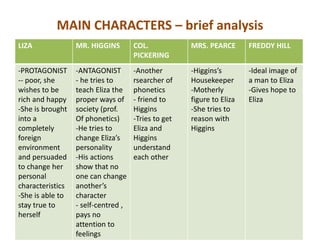
MAIN CHARACTERS – brief analysis
LIZA MR. HIGGINS COL.
PICKERING
MRS. PEARCE FREDDY HILL
-PROTAGONIST
-- poor, she
wishes to be
rich and happy
-She is brought
into a
completely
foreign
environment
and persuaded
to change her
personal
characteristics
-She is able to
stay true to
herself
-ANTAGONIST
- he tries to
teach Eliza the
proper ways of
society (prof.
Of phonetics)
-He tries to
change Eliza’s
personality
-His actions
show that no
one can change
another’s
character
- self-centred ,
pays no
attention to
feelings
-Another
rsearcher of
phonetics
- friend to
Higgins
-Tries to get
Eliza and
Higgins
understand
each other
-Higgins’s
Housekeeper
-Motherly
figure to Eliza
-She tries to
reason with
Higgins
-Ideal image of
a man to Eliza
-Gives hope to
Eliza
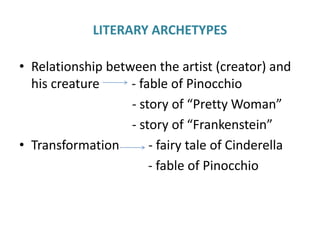
LITERARY ARCHETYPES
• Relationship between the artist (creator) and
his creature - fable of Pinocchio
- story of “Pretty Woman”
- story of “Frankenstein”
• Transformation - fairy tale of Cinderella
- fable of Pinocchio
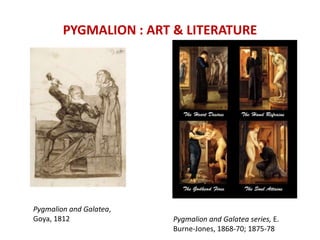
PYGMALION : ART & LITERATURE
Pygmalion and Galatea,
Goya, 1812 Pygmalion and Galatea series, E.
Burne-Jones, 1868-70; 1875-78
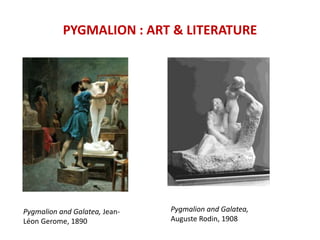
PYGMALION : ART & LITERATURE
Pygmalion and Galatea, Jean-
Léon Gerome, 1890
Pygmalion and Galatea,
Auguste Rodin, 1908

G . B. Shaw - Pygmalion

  • 1.
    George Bernard Shaw (1856-1950) •he was born in Dublin •His father’s alcoholism and his family’s poverty were great source of frustration to him •His schooling was irregular, he cultivated music , visited art galleries and theatres, spent most of his time reading literature •In 1876 he joined his mother in London and never went back to Ireland for many years • After reading Marx’s “Das Kapital” and accepting socialist ideas, in 1884 he joined the FABIAN SOCIETY : a socialist organisation which advocated the gradual introduction of social reforms instead of drastic immediate revolutionary measures . •In 1925: he was awarded the Nobel Prize for Literature •He became a music critic and theatre critic he supported the introduction of Ibsen into England : a new dramawhere the dramatist was both ethical philosopher and social reformer
  • 2.
    Shaw: The Freethinker •Playwright, literary critic , a socialist spokesman and a leading figure in the 20 th century theatre • He was a defender of women’s rights and advocated equality of income • He supported abolition of private property, radical change in the voting system, campaigned for the simplification of spelling and the reform of the English alphabet
  • 3.
    The influence ofIbsen Henrik Ibsen: a Norwegian playwright (1828-1906) exposed the hypocrisy and corruption of the middle class + art: seen as an instrument of moral propaganda = anti romantic theatre Shaw shared Ibsen’s idea about the stage as a powerful force for awakening people’s social conscience THEATRE OF IDEAS: Shaw wanted to force his audience to face the reality of unpleasant events “SHAVIAN” DRAMA: (refers to “Shaw”) type of politically and socially committed drama also known as “discussion plays” made popular by him and others.
  • 4.
    Shaw’s plays… Shaw wrotemore than sixty plays, which were grouped into small collections. In 1898 he wrote two volumes of plays: Plays Pleasant • “Arms and the Man” 1894 – parody of military heroism •“You Never Can Tell” 1897 – on the authority of parents •… PlaysUnpleasant • “Widowers’ Houses” 1892- on the problem of slums • “Mrs Warren’s Profession” 1893 – on the economic basis of modern prostitution •…
  • 5.
    Features of Shaw’splays • The purpose was not so much to make people laugh but to make them realize the hypocrisy and absurdity of some prejudices and attitudes • Debate is one main feature “discussion plays” – this gives mental and intellectual action • Conflict of passions is deliberatly replaced by conflict of thoughts and ideas • Dialogues are vigorous and brilliant, rich in wit, paradoxes, nonsense, puns • Problems are often faced from various viewpoints: dialectic of confrontation technique • Characters: not always lifelike
  • 6.
    Pygmalion – aplay by G.B. Shaw written in 1912 and first staged in English in 1914 1938 – the non-musical film version ; directed by A. Asquith and L. Howard . Very sophisticated version of Shaw’s play 1964 –directed by George Cukor. It’s a musical adaptation . It was a big hit and won 3 oscars Shaw’s play was the basis but both the film , the musical and the play have different endings.
  • 7.
    Pygmalion (1912) aplay in 5 Acts Plot overview (Act 1) Covent Garden – London – rainy evening. Professor Higgins, a professor of phonetics, is taking notes about the dialect spoken in that area and tries to guess where everyone is from based on their manner of speech. Here he meets a poor flower girl, Eliza Doolittle. Higgins bets his friend Pickering that he could teach the girl to speak so well in just three months that she could pass for a noble lady. (Act 2) Higgins’s Laboratory: Pickering steps in and bets Higgins that he can't teach Eliza to speak so well that she passes as a wealthy lady at an ambassador's garden party in six months. He offers to pay for her lessons. Higgins likes the idea and tells his housekeeper Mrs. Pearce to wash Eliza and dress her in new clothes. He will teach her to speak standard English so that no one will be able to tell her from a member of the upper class.
  • 8.
    Pygmalion - Plotoverview (Act 3) A few months later at Higgins’s mother’s house. Liza is ready for her first appearance in society: invitation for a tea. People don’t recognize her as the flower girl. Everybody starts making small talk about the weather and Eliza makes her clumsy comments. Higgins’s mother cautions her son about treating Eliza like a "live doll," but Pickering assures her that they take Eliza seriously. Higgins refers to Eliza as merely an experiment. Mrs. Higgins worries about what will happen to Eliza when the "experiment" is over. (Act 4) several months later. Higgins has won his bet. He has taken Liza to an Embassy bull in London where she mingled with the upper classes and everybody thought she was a foreign princess. The moment of Higgins’s triumph is also the moment of Liza’s self awareness : she realizes that Higgins is only interested in his own success and has no consideration for her as a human being, she leaves his house.
  • 9.
    Pygmalion - Plotoverview (Act 5) Next day – Mrs Higgins’s house. Mrs. Higgins scolds Higgins and Pickering for how they have treated Eliza and reveals that Eliza is there. Pickering is nice to Eliza, but Higgins is angry and rude to her, ordering her to come back to his house. Eliza thanks Pickering for teaching her good manners but she says to Higgins that she is a slave, despite her expensive clothes. She then says that if she can't have kindness from him, she will have her independence. She tells Higgins that she will become a teacher of phonetics, stealing everything she has learned from him in order to take his clients. Higgins is suddenly impressed by Eliza's strength and confidence. Eliza shows she has a will of her own. OPEN ENDING: we don’t know if E. marries Freddy or she goes to live with Higgins.
  • 10.
    The title allusion… Ovid’s Metamorphoses myth of Pygmalion Pygmalion : name of a mythological figure, a sculptor who scorns all the women around him and creates the statue of his ideal woman. He fells in love with this beautiful ivory woman he calls Galatea (white like milk). Aphrodite, the goddess of love, gave life to the inanimate creation. Galatea awakens so that the artist can marry and be happy with his own creation .
  • 11.
    Theme 1 :femininity and role of women in society • Pygmalion's perfect woman can only be attained with an artificial creation, a sculpture. Similarly, the ideal noble lady of upper society of Shaw's play is a kind of fake, only a role that Eliza must learn to play. (only appearance) Pygmalion also shows how oppressive unrealistic ideals of femininity can be: to attain these ideals, Eliza has to be coached, disciplined, and taught. She has to pretend to be someone other than who she really is.
  • 12.
    Theme 2: change– appearance and reality • Criticism of Victorian middle class morality and rigid artificiality of class division the ability to speak good English and to learn good manners are elements of both social discrimination and social promotion. • Eliza undergoes a physical and external transformation throughout the play BUT has she really changed her natural identity? Or can’t she escape the reality she was born in?
  • 13.
    SOME LINGUISTICS… • ACCENT:a method of pronouncing words common to a group of people (inhabitants of a locality or members of a social class). It can also refer to stress on certain syllables (intonation) • Local accents (pronounciation) are part of local dialects. Any dialect of English has unique features in pronunciation, vocabulary and grammar • COCKNEY: English spoken by working class people living in London • Audiences were shocked when they heard Liza’s coarse use of swear words. Besides we have humor when Liza has the ability to speak well but can’t choose the right conversation acceptable to polite society
  • 14.
    MAIN CHARACTERS –brief analysis LIZA MR. HIGGINS COL. PICKERING MRS. PEARCE FREDDY HILL -PROTAGONIST -- poor, she wishes to be rich and happy -She is brought into a completely foreign environment and persuaded to change her personal characteristics -She is able to stay true to herself -ANTAGONIST - he tries to teach Eliza the proper ways of society (prof. Of phonetics) -He tries to change Eliza’s personality -His actions show that no one can change another’s character - self-centred , pays no attention to feelings -Another rsearcher of phonetics - friend to Higgins -Tries to get Eliza and Higgins understand each other -Higgins’s Housekeeper -Motherly figure to Eliza -She tries to reason with Higgins -Ideal image of a man to Eliza -Gives hope to Eliza
  • 15.
    LITERARY ARCHETYPES • Relationshipbetween the artist (creator) and his creature - fable of Pinocchio - story of “Pretty Woman” - story of “Frankenstein” • Transformation - fairy tale of Cinderella - fable of Pinocchio
  • 16.
    PYGMALION : ART& LITERATURE Pygmalion and Galatea, Goya, 1812 Pygmalion and Galatea series, E. Burne-Jones, 1868-70; 1875-78
  • 17.
    PYGMALION : ART& LITERATURE Pygmalion and Galatea, Jean- Léon Gerome, 1890 Pygmalion and Galatea, Auguste Rodin, 1908