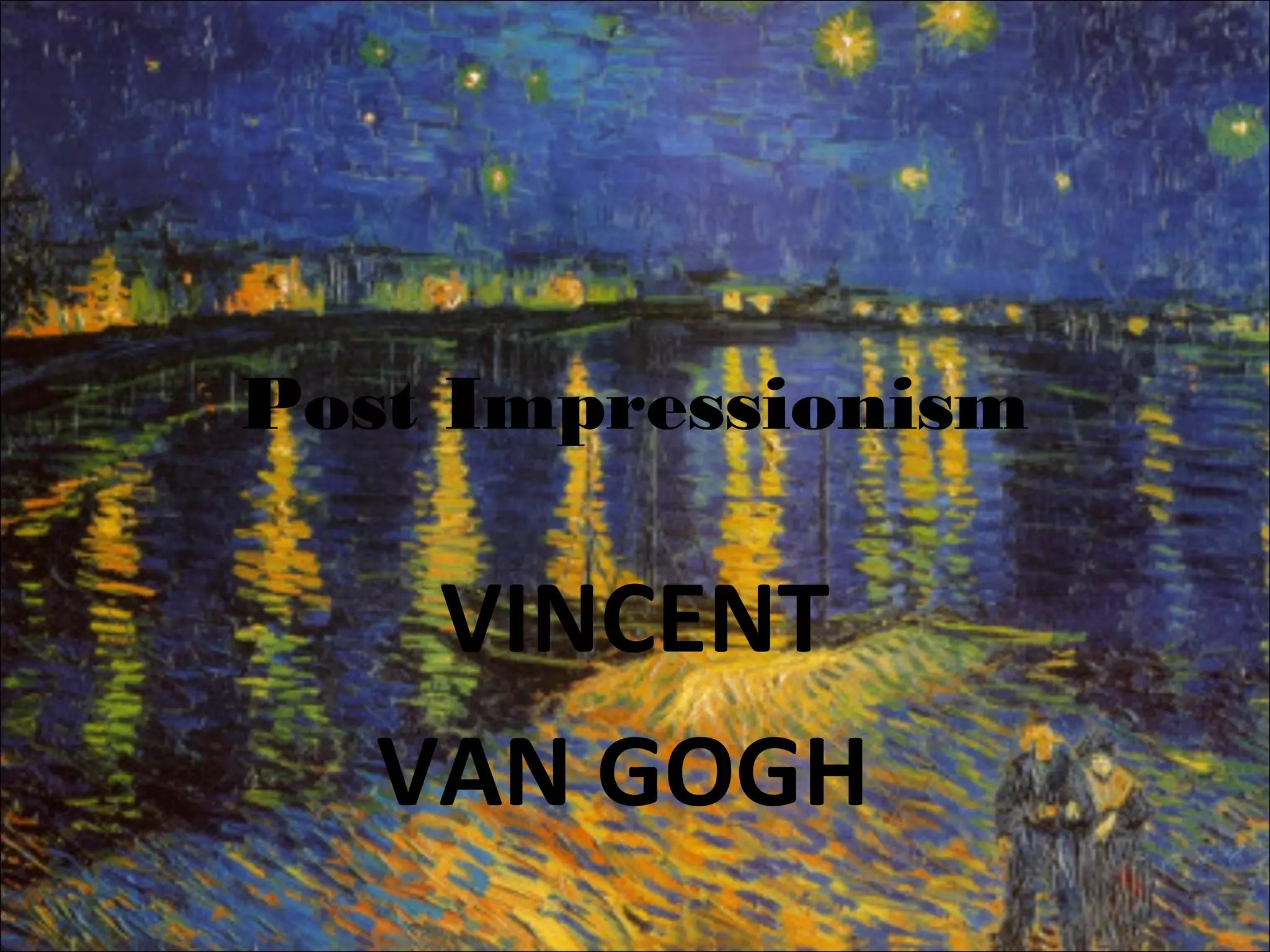
Post Impressionism
VINCENT
VAN GOGH
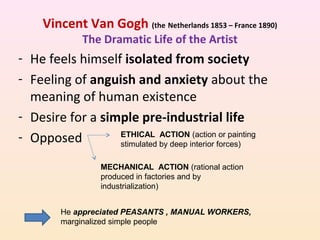
Vincent Van Gogh (the Netherlands 1853 – France 1890)
The Dramatic Life of the Artist
- He feels himself isolated from society
- Feeling of anguish and anxiety about the
meaning of human existence
- Desire for a simple pre-industrial life
- Opposed ETHICAL ACTION (action or painting
stimulated by deep interior forces)
MECHANICAL ACTION (rational action
produced in factories and by
industrialization)
He appreciated PEASANTS , MANUAL WORKERS,
marginalized simple people
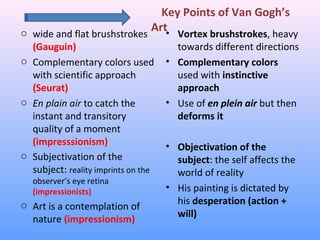
Key Points of Van Gogh’s
Arto wide and flat brushstrokes
(Gauguin)
o Complementary colors used
with scientific approach
(Seurat)
o En plain air to catch the
instant and transitory
quality of a moment
(impresssionism)
o Subjectivation of the
subject: reality imprints on the
observer’s eye retina
(impressionists)
o Art is a contemplation of
nature (impressionism)
• Vortex brushstrokes, heavy
towards different directions
• Complementary colors
used with instinctive
approach
• Use of en plein air but then
deforms it
• Objectivation of the
subject: the self affects the
world of reality
• His painting is dictated by
his desperation (action +
will)
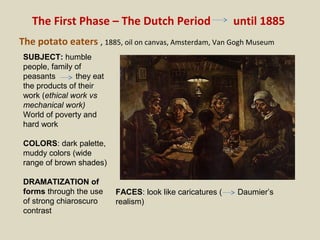
The First Phase – The Dutch Period until 1885
The potato eaters , 1885, oil on canvas, Amsterdam, Van Gogh Museum
SUBJECT: humble
people, family of
peasants they eat
the products of their
work (ethical work vs
mechanical work)
World of poverty and
hard work
COLORS: dark palette,
muddy colors (wide
range of brown shades)
DRAMATIZATION of
forms through the use
of strong chiaroscuro
contrast
FACES: look like caricatures ( Daumier’s
realism)
The potato eaters , 1885, oil on canvas, Amsterdam, Van Gogh Museum
My dear Theo, […]
You see, I really have
wanted to make it so
that people get the
idea that these folk,
who are eating their
potatoes by the light
of their little lamp,
have tilled the earth
themselves with these
hands they are putting
in the dish, and so it
speaks of MANUAL
LABOUR and — that
they have thus
honestly earned their
food. I wanted it to
give the idea of a
wholly different way
of life from ours —
civilized people.
(Nuenen, Thursday, 30 April
1885)
PAINTING TECHNIQUE vs MECHANICH TECHNIQUE
(factories)
It’s a way of facing reality
In order to catch and grasp its alienating work which
Inner essence: life exstinguishes man and his
ETICH ACTION life: MECHANIC ACTION
Realism
(faces- things
on the table –
poverty)
+
Atmosphere
of
spirituality
and
generosity
Simple peasants sitting at the table
The Second Phase – Arles : 1888 - 1889
• From Paris he moved to Southern France : Arles
(1886-Jan.1888)
-Company of Theo
-Admiration of
Impressionists
-Influence from Japanese
prints
-Started to use lighter
palette
-Brushstrokes became
faster and dynamic
-Emphasized expressive
quality of colors
(from Febr. 1888 – April 1889)
-Feels better health condition
-Positively affected by the
sunlight of Provence
-Very prolific period. Lots of
masterpieces
-He was enchanted by local
landscape and light
-Prevalent colors: yellow,
ultramarine, mauve
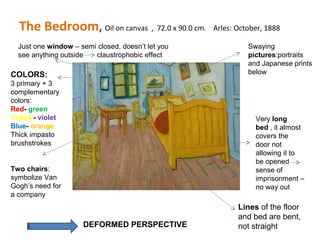
The Bedroom, Oil on canvas , 72.0 x 90.0 cm. Arles: October, 1888
Lines of the floor
and bed are bent,
not straight
Just one window – semi closed, doesn’t let you
see anything outside claustrophobic effect
Two chairs:
symbolize Van
Gogh’s need for
a company
Swaying
pictures:portraits
and Japanese prints
below
Very long
bed , it almost
covers the
door not
allowing it to
be opened
sense of
imprisonment –
no way out
DEFORMED PERSPECTIVE
COLORS:
3 primary + 3
complementary
colors:
Red- green
Yellow- violet
Blue- orange
Thick impasto
brushstrokes
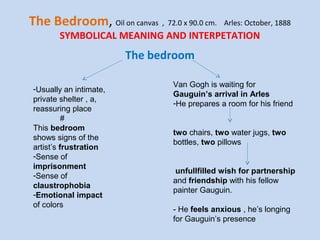
The Bedroom, Oil on canvas , 72.0 x 90.0 cm. Arles: October, 1888
SYMBOLICAL MEANING AND INTERPETATION
The bedroom
-Usually an intimate,
private shelter , a,
reassuring place
#
This bedroom
shows signs of the
artist’s frustration
-Sense of
imprisonment
-Sense of
claustrophobia
-Emotional impact
of colors
Van Gogh is waiting for
Gauguin’s arrival in Arles
-He prepares a room for his friend
two chairs, two water jugs, two
bottles, two pillows
unfullfilled wish for partnership
and friendship with his fellow
painter Gauguin.
- He feels anxious , he’s longing
for Gauguin’s presence
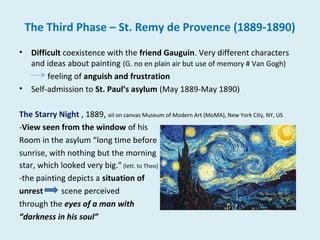
The Third Phase – St. Remy de Provence (1889-1890)
• Difficult coexistence with the friend Gauguin. Very different characters
and ideas about painting (G. no en plain air but use of memory # Van Gogh)
feeling of anguish and frustration
• Self-admission to St. Paul’s asylum (May 1889-May 1890)
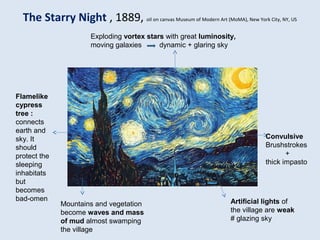
The Starry Night , 1889, oil on canvas Museum of Modern Art (MoMA), New York City, NY, US
-View seen from the window of his
Room in the asylum “long time before
sunrise, with nothing but the morning
star, which looked very big." (lett. to Theo)
-the painting depicts a situation of
unrest scene perceived
through the eyes of a man with
“darkness in his soul”
The Starry Night , 1889, oil on canvas Museum of Modern Art (MoMA), New York City, NY, US
Flamelike
cypress
tree :
connects
earth and
sky. It
should
protect the
sleeping
inhabitats
but
becomes
bad-omen
Mountains and vegetation
become waves and mass
of mud almost swamping
the village
Exploding vortex stars with great luminosity,
moving galaxies dynamic + glaring sky
Convulsive
Brushstrokes
+
thick impasto
Artificial lights of
the village are weak
# glazing sky
The Fourth Phase – Auvers from 1890
- Spring 1890 Van Gogh settled in Auvers-sur-Oise, a village in the outskirts of
Paris
- He visited Dr. Gachet stimulated him to keep painting
- By July (29, his death) Van Gogh produced more than 70 paintings
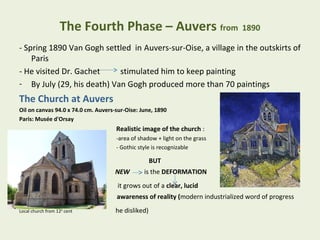
The Church at Auvers
Oil on canvas 94.0 x 74.0 cm. Auvers-sur-Oise: June, 1890
Paris: Musée d'Orsay
Realistic image of the church :
-area of shadow + light on the grass
- Gothic style is recognizable
BUT
NEW is the DEFORMATION
it grows out of a clear, lucid
awareness of reality (modern industrialized word of progress
Local church from 12th cent he disliked)
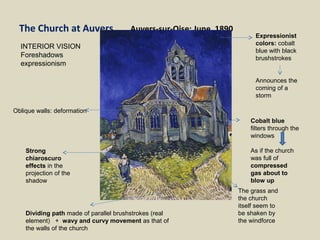
The Church at Auvers Auvers-sur-Oise: June, 1890
Oblique walls: deformation
Expressionist
colors: cobalt
blue with black
brushstrokes
Announces the
coming of a
storm
The grass and
the church
itself seem to
be shaken by
the windforce
Strong
chiaroscuro
effects in the
projection of the
shadow
Dividing path made of parallel brushstrokes (real
element) + wavy and curvy movement as that of
the walls of the church
Cobalt blue
filters through the
windows
As if the church
was full of
compressed
gas about to
blow up
INTERIOR VISION
Foreshadows
expressionism
https://www.youtube.com/watch?v=oxHnRfhDmrk
DON MCLEAN - "Vincent (Starry, Starry Night)“
ART GLOSSARY
• still lifes: nature morte
• flat : piatto / flatness: piattezza
• spatial recession: profondità spaziale
• time depth: profondità temporal
• stained glass: vetrate dipinte
• impasto: densa material pittorica
• texture: consistenza
• to depict: rappresentare/ dipingere
• depiction/ portrayal: rappresentazione
• Outline / contour line: linea di contorno
• perspective: prospettiva
• foreground / background: primo piano/ sfondo
• contours: contorni
• brushstroke: pennellata
• to lay down paint: stendere il colore
• dots: puntini
• (multidirectional) dashes: tratti impetuosi
/compulsivi (in più direzioni)
• shape:forme
• wide layer: ampia campitura
• canvas: tela
• brushtip:punta del pennello
• decomposition (to decompose): scomposizione
(scomporre)
• aim/goal/purpose: scopo /obiettivo
• Palette: tavolozza

Van gogh post impressionism 4

  • 1.
  • 2.
    Vincent Van Gogh(the Netherlands 1853 – France 1890) The Dramatic Life of the Artist - He feels himself isolated from society - Feeling of anguish and anxiety about the meaning of human existence - Desire for a simple pre-industrial life - Opposed ETHICAL ACTION (action or painting stimulated by deep interior forces) MECHANICAL ACTION (rational action produced in factories and by industrialization) He appreciated PEASANTS , MANUAL WORKERS, marginalized simple people
  • 3.
    Key Points ofVan Gogh’s Arto wide and flat brushstrokes (Gauguin) o Complementary colors used with scientific approach (Seurat) o En plain air to catch the instant and transitory quality of a moment (impresssionism) o Subjectivation of the subject: reality imprints on the observer’s eye retina (impressionists) o Art is a contemplation of nature (impressionism) • Vortex brushstrokes, heavy towards different directions • Complementary colors used with instinctive approach • Use of en plein air but then deforms it • Objectivation of the subject: the self affects the world of reality • His painting is dictated by his desperation (action + will)
  • 4.
    The First Phase– The Dutch Period until 1885 The potato eaters , 1885, oil on canvas, Amsterdam, Van Gogh Museum SUBJECT: humble people, family of peasants they eat the products of their work (ethical work vs mechanical work) World of poverty and hard work COLORS: dark palette, muddy colors (wide range of brown shades) DRAMATIZATION of forms through the use of strong chiaroscuro contrast FACES: look like caricatures ( Daumier’s realism)
  • 5.
    The potato eaters, 1885, oil on canvas, Amsterdam, Van Gogh Museum My dear Theo, […] You see, I really have wanted to make it so that people get the idea that these folk, who are eating their potatoes by the light of their little lamp, have tilled the earth themselves with these hands they are putting in the dish, and so it speaks of MANUAL LABOUR and — that they have thus honestly earned their food. I wanted it to give the idea of a wholly different way of life from ours — civilized people. (Nuenen, Thursday, 30 April 1885) PAINTING TECHNIQUE vs MECHANICH TECHNIQUE (factories) It’s a way of facing reality In order to catch and grasp its alienating work which Inner essence: life exstinguishes man and his ETICH ACTION life: MECHANIC ACTION Realism (faces- things on the table – poverty) + Atmosphere of spirituality and generosity Simple peasants sitting at the table
  • 6.
    The Second Phase– Arles : 1888 - 1889 • From Paris he moved to Southern France : Arles (1886-Jan.1888) -Company of Theo -Admiration of Impressionists -Influence from Japanese prints -Started to use lighter palette -Brushstrokes became faster and dynamic -Emphasized expressive quality of colors (from Febr. 1888 – April 1889) -Feels better health condition -Positively affected by the sunlight of Provence -Very prolific period. Lots of masterpieces -He was enchanted by local landscape and light -Prevalent colors: yellow, ultramarine, mauve
  • 7.
    The Bedroom, Oilon canvas , 72.0 x 90.0 cm. Arles: October, 1888 Lines of the floor and bed are bent, not straight Just one window – semi closed, doesn’t let you see anything outside claustrophobic effect Two chairs: symbolize Van Gogh’s need for a company Swaying pictures:portraits and Japanese prints below Very long bed , it almost covers the door not allowing it to be opened sense of imprisonment – no way out DEFORMED PERSPECTIVE COLORS: 3 primary + 3 complementary colors: Red- green Yellow- violet Blue- orange Thick impasto brushstrokes
  • 8.
    The Bedroom, Oilon canvas , 72.0 x 90.0 cm. Arles: October, 1888 SYMBOLICAL MEANING AND INTERPETATION The bedroom -Usually an intimate, private shelter , a, reassuring place # This bedroom shows signs of the artist’s frustration -Sense of imprisonment -Sense of claustrophobia -Emotional impact of colors Van Gogh is waiting for Gauguin’s arrival in Arles -He prepares a room for his friend two chairs, two water jugs, two bottles, two pillows unfullfilled wish for partnership and friendship with his fellow painter Gauguin. - He feels anxious , he’s longing for Gauguin’s presence
  • 9.
    The Third Phase– St. Remy de Provence (1889-1890) • Difficult coexistence with the friend Gauguin. Very different characters and ideas about painting (G. no en plain air but use of memory # Van Gogh) feeling of anguish and frustration • Self-admission to St. Paul’s asylum (May 1889-May 1890) The Starry Night , 1889, oil on canvas Museum of Modern Art (MoMA), New York City, NY, US -View seen from the window of his Room in the asylum “long time before sunrise, with nothing but the morning star, which looked very big." (lett. to Theo) -the painting depicts a situation of unrest scene perceived through the eyes of a man with “darkness in his soul”
  • 10.
    The Starry Night, 1889, oil on canvas Museum of Modern Art (MoMA), New York City, NY, US Flamelike cypress tree : connects earth and sky. It should protect the sleeping inhabitats but becomes bad-omen Mountains and vegetation become waves and mass of mud almost swamping the village Exploding vortex stars with great luminosity, moving galaxies dynamic + glaring sky Convulsive Brushstrokes + thick impasto Artificial lights of the village are weak # glazing sky
  • 11.
    The Fourth Phase– Auvers from 1890 - Spring 1890 Van Gogh settled in Auvers-sur-Oise, a village in the outskirts of Paris - He visited Dr. Gachet stimulated him to keep painting - By July (29, his death) Van Gogh produced more than 70 paintings The Church at Auvers Oil on canvas 94.0 x 74.0 cm. Auvers-sur-Oise: June, 1890 Paris: Musée d'Orsay Realistic image of the church : -area of shadow + light on the grass - Gothic style is recognizable BUT NEW is the DEFORMATION it grows out of a clear, lucid awareness of reality (modern industrialized word of progress Local church from 12th cent he disliked)
  • 12.
    The Church atAuvers Auvers-sur-Oise: June, 1890 Oblique walls: deformation Expressionist colors: cobalt blue with black brushstrokes Announces the coming of a storm The grass and the church itself seem to be shaken by the windforce Strong chiaroscuro effects in the projection of the shadow Dividing path made of parallel brushstrokes (real element) + wavy and curvy movement as that of the walls of the church Cobalt blue filters through the windows As if the church was full of compressed gas about to blow up INTERIOR VISION Foreshadows expressionism
  • 13.
    https://www.youtube.com/watch?v=oxHnRfhDmrk DON MCLEAN -"Vincent (Starry, Starry Night)“ ART GLOSSARY • still lifes: nature morte • flat : piatto / flatness: piattezza • spatial recession: profondità spaziale • time depth: profondità temporal • stained glass: vetrate dipinte • impasto: densa material pittorica • texture: consistenza • to depict: rappresentare/ dipingere • depiction/ portrayal: rappresentazione • Outline / contour line: linea di contorno • perspective: prospettiva • foreground / background: primo piano/ sfondo • contours: contorni • brushstroke: pennellata • to lay down paint: stendere il colore • dots: puntini • (multidirectional) dashes: tratti impetuosi /compulsivi (in più direzioni) • shape:forme • wide layer: ampia campitura • canvas: tela • brushtip:punta del pennello • decomposition (to decompose): scomposizione (scomporre) • aim/goal/purpose: scopo /obiettivo • Palette: tavolozza