Evaluation of Investment
Performance
Chapter 22
Charles P. Jones, Investments: Analysis and Management
22-1
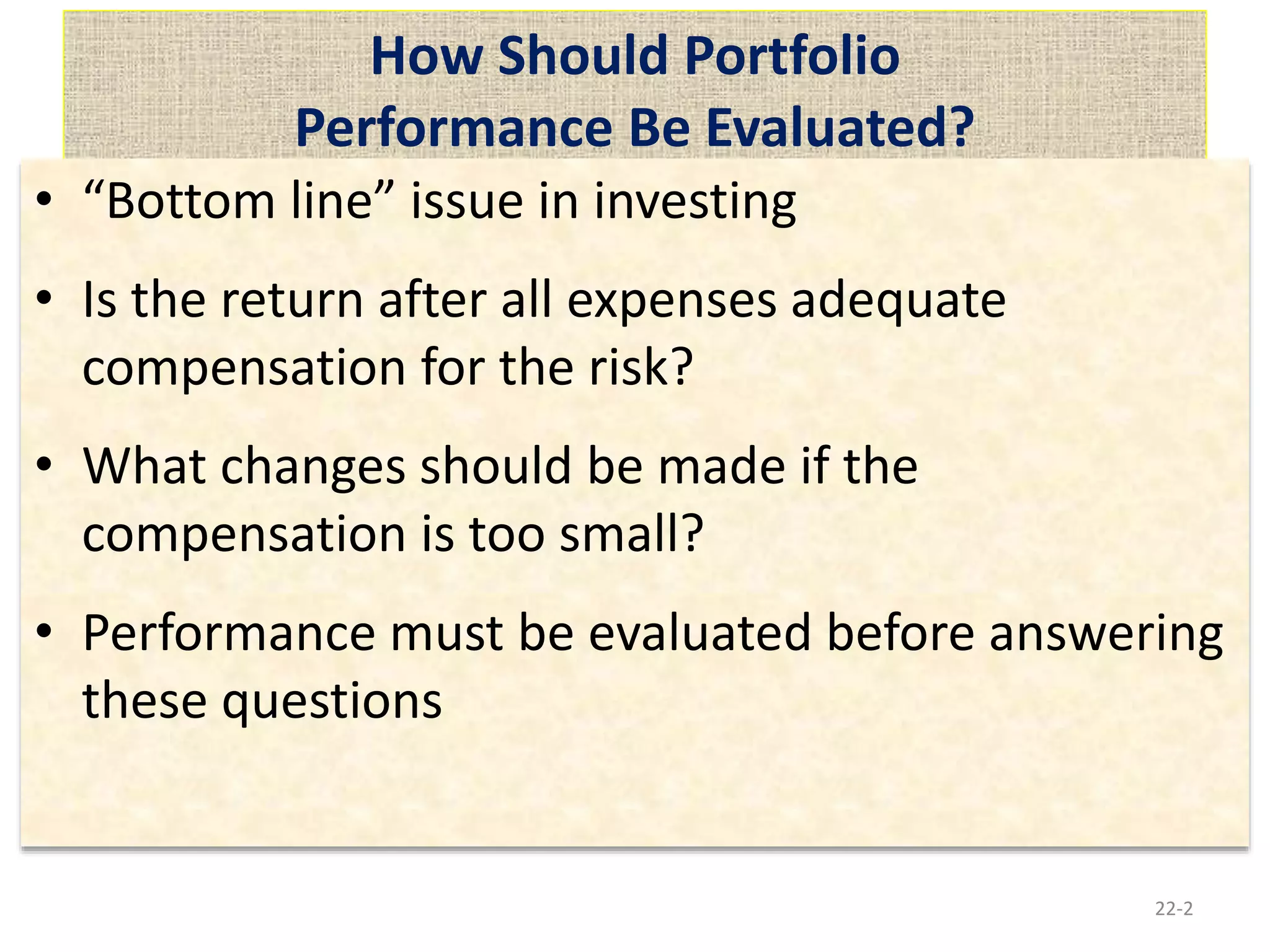
How Should Portfolio
Performance Be Evaluated?
• “Bottom line” issue in investing
• Is the return after all expenses adequate
compensation for the risk?
• What changes should be made if the
compensation is too small?
• Performance must be evaluated before answering
these questions
22-2
Considerations
• Without knowledge of risks taken, little can be
said about performance
– Intelligent decisions require an evaluation of risk and
return
– Risk-adjusted performance best
• Relative performance comparisons
– Benchmark portfolio must be legitimate alternative
that reflects objectives
22-3
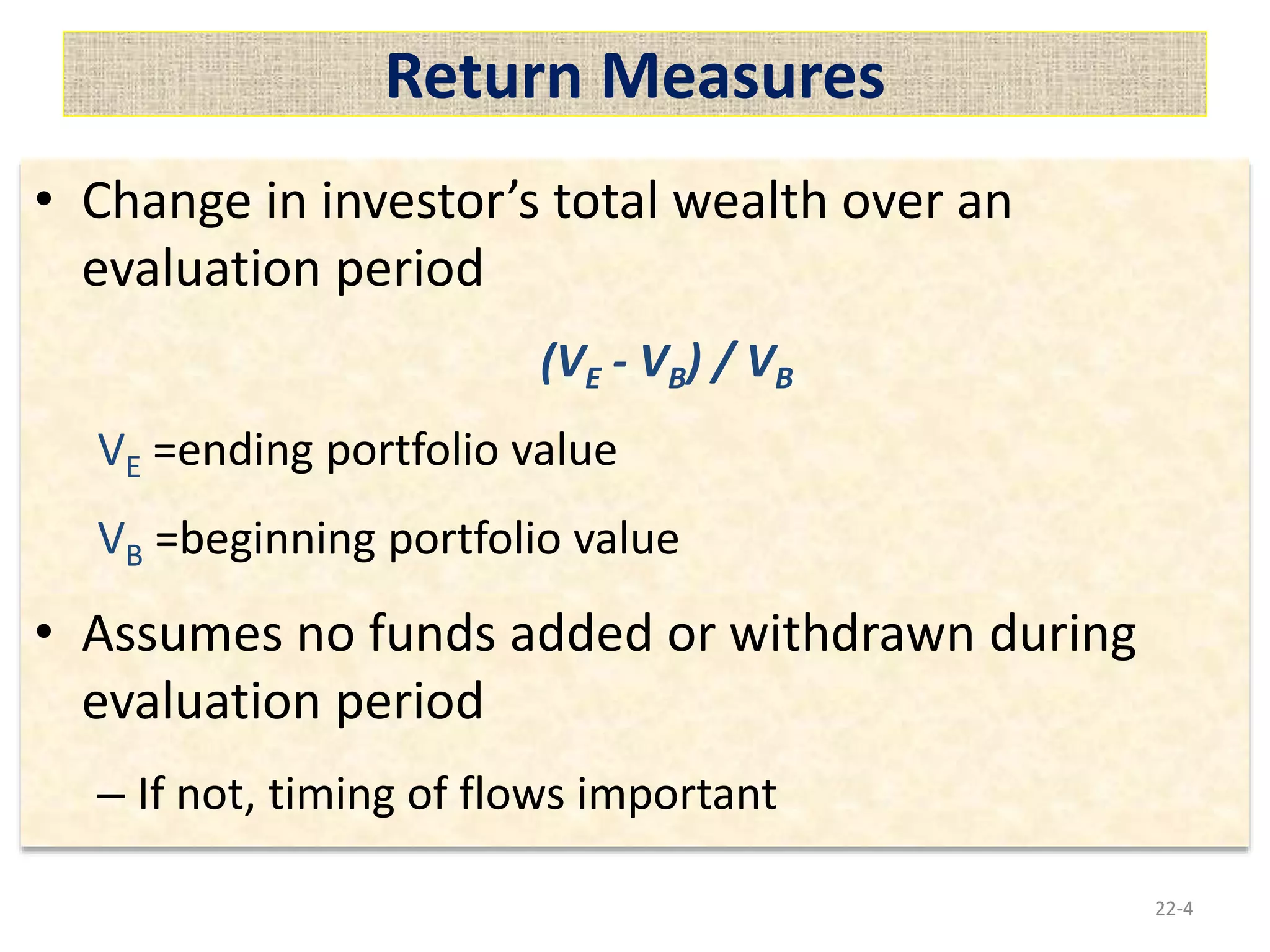
Return Measures
• Change in investor’s total wealth over an
evaluation period
(VE - VB) / VB
VE =ending portfolio value
VB =beginning portfolio value
• Assumes no funds added or withdrawn during
evaluation period
– If not, timing of flows important
22-4
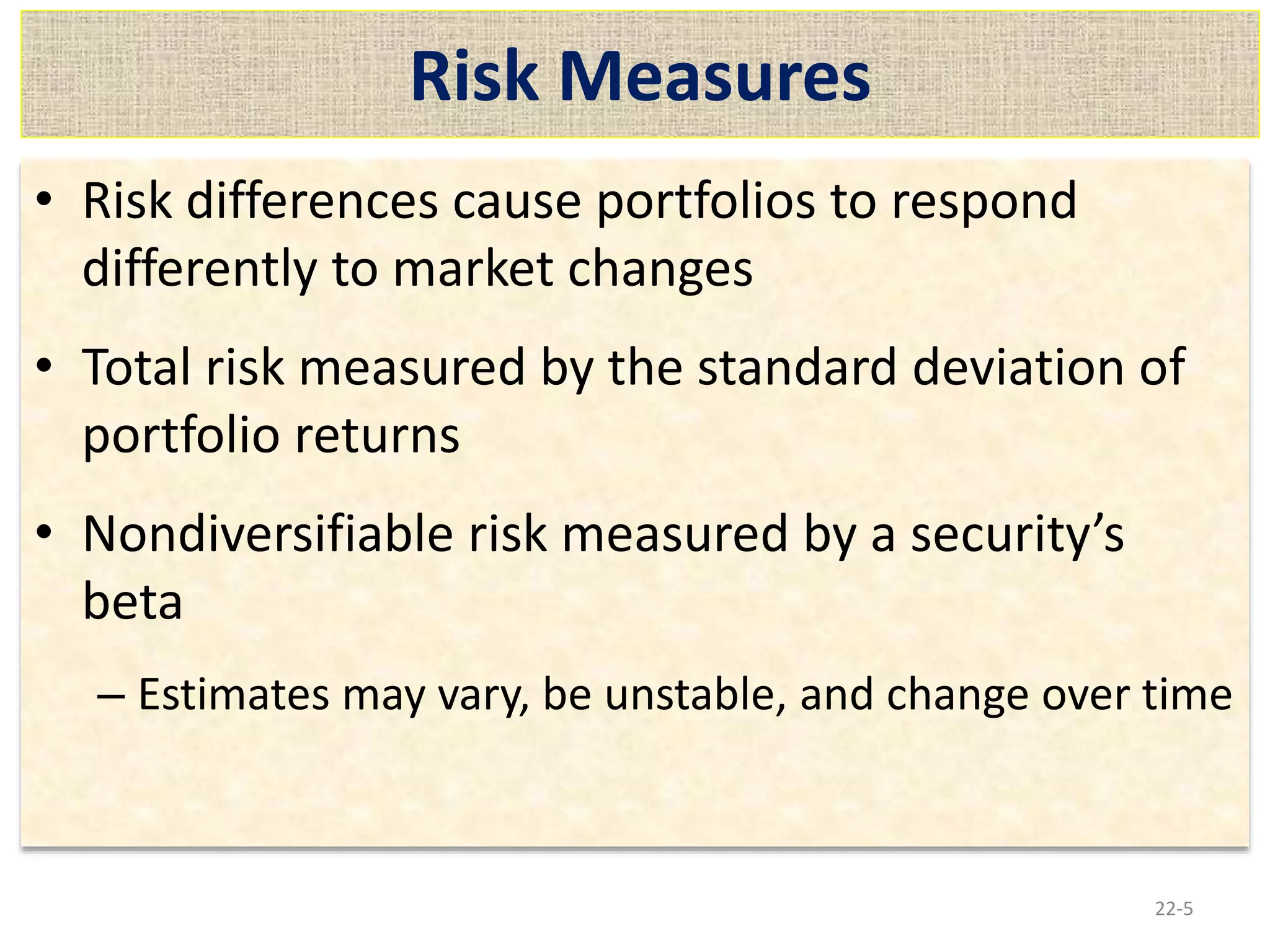
Risk Measures
• Risk differences cause portfolios to respond
differently to market changes
• Total risk measured by the standard deviation of
portfolio returns
• Nondiversifiable risk measured by a security’s
beta
– Estimates may vary, be unstable, and change over time
22-5
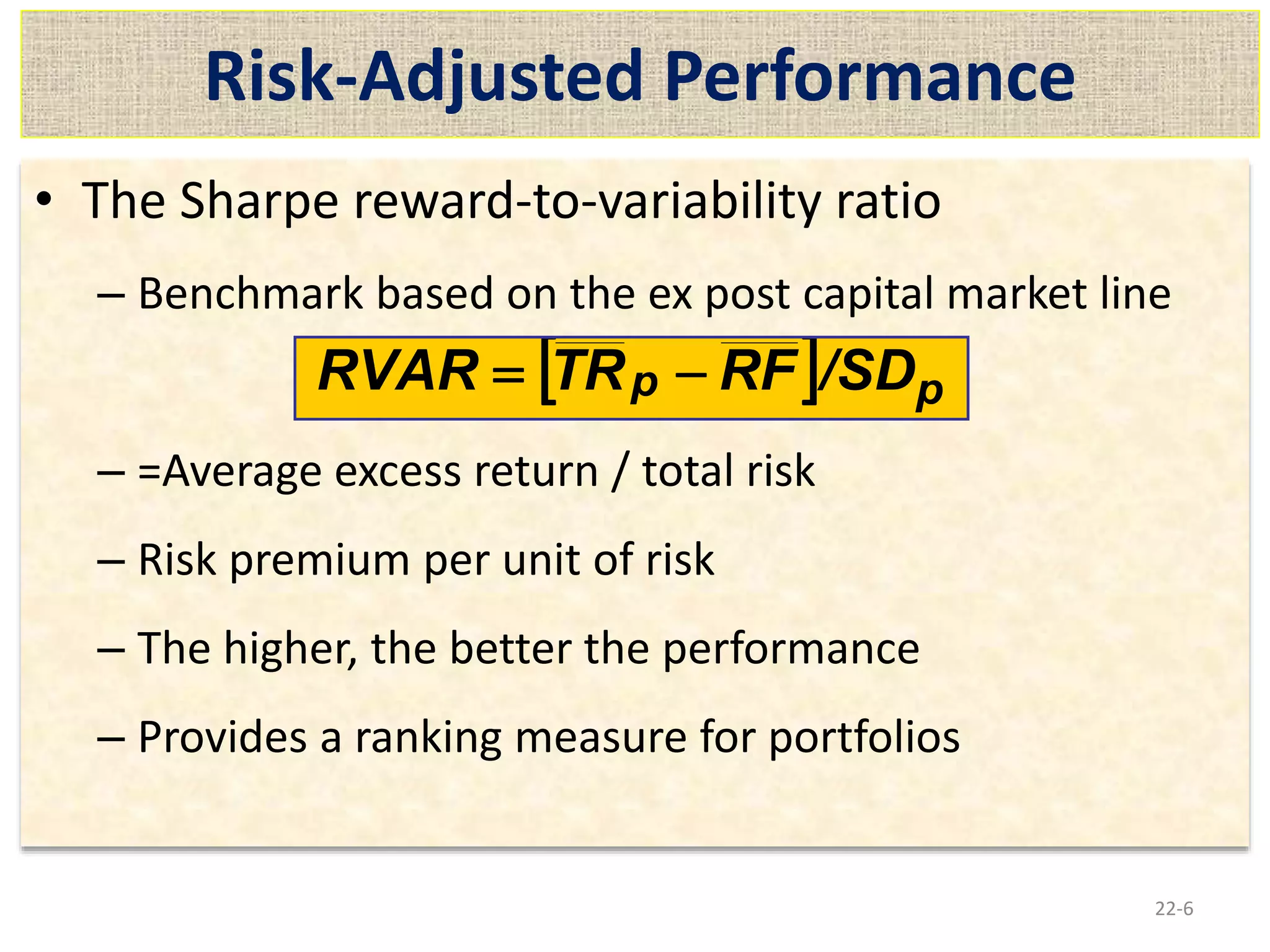
Risk-Adjusted Performance
• The Sharpe reward-to-variability ratio
– Benchmark based on the ex post capital market line
– =Average excess return / total risk
– Risk premium per unit of risk
– The higher, the better the performance
– Provides a ranking measure for portfolios
22-6
 /SD
RF
TR
RVAR p
p 

Risk-Adjusted Performance
• The Treynor reward-to-volatilty ratio
– Distinguishes between total and systematic risk
– =Average excess return / market risk
– Risk premium per unit of market risk
– The higher, the better the performance
– Implies a diversified portfolio
22-7
 /β
RF
TR
RVOL p
p 

RVAR or RVOL?
• Depends on the definition of risk
– If total (systematic) risk best, use RVAR (RVOL)
– If portfolios perfectly diversified, rankings based on
either RVAR or RVOL are the same
– Differences in diversification cause ranking differences
• RVAR captures portfolio diversification
22-8
Measuring Diversification
• How correlated are portfolio’s returns to
market portfolio?
– R2 from estimation of
Rpt - RFt =ap +bp [RMt - RFt] +ept
– R2 is the coefficient of determination
– Excess return form of characteristic line
– The lower the R2, the greater the diversifiable risk
and the less diversified
22-9
Jensen’s Alpha
• The estimated a coefficient in
Rpt - RFt =ap +bp [RMt - RFt] +ept
is a means to identify superior or inferior portfolio performance
– CAPM implies a is zero
– Measures contribution of portfolio manager beyond return
attributable to risk
• If a >0 (<0,=0), performance superior (inferior, equals) to
market, risk-adjusted
22-10
Measurement Problems
• Performance measures based on CAPM and its
assumptions
– Riskless borrowing?
– What should market proxy be?
• If not efficient, benchmark error
• Global investing increases problem
• How long an evaluation period?
– AMIR stipulates a 10 year period
22-11

Evaluation of Investment Performance.ppt

  • 1.
    Evaluation of Investment Performance Chapter22 Charles P. Jones, Investments: Analysis and Management 22-1
  • 2.
    How Should Portfolio PerformanceBe Evaluated? • “Bottom line” issue in investing • Is the return after all expenses adequate compensation for the risk? • What changes should be made if the compensation is too small? • Performance must be evaluated before answering these questions 22-2
  • 3.
    Considerations • Without knowledgeof risks taken, little can be said about performance – Intelligent decisions require an evaluation of risk and return – Risk-adjusted performance best • Relative performance comparisons – Benchmark portfolio must be legitimate alternative that reflects objectives 22-3
  • 4.
    Return Measures • Changein investor’s total wealth over an evaluation period (VE - VB) / VB VE =ending portfolio value VB =beginning portfolio value • Assumes no funds added or withdrawn during evaluation period – If not, timing of flows important 22-4
  • 5.
    Risk Measures • Riskdifferences cause portfolios to respond differently to market changes • Total risk measured by the standard deviation of portfolio returns • Nondiversifiable risk measured by a security’s beta – Estimates may vary, be unstable, and change over time 22-5
  • 6.
    Risk-Adjusted Performance • TheSharpe reward-to-variability ratio – Benchmark based on the ex post capital market line – =Average excess return / total risk – Risk premium per unit of risk – The higher, the better the performance – Provides a ranking measure for portfolios 22-6  /SD RF TR RVAR p p  
  • 7.
    Risk-Adjusted Performance • TheTreynor reward-to-volatilty ratio – Distinguishes between total and systematic risk – =Average excess return / market risk – Risk premium per unit of market risk – The higher, the better the performance – Implies a diversified portfolio 22-7  /β RF TR RVOL p p  
  • 8.
    RVAR or RVOL? •Depends on the definition of risk – If total (systematic) risk best, use RVAR (RVOL) – If portfolios perfectly diversified, rankings based on either RVAR or RVOL are the same – Differences in diversification cause ranking differences • RVAR captures portfolio diversification 22-8
  • 9.
    Measuring Diversification • Howcorrelated are portfolio’s returns to market portfolio? – R2 from estimation of Rpt - RFt =ap +bp [RMt - RFt] +ept – R2 is the coefficient of determination – Excess return form of characteristic line – The lower the R2, the greater the diversifiable risk and the less diversified 22-9
  • 10.
    Jensen’s Alpha • Theestimated a coefficient in Rpt - RFt =ap +bp [RMt - RFt] +ept is a means to identify superior or inferior portfolio performance – CAPM implies a is zero – Measures contribution of portfolio manager beyond return attributable to risk • If a >0 (<0,=0), performance superior (inferior, equals) to market, risk-adjusted 22-10
  • 11.
    Measurement Problems • Performancemeasures based on CAPM and its assumptions – Riskless borrowing? – What should market proxy be? • If not efficient, benchmark error • Global investing increases problem • How long an evaluation period? – AMIR stipulates a 10 year period 22-11