TOPIC:PORTFOLIO MANAGEMENT
INTRODUCTION
PORTFOLIO:
 Portfolio refers to the collection of investment tools such as stocks, shares,
mutual funds, bonds, cash and so on depending upon the investor’s
income, budget and convenient time frame.
 Following are the two types of portfolio:
1. Market Portfolio
2. Zero Investment Portfolio
PORTFOLIO MANAGEMENT:
 The portfolio management deals with the process of selection of securities
from the number of opportunities available with different expected returns
and carrying different levels of risk.
 Portfolio management involves deciding about the optimal portfolio,
matching investment with the objectives, allocation of assets and balancing
risk.
 It is also the selection of securities which is made with a view to provide
the investors the maximum yield for a given level of risk or ensure
minimize risk for a given level of return
NEED FOR PORTFOLIO MANAGEMENT
 Portfolio management presents the best investment plan to
individuals as per their income, budget, age and the ability
to take risks.
 It minimize the risks involved in investing and also
increases the chance of making profits.
 It also enables the portfolio managers to provide customized
investment solutions to clients as per their needs and
requirement.
 Customization” is possible because individual’s needs and
choices are kept in mind i.e. when the person needs the
return, how much return expectation a person has and how
much investment period an individual selects.
TYPES OF PORTFOLIO MANAGEMENT
 Active Portfolio Management: When the portfolio managers actively
participate in the trading of securities with a view to earning a maximum
return to the investor, it is called active portfolio management.
 Passive Portfolio Management: When the portfolio managers are concerned
with a fixed portfolio, which is created in alignment with the present market
trends, is called passive portfolio management.
 Discretionary Portfolio Management: The Portfolio Management in which
the investor places the fund with the manager, and authorizes him to invest
them as per his discretion, on the investor’s behalf. The portfolio manager
looks after all the investment needs, documentation, etc.
 Non-Discretionary Portfolio Management: Non-discretionary portfolio
management is one in which the portfolio managers gives advice to the
investor or client, who can accept or reject it.
ACTIVITIES INVOLVED IN PORTFOLIO
MANAGEMENT
 Asset allocation i.e. selection of various securities
with different risks and returns to place them in a
portfolio.
 Redesigning of portfolio basing on the market
conditions to achieve the portfolio objectives.
 Security selection with in asset classes.
PROCESS OF PORTFOLIO MANAGEMENT
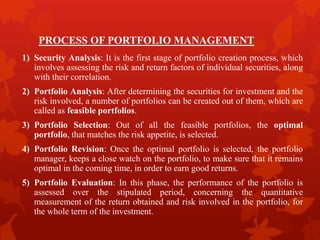
1) Security Analysis: It is the first stage of portfolio creation process, which
involves assessing the risk and return factors of individual securities, along
with their correlation.
2) Portfolio Analysis: After determining the securities for investment and the
risk involved, a number of portfolios can be created out of them, which are
called as feasible portfolios.
3) Portfolio Selection: Out of all the feasible portfolios, the optimal
portfolio, that matches the risk appetite, is selected.
4) Portfolio Revision: Once the optimal portfolio is selected, the portfolio
manager, keeps a close watch on the portfolio, to make sure that it remains
optimal in the coming time, in order to earn good returns.
5) Portfolio Evaluation: In this phase, the performance of the portfolio is
assessed over the stipulated period, concerning the quantitative
measurement of the return obtained and risk involved in the portfolio, for
the whole term of the investment.
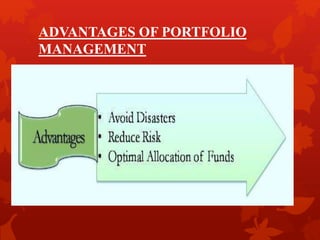
ADVANTAGES OF PORTFOLIO
MANAGEMENT
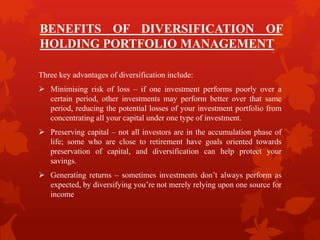
BENEFITS OF DIVERSIFICATION OF
HOLDING PORTFOLIO MANAGEMENT
Three key advantages of diversification include:
 Minimising risk of loss – if one investment performs poorly over a
certain period, other investments may perform better over that same
period, reducing the potential losses of your investment portfolio from
concentrating all your capital under one type of investment.
 Preserving capital – not all investors are in the accumulation phase of
life; some who are close to retirement have goals oriented towards
preservation of capital, and diversification can help protect your
savings.
 Generating returns – sometimes investments don’t always perform as
expected, by diversifying you’re not merely relying upon one source for
income
PORTFOLIO MANAGEMENT MODEL
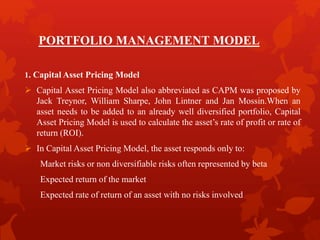
1. Capital Asset Pricing Model
 Capital Asset Pricing Model also abbreviated as CAPM was proposed by
Jack Treynor, William Sharpe, John Lintner and Jan Mossin.When an
asset needs to be added to an already well diversified portfolio, Capital
Asset Pricing Model is used to calculate the asset’s rate of profit or rate of
return (ROI).
 In Capital Asset Pricing Model, the asset responds only to:
Market risks or non diversifiable risks often represented by beta
Expected return of the market
Expected rate of return of an asset with no risks involved
2. Arbitrage Pricing Theory
 Stephen Ross proposed the Arbitrage Pricing Theory in 1976.
 Arbitrage Pricing Theory highlights the relationship between an asset and several
similar market risk factors.
 According to Arbitrage Pricing Theory, the value of an asset is dependent on macro
and company specific factors.
3. Modern Portfolio Theory
 Modern Portfolio Theory was introduced by Harry Markowitz.
 According to Modern Portfolio Theory, while designing a portfolio, the ratio of each
asset must be chosen and combined carefully in a portfolio for maximum returns
and minimum risks.
 In Modern Portfolio Theory emphasis is not laid on a single asset in a portfolio, but
how each asset changes in relation to the other asset in the portfolio with reference
to fluctuations in the price.
 Modern Portfolio theory proposes that a portfolio manager must carefully choose
various assets while designing a portfolio for maximum guaranteed returns in the
future.
4. Value at Risk Model
 Value at Risk Model was proposed to calculate the risk involved in financial
market. Financial markets are characterized by risks and uncertainty over the
returns earned in future on various investment products. Market conditions
can fluctuate anytime giving rise to major crisis.
 The potential risk involved and the potential loss in value of a portfolio over a
certain period of time is defined as value at risk model.
5. Jensen’s Performance Index
 Jensen’s Performance Index was proposed by Michael Jensen in
1968.Jensen’s Performance Index is used to calculate the abnormal return of
any financial asset (bonds, shares, securities) as compared to its expected
return in any portfolio.
 Also called Jensen’s alpha, investors prefer portfolio with abnormal returns or
positive alpha.
 Jensen’s alpha = Portfolio Return – [Risk Free Rate + Portfolio Beta *
(Market Return – Risk Free Rate)
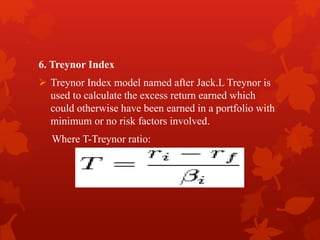
6. Treynor Index
 Treynor Index model named after Jack.L Treynor is
used to calculate the excess return earned which
could otherwise have been earned in a portfolio with
minimum or no risk factors involved.
Where T-Treynor ratio:
CONCLUSION
 Today, the financial market is increasingly complex and managing
one’s own portfolio will take up a lot of time and effort.
 There are situations when we don’t have time or knowledge to explore
the best investment alternatives in the market.
 This is a common problem faced by many wannabe investors. At this
juncture, portfolio management can help investor get out of this
dilemma.
 So, the investor can simply assign his investments to portfolio
management who will report to him regularly on his portfolio
performance.
 Thus, investor will not feel lost in this complex world of investments
and the experts will do their job.

PORTFOLIO MANAGEMENT

  • 1.
  • 2.
    INTRODUCTION PORTFOLIO:  Portfolio refersto the collection of investment tools such as stocks, shares, mutual funds, bonds, cash and so on depending upon the investor’s income, budget and convenient time frame.  Following are the two types of portfolio: 1. Market Portfolio 2. Zero Investment Portfolio PORTFOLIO MANAGEMENT:  The portfolio management deals with the process of selection of securities from the number of opportunities available with different expected returns and carrying different levels of risk.  Portfolio management involves deciding about the optimal portfolio, matching investment with the objectives, allocation of assets and balancing risk.  It is also the selection of securities which is made with a view to provide the investors the maximum yield for a given level of risk or ensure minimize risk for a given level of return
  • 3.
    NEED FOR PORTFOLIOMANAGEMENT  Portfolio management presents the best investment plan to individuals as per their income, budget, age and the ability to take risks.  It minimize the risks involved in investing and also increases the chance of making profits.  It also enables the portfolio managers to provide customized investment solutions to clients as per their needs and requirement.  Customization” is possible because individual’s needs and choices are kept in mind i.e. when the person needs the return, how much return expectation a person has and how much investment period an individual selects.
  • 4.
    TYPES OF PORTFOLIOMANAGEMENT  Active Portfolio Management: When the portfolio managers actively participate in the trading of securities with a view to earning a maximum return to the investor, it is called active portfolio management.  Passive Portfolio Management: When the portfolio managers are concerned with a fixed portfolio, which is created in alignment with the present market trends, is called passive portfolio management.  Discretionary Portfolio Management: The Portfolio Management in which the investor places the fund with the manager, and authorizes him to invest them as per his discretion, on the investor’s behalf. The portfolio manager looks after all the investment needs, documentation, etc.  Non-Discretionary Portfolio Management: Non-discretionary portfolio management is one in which the portfolio managers gives advice to the investor or client, who can accept or reject it.
  • 5.
    ACTIVITIES INVOLVED INPORTFOLIO MANAGEMENT  Asset allocation i.e. selection of various securities with different risks and returns to place them in a portfolio.  Redesigning of portfolio basing on the market conditions to achieve the portfolio objectives.  Security selection with in asset classes.
  • 6.
    PROCESS OF PORTFOLIOMANAGEMENT 1) Security Analysis: It is the first stage of portfolio creation process, which involves assessing the risk and return factors of individual securities, along with their correlation. 2) Portfolio Analysis: After determining the securities for investment and the risk involved, a number of portfolios can be created out of them, which are called as feasible portfolios. 3) Portfolio Selection: Out of all the feasible portfolios, the optimal portfolio, that matches the risk appetite, is selected. 4) Portfolio Revision: Once the optimal portfolio is selected, the portfolio manager, keeps a close watch on the portfolio, to make sure that it remains optimal in the coming time, in order to earn good returns. 5) Portfolio Evaluation: In this phase, the performance of the portfolio is assessed over the stipulated period, concerning the quantitative measurement of the return obtained and risk involved in the portfolio, for the whole term of the investment.
  • 7.
  • 8.
    BENEFITS OF DIVERSIFICATIONOF HOLDING PORTFOLIO MANAGEMENT Three key advantages of diversification include:  Minimising risk of loss – if one investment performs poorly over a certain period, other investments may perform better over that same period, reducing the potential losses of your investment portfolio from concentrating all your capital under one type of investment.  Preserving capital – not all investors are in the accumulation phase of life; some who are close to retirement have goals oriented towards preservation of capital, and diversification can help protect your savings.  Generating returns – sometimes investments don’t always perform as expected, by diversifying you’re not merely relying upon one source for income
  • 9.
    PORTFOLIO MANAGEMENT MODEL 1.Capital Asset Pricing Model  Capital Asset Pricing Model also abbreviated as CAPM was proposed by Jack Treynor, William Sharpe, John Lintner and Jan Mossin.When an asset needs to be added to an already well diversified portfolio, Capital Asset Pricing Model is used to calculate the asset’s rate of profit or rate of return (ROI).  In Capital Asset Pricing Model, the asset responds only to: Market risks or non diversifiable risks often represented by beta Expected return of the market Expected rate of return of an asset with no risks involved
  • 10.
    2. Arbitrage PricingTheory  Stephen Ross proposed the Arbitrage Pricing Theory in 1976.  Arbitrage Pricing Theory highlights the relationship between an asset and several similar market risk factors.  According to Arbitrage Pricing Theory, the value of an asset is dependent on macro and company specific factors. 3. Modern Portfolio Theory  Modern Portfolio Theory was introduced by Harry Markowitz.  According to Modern Portfolio Theory, while designing a portfolio, the ratio of each asset must be chosen and combined carefully in a portfolio for maximum returns and minimum risks.  In Modern Portfolio Theory emphasis is not laid on a single asset in a portfolio, but how each asset changes in relation to the other asset in the portfolio with reference to fluctuations in the price.  Modern Portfolio theory proposes that a portfolio manager must carefully choose various assets while designing a portfolio for maximum guaranteed returns in the future.
  • 11.
    4. Value atRisk Model  Value at Risk Model was proposed to calculate the risk involved in financial market. Financial markets are characterized by risks and uncertainty over the returns earned in future on various investment products. Market conditions can fluctuate anytime giving rise to major crisis.  The potential risk involved and the potential loss in value of a portfolio over a certain period of time is defined as value at risk model. 5. Jensen’s Performance Index  Jensen’s Performance Index was proposed by Michael Jensen in 1968.Jensen’s Performance Index is used to calculate the abnormal return of any financial asset (bonds, shares, securities) as compared to its expected return in any portfolio.  Also called Jensen’s alpha, investors prefer portfolio with abnormal returns or positive alpha.  Jensen’s alpha = Portfolio Return – [Risk Free Rate + Portfolio Beta * (Market Return – Risk Free Rate)
  • 12.
    6. Treynor Index Treynor Index model named after Jack.L Treynor is used to calculate the excess return earned which could otherwise have been earned in a portfolio with minimum or no risk factors involved. Where T-Treynor ratio:
  • 13.
    CONCLUSION  Today, thefinancial market is increasingly complex and managing one’s own portfolio will take up a lot of time and effort.  There are situations when we don’t have time or knowledge to explore the best investment alternatives in the market.  This is a common problem faced by many wannabe investors. At this juncture, portfolio management can help investor get out of this dilemma.  So, the investor can simply assign his investments to portfolio management who will report to him regularly on his portfolio performance.  Thus, investor will not feel lost in this complex world of investments and the experts will do their job.