Page 1
CHAPTER 1: INTRODUCTION TO FINANCIAL MANAGEMENT
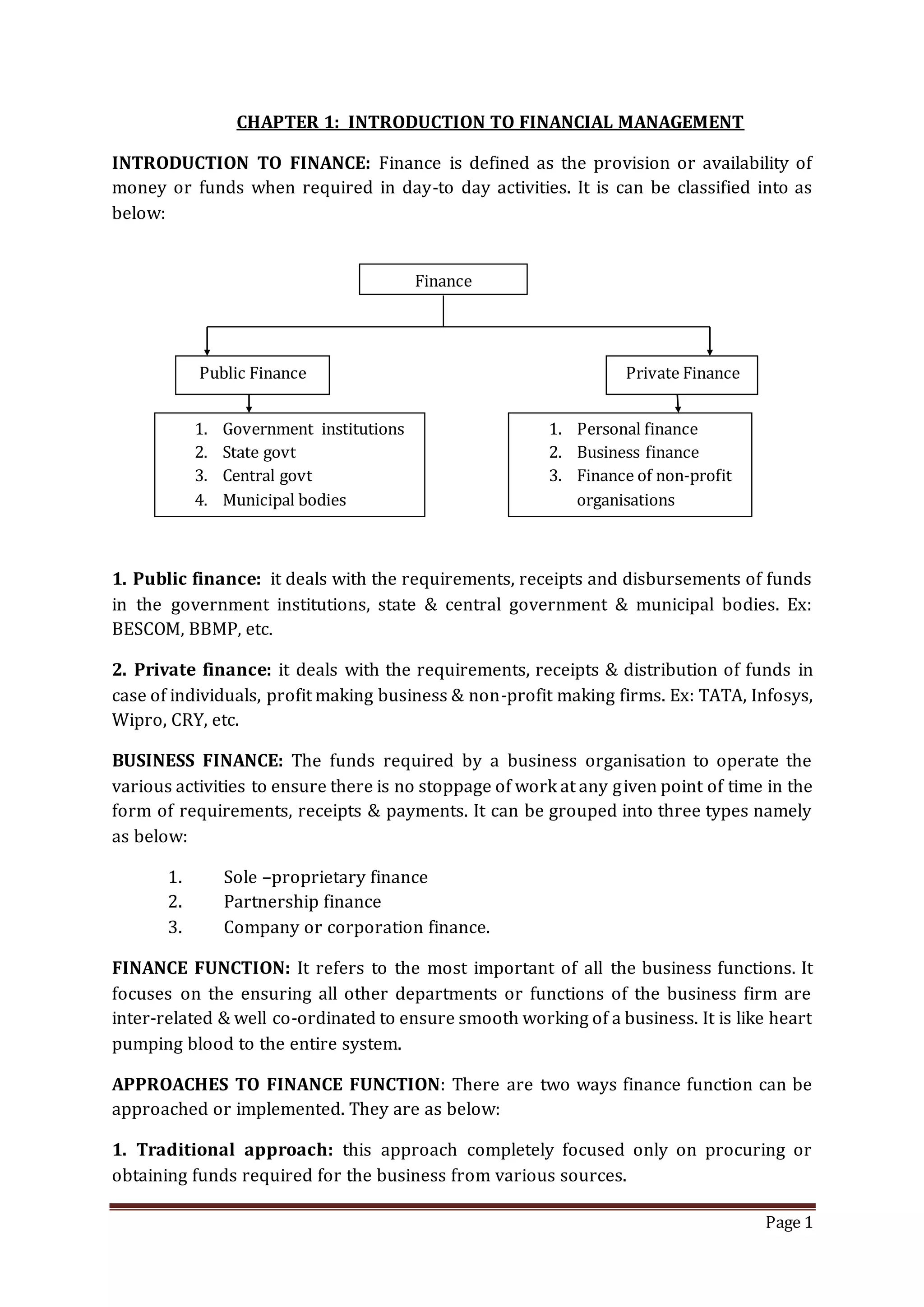
INTRODUCTION TO FINANCE: Finance is defined as the provision or availability of
money or funds when required in day-to day activities. It is can be classified into as
below:
1. Public finance: it deals with the requirements, receipts and disbursements of funds
in the government institutions, state & central government & municipal bodies. Ex:
BESCOM, BBMP, etc.
2. Private finance: it deals with the requirements, receipts & distribution of funds in
case of individuals, profit making business & non-profit making firms. Ex: TATA, Infosys,
Wipro, CRY, etc.
BUSINESS FINANCE: The funds required by a business organisation to operate the
various activities to ensure there is no stoppage of work at any given point of time in the
form of requirements, receipts & payments. It can be grouped into three types namely
as below:
1. Sole –proprietary finance
2. Partnership finance
3. Company or corporation finance.
FINANCE FUNCTION: It refers to the most important of all the business functions. It
focuses on the ensuring all other departments or functions of the business firm are
inter-related & well co-ordinated to ensure smooth working of a business. It is like heart
pumping blood to the entire system.
APPROACHES TO FINANCE FUNCTION: There are two ways finance function can be
approached or implemented. They are as below:
1. Traditional approach: this approach completely focused only on procuring or
obtaining funds required for the business from various sources.
Finance
Public Finance Private Finance
1. Government institutions
2. State govt
3. Central govt
4. Municipal bodies
1. Personal finance
2. Business finance
3. Finance of non-profit
organisations
Page 2
2. Modern approach: This approach not only focus on procuring or obtaining funds
required for the business from various sources but also concentrates on effective and
efficient application of funds.
AIMS OF FINANCE FUNCTION: The primary aim of finance function is to arrange as
much as funds for the business on timely manner. They are as follows:
AIMS OF FINANCE FUNCTION
1. Acquiring sufficient funds
2. Proper utilisation of funds
3. Increase profitability
4. Maximise firm’s value
1. Acquiring sufficient funds: This is to identifying the amount of finance required by a
firm & looking out for the different sources from which funds can be obtained on timely
manner.
2. Proper utilisation of funds: Funds must be used more effectively & efficiently so
that maximum benefits can be earned by the firm. It must ensure there is neither excess
nor shortage of funds.
3. Increase profitability: The main priority of any firm must be to earn profits. To earn
sufficient return, firm must invest on profitable ventures taking the cost & rate of return
etc into consideration.
4. Maximise firm’s value: Firm usually makes sure not only profits are maximized but
also value of the firm in the market which helps to increase the market price of their
security resulting in higher satisfaction among investors.
FINANCIAL MANAGEMENT: It refers to the process of planning, organising, co-
ordinating, directing & controlling of the funds in the business firm which enables into
success of the firm in the long run.
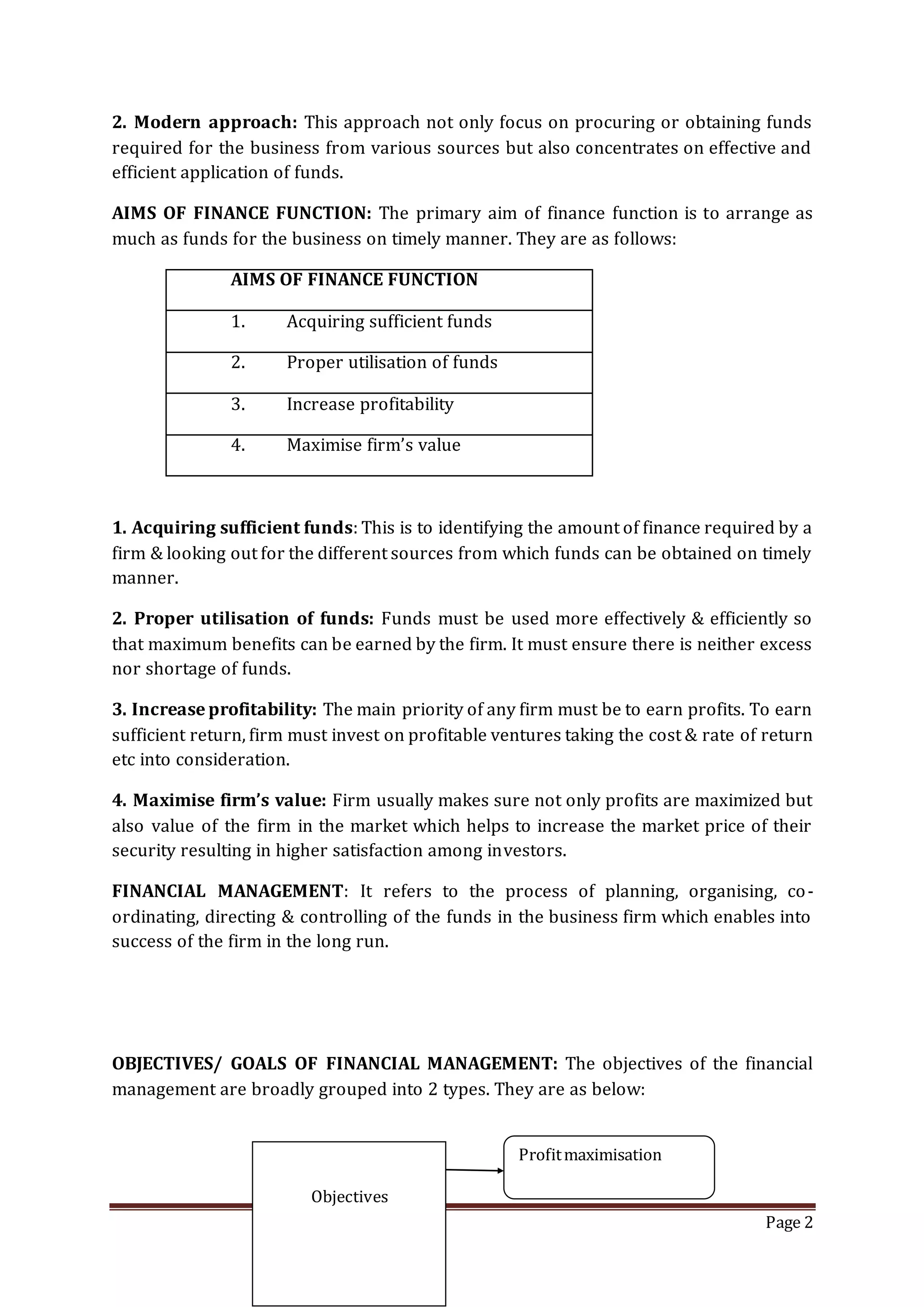
OBJECTIVES/ GOALS OF FINANCIAL MANAGEMENT: The objectives of the financial
management are broadly grouped into 2 types. They are as below:
Objectives
Profitmaximisation
Page 3
1. Profit maximisation: This objective is primarily focused on increasing the profits of
the firm by various strategies & implementing various methods & techniques of
financial models as profits are the main source of finance to a business for survival &
future growth.
2. Wealth maximisation: It means increasing the wealth of the shareholders which
maximising the stock market price & value of the firm in the market with better
performance.
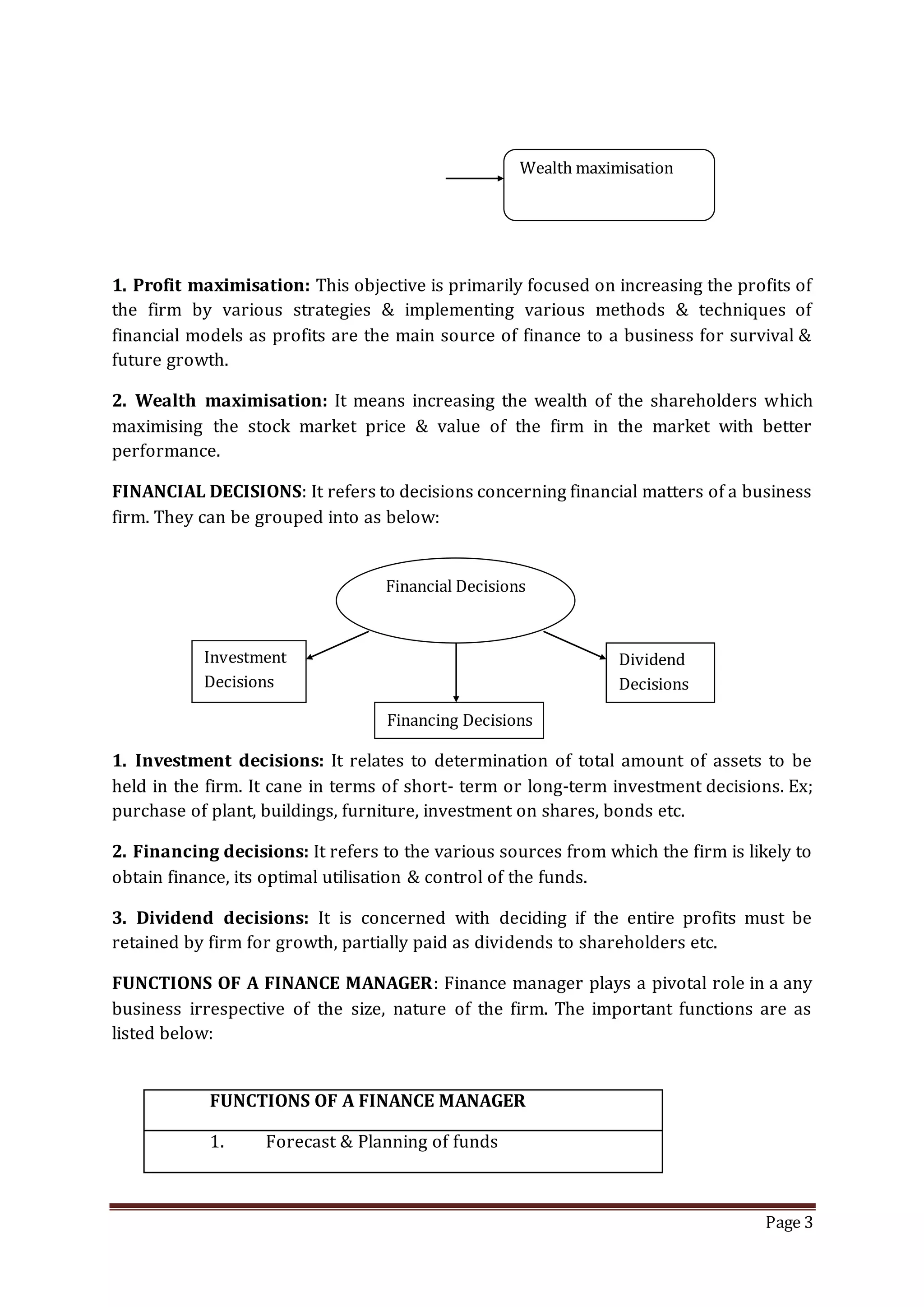
FINANCIAL DECISIONS: It refers to decisions concerning financial matters of a business
firm. They can be grouped into as below:
1. Investment decisions: It relates to determination of total amount of assets to be
held in the firm. It cane in terms of short- term or long-term investment decisions. Ex;
purchase of plant, buildings, furniture, investment on shares, bonds etc.
2. Financing decisions: It refers to the various sources from which the firm is likely to
obtain finance, its optimal utilisation & control of the funds.
3. Dividend decisions: It is concerned with deciding if the entire profits must be
retained by firm for growth, partially paid as dividends to shareholders etc.
FUNCTIONS OF A FINANCE MANAGER: Finance manager plays a pivotal role in a any
business irrespective of the size, nature of the firm. The important functions are as
listed below:
FUNCTIONS OF A FINANCE MANAGER
1. Forecast & Planning of funds
Wealth maximisation
Financial Decisions
Investment
Decisions
Financing Decisions
Dividend
Decisions
Page 4
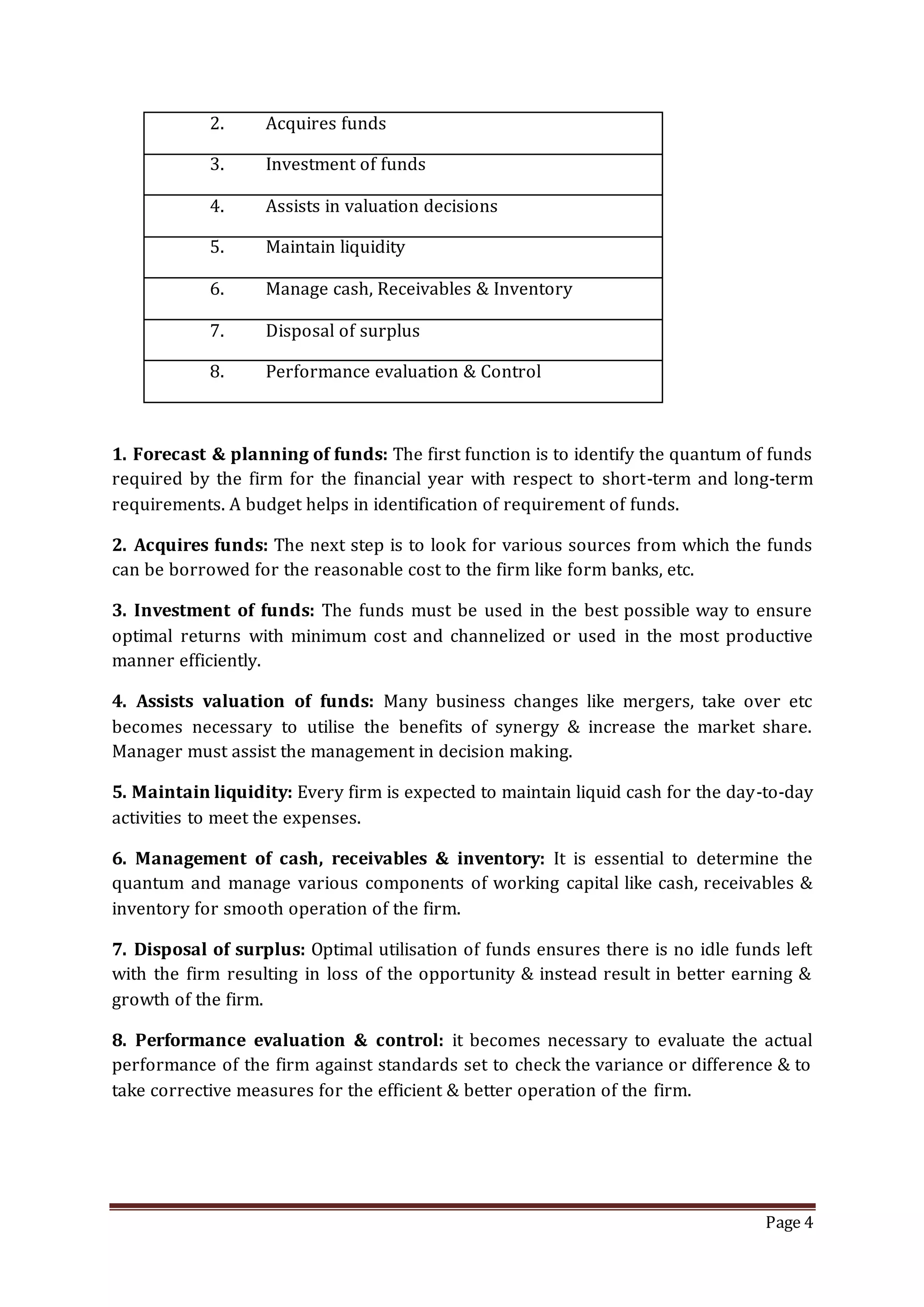
2. Acquires funds
3. Investment of funds
4. Assists in valuation decisions
5. Maintain liquidity
6. Manage cash, Receivables & Inventory
7. Disposal of surplus
8. Performance evaluation & Control
1. Forecast & planning of funds: The first function is to identify the quantum of funds
required by the firm for the financial year with respect to short-term and long-term
requirements. A budget helps in identification of requirement of funds.
2. Acquires funds: The next step is to look for various sources from which the funds
can be borrowed for the reasonable cost to the firm like form banks, etc.
3. Investment of funds: The funds must be used in the best possible way to ensure
optimal returns with minimum cost and channelized or used in the most productive
manner efficiently.
4. Assists valuation of funds: Many business changes like mergers, take over etc
becomes necessary to utilise the benefits of synergy & increase the market share.
Manager must assist the management in decision making.
5. Maintain liquidity: Every firm is expected to maintain liquid cash for the day-to-day
activities to meet the expenses.
6. Management of cash, receivables & inventory: It is essential to determine the
quantum and manage various components of working capital like cash, receivables &
inventory for smooth operation of the firm.
7. Disposal of surplus: Optimal utilisation of funds ensures there is no idle funds left
with the firm resulting in loss of the opportunity & instead result in better earning &
growth of the firm.
8. Performance evaluation & control: it becomes necessary to evaluate the actual
performance of the firm against standards set to check the variance or difference & to
take corrective measures for the efficient & better operation of the firm.
Page 5
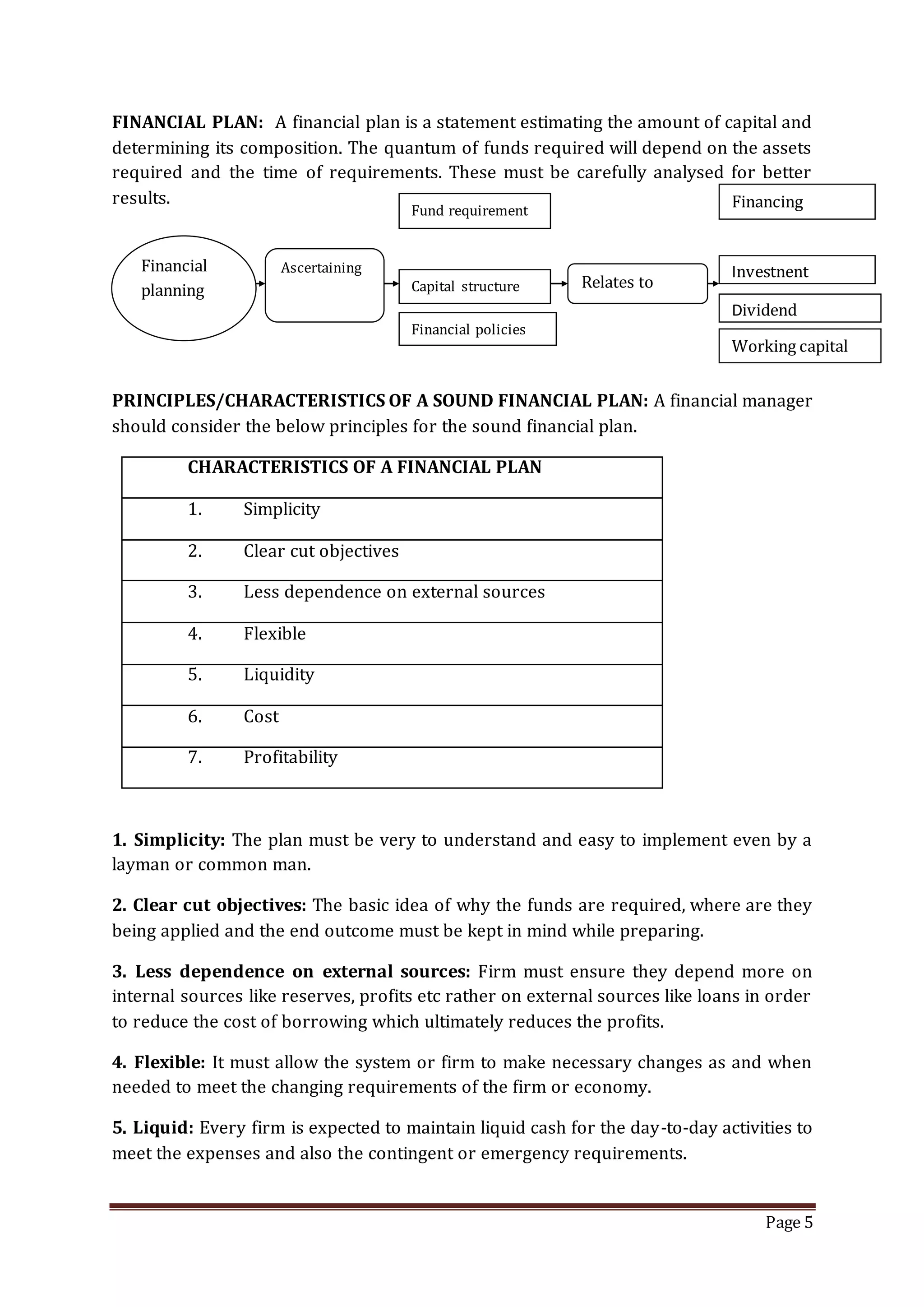
FINANCIAL PLAN: A financial plan is a statement estimating the amount of capital and
determining its composition. The quantum of funds required will depend on the assets
required and the time of requirements. These must be carefully analysed for better
results.
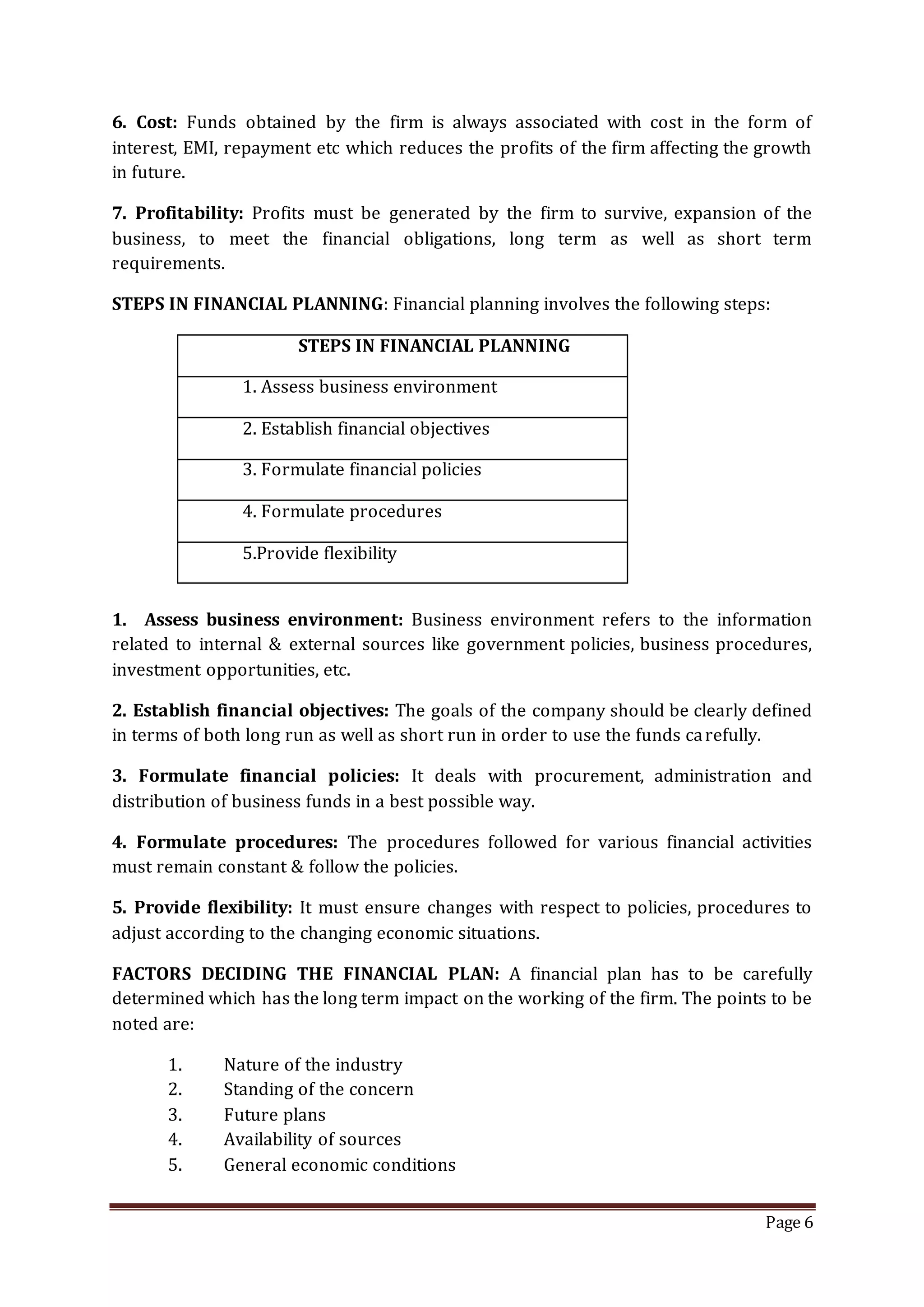
PRINCIPLES/CHARACTERISTICS OF A SOUND FINANCIAL PLAN: A financial manager
should consider the below principles for the sound financial plan.
CHARACTERISTICS OF A FINANCIAL PLAN
1. Simplicity
2. Clear cut objectives
3. Less dependence on external sources
4. Flexible
5. Liquidity
6. Cost
7. Profitability
1. Simplicity: The plan must be very to understand and easy to implement even by a
layman or common man.
2. Clear cut objectives: The basic idea of why the funds are required, where are they
being applied and the end outcome must be kept in mind while preparing.
3. Less dependence on external sources: Firm must ensure they depend more on
internal sources like reserves, profits etc rather on external sources like loans in order
to reduce the cost of borrowing which ultimately reduces the profits.
4. Flexible: It must allow the system or firm to make necessary changes as and when
needed to meet the changing requirements of the firm or economy.
5. Liquid: Every firm is expected to maintain liquid cash for the day-to-day activities to
meet the expenses and also the contingent or emergency requirements.
Financial
planning
Ascertaining
Fund requirement
Capital structure
Financial policies
Relates to
Financing
Investnent
Dividend
Working capital
Page 6
6. Cost: Funds obtained by the firm is always associated with cost in the form of
interest, EMI, repayment etc which reduces the profits of the firm affecting the growth
in future.
7. Profitability: Profits must be generated by the firm to survive, expansion of the
business, to meet the financial obligations, long term as well as short term
requirements.
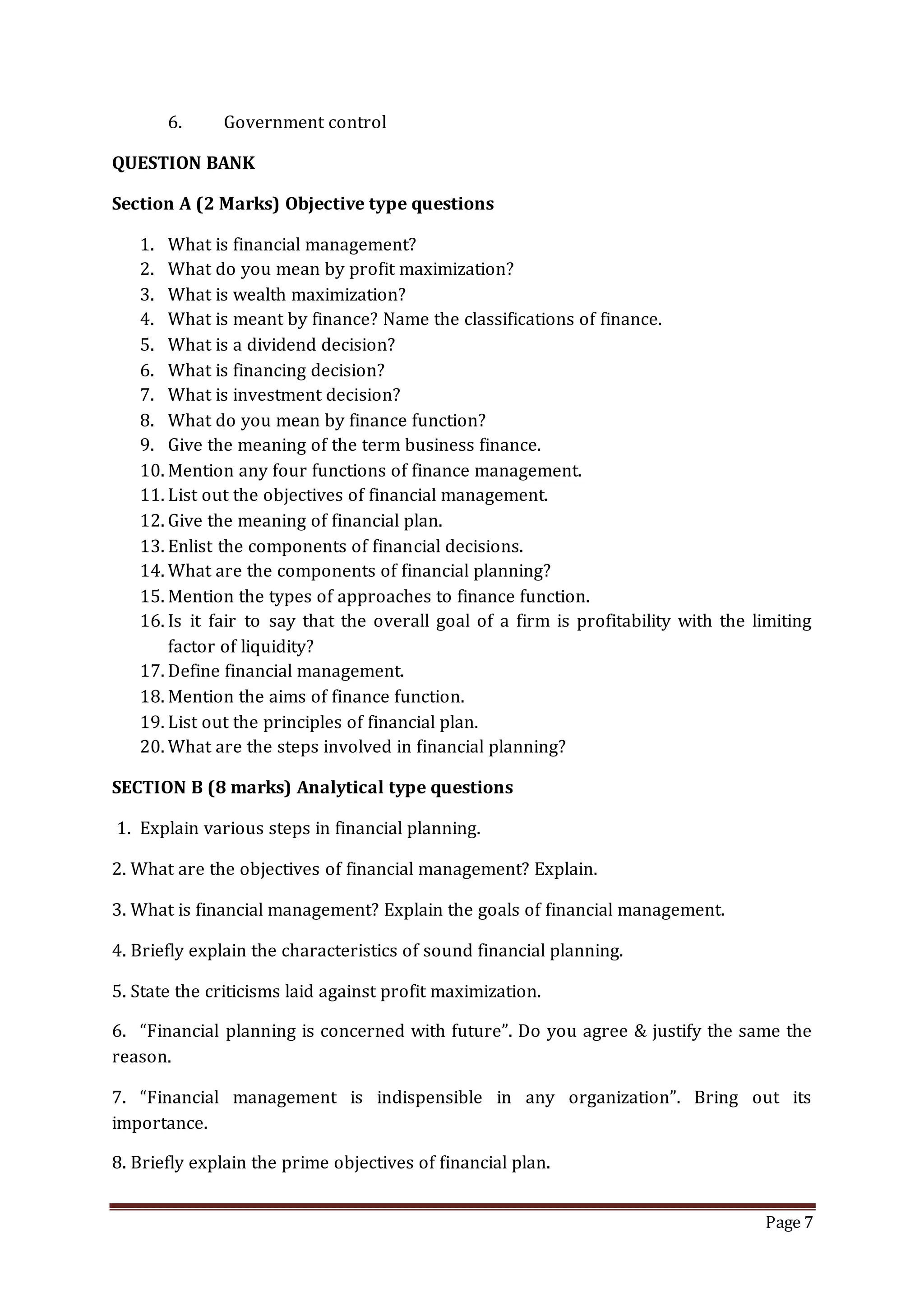
STEPS IN FINANCIAL PLANNING: Financial planning involves the following steps:
STEPS IN FINANCIAL PLANNING
1. Assess business environment
2. Establish financial objectives
3. Formulate financial policies
4. Formulate procedures
5.Provide flexibility
1. Assess business environment: Business environment refers to the information
related to internal & external sources like government policies, business procedures,
investment opportunities, etc.
2. Establish financial objectives: The goals of the company should be clearly defined
in terms of both long run as well as short run in order to use the funds carefully.
3. Formulate financial policies: It deals with procurement, administration and
distribution of business funds in a best possible way.
4. Formulate procedures: The procedures followed for various financial activities
must remain constant & follow the policies.
5. Provide flexibility: It must ensure changes with respect to policies, procedures to
adjust according to the changing economic situations.
FACTORS DECIDING THE FINANCIAL PLAN: A financial plan has to be carefully
determined which has the long term impact on the working of the firm. The points to be
noted are:
1. Nature of the industry
2. Standing of the concern
3. Future plans
4. Availability of sources
5. General economic conditions
Page 7
6. Government control
QUESTION BANK
Section A (2 Marks) Objective type questions
1. What is financial management?
2. What do you mean by profit maximization?
3. What is wealth maximization?
4. What is meant by finance? Name the classifications of finance.
5. What is a dividend decision?
6. What is financing decision?
7. What is investment decision?
8. What do you mean by finance function?
9. Give the meaning of the term business finance.
10. Mention any four functions of finance management.
11. List out the objectives of financial management.
12. Give the meaning of financial plan.
13. Enlist the components of financial decisions.
14. What are the components of financial planning?
15. Mention the types of approaches to finance function.
16. Is it fair to say that the overall goal of a firm is profitability with the limiting
factor of liquidity?
17. Define financial management.
18. Mention the aims of finance function.
19. List out the principles of financial plan.
20. What are the steps involved in financial planning?
SECTION B (8 marks) Analytical type questions
1. Explain various steps in financial planning.
2. What are the objectives of financial management? Explain.
3. What is financial management? Explain the goals of financial management.
4. Briefly explain the characteristics of sound financial planning.
5. State the criticisms laid against profit maximization.
6. “Financial planning is concerned with future”. Do you agree & justify the same the
reason.
7. “Financial management is indispensible in any organization”. Bring out its
importance.
8. Briefly explain the prime objectives of financial plan.
Page 8
9. “The wealth maximization objective provides an operationally appropriate decision
criterion”. Analyze the statement.
10. Outline the limitations of financial planning.
11. Distinguish between the profit maximization and wealth maximization objectives of
financial management.
12. What is finance? Explain how this filed affects all of the activities in business
enterprise.
SECTION C (14 marks) Essay type questions.
1. Explain the importance of financial management.
2. Discuss the objectives of financial management.
3. Critically evaluate various approaches to the finance function.
4. Explain the scope of financial management.
5. Discuss the role of financial manager in a business firm.
6. Discuss the significance of various financial decisions.
7. Explain the concept of wealth in the context of wealth maximization objective.
8. Describe the role of financial manager in current scenario.
9. Analyze the various financial decisions in a business firm.
10. Discuss the various steps involved in financial planning.
11. Enumerate the various principles of financial planning.
12. What do you mean by financial plan? Explain the factors influencing the sound
financial plan in a business firm.

Notes on Introduction to Financial management

  • 1.
    Page 1 CHAPTER 1:INTRODUCTION TO FINANCIAL MANAGEMENT INTRODUCTION TO FINANCE: Finance is defined as the provision or availability of money or funds when required in day-to day activities. It is can be classified into as below: 1. Public finance: it deals with the requirements, receipts and disbursements of funds in the government institutions, state & central government & municipal bodies. Ex: BESCOM, BBMP, etc. 2. Private finance: it deals with the requirements, receipts & distribution of funds in case of individuals, profit making business & non-profit making firms. Ex: TATA, Infosys, Wipro, CRY, etc. BUSINESS FINANCE: The funds required by a business organisation to operate the various activities to ensure there is no stoppage of work at any given point of time in the form of requirements, receipts & payments. It can be grouped into three types namely as below: 1. Sole –proprietary finance 2. Partnership finance 3. Company or corporation finance. FINANCE FUNCTION: It refers to the most important of all the business functions. It focuses on the ensuring all other departments or functions of the business firm are inter-related & well co-ordinated to ensure smooth working of a business. It is like heart pumping blood to the entire system. APPROACHES TO FINANCE FUNCTION: There are two ways finance function can be approached or implemented. They are as below: 1. Traditional approach: this approach completely focused only on procuring or obtaining funds required for the business from various sources. Finance Public Finance Private Finance 1. Government institutions 2. State govt 3. Central govt 4. Municipal bodies 1. Personal finance 2. Business finance 3. Finance of non-profit organisations
  • 2.
    Page 2 2. Modernapproach: This approach not only focus on procuring or obtaining funds required for the business from various sources but also concentrates on effective and efficient application of funds. AIMS OF FINANCE FUNCTION: The primary aim of finance function is to arrange as much as funds for the business on timely manner. They are as follows: AIMS OF FINANCE FUNCTION 1. Acquiring sufficient funds 2. Proper utilisation of funds 3. Increase profitability 4. Maximise firm’s value 1. Acquiring sufficient funds: This is to identifying the amount of finance required by a firm & looking out for the different sources from which funds can be obtained on timely manner. 2. Proper utilisation of funds: Funds must be used more effectively & efficiently so that maximum benefits can be earned by the firm. It must ensure there is neither excess nor shortage of funds. 3. Increase profitability: The main priority of any firm must be to earn profits. To earn sufficient return, firm must invest on profitable ventures taking the cost & rate of return etc into consideration. 4. Maximise firm’s value: Firm usually makes sure not only profits are maximized but also value of the firm in the market which helps to increase the market price of their security resulting in higher satisfaction among investors. FINANCIAL MANAGEMENT: It refers to the process of planning, organising, co- ordinating, directing & controlling of the funds in the business firm which enables into success of the firm in the long run. OBJECTIVES/ GOALS OF FINANCIAL MANAGEMENT: The objectives of the financial management are broadly grouped into 2 types. They are as below: Objectives Profitmaximisation
  • 3.
    Page 3 1. Profitmaximisation: This objective is primarily focused on increasing the profits of the firm by various strategies & implementing various methods & techniques of financial models as profits are the main source of finance to a business for survival & future growth. 2. Wealth maximisation: It means increasing the wealth of the shareholders which maximising the stock market price & value of the firm in the market with better performance. FINANCIAL DECISIONS: It refers to decisions concerning financial matters of a business firm. They can be grouped into as below: 1. Investment decisions: It relates to determination of total amount of assets to be held in the firm. It cane in terms of short- term or long-term investment decisions. Ex; purchase of plant, buildings, furniture, investment on shares, bonds etc. 2. Financing decisions: It refers to the various sources from which the firm is likely to obtain finance, its optimal utilisation & control of the funds. 3. Dividend decisions: It is concerned with deciding if the entire profits must be retained by firm for growth, partially paid as dividends to shareholders etc. FUNCTIONS OF A FINANCE MANAGER: Finance manager plays a pivotal role in a any business irrespective of the size, nature of the firm. The important functions are as listed below: FUNCTIONS OF A FINANCE MANAGER 1. Forecast & Planning of funds Wealth maximisation Financial Decisions Investment Decisions Financing Decisions Dividend Decisions
  • 4.
    Page 4 2. Acquiresfunds 3. Investment of funds 4. Assists in valuation decisions 5. Maintain liquidity 6. Manage cash, Receivables & Inventory 7. Disposal of surplus 8. Performance evaluation & Control 1. Forecast & planning of funds: The first function is to identify the quantum of funds required by the firm for the financial year with respect to short-term and long-term requirements. A budget helps in identification of requirement of funds. 2. Acquires funds: The next step is to look for various sources from which the funds can be borrowed for the reasonable cost to the firm like form banks, etc. 3. Investment of funds: The funds must be used in the best possible way to ensure optimal returns with minimum cost and channelized or used in the most productive manner efficiently. 4. Assists valuation of funds: Many business changes like mergers, take over etc becomes necessary to utilise the benefits of synergy & increase the market share. Manager must assist the management in decision making. 5. Maintain liquidity: Every firm is expected to maintain liquid cash for the day-to-day activities to meet the expenses. 6. Management of cash, receivables & inventory: It is essential to determine the quantum and manage various components of working capital like cash, receivables & inventory for smooth operation of the firm. 7. Disposal of surplus: Optimal utilisation of funds ensures there is no idle funds left with the firm resulting in loss of the opportunity & instead result in better earning & growth of the firm. 8. Performance evaluation & control: it becomes necessary to evaluate the actual performance of the firm against standards set to check the variance or difference & to take corrective measures for the efficient & better operation of the firm.
  • 5.
    Page 5 FINANCIAL PLAN:A financial plan is a statement estimating the amount of capital and determining its composition. The quantum of funds required will depend on the assets required and the time of requirements. These must be carefully analysed for better results. PRINCIPLES/CHARACTERISTICS OF A SOUND FINANCIAL PLAN: A financial manager should consider the below principles for the sound financial plan. CHARACTERISTICS OF A FINANCIAL PLAN 1. Simplicity 2. Clear cut objectives 3. Less dependence on external sources 4. Flexible 5. Liquidity 6. Cost 7. Profitability 1. Simplicity: The plan must be very to understand and easy to implement even by a layman or common man. 2. Clear cut objectives: The basic idea of why the funds are required, where are they being applied and the end outcome must be kept in mind while preparing. 3. Less dependence on external sources: Firm must ensure they depend more on internal sources like reserves, profits etc rather on external sources like loans in order to reduce the cost of borrowing which ultimately reduces the profits. 4. Flexible: It must allow the system or firm to make necessary changes as and when needed to meet the changing requirements of the firm or economy. 5. Liquid: Every firm is expected to maintain liquid cash for the day-to-day activities to meet the expenses and also the contingent or emergency requirements. Financial planning Ascertaining Fund requirement Capital structure Financial policies Relates to Financing Investnent Dividend Working capital
  • 6.
    Page 6 6. Cost:Funds obtained by the firm is always associated with cost in the form of interest, EMI, repayment etc which reduces the profits of the firm affecting the growth in future. 7. Profitability: Profits must be generated by the firm to survive, expansion of the business, to meet the financial obligations, long term as well as short term requirements. STEPS IN FINANCIAL PLANNING: Financial planning involves the following steps: STEPS IN FINANCIAL PLANNING 1. Assess business environment 2. Establish financial objectives 3. Formulate financial policies 4. Formulate procedures 5.Provide flexibility 1. Assess business environment: Business environment refers to the information related to internal & external sources like government policies, business procedures, investment opportunities, etc. 2. Establish financial objectives: The goals of the company should be clearly defined in terms of both long run as well as short run in order to use the funds carefully. 3. Formulate financial policies: It deals with procurement, administration and distribution of business funds in a best possible way. 4. Formulate procedures: The procedures followed for various financial activities must remain constant & follow the policies. 5. Provide flexibility: It must ensure changes with respect to policies, procedures to adjust according to the changing economic situations. FACTORS DECIDING THE FINANCIAL PLAN: A financial plan has to be carefully determined which has the long term impact on the working of the firm. The points to be noted are: 1. Nature of the industry 2. Standing of the concern 3. Future plans 4. Availability of sources 5. General economic conditions
  • 7.
    Page 7 6. Governmentcontrol QUESTION BANK Section A (2 Marks) Objective type questions 1. What is financial management? 2. What do you mean by profit maximization? 3. What is wealth maximization? 4. What is meant by finance? Name the classifications of finance. 5. What is a dividend decision? 6. What is financing decision? 7. What is investment decision? 8. What do you mean by finance function? 9. Give the meaning of the term business finance. 10. Mention any four functions of finance management. 11. List out the objectives of financial management. 12. Give the meaning of financial plan. 13. Enlist the components of financial decisions. 14. What are the components of financial planning? 15. Mention the types of approaches to finance function. 16. Is it fair to say that the overall goal of a firm is profitability with the limiting factor of liquidity? 17. Define financial management. 18. Mention the aims of finance function. 19. List out the principles of financial plan. 20. What are the steps involved in financial planning? SECTION B (8 marks) Analytical type questions 1. Explain various steps in financial planning. 2. What are the objectives of financial management? Explain. 3. What is financial management? Explain the goals of financial management. 4. Briefly explain the characteristics of sound financial planning. 5. State the criticisms laid against profit maximization. 6. “Financial planning is concerned with future”. Do you agree & justify the same the reason. 7. “Financial management is indispensible in any organization”. Bring out its importance. 8. Briefly explain the prime objectives of financial plan.
  • 8.
    Page 8 9. “Thewealth maximization objective provides an operationally appropriate decision criterion”. Analyze the statement. 10. Outline the limitations of financial planning. 11. Distinguish between the profit maximization and wealth maximization objectives of financial management. 12. What is finance? Explain how this filed affects all of the activities in business enterprise. SECTION C (14 marks) Essay type questions. 1. Explain the importance of financial management. 2. Discuss the objectives of financial management. 3. Critically evaluate various approaches to the finance function. 4. Explain the scope of financial management. 5. Discuss the role of financial manager in a business firm. 6. Discuss the significance of various financial decisions. 7. Explain the concept of wealth in the context of wealth maximization objective. 8. Describe the role of financial manager in current scenario. 9. Analyze the various financial decisions in a business firm. 10. Discuss the various steps involved in financial planning. 11. Enumerate the various principles of financial planning. 12. What do you mean by financial plan? Explain the factors influencing the sound financial plan in a business firm.