Phylum Porifera
“Sponges”
Kingdom: Animalia
Phylum: Porifera
Classes: Hexactinellida
Demospongia
Calcarea
By
Dr. Priti D.Diwan
AssistantProfessor
Department of Zoology
J.D.Patil Sangludkar Mahavidyalay Daryapur.
Phylum Porifera
 Pronounced (po-rif'-er-a)
 The name means
“bearing pores”
• 5,000 living species
• Most primitive of all
animals
Phylum Porifera
 Sponges are sessile, meaning they have a
stationary, inactive lifestyle can move up
to 4 mm per day
 Because they are sessile, they are highly
dependent on ocean currents to bring
food to them and eliminate waste
products.
 Embryos are free-swimming.
Major Characteristics:
 They have no organs or true tissues.
 Digestion, respiration, and excretion all
occur by simple diffusion directly into and
out of the cells.
 No nervous system.
 Most sponges are asymmetrical.
Occasionally radial
Major Characteristics:
 Their bodies are made up of thousands of
cells mixed together in a gel-like mixture,
supported by small skeletal structures
called spicules.
Major Characteristics:
• Feed by filtering water through their outer
walls and pumping it out of body
• Flow of water is uni-directional
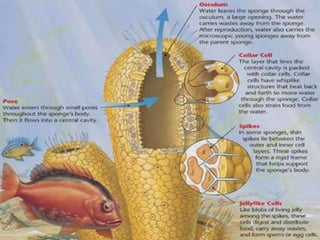
 Sponges are made up of a system of tiny
pores and canals that make up a intricate
filter feeding system.
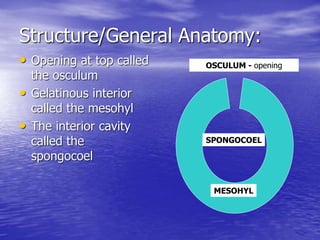
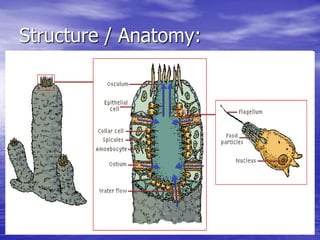
Structure/General Anatomy:
• Opening at top called
the osculum
• Gelatinous interior
called the mesohyl
• The interior cavity
called the
spongocoel
OSCULUM - opening
MESOHYL
SPONGOCOEL
Sponge Skeletons
 Thin strands of collagen are found
throughout the bodies of sponges.
 The class of Demospongiae produces a
form of collagen known as spongin.
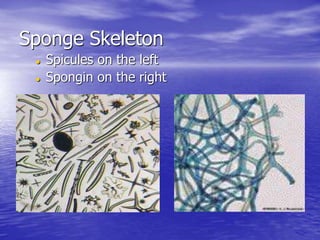
Sponge Skeleton
 Spicules on the left
 Spongin on the right
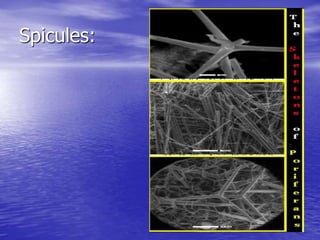
Spicules:
Structure / Anatomy:
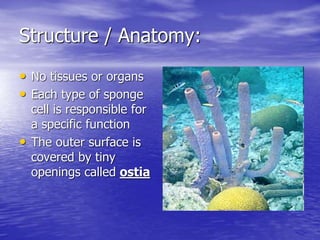
• No tissues or organs
• Each type of sponge
cell is responsible for
a specific function
• The outer surface is
covered by tiny
openings called ostia
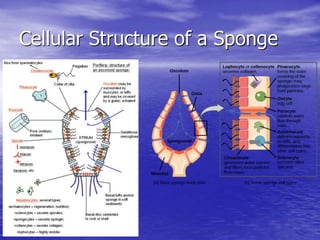
Cellular Structure of Sponges
 The inner material that makes up the main body (a
type of connective tissue) of a sponge consists of a
loose gel-like mixture called Mesohyl.
 Porocytes make up the ostia that allow the
passage of water into the sponge.
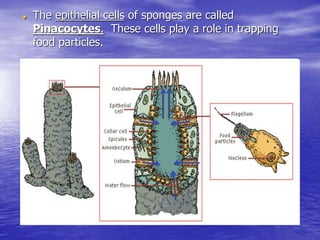
 The epithelial cells of sponges are called
Pinacocytes. These cells play a role in trapping
food particles.
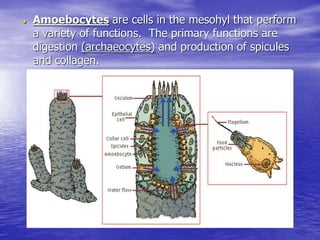
 Amoebocytes are cells in the mesohyl that perform
a variety of functions. The primary functions are
digestion (archaeocytes) and production of spicules
and collagen.
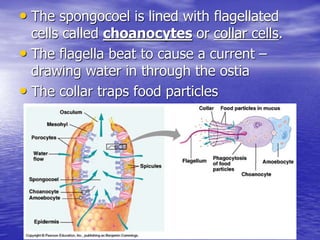
• The spongocoel is lined with flagellated
cells called choanocytes or collar cells.
• The flagella beat to cause a current –
drawing water in through the ostia
• The collar traps food particles
Cellular Structure of a Sponge
Structure / Anatomy:
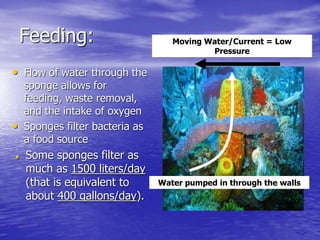
Feeding:
• Flow of water through the
sponge allows for
feeding, waste removal,
and the intake of oxygen
• Sponges filter bacteria as
a food source
 Some sponges filter as
much as 1500 liters/day
(that is equivalent to
about 400 gallons/day).
Moving Water/Current = Low
Pressure
Water pumped in through the walls
Sponge Digestion
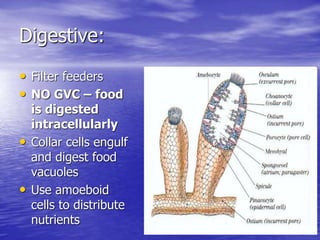
Digestive:
• Filter feeders
• NO GVC – food
is digested
intracellularly
• Collar cells engulf
and digest food
vacuoles
• Use amoeboid
cells to distribute
nutrients
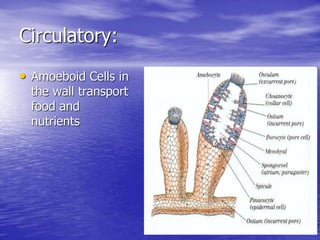
Circulatory:
• Amoeboid Cells in
the wall transport
food and
nutrients
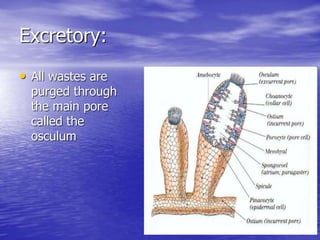
Excretory:
• All wastes are
purged through
the main pore
called the
osculum
Respiratory
• Various cells take in oxygen through
diffusion
Sponge Sexual Reproduction
 Most sponges are monoecious. Meaning a
single sponge can have both male and female sex
cells.
 Sperm cells develop from choanocytes. Egg cells
can develop from choanocytes in some species
and from archaeocytes in others.
 After fertilization, the a free-swimming flagellated
larva called a parenchymula breaks off from the
adult sponge and are carried away by ocean
currents.
Sponge Asexual Reproduction
 fragmentation and by external budding.
 Fragmentation occurs when a fragment is broken off
from the main body of the sponge.
 Budding occurs when a small sponge grows off of the
adult sponge. Eventually these can break off and
regenerate.
Sponge Asexual Reproduction
 Gemmules are internal buds that usually remain
dormant and contain archaeocytes.
 Gemmules are usually formed during unfavorable
conditions
 After the unfavorable conditions pass, the
archaeocytes can then be released - regenerate into
a new adult sponge.
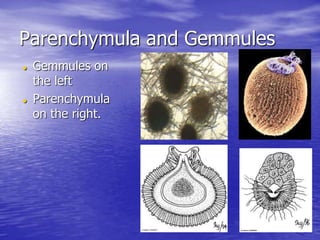
Parenchymula and Gemmules
 Gemmules on
the left
 Parenchymula
on the right.
Sponge Ecology
 Adults are always attached to other
objects. (rocks, corals, submerged objects
etc.)
 Many other organisms such as crab and
fish live symbiotically in or on sponges.
 Some sponges live on other organisms
like mollusk shells and corals.
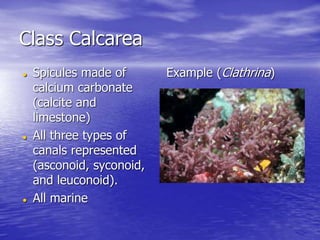
Class Calcarea
 Spicules made of
calcium carbonate
(calcite and
limestone)
 All three types of
canals represented
(asconoid, syconoid,
and leuconoid).
 All marine
Example (Clathrina)
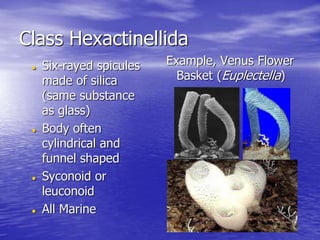
Class Hexactinellida
 Six-rayed spicules
made of silica
(same substance
as glass)
 Body often
cylindrical and
funnel shaped
 Syconoid or
leuconoid
 All Marine
Example, Venus Flower
Basket (Euplectella)
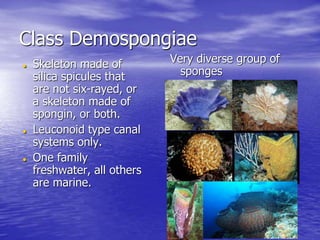
Class Demospongiae
 Skeleton made of
silica spicules that
are not six-rayed, or
a skeleton made of
spongin, or both.
 Leuconoid type canal
systems only.
 One family
freshwater, all others
are marine.
Very diverse group of
sponges

phylum porifera

  • 1.
    Phylum Porifera “Sponges” Kingdom: Animalia Phylum:Porifera Classes: Hexactinellida Demospongia Calcarea By Dr. Priti D.Diwan AssistantProfessor Department of Zoology J.D.Patil Sangludkar Mahavidyalay Daryapur.
  • 2.
    Phylum Porifera  Pronounced(po-rif'-er-a)  The name means “bearing pores” • 5,000 living species • Most primitive of all animals
  • 3.
    Phylum Porifera  Spongesare sessile, meaning they have a stationary, inactive lifestyle can move up to 4 mm per day  Because they are sessile, they are highly dependent on ocean currents to bring food to them and eliminate waste products.  Embryos are free-swimming.
  • 4.
    Major Characteristics:  Theyhave no organs or true tissues.  Digestion, respiration, and excretion all occur by simple diffusion directly into and out of the cells.  No nervous system.  Most sponges are asymmetrical. Occasionally radial
  • 5.
    Major Characteristics:  Theirbodies are made up of thousands of cells mixed together in a gel-like mixture, supported by small skeletal structures called spicules.
  • 6.
    Major Characteristics: • Feedby filtering water through their outer walls and pumping it out of body • Flow of water is uni-directional  Sponges are made up of a system of tiny pores and canals that make up a intricate filter feeding system.
  • 7.
    Structure/General Anatomy: • Openingat top called the osculum • Gelatinous interior called the mesohyl • The interior cavity called the spongocoel OSCULUM - opening MESOHYL SPONGOCOEL
  • 8.
    Sponge Skeletons  Thinstrands of collagen are found throughout the bodies of sponges.  The class of Demospongiae produces a form of collagen known as spongin.
  • 9.
    Sponge Skeleton  Spiculeson the left  Spongin on the right
  • 10.
  • 11.
  • 13.
    Structure / Anatomy: •No tissues or organs • Each type of sponge cell is responsible for a specific function • The outer surface is covered by tiny openings called ostia
  • 14.
    Cellular Structure ofSponges  The inner material that makes up the main body (a type of connective tissue) of a sponge consists of a loose gel-like mixture called Mesohyl.  Porocytes make up the ostia that allow the passage of water into the sponge.
  • 15.
     The epithelialcells of sponges are called Pinacocytes. These cells play a role in trapping food particles.
  • 16.
     Amoebocytes arecells in the mesohyl that perform a variety of functions. The primary functions are digestion (archaeocytes) and production of spicules and collagen.
  • 17.
    • The spongocoelis lined with flagellated cells called choanocytes or collar cells. • The flagella beat to cause a current – drawing water in through the ostia • The collar traps food particles
  • 18.
  • 19.
  • 20.
    Feeding: • Flow ofwater through the sponge allows for feeding, waste removal, and the intake of oxygen • Sponges filter bacteria as a food source  Some sponges filter as much as 1500 liters/day (that is equivalent to about 400 gallons/day). Moving Water/Current = Low Pressure Water pumped in through the walls
  • 21.
  • 22.
    Digestive: • Filter feeders •NO GVC – food is digested intracellularly • Collar cells engulf and digest food vacuoles • Use amoeboid cells to distribute nutrients
  • 23.
    Circulatory: • Amoeboid Cellsin the wall transport food and nutrients
  • 24.
    Excretory: • All wastesare purged through the main pore called the osculum
  • 25.
    Respiratory • Various cellstake in oxygen through diffusion
  • 26.
    Sponge Sexual Reproduction Most sponges are monoecious. Meaning a single sponge can have both male and female sex cells.  Sperm cells develop from choanocytes. Egg cells can develop from choanocytes in some species and from archaeocytes in others.  After fertilization, the a free-swimming flagellated larva called a parenchymula breaks off from the adult sponge and are carried away by ocean currents.
  • 27.
    Sponge Asexual Reproduction fragmentation and by external budding.  Fragmentation occurs when a fragment is broken off from the main body of the sponge.  Budding occurs when a small sponge grows off of the adult sponge. Eventually these can break off and regenerate.
  • 28.
    Sponge Asexual Reproduction Gemmules are internal buds that usually remain dormant and contain archaeocytes.  Gemmules are usually formed during unfavorable conditions  After the unfavorable conditions pass, the archaeocytes can then be released - regenerate into a new adult sponge.
  • 29.
    Parenchymula and Gemmules Gemmules on the left  Parenchymula on the right.
  • 30.
    Sponge Ecology  Adultsare always attached to other objects. (rocks, corals, submerged objects etc.)  Many other organisms such as crab and fish live symbiotically in or on sponges.  Some sponges live on other organisms like mollusk shells and corals.
  • 31.
    Class Calcarea  Spiculesmade of calcium carbonate (calcite and limestone)  All three types of canals represented (asconoid, syconoid, and leuconoid).  All marine Example (Clathrina)
  • 32.
    Class Hexactinellida  Six-rayedspicules made of silica (same substance as glass)  Body often cylindrical and funnel shaped  Syconoid or leuconoid  All Marine Example, Venus Flower Basket (Euplectella)
  • 33.
    Class Demospongiae  Skeletonmade of silica spicules that are not six-rayed, or a skeleton made of spongin, or both.  Leuconoid type canal systems only.  One family freshwater, all others are marine. Very diverse group of sponges