Dr. Karri Rama Rao
M.Sc (Zoo); M.Sc (Psy); M.Ed; Ph.D; PDF (dst); PDF (dbt); D.Litt
Biostatistics
Statistical processes and methods applied to the
collection, analysis, and interpretation of
biological data and especially data relating to
human biology, health and medicine.
Biostatistics and statistics both involve data
collection and interpretation. Statistics is a
broad approach to data analysis and collection.
The key distinction is that biostatistics
uses statistical methods to answer
questions pertaining to topics in biology.
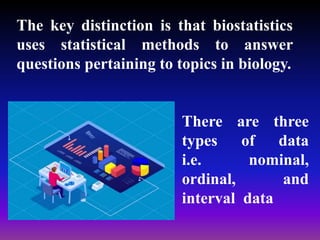
There are three
types of data
i.e. nominal,
ordinal, and
interval data
But when placed on a scale and arranged in a
given order (very hot, hot, warm, cold, very
cold), they are regarded as ordinal data.
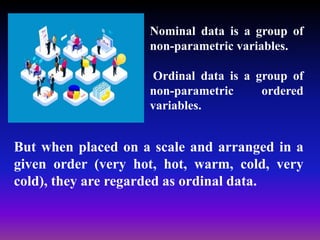
Nominal data is a group of
non-parametric variables.
Ordinal data is a group of
non-parametric ordered
variables.
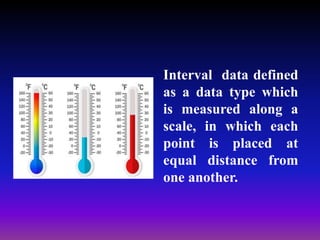
Interval data defined
as a data type which
is measured along a
scale, in which each
point is placed at
equal distance from
one another.
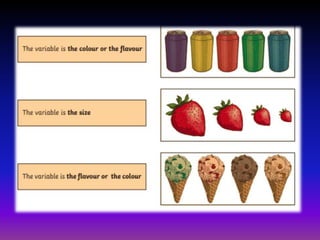
variable
In mathematics, a variable is a symbol and
placeholder for (historically) a quantity that
may change, or (nowadays) any mathematical
object.
A variable may represent a number, a vector, a
matrix, a function, the argument of a function,
a set, or an element of a set.
Importance of Statistics in biology
Biostatistics is also known as biometry, the
development and application of statistical
methods to a wide range of topics in biology.
It encompasses the design of biological
experiments, the collection and analysis of
data from those experiments and the
interpretation of the results.
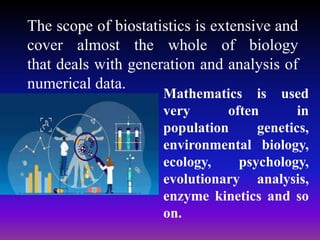
The scope of biostatistics is extensive and
cover almost the whole of biology
that deals with generation and analysis of
numerical data.
Mathematics is used
very often in
population genetics,
environmental biology,
ecology, psychology,
evolutionary analysis,
enzyme kinetics and so
on.
Statistics in biology have an essential role.
The main role of statistics in biology is to test
various hypotheses and interpret
experimental results.
Statistics can also help experimental
biologists prepare experiments, methods,
calculations, and result in interpretation.
Some statistical concepts can help choose
sample size or which organisms to study
from a group.
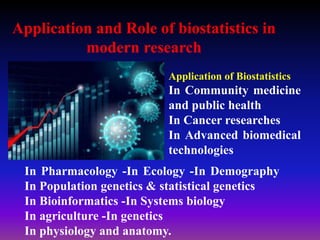
Application and Role of biostatistics in
modern research
Application of Biostatistics
In Community medicine
and public health
In Cancer researches
In Advanced biomedical
technologies
In Pharmacology -In Ecology -In Demography
In Population genetics & statistical genetics
In Bioinformatics -In Systems biology
In agriculture -In genetics
In physiology and anatomy.
Useful in determining of a treatment will work
out or not.
To test usefulness of vaccines in
epidemiological studies.
Medical research studies use Biostatistics from
beginning to end.
To reach conclusions about diseases within
certain population groups.
To determine development , progressive nature
and spread of a disease. It predicts mortality
rate, symptoms and even the time of
occurrence. Eg: Flu
•Another example is in case of development of
polio vaccine.
Randomization—
Paul Meier
experimental and
standard treatment
comparison,
calculate efficiency
of treatment.
IN AGRICULTURE
In crop improvement.
In agricultural works, the
decision as to whether one
variety of crop is better than
the other will be made on the
results of a carefully planned
series of statistical
experiments.
IN GENETICS
Two important laws in genetics for example is largely
used in the field of genetics. Mendel's Laws o Hardy-
Weingberg equilibrium
IN PHYSIOLOGYAND ANATOMY
Limits of normal and healthy values in a
population
Differences between means and populations.
IN CANCER RESEARCHES
Cancer is not a one size fits all disease. So it is
used to identify how factors such as drug
interaction , association between 2 attributes
(smoking & cancer) diet etc.
Examine traits of cancer and occurrences in
various ages, genders, and racial groups to
work on prevention.
Clinical trials—number based.
Make predictions about real effects of
treatment.
Randomization and stratification techniques
applied here also.
IN ADVANCED BIOMEDICAL TECHNOLOGIES
•Computer intensive biostatistical methods–
bootstrapping and re-sampling methods.
•Micro arrays, next generation sequencers (for
genomics) , mass spectrometry (proteins)
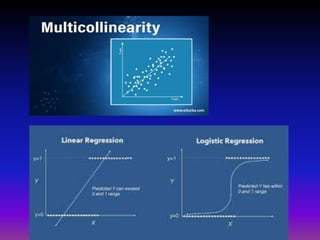
•The datas obtained from these method could be
analysed only with the help of biostatistical methods
(problem of multicollinearity)
•Very difficult with classical statistical methods like
linear or logistic regression.
IN PHARMACOLOGY
•To find action of a drug.
•To compare actions of two different
drugs and dosages
•To find relative potency of new drug.
IN ECOLOGY
Constructing biological pyramids/
ecological pyramids
calculation of total energy content in
different trophic levels.
Effects of climate change and other
environmental impacts on ecological
communities.
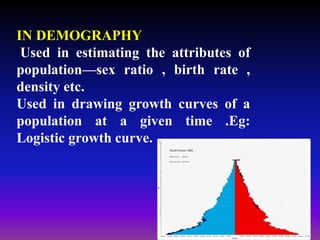
IN DEMOGRAPHY
Used in estimating the attributes of
population—sex ratio , birth rate ,
density etc.
Used in drawing growth curves of a
population at a given time .Eg:
Logistic growth curve.
In Population Genetics and
Statistical Genetics
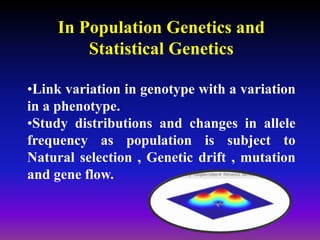
•Link variation in genotype with a variation
in a phenotype.
•Study distributions and changes in allele
frequency as population is subject to
Natural selection , Genetic drift , mutation
and gene flow.
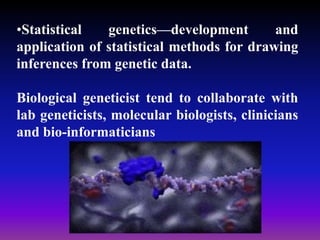
•Statistical genetics—development and
application of statistical methods for drawing
inferences from genetic data.
Biological geneticist tend to collaborate with
lab geneticists, molecular biologists, clinicians
and bio-informaticians
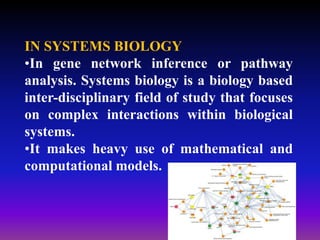
IN SYSTEMS BIOLOGY
•In gene network inference or pathway
analysis. Systems biology is a biology based
inter-disciplinary field of study that focuses
on complex interactions within biological
systems.
•It makes heavy use of mathematical and
computational models.
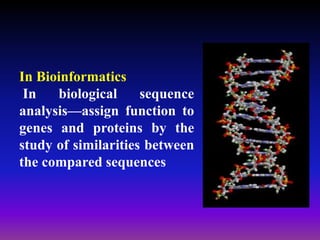
In Bioinformatics
In biological sequence
analysis—assign function to
genes and proteins by the
study of similarities between
the compared sequences
Statistical tests used in biology help provide scientists
with insight about processes that are either too vast,
too microscopic or too numerous to be analyzed by
other methods.
The main role of statistics in biology is to test
hypotheses.
Other statistical tests are used in biology to help set up
experiments and interpret results.
ROLE OF BIOSTATISTICS
Some statistical concepts can help choose
sample size or which organisms to study from a
group.
A group at random would provide the best
group to analyze, random samplings can
accidentally produce patterns that aren’t
naturally occurring outside the sample group.
Biologists are careful to use statistical
programs to help them with sampling in order
to keep their findings pure.
Use of Biologists
The basic types of statistical tests used in
biology fall into four basic categories:
correlational, comparison of means, regression
and nonparametric.
Correlational tests measure how closely two or
more variables are related.
Regressions analyze if a change in one variable
Comparisons of means measure the difference

Biostatistics

  • 1.
    Dr. Karri RamaRao M.Sc (Zoo); M.Sc (Psy); M.Ed; Ph.D; PDF (dst); PDF (dbt); D.Litt Biostatistics
  • 2.
    Statistical processes andmethods applied to the collection, analysis, and interpretation of biological data and especially data relating to human biology, health and medicine. Biostatistics and statistics both involve data collection and interpretation. Statistics is a broad approach to data analysis and collection.
  • 3.
    The key distinctionis that biostatistics uses statistical methods to answer questions pertaining to topics in biology. There are three types of data i.e. nominal, ordinal, and interval data
  • 4.
    But when placedon a scale and arranged in a given order (very hot, hot, warm, cold, very cold), they are regarded as ordinal data. Nominal data is a group of non-parametric variables. Ordinal data is a group of non-parametric ordered variables.
  • 5.
    Interval data defined asa data type which is measured along a scale, in which each point is placed at equal distance from one another.
  • 6.
    variable In mathematics, avariable is a symbol and placeholder for (historically) a quantity that may change, or (nowadays) any mathematical object. A variable may represent a number, a vector, a matrix, a function, the argument of a function, a set, or an element of a set.
  • 8.
    Importance of Statisticsin biology Biostatistics is also known as biometry, the development and application of statistical methods to a wide range of topics in biology. It encompasses the design of biological experiments, the collection and analysis of data from those experiments and the interpretation of the results.
  • 9.
    The scope ofbiostatistics is extensive and cover almost the whole of biology that deals with generation and analysis of numerical data. Mathematics is used very often in population genetics, environmental biology, ecology, psychology, evolutionary analysis, enzyme kinetics and so on.
  • 10.
    Statistics in biologyhave an essential role. The main role of statistics in biology is to test various hypotheses and interpret experimental results. Statistics can also help experimental biologists prepare experiments, methods, calculations, and result in interpretation. Some statistical concepts can help choose sample size or which organisms to study from a group.
  • 11.
    Application and Roleof biostatistics in modern research Application of Biostatistics In Community medicine and public health In Cancer researches In Advanced biomedical technologies In Pharmacology -In Ecology -In Demography In Population genetics & statistical genetics In Bioinformatics -In Systems biology In agriculture -In genetics In physiology and anatomy.
  • 12.
    Useful in determiningof a treatment will work out or not. To test usefulness of vaccines in epidemiological studies. Medical research studies use Biostatistics from beginning to end. To reach conclusions about diseases within certain population groups.
  • 13.
    To determine development, progressive nature and spread of a disease. It predicts mortality rate, symptoms and even the time of occurrence. Eg: Flu •Another example is in case of development of polio vaccine. Randomization— Paul Meier experimental and standard treatment comparison, calculate efficiency of treatment.
  • 14.
    IN AGRICULTURE In cropimprovement. In agricultural works, the decision as to whether one variety of crop is better than the other will be made on the results of a carefully planned series of statistical experiments. IN GENETICS Two important laws in genetics for example is largely used in the field of genetics. Mendel's Laws o Hardy- Weingberg equilibrium
  • 15.
    IN PHYSIOLOGYAND ANATOMY Limitsof normal and healthy values in a population Differences between means and populations. IN CANCER RESEARCHES Cancer is not a one size fits all disease. So it is used to identify how factors such as drug interaction , association between 2 attributes (smoking & cancer) diet etc.
  • 16.
    Examine traits ofcancer and occurrences in various ages, genders, and racial groups to work on prevention. Clinical trials—number based. Make predictions about real effects of treatment. Randomization and stratification techniques applied here also.
  • 17.
    IN ADVANCED BIOMEDICALTECHNOLOGIES •Computer intensive biostatistical methods– bootstrapping and re-sampling methods. •Micro arrays, next generation sequencers (for genomics) , mass spectrometry (proteins) •The datas obtained from these method could be analysed only with the help of biostatistical methods (problem of multicollinearity) •Very difficult with classical statistical methods like linear or logistic regression.
  • 19.
    IN PHARMACOLOGY •To findaction of a drug. •To compare actions of two different drugs and dosages •To find relative potency of new drug.
  • 20.
    IN ECOLOGY Constructing biologicalpyramids/ ecological pyramids calculation of total energy content in different trophic levels. Effects of climate change and other environmental impacts on ecological communities.
  • 21.
    IN DEMOGRAPHY Used inestimating the attributes of population—sex ratio , birth rate , density etc. Used in drawing growth curves of a population at a given time .Eg: Logistic growth curve.
  • 22.
    In Population Geneticsand Statistical Genetics •Link variation in genotype with a variation in a phenotype. •Study distributions and changes in allele frequency as population is subject to Natural selection , Genetic drift , mutation and gene flow.
  • 23.
    •Statistical genetics—development and applicationof statistical methods for drawing inferences from genetic data. Biological geneticist tend to collaborate with lab geneticists, molecular biologists, clinicians and bio-informaticians
  • 24.
    IN SYSTEMS BIOLOGY •Ingene network inference or pathway analysis. Systems biology is a biology based inter-disciplinary field of study that focuses on complex interactions within biological systems. •It makes heavy use of mathematical and computational models.
  • 25.
    In Bioinformatics In biologicalsequence analysis—assign function to genes and proteins by the study of similarities between the compared sequences
  • 26.
    Statistical tests usedin biology help provide scientists with insight about processes that are either too vast, too microscopic or too numerous to be analyzed by other methods. The main role of statistics in biology is to test hypotheses. Other statistical tests are used in biology to help set up experiments and interpret results. ROLE OF BIOSTATISTICS
  • 27.
    Some statistical conceptscan help choose sample size or which organisms to study from a group. A group at random would provide the best group to analyze, random samplings can accidentally produce patterns that aren’t naturally occurring outside the sample group. Biologists are careful to use statistical programs to help them with sampling in order to keep their findings pure.
  • 28.
    Use of Biologists Thebasic types of statistical tests used in biology fall into four basic categories: correlational, comparison of means, regression and nonparametric. Correlational tests measure how closely two or more variables are related. Regressions analyze if a change in one variable Comparisons of means measure the difference