Class - 10th
Polynomials
Prime Paathshala
+91-8989815785
Table of contents
 Introduction to polynomials
 Polynomial classifications
 Degrees of a polynomial
 Terms of a polynomial
 Types of polynomials
 Graphical representation of equations
 Zeroes of a polynomial
 Graphical meaning of zeroes of polynomial
 Number of zeroes
 Factorization of polynomials
 Relations between zeroes and coefficient of a
polynomial
 Zeroes of a polynomial examples
 Division algorithm
 Algebraic identities
Introduction to Polynomials
The word polynomial is derived from the Greek words ‘poly’ means ‘many‘
and ‘nominal’ means ‘terms‘, so altogether it said “many terms”. A polynomial
can have any number of terms but not infinite. It is defined as an expression
which is composed of variables, constants and exponents, that are combined
using the mathematical operations such as addition, subtraction, multiplication
and division.
Polynomials are algebraic expressions that consist of variables and coefficients.
Variables are also sometimes called indeterminates. For example: x²+x-12.
Based on the numbers of terms present in the
expression, it is classified as monomial, binomial, and
trinomial. Examples of constants, variables and
exponents are as follows
Constants. Example: 1, 2, 3, etc.
Variables. Example: g, h, x, y, etc.
Exponents: Example: 5 in x5 etc.
Polynomial Classifications
The polynomial function is denoted by P(x) where x represents the
variable. For example, P(x) = x²+5x+11
If the variable is denoted by a, then the function will be P(a)
Degree of a polynomial
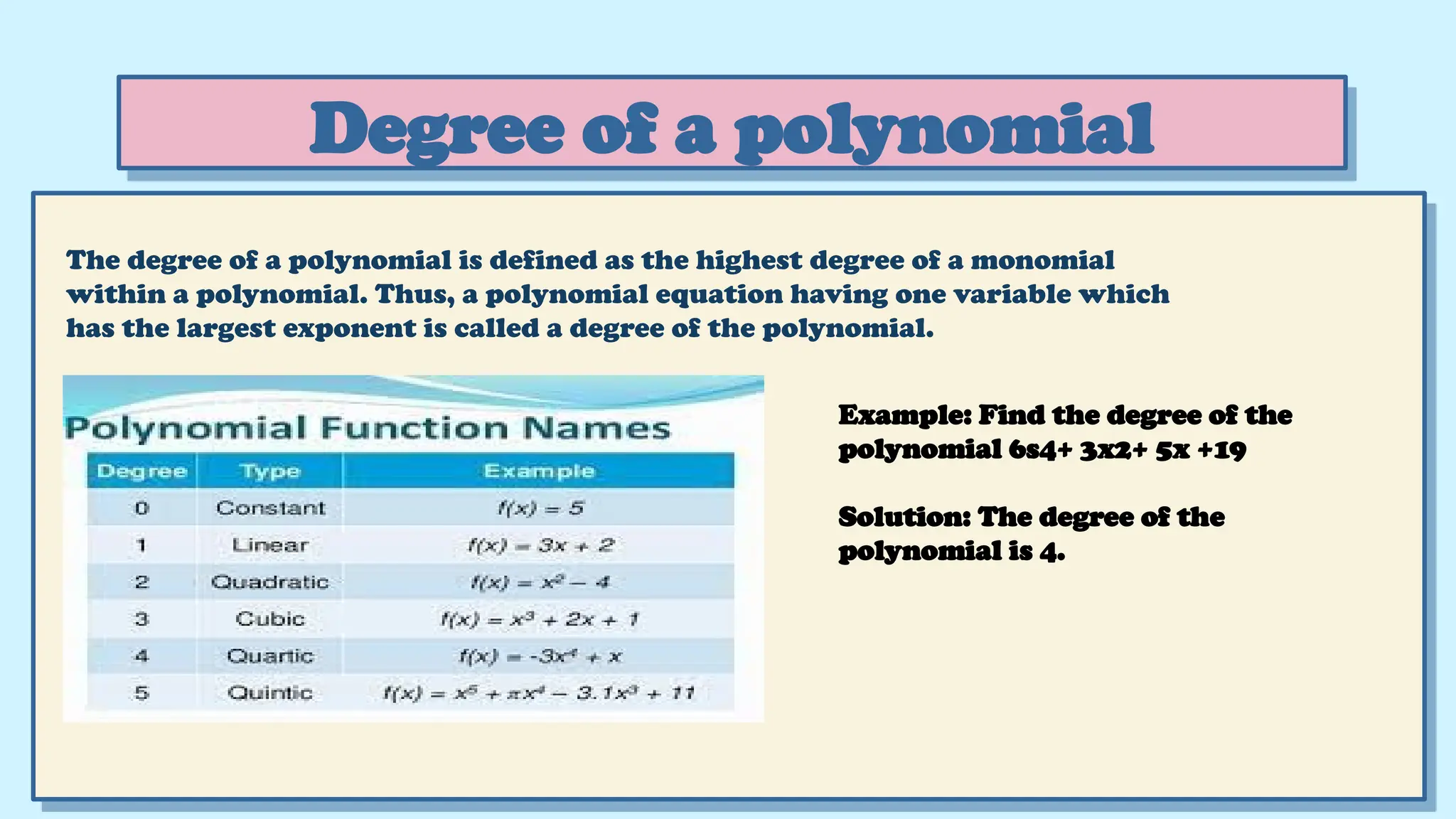
The degree of a polynomial is defined as the highest degree of a monomial
within a polynomial. Thus, a polynomial equation having one variable which
has the largest exponent is called a degree of the polynomial.
Example: Find the degree of the
polynomial 6s4+ 3x2+ 5x +19
Solution: The degree of the
polynomial is 4.
TERMS OF POLYNOMIAL
The terms of polynomials are the parts of the
equation which are generally separated by “+”
or “-” signs. So, each part of a polynomial in
an equation is a term. For example, in a
polynomial, say, 2x2 + 5 +4, the number of
terms will be 3. The classification of a
polynomial is done based on the number of
terms in it.
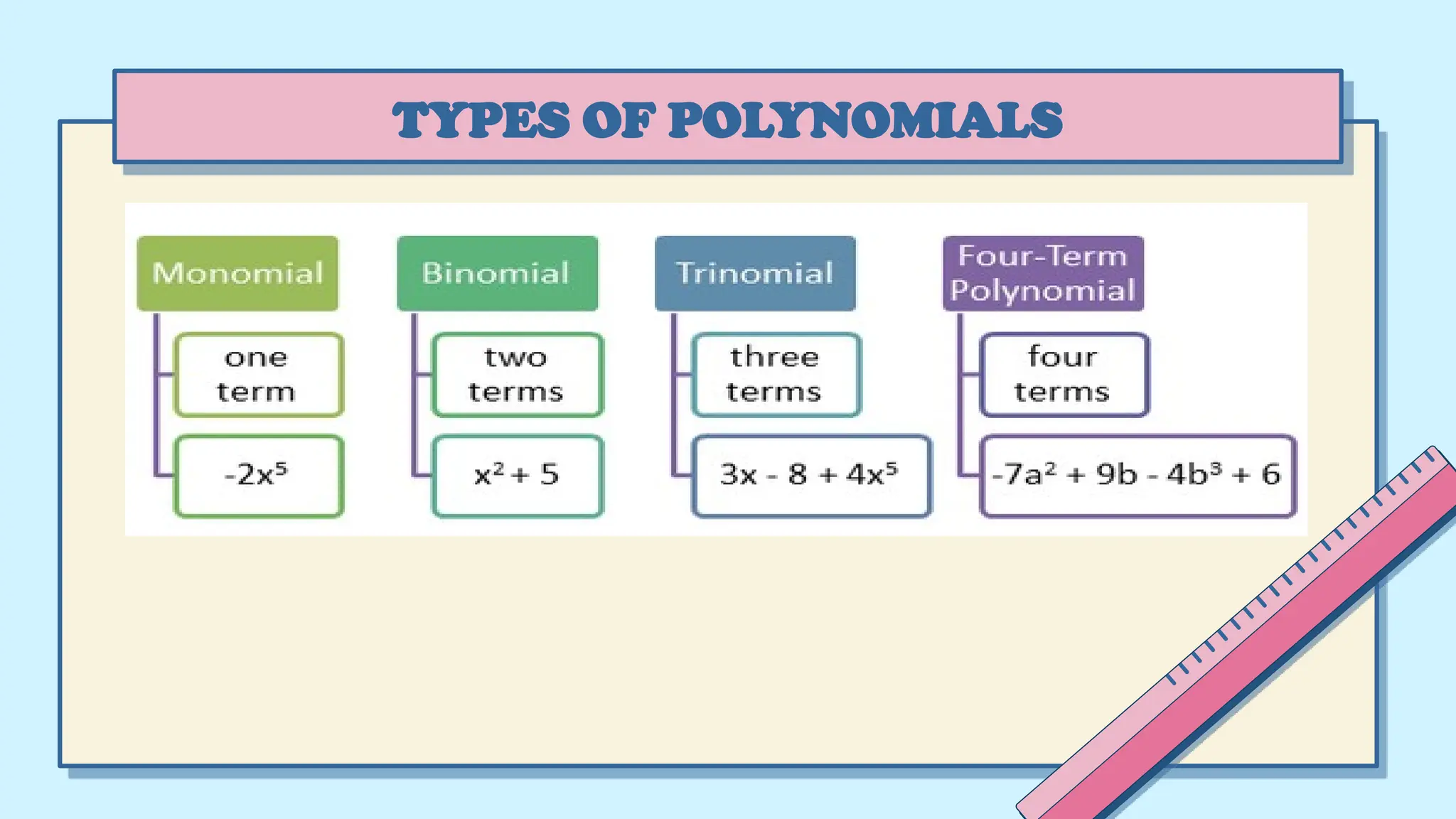
Polynomials are of 3 different types and are classified
based on the number of terms in it. The three types of
polynomials are:
Monomial
Binomial
Trinomial
TYPES OF POLYNOMIALS
These polynomials can be combined using addition, subtraction,
multiplication, and division but is never division by a variable. A
few examples of Non Polynomials are: 1/x+2, x-3
TYPES OF POLYNOMIALS
GRAPHICAL REPRESENTATION OF EQUATIONS
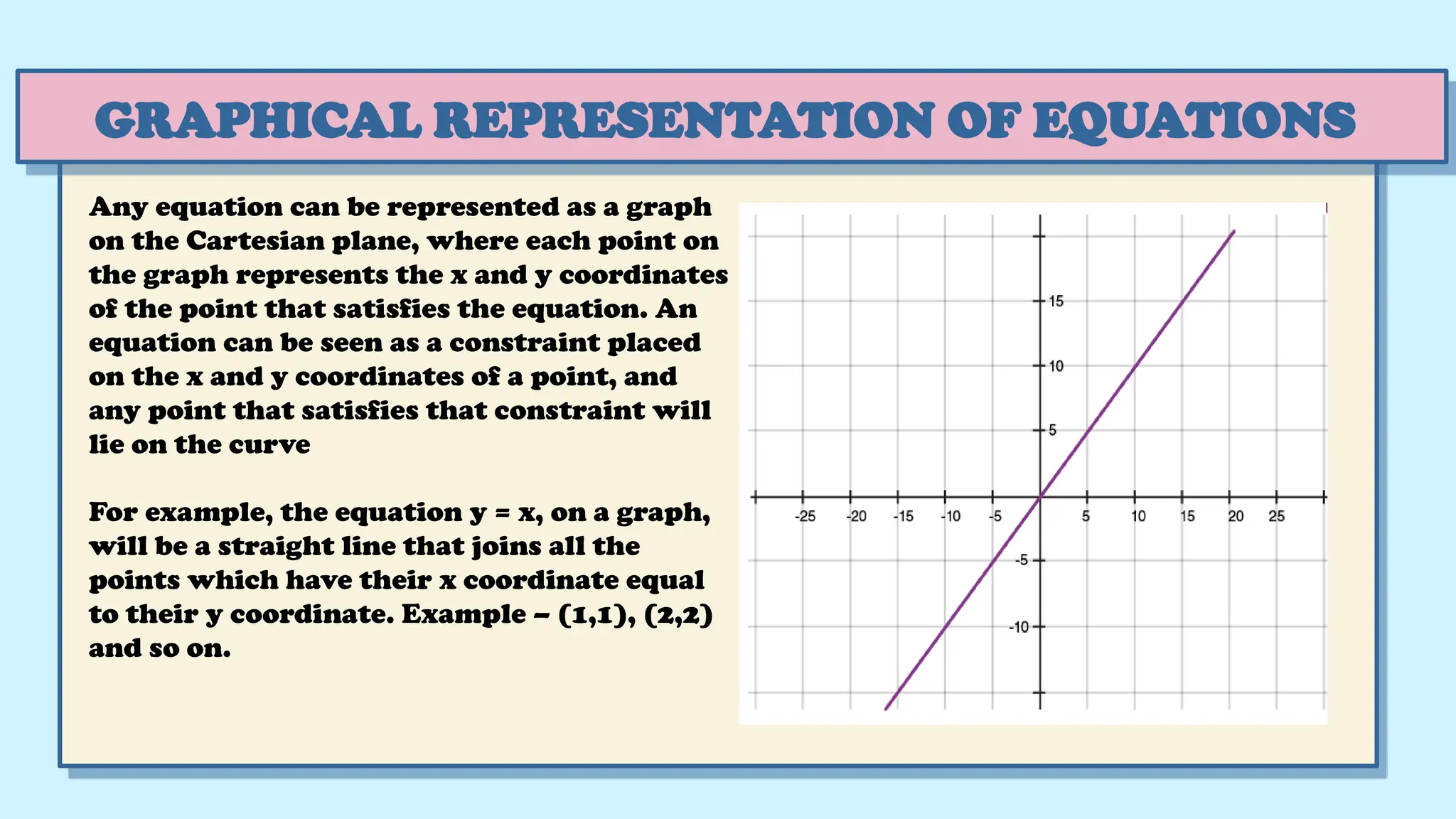
Any equation can be represented as a graph
on the Cartesian plane, where each point on
the graph represents the x and y coordinates
of the point that satisfies the equation. An
equation can be seen as a constraint placed
on the x and y coordinates of a point, and
any point that satisfies that constraint will
lie on the curve
For example, the equation y = x, on a graph,
will be a straight line that joins all the
points which have their x coordinate equal
to their y coordinate. Example – (1,1), (2,2)
and so on.
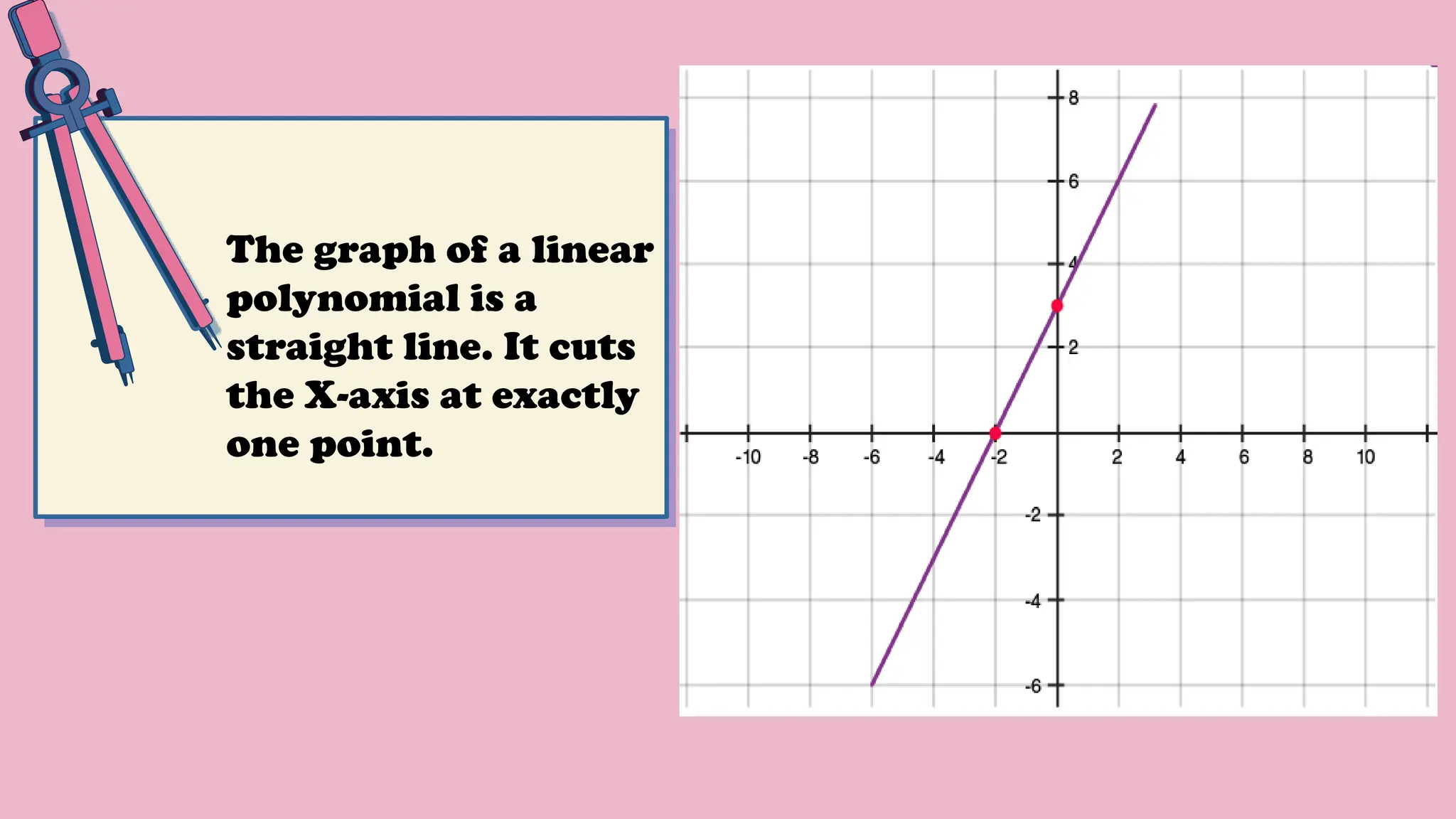
The graph of a linear
polynomial is a
straight line. It cuts
the X-axis at exactly
one point.
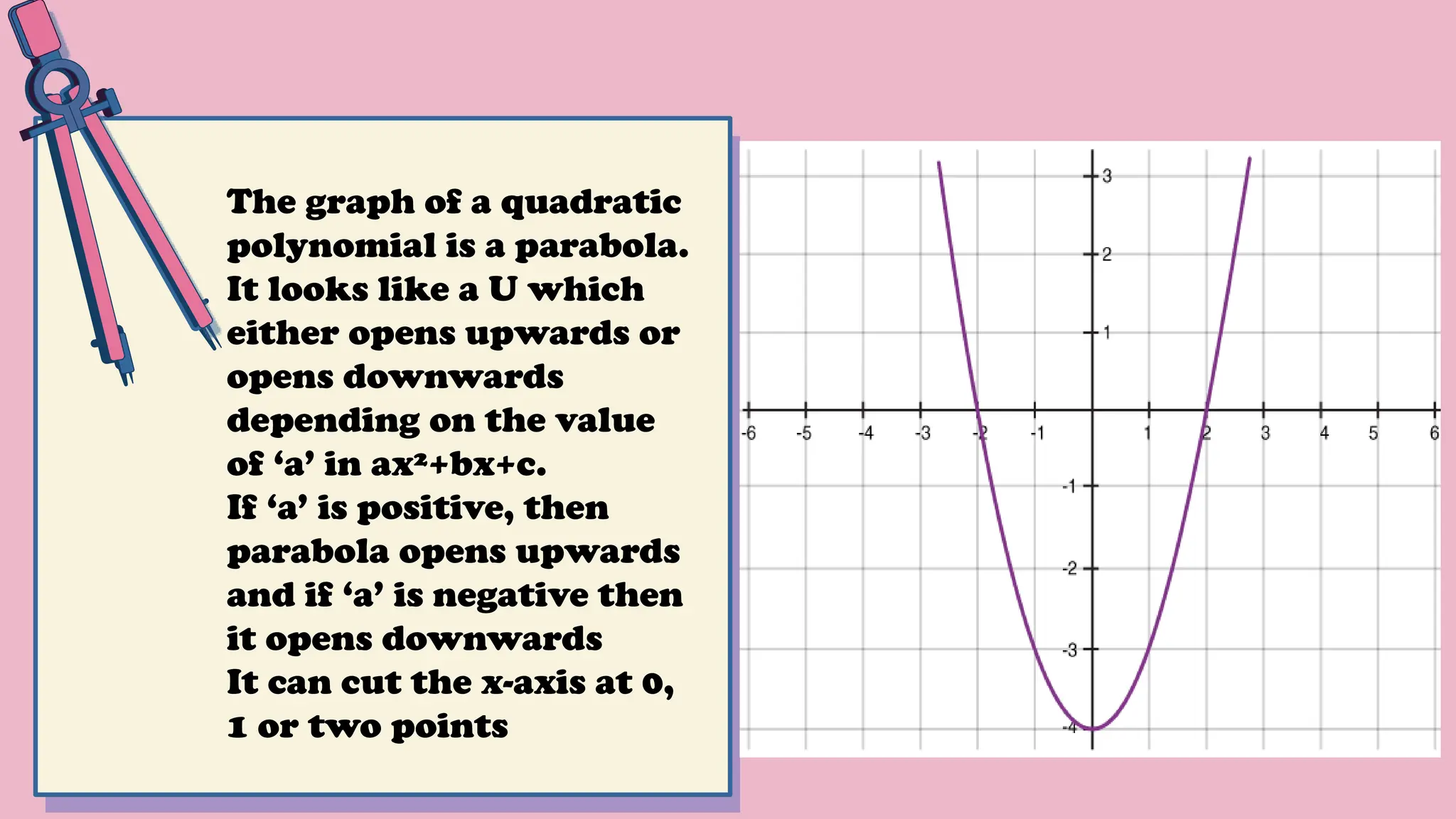
The graph of a quadratic
polynomial is a parabola.
It looks like a U which
either opens upwards or
opens downwards
depending on the value
of ‘a’ in ax²+bx+c.
If ‘a’ is positive, then
parabola opens upwards
and if ‘a’ is negative then
it opens downwards
It can cut the x-axis at 0,
1 or two points
ZEROES OF A POLYNOMIAL
A zero of a polynomial p(x) is the value of x for which the
value of p(x) is 0. If k is a zero of p(x), then p(k)=0.
For example, consider a polynomial p(x)=x2 3x+2.
−
When x=1, the value of p(x) will be equal to
p(1)=12 3×1+2
−
=1 3+2
−
=0
Since p(x)=0 at x=1, we say that 1 is a zero of the polynomial
x2 3x+2
−
Graphical Meaning of zeroes of a Polynmomial
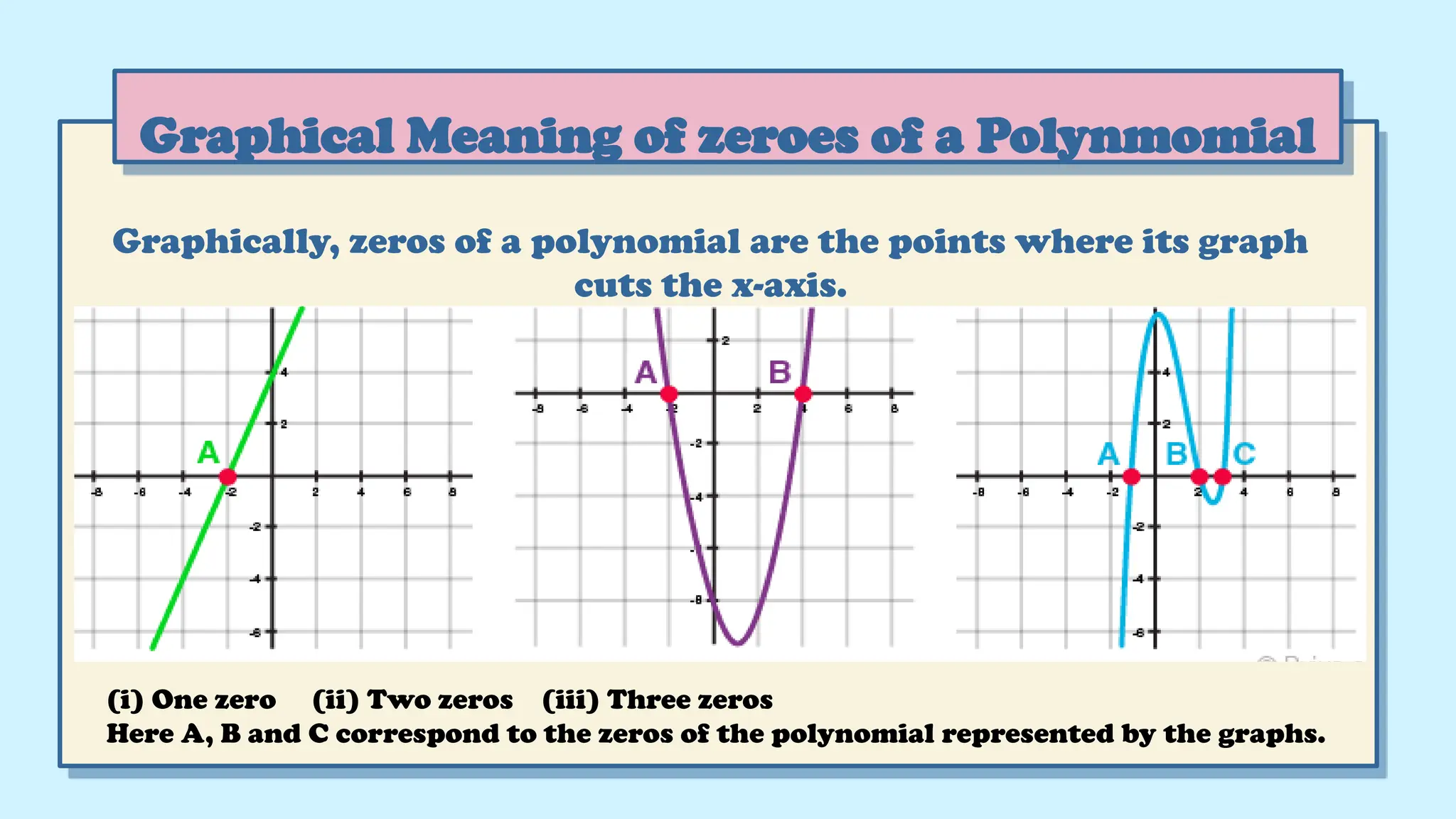
Graphically, zeros of a polynomial are the points where its graph
cuts the x-axis.
(i) One zero (ii) Two zeros (iii) Three zeros
Here A, B and C correspond to the zeros of the polynomial represented by the graphs.
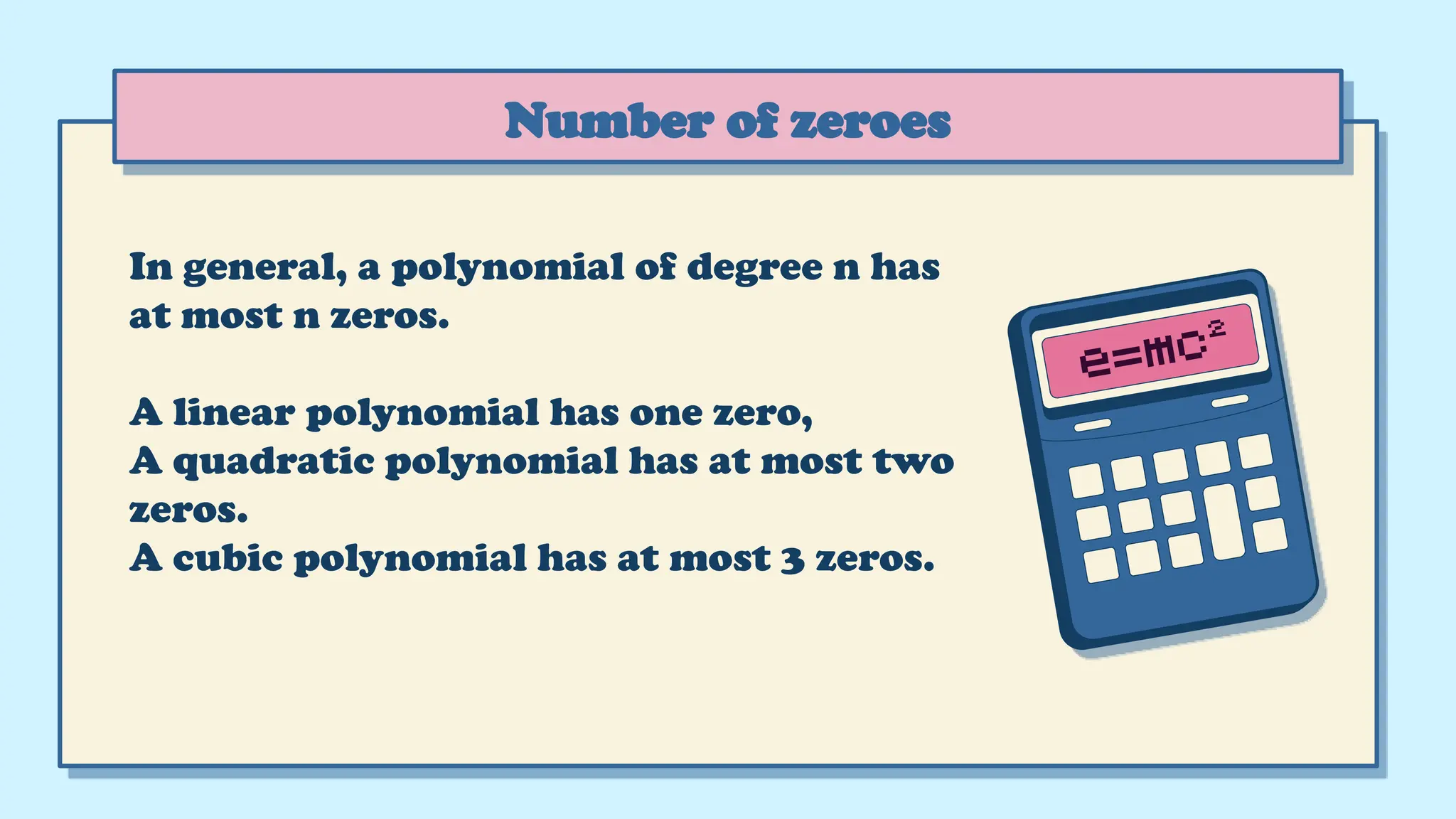
In general, a polynomial of degree n has
at most n zeros.
A linear polynomial has one zero,
A quadratic polynomial has at most two
zeros.
A cubic polynomial has at most 3 zeros.
Number of zeroes
Factorization of Polynomials
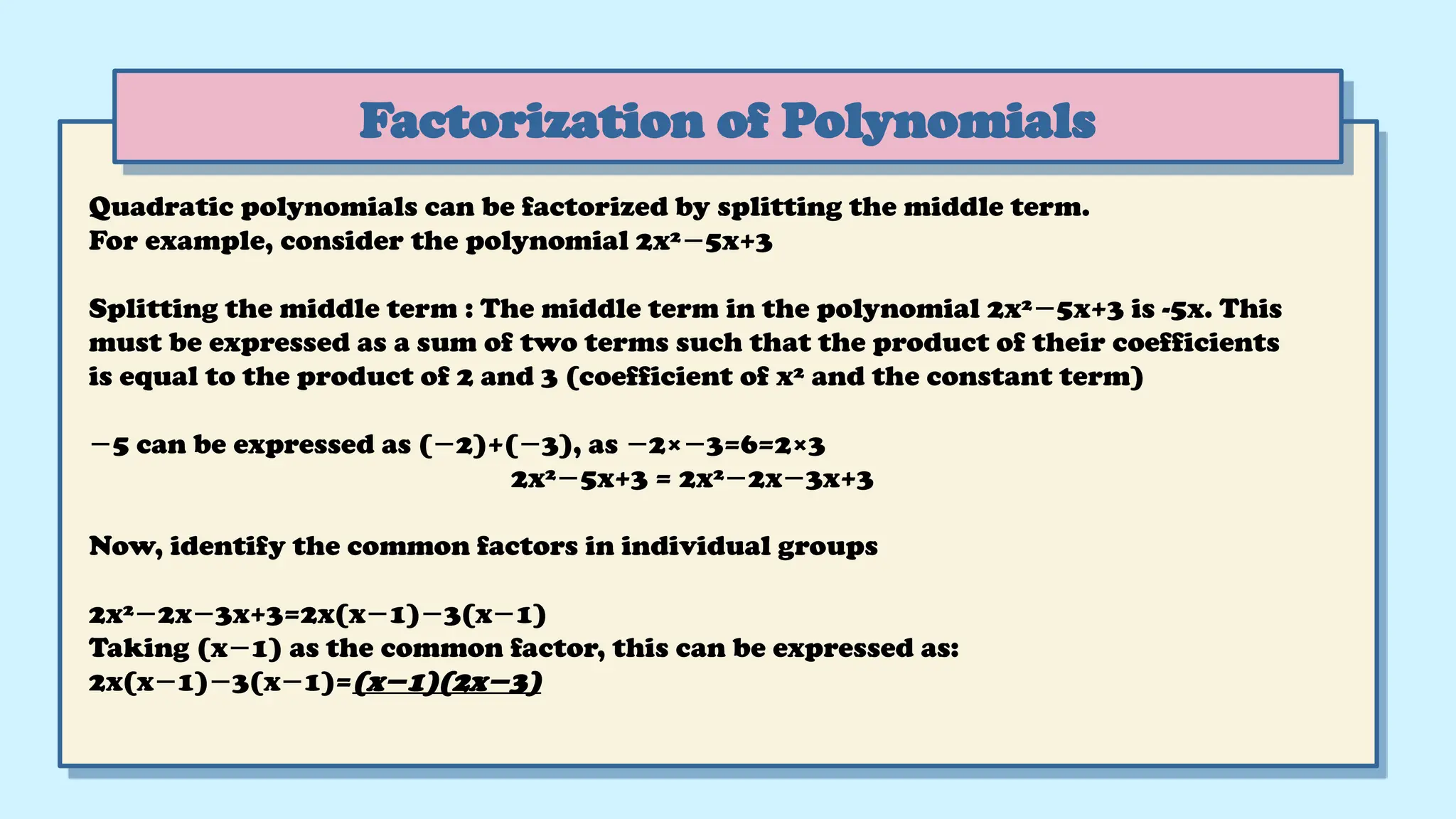
Quadratic polynomials can be factorized by splitting the middle term.
For example, consider the polynomial 2x² 5x+3
−
Splitting the middle term : The middle term in the polynomial 2x² 5x+3 is -5x. This
−
must be expressed as a sum of two terms such that the product of their coefficients
is equal to the product of 2 and 3 (coefficient of x² and the constant term)
−5 can be expressed as ( 2)+( 3), as 2× 3=6=2×3
− − − −
2x² 5x+3
− = 2x² 2x 3x+3
− −
Now, identify the common factors in individual groups
2x² 2x 3x+3=2x(x 1) 3(x 1)
− − − − −
Taking (x 1) as the common factor, this can be expressed as:
−
2x(x 1) 3(x 1)=
− − − (x 1)(2x 3)
− −
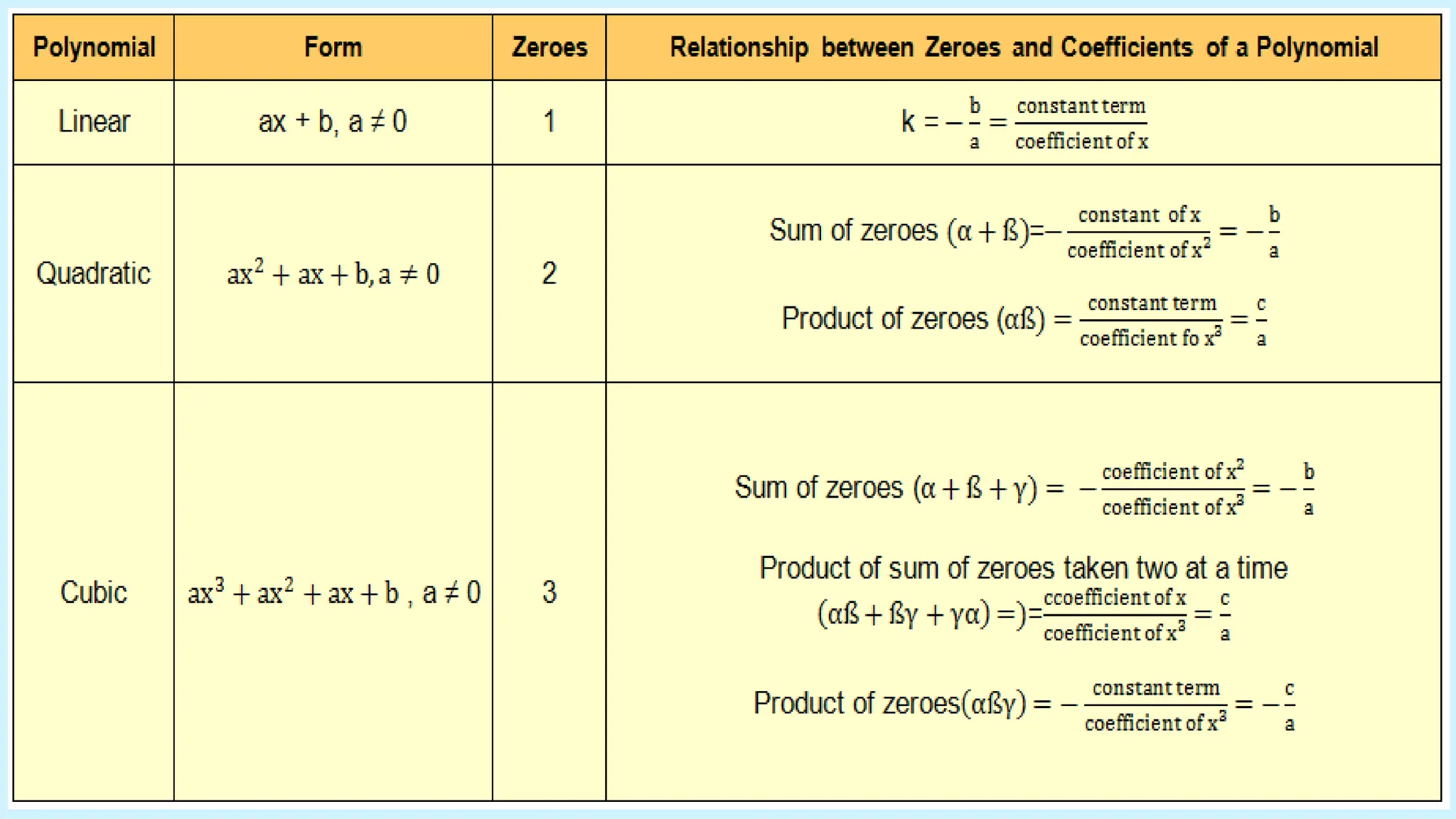
Relation Between Zeros and Coefficient of a Polynomial
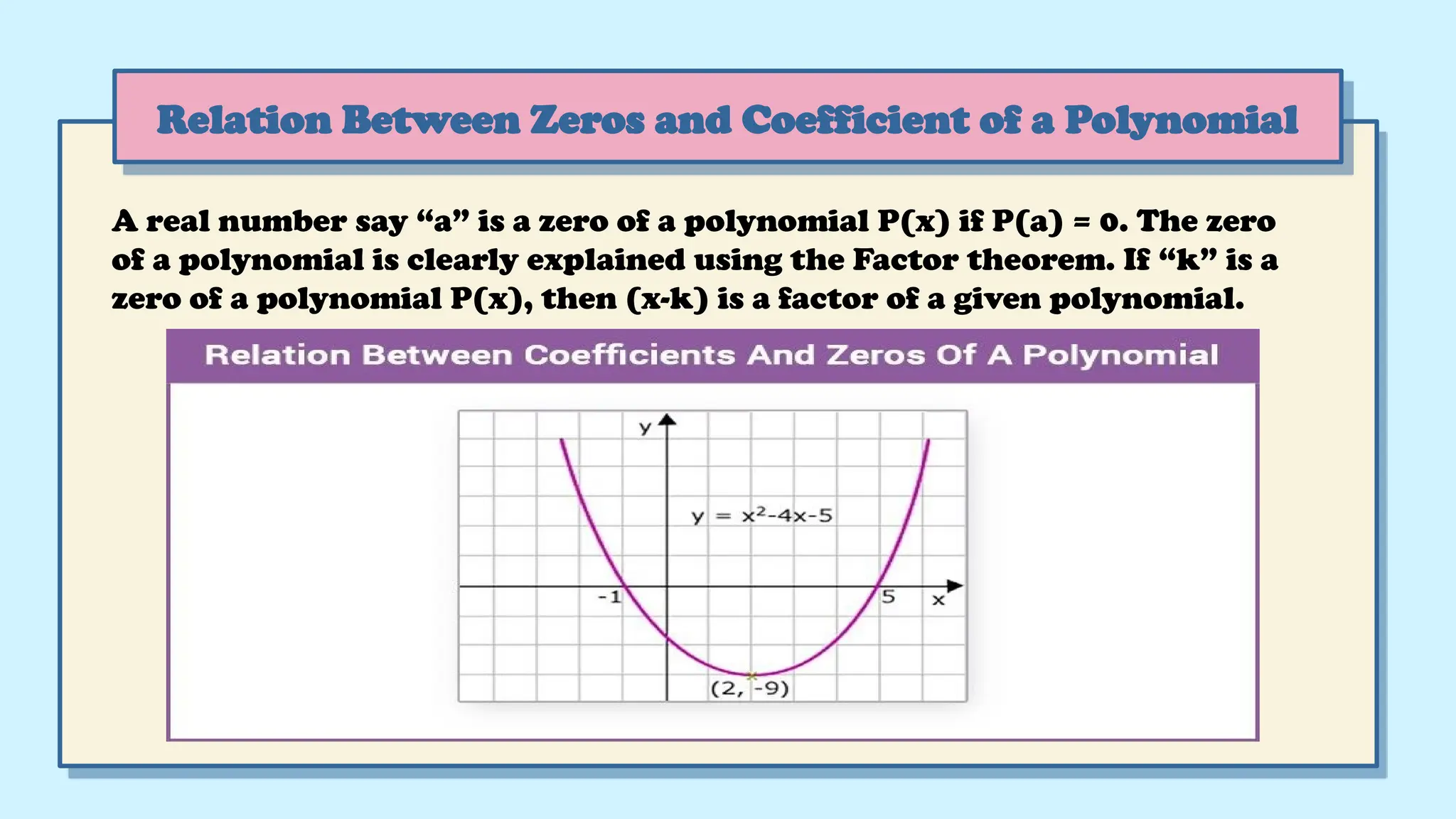
A real number say “a” is a zero of a polynomial P(x) if P(a) = 0. The zero
of a polynomial is clearly explained using the Factor theorem. If “k” is a
zero of a polynomial P(x), then (x-k) is a factor of a given polynomial.
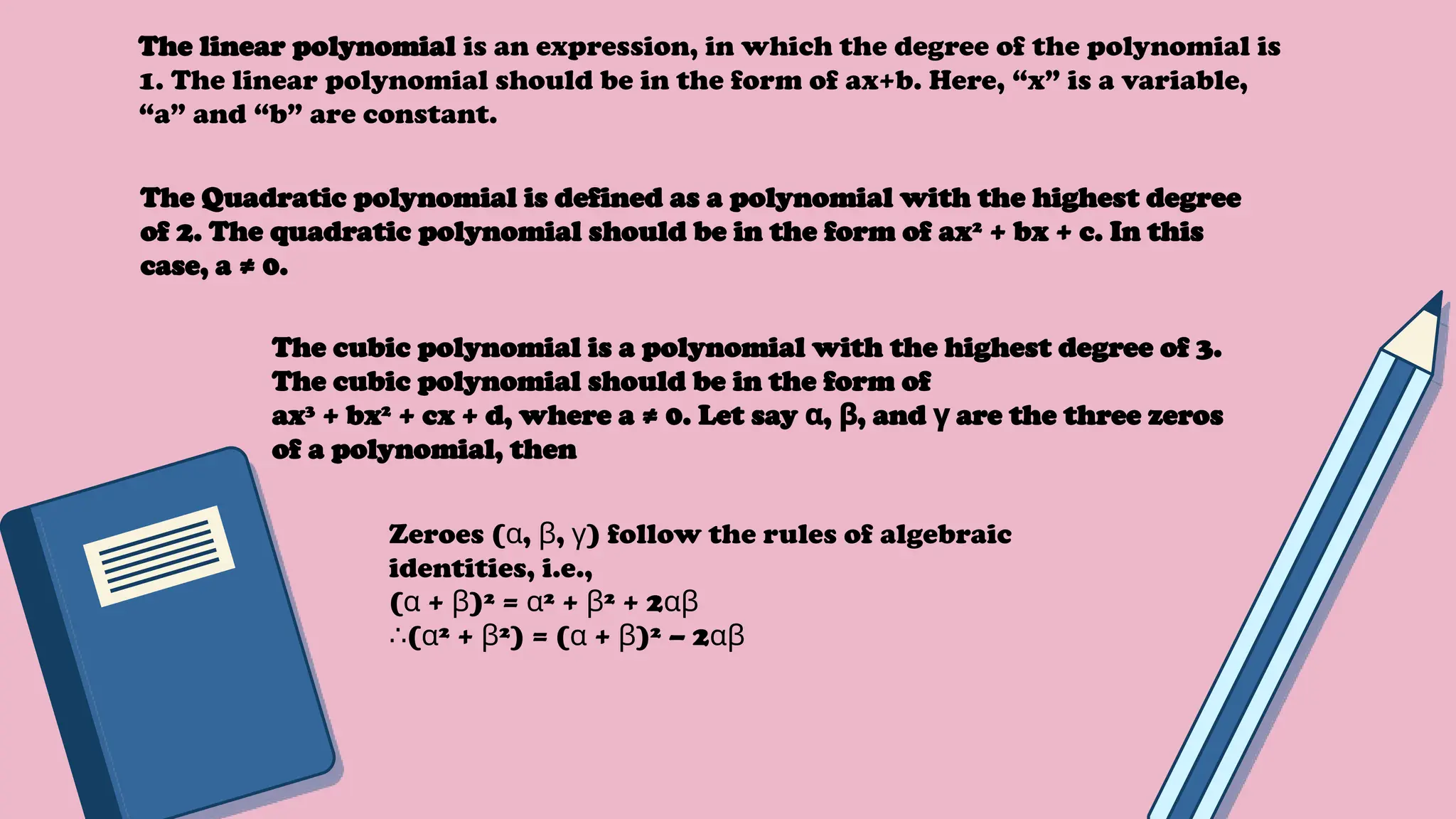
The linear polynomial is an expression, in which the degree of the polynomial is
1. The linear polynomial should be in the form of ax+b. Here, “x” is a variable,
“a” and “b” are constant.
The Quadratic polynomial is defined as a polynomial with the highest degree
of 2. The quadratic polynomial should be in the form of ax2
+ bx + c. In this
case, a ≠ 0.
The cubic polynomial is a polynomial with the highest degree of 3.
The cubic polynomial should be in the form of
ax3
+ bx2
+ cx + d, where a ≠ 0. Let say , , and are the three zeros
α β γ
of a polynomial, then
Zeroes ( , , ) follow the rules of algebraic
α β γ
identities, i.e.,
( + )² = ² + ² + 2
α β α β αβ
∴( ² + ²) = ( + )² – 2
α β α β αβ
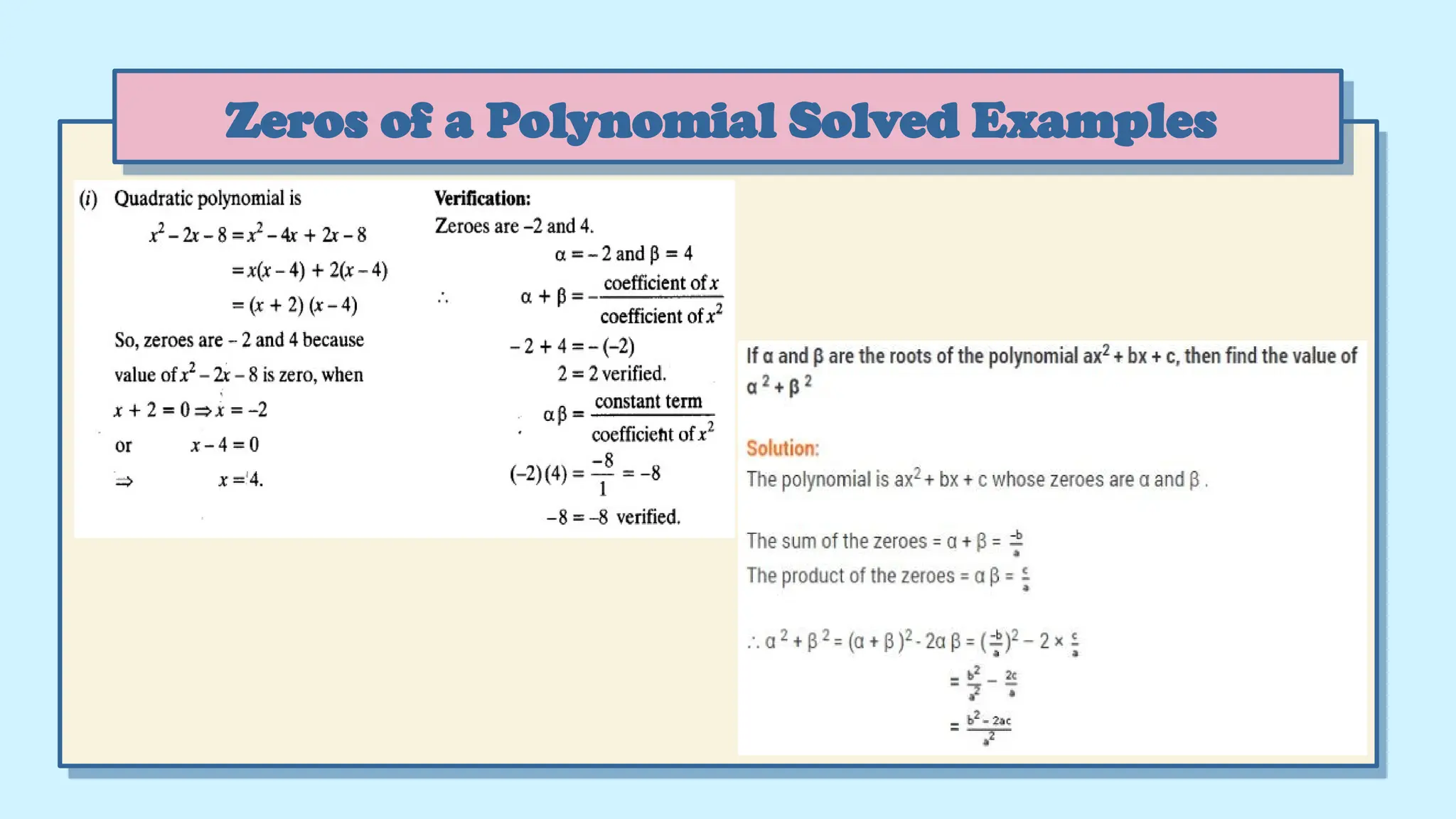
Zeros of a Polynomial Solved Examples
Division Algorithm
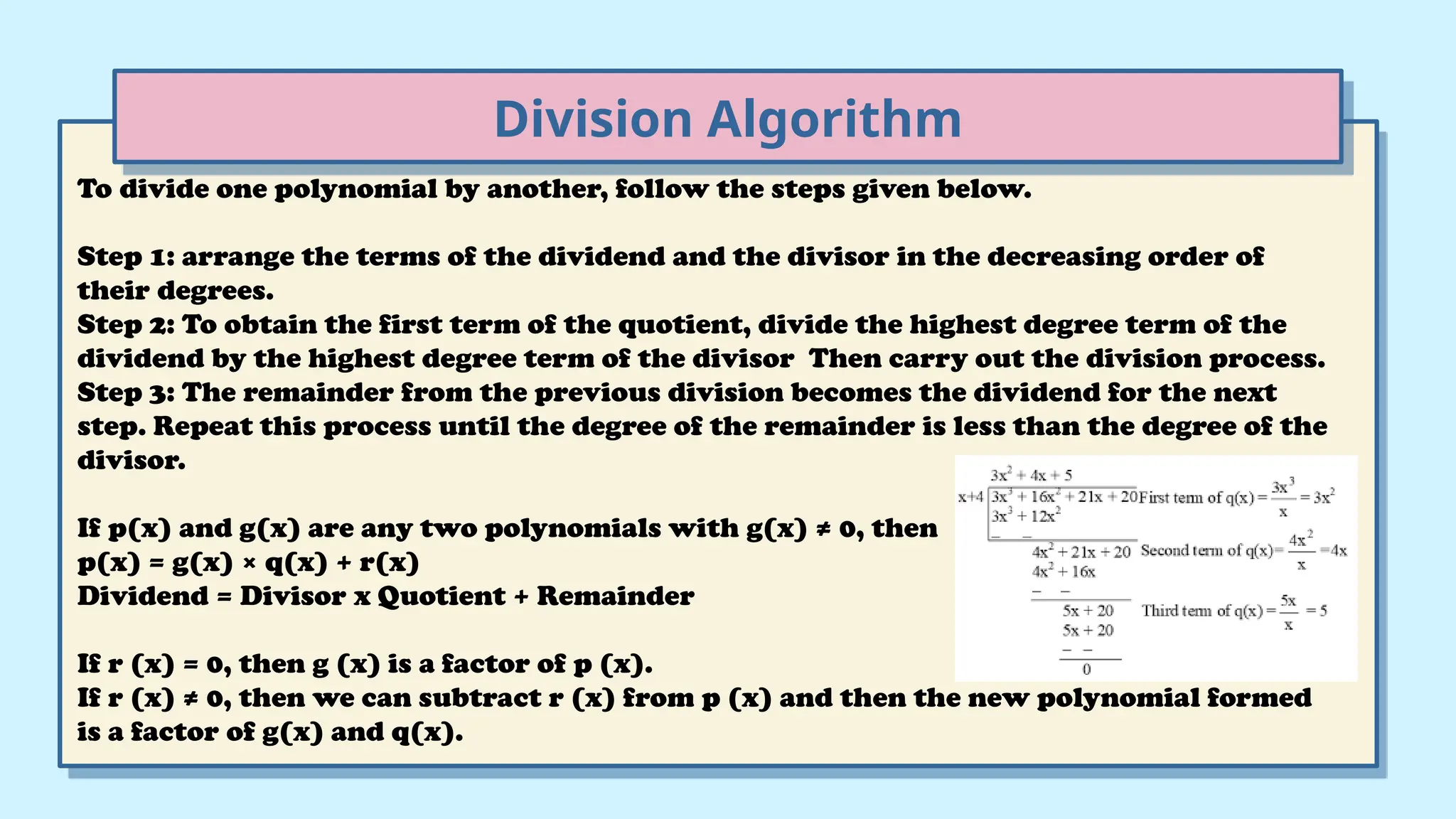
To divide one polynomial by another, follow the steps given below.
Step 1: arrange the terms of the dividend and the divisor in the decreasing order of
their degrees.
Step 2: To obtain the first term of the quotient, divide the highest degree term of the
dividend by the highest degree term of the divisor Then carry out the division process.
Step 3: The remainder from the previous division becomes the dividend for the next
step. Repeat this process until the degree of the remainder is less than the degree of the
divisor.
If p(x) and g(x) are any two polynomials with g(x) ≠ 0, then
p(x) = g(x) × q(x) + r(x)
Dividend = Divisor x Quotient + Remainder
If r (x) = 0, then g (x) is a factor of p (x).
If r (x) ≠ 0, then we can subtract r (x) from p (x) and then the new polynomial formed
is a factor of g(x) and q(x).
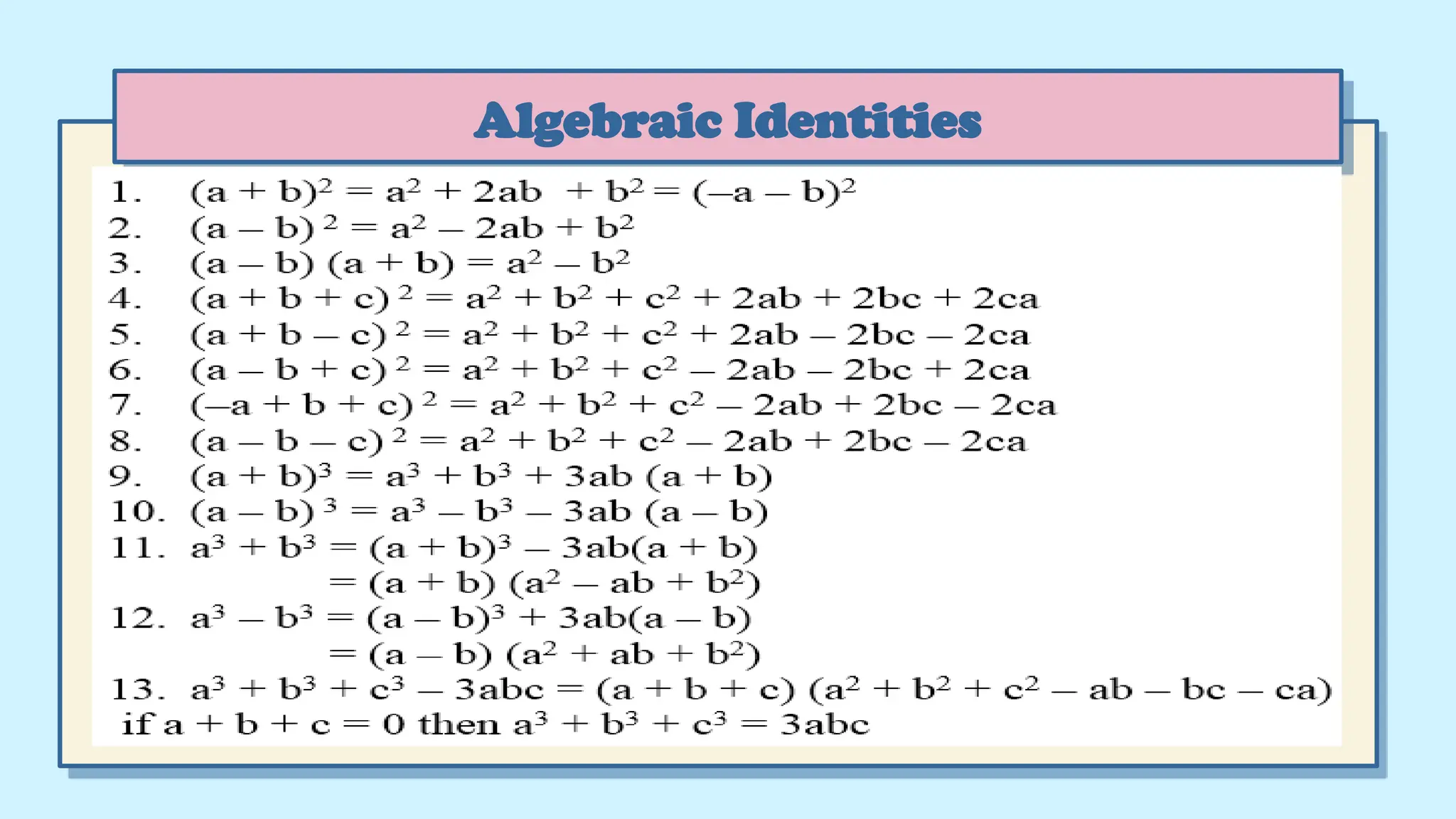
Algebraic Identities
CREDITS: This presentation template was created by Slidesgo
, including icons by Flaticon and infographics & images by
Freepik
Thank You!!

Polynomial PowerPoint Presentation for CBSE

  • 1.
    Class - 10th Polynomials PrimePaathshala +91-8989815785
  • 2.
    Table of contents Introduction to polynomials  Polynomial classifications  Degrees of a polynomial  Terms of a polynomial  Types of polynomials  Graphical representation of equations  Zeroes of a polynomial  Graphical meaning of zeroes of polynomial  Number of zeroes  Factorization of polynomials  Relations between zeroes and coefficient of a polynomial  Zeroes of a polynomial examples  Division algorithm  Algebraic identities
  • 3.
    Introduction to Polynomials Theword polynomial is derived from the Greek words ‘poly’ means ‘many‘ and ‘nominal’ means ‘terms‘, so altogether it said “many terms”. A polynomial can have any number of terms but not infinite. It is defined as an expression which is composed of variables, constants and exponents, that are combined using the mathematical operations such as addition, subtraction, multiplication and division. Polynomials are algebraic expressions that consist of variables and coefficients. Variables are also sometimes called indeterminates. For example: x²+x-12.
  • 4.
    Based on thenumbers of terms present in the expression, it is classified as monomial, binomial, and trinomial. Examples of constants, variables and exponents are as follows Constants. Example: 1, 2, 3, etc. Variables. Example: g, h, x, y, etc. Exponents: Example: 5 in x5 etc. Polynomial Classifications The polynomial function is denoted by P(x) where x represents the variable. For example, P(x) = x²+5x+11 If the variable is denoted by a, then the function will be P(a)
  • 5.
    Degree of apolynomial The degree of a polynomial is defined as the highest degree of a monomial within a polynomial. Thus, a polynomial equation having one variable which has the largest exponent is called a degree of the polynomial. Example: Find the degree of the polynomial 6s4+ 3x2+ 5x +19 Solution: The degree of the polynomial is 4.
  • 6.
    TERMS OF POLYNOMIAL Theterms of polynomials are the parts of the equation which are generally separated by “+” or “-” signs. So, each part of a polynomial in an equation is a term. For example, in a polynomial, say, 2x2 + 5 +4, the number of terms will be 3. The classification of a polynomial is done based on the number of terms in it.
  • 7.
    Polynomials are of3 different types and are classified based on the number of terms in it. The three types of polynomials are: Monomial Binomial Trinomial TYPES OF POLYNOMIALS These polynomials can be combined using addition, subtraction, multiplication, and division but is never division by a variable. A few examples of Non Polynomials are: 1/x+2, x-3
  • 8.
  • 9.
    GRAPHICAL REPRESENTATION OFEQUATIONS Any equation can be represented as a graph on the Cartesian plane, where each point on the graph represents the x and y coordinates of the point that satisfies the equation. An equation can be seen as a constraint placed on the x and y coordinates of a point, and any point that satisfies that constraint will lie on the curve For example, the equation y = x, on a graph, will be a straight line that joins all the points which have their x coordinate equal to their y coordinate. Example – (1,1), (2,2) and so on.
  • 10.
    The graph ofa linear polynomial is a straight line. It cuts the X-axis at exactly one point.
  • 11.
    The graph ofa quadratic polynomial is a parabola. It looks like a U which either opens upwards or opens downwards depending on the value of ‘a’ in ax²+bx+c. If ‘a’ is positive, then parabola opens upwards and if ‘a’ is negative then it opens downwards It can cut the x-axis at 0, 1 or two points
  • 12.
    ZEROES OF APOLYNOMIAL A zero of a polynomial p(x) is the value of x for which the value of p(x) is 0. If k is a zero of p(x), then p(k)=0. For example, consider a polynomial p(x)=x2 3x+2. − When x=1, the value of p(x) will be equal to p(1)=12 3×1+2 − =1 3+2 − =0 Since p(x)=0 at x=1, we say that 1 is a zero of the polynomial x2 3x+2 −
  • 13.
    Graphical Meaning ofzeroes of a Polynmomial Graphically, zeros of a polynomial are the points where its graph cuts the x-axis. (i) One zero (ii) Two zeros (iii) Three zeros Here A, B and C correspond to the zeros of the polynomial represented by the graphs.
  • 14.
    In general, apolynomial of degree n has at most n zeros. A linear polynomial has one zero, A quadratic polynomial has at most two zeros. A cubic polynomial has at most 3 zeros. Number of zeroes
  • 15.
    Factorization of Polynomials Quadraticpolynomials can be factorized by splitting the middle term. For example, consider the polynomial 2x² 5x+3 − Splitting the middle term : The middle term in the polynomial 2x² 5x+3 is -5x. This − must be expressed as a sum of two terms such that the product of their coefficients is equal to the product of 2 and 3 (coefficient of x² and the constant term) −5 can be expressed as ( 2)+( 3), as 2× 3=6=2×3 − − − − 2x² 5x+3 − = 2x² 2x 3x+3 − − Now, identify the common factors in individual groups 2x² 2x 3x+3=2x(x 1) 3(x 1) − − − − − Taking (x 1) as the common factor, this can be expressed as: − 2x(x 1) 3(x 1)= − − − (x 1)(2x 3) − −
  • 16.
    Relation Between Zerosand Coefficient of a Polynomial A real number say “a” is a zero of a polynomial P(x) if P(a) = 0. The zero of a polynomial is clearly explained using the Factor theorem. If “k” is a zero of a polynomial P(x), then (x-k) is a factor of a given polynomial.
  • 17.
    The linear polynomialis an expression, in which the degree of the polynomial is 1. The linear polynomial should be in the form of ax+b. Here, “x” is a variable, “a” and “b” are constant. The Quadratic polynomial is defined as a polynomial with the highest degree of 2. The quadratic polynomial should be in the form of ax2 + bx + c. In this case, a ≠ 0. The cubic polynomial is a polynomial with the highest degree of 3. The cubic polynomial should be in the form of ax3 + bx2 + cx + d, where a ≠ 0. Let say , , and are the three zeros α β γ of a polynomial, then Zeroes ( , , ) follow the rules of algebraic α β γ identities, i.e., ( + )² = ² + ² + 2 α β α β αβ ∴( ² + ²) = ( + )² – 2 α β α β αβ
  • 19.
    Zeros of aPolynomial Solved Examples
  • 20.
    Division Algorithm To divideone polynomial by another, follow the steps given below. Step 1: arrange the terms of the dividend and the divisor in the decreasing order of their degrees. Step 2: To obtain the first term of the quotient, divide the highest degree term of the dividend by the highest degree term of the divisor Then carry out the division process. Step 3: The remainder from the previous division becomes the dividend for the next step. Repeat this process until the degree of the remainder is less than the degree of the divisor. If p(x) and g(x) are any two polynomials with g(x) ≠ 0, then p(x) = g(x) × q(x) + r(x) Dividend = Divisor x Quotient + Remainder If r (x) = 0, then g (x) is a factor of p (x). If r (x) ≠ 0, then we can subtract r (x) from p (x) and then the new polynomial formed is a factor of g(x) and q(x).
  • 21.
  • 22.
    CREDITS: This presentationtemplate was created by Slidesgo , including icons by Flaticon and infographics & images by Freepik Thank You!!