Rational and
Irrational number
Rational numbers are in the
form of p/q where p and
q both are integers and q is not
equal to 0
Eg 2/5 , 4/7 ,7/20
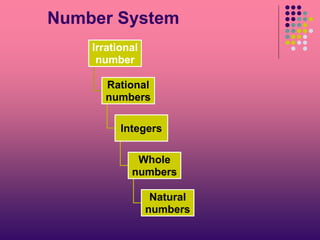
Number System
Irrational
number
Rational
numbers
Integers
Whole
numbers
Natural
numbers
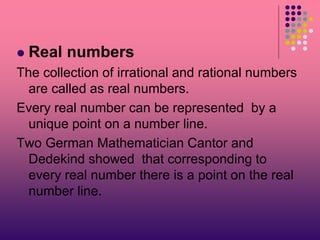
 Real numbers
The collection of irrational and rational numbers
are called as real numbers.
Every real number can be represented by a
unique point on a number line.
Two German Mathematician Cantor and
Dedekind showed that corresponding to
every real number there is a point on the real
number line.
Terminating and non terminating
decimals
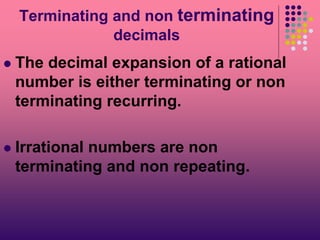
 The decimal expansion of a rational
number is either terminating or non
terminating recurring.
 Irrational numbers are non
terminating and non repeating.
Examples of irrational
numbers
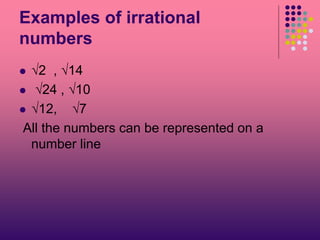
 √2 , √14
 √24 , √10
 √12, √7
All the numbers can be represented on a
number line
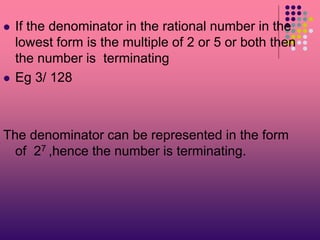
 If the denominator in the rational number in the
lowest form is the multiple of 2 or 5 or both then
the number is terminating
 Eg 3/ 128
The denominator can be represented in the form
of 27 ,hence the number is terminating.
Rationalising the denominator
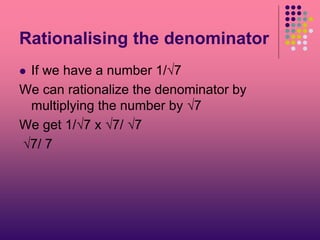
 If we have a number 1/√7
We can rationalize the denominator by
multiplying the number by √7
We get 1/√7 x √7/ √7
√7/ 7
 Every point on a number line represents a
real number.
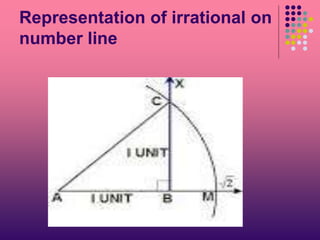
 We can represent √2 , √3, √5 on a number
line
Representation of irrational on
number line
Conclusion
 Rational numbers are either terminating or
non terminating repeating decimals
 Irrational numbers are non terminating non
repeating decimals.
 Every real numbers can be represented on a
number line
 Every point on a number line represents a
real numbers.

Class9 number system

  • 1.
    Rational and Irrational number Rationalnumbers are in the form of p/q where p and q both are integers and q is not equal to 0 Eg 2/5 , 4/7 ,7/20
  • 2.
  • 3.
     Real numbers Thecollection of irrational and rational numbers are called as real numbers. Every real number can be represented by a unique point on a number line. Two German Mathematician Cantor and Dedekind showed that corresponding to every real number there is a point on the real number line.
  • 4.
    Terminating and nonterminating decimals  The decimal expansion of a rational number is either terminating or non terminating recurring.  Irrational numbers are non terminating and non repeating.
  • 5.
    Examples of irrational numbers √2 , √14  √24 , √10  √12, √7 All the numbers can be represented on a number line
  • 6.
     If thedenominator in the rational number in the lowest form is the multiple of 2 or 5 or both then the number is terminating  Eg 3/ 128 The denominator can be represented in the form of 27 ,hence the number is terminating.
  • 7.
    Rationalising the denominator If we have a number 1/√7 We can rationalize the denominator by multiplying the number by √7 We get 1/√7 x √7/ √7 √7/ 7
  • 8.
     Every pointon a number line represents a real number.  We can represent √2 , √3, √5 on a number line
  • 9.
  • 10.
    Conclusion  Rational numbersare either terminating or non terminating repeating decimals  Irrational numbers are non terminating non repeating decimals.  Every real numbers can be represented on a number line  Every point on a number line represents a real numbers.