SLIDE ON TSUNAMI
 I would like to express my special thanks of gratitude to
my teacher Mrs.Kavita Ekka madam as well as our
principal who gave me the golden opportunity to do this
wonderful project on the topic tsunami, which also helped
me in doing a lot of Research and I came to know about so
many new things
I am really thankful to them.
Secondly I would also like to thank my parents and friends
who helped me a lot in finishing this project within the
limited time.
I am making this project not only for marks but to also
increase my knowledge .
THANKS AGAIN TO ALL WHO HELPED ME.
ACKNOWLEDGEMENT
__
SR. NO TOPIC Slide no.
1
2
3
4
5
What is a Tsunami?
 When mass movement, such as an earthquake or
landslide, suddenly displaces a large amount of water
from its equilibrium state a disastrous wave called a
tsunami can form.
 Tsunami literally translates from Japanese to “harbor
wave” but are often call tidal waves because small,
distant-source tsunamis resemble tidal surges.
BANDA ACEH, INDONESIA: June 23, 2004
A satellite image of the waterfront area of Aceh province's
capital city before the tsunami.
More than 2,174 miles of roads destroyed. $10 billion in damages
in barely 24 hours.
Tsunami Earthquakes
 Some earthquakes have generated very large tsunamis
for their “size”. These events are called tsunami
earthquakes.
 Analysis of seismograms from these events suggest that
they are the result of low-frequency seismic energy.
 These earthquakes present a problem for tsunami
warning systems
Tsunami Earthquakes
 One way to identify these events is to compare Ms to
Mw
 Ms ~ 20 seconds period
 Mw ~ 100-200 seconds period
 Since the signals are enriched in long periods the
magnitude is unusually larger than the Ms estimate.
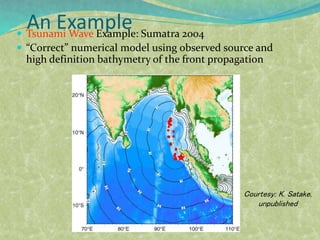
An Example Tsunami Wave Example: Sumatra 2004
 “Correct” numerical model using observed source and
high definition bathymetry of the front propagation
Courtesy: K. Satake,
unpublished
Describing Tsunamis
 Tsunami wave height is the height of the wave at the
shore.
 Tsunami run-up height is the maximum height that
the wave reaches on land.
Tsunami Propagation
 Tsunamis are most devastating near the earthquake.
They are larger and strike the region soon after the
earthquake.
 They also travel across entire oceans and cause damage
and death thousands of miles from the earthquake.
Tsunami Warning
 Because tsunamis travel relatively slowly, we have a
chance to warn distant regions of potential tsunamis.
 These efforts provide strong arguments for real-time
earthquake monitoring.
 Alerts are issued routinely by cooperating
governments.
 Check out:
 http://wcatwc.gov/
Tsunami Locations
 Large seduction zones produce the most tsunamis.
The Pacific, rimmed with seduction zones, has the
most tsunamis.
 Pacific ~ 80%
 Atlantic ~ 10%
 Elsewhere ~ 10%
Protecting Yourself (Tsunami)
 Move to higher ground.
 Wait until authorities give the go ahead to return to
low-lying regions.
 Watch for surges of water in rivers and streams near
the coast.
 If you feel a strong earthquake, don’t wait for a formal
warning.
Tsunami Hazard Mitigation
 We can warn people of potential tsunamis from
distant earthquakes. Warning of near source tsunamis
is much more difficult.
 Prevention of tsunami catastrophes requires carefully
planned use of low-lying areas.
 This is not always possible, or affordable.
The 2004 Boxing Day Earthquake
Globally, this is the 5th largest earthquake since 1900 (or 4th depends
on M).
7.8
8
8.2
8.4
8.6
8.8
9
9.2
9.4
9.6
1900 1920 1940 1960 1980 2000 2020
Magnitude
Year
Great (M > 8) Earthquakes Since 1900
Chile1906
Chile 1960
Alaska 1964
Sumatra 2004
Chile 2010
Japan 2011
Russia 1952
Ecuador 1906
Alaska 1965
How do EQ cause tsunami?
http://geology.com/articles/tsunami-geology.shtml
Tsunami wavelength
 Long wavelengths (over 100 km)
 Periods longer than 1 hour
316,800 ft = 60 miles
Tsunami wave speed
 Travel at high speeds :
400 to 500 mph (~200 yards/sec)
 Alaska to CA 4 to 7 hrs
 Alaska to Hawaii 4 to 6 hrs
 Chile to Hawaii 14 to 15 hrs
 Chile to Japan 22 to 33 hrs
What happens when tsunami gets near
shore?
 Tsunami slows down (shallower water)
 Example: d = 100 m, v = 113 km/hr
 Wave gets taller
 λ gets shorter, T gets shorter
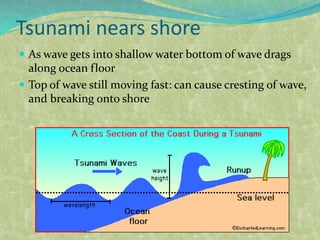
Tsunami nears shore
 As wave gets into shallow water bottom of wave drags
along ocean floor
 Top of wave still moving fast: can cause cresting of wave,
and breaking onto shore
Damage due to tsunami
 Waves often full of debris (trees, cars, pieces of wood
etc.)
 As the wave recedes, the debris drags more stuff with it
 Can recede as much as a km out to sea, leaving
shoreline empty with flopping fish, boats, etc. on the
bottom

Tsunami

  • 1.
  • 3.
     I wouldlike to express my special thanks of gratitude to my teacher Mrs.Kavita Ekka madam as well as our principal who gave me the golden opportunity to do this wonderful project on the topic tsunami, which also helped me in doing a lot of Research and I came to know about so many new things I am really thankful to them. Secondly I would also like to thank my parents and friends who helped me a lot in finishing this project within the limited time. I am making this project not only for marks but to also increase my knowledge . THANKS AGAIN TO ALL WHO HELPED ME. ACKNOWLEDGEMENT
  • 4.
    __ SR. NO TOPICSlide no. 1 2 3 4 5
  • 6.
    What is aTsunami?  When mass movement, such as an earthquake or landslide, suddenly displaces a large amount of water from its equilibrium state a disastrous wave called a tsunami can form.  Tsunami literally translates from Japanese to “harbor wave” but are often call tidal waves because small, distant-source tsunamis resemble tidal surges.
  • 7.
    BANDA ACEH, INDONESIA:June 23, 2004 A satellite image of the waterfront area of Aceh province's capital city before the tsunami.
  • 8.
    More than 2,174miles of roads destroyed. $10 billion in damages in barely 24 hours.
  • 9.
    Tsunami Earthquakes  Someearthquakes have generated very large tsunamis for their “size”. These events are called tsunami earthquakes.  Analysis of seismograms from these events suggest that they are the result of low-frequency seismic energy.  These earthquakes present a problem for tsunami warning systems
  • 10.
    Tsunami Earthquakes  Oneway to identify these events is to compare Ms to Mw  Ms ~ 20 seconds period  Mw ~ 100-200 seconds period  Since the signals are enriched in long periods the magnitude is unusually larger than the Ms estimate.
  • 11.
    An Example TsunamiWave Example: Sumatra 2004  “Correct” numerical model using observed source and high definition bathymetry of the front propagation Courtesy: K. Satake, unpublished
  • 12.
    Describing Tsunamis  Tsunamiwave height is the height of the wave at the shore.  Tsunami run-up height is the maximum height that the wave reaches on land.
  • 13.
    Tsunami Propagation  Tsunamisare most devastating near the earthquake. They are larger and strike the region soon after the earthquake.  They also travel across entire oceans and cause damage and death thousands of miles from the earthquake.
  • 14.
    Tsunami Warning  Becausetsunamis travel relatively slowly, we have a chance to warn distant regions of potential tsunamis.  These efforts provide strong arguments for real-time earthquake monitoring.  Alerts are issued routinely by cooperating governments.  Check out:  http://wcatwc.gov/
  • 15.
    Tsunami Locations  Largeseduction zones produce the most tsunamis. The Pacific, rimmed with seduction zones, has the most tsunamis.  Pacific ~ 80%  Atlantic ~ 10%  Elsewhere ~ 10%
  • 18.
    Protecting Yourself (Tsunami) Move to higher ground.  Wait until authorities give the go ahead to return to low-lying regions.  Watch for surges of water in rivers and streams near the coast.  If you feel a strong earthquake, don’t wait for a formal warning.
  • 19.
    Tsunami Hazard Mitigation We can warn people of potential tsunamis from distant earthquakes. Warning of near source tsunamis is much more difficult.  Prevention of tsunami catastrophes requires carefully planned use of low-lying areas.  This is not always possible, or affordable.
  • 20.
    The 2004 BoxingDay Earthquake
  • 22.
    Globally, this isthe 5th largest earthquake since 1900 (or 4th depends on M). 7.8 8 8.2 8.4 8.6 8.8 9 9.2 9.4 9.6 1900 1920 1940 1960 1980 2000 2020 Magnitude Year Great (M > 8) Earthquakes Since 1900 Chile1906 Chile 1960 Alaska 1964 Sumatra 2004 Chile 2010 Japan 2011 Russia 1952 Ecuador 1906 Alaska 1965
  • 23.
    How do EQcause tsunami? http://geology.com/articles/tsunami-geology.shtml
  • 24.
    Tsunami wavelength  Longwavelengths (over 100 km)  Periods longer than 1 hour 316,800 ft = 60 miles
  • 25.
    Tsunami wave speed Travel at high speeds : 400 to 500 mph (~200 yards/sec)  Alaska to CA 4 to 7 hrs  Alaska to Hawaii 4 to 6 hrs  Chile to Hawaii 14 to 15 hrs  Chile to Japan 22 to 33 hrs
  • 26.
    What happens whentsunami gets near shore?  Tsunami slows down (shallower water)  Example: d = 100 m, v = 113 km/hr  Wave gets taller  λ gets shorter, T gets shorter
  • 27.
    Tsunami nears shore As wave gets into shallow water bottom of wave drags along ocean floor  Top of wave still moving fast: can cause cresting of wave, and breaking onto shore
  • 28.
    Damage due totsunami  Waves often full of debris (trees, cars, pieces of wood etc.)  As the wave recedes, the debris drags more stuff with it  Can recede as much as a km out to sea, leaving shoreline empty with flopping fish, boats, etc. on the bottom