GLORY ENGLISH MEDIUM
SCHOOL
SUBJECT: MATHEMATICS
CLASS: 10TH
TOPIC:REAL NUMBER(CHAPTER 1)
PRESENTED BY
POOJA VAISH
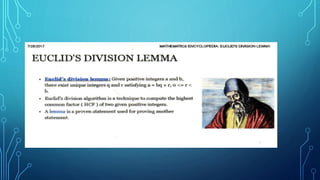
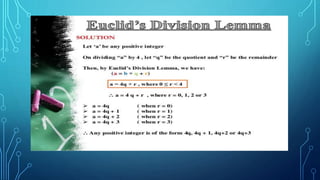
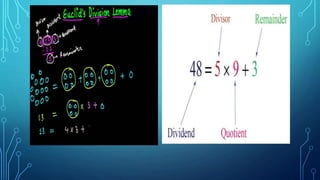
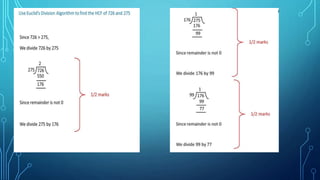
EUCLIDS DIVISION LEMMA
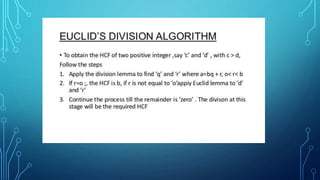
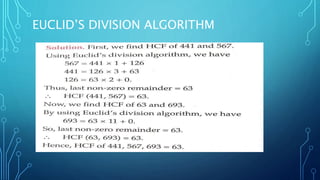
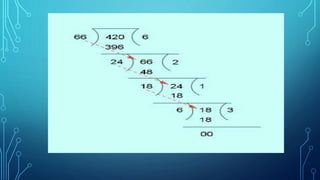
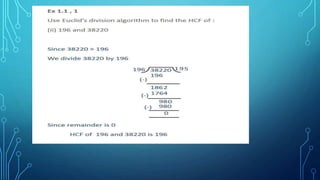
EUCLID’S DIVISION ALGORITHM
THE FUNDAMENTAL THEOREM OF
ARITHMATIC
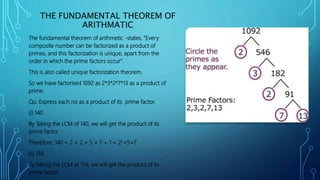
The fundamental theorem of arithmetic -states, "Every
composite number can be factorized as a product of
primes, and this factorization is unique, apart from the
order in which the prime factors occur".
This is also called unique factorization theorem.
So we have factorised 1092 as 2*3*2*7*13 as a product of
prime.
Qu: Express each no as a product of its prime factor.
(i) 140
By Taking the LCM of 140, we will get the product of its
prime factor.
Therefore, 140 = 2 × 2 × 5 × 7 × 1 = 22×5×7
(ii) 156
By Taking the LCM of 156, we will get the product of its
prime factor.
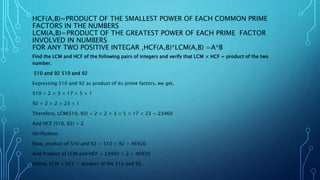
HCF(A,B)=PRODUCT OF THE SMALLEST POWER OF EACH COMMON PRIME
FACTORS IN THE NUMBERS
LCM(A,B)=PRODUCT OF THE GREATEST POWER OF EACH PRIME FACTOR
INVOLVED IN NUMBERS
FOR ANY TWO POSITIVE INTEGAR ,HCF(A,B)*LCM(A,B) =A*B
Find the LCM and HCF of the following pairs of integers and verify that LCM × HCF = product of the two
number.
510 and 92 510 and 92
Expressing 510 and 92 as product of its prime factors, we get,
510 = 2 × 3 × 17 × 5 × 1
92 = 2 × 2 × 23 × 1
Therefore, LCM(510, 92) = 2 × 2 × 3 × 5 × 17 × 23 = 23460
And HCF (510, 92) = 2
Verification
Now, product of 510 and 92 = 510 × 92 = 46920
And Product of LCM and HCF = 23460 × 2 = 46920
Hence, LCM × HCF = product of the 510 and 92.
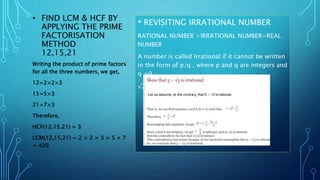
• FIND LCM & HCF BY
APPLYING THE PRIME
FACTORISATION
METHOD
12,15,21
Writing the product of prime factors
for all the three numbers, we get,
12=2×2×3
15=5×3
21=7×3
Therefore,
HCF(12,15,21) = 3
LCM(12,15,21) = 2 × 2 × 3 × 5 × 7
= 420
• REVISITING IRRATIONAL NUMBER
RATIONAL NUMBER +IRRATIONAL NUMBER=REAL
NUMBER
A number is called Irrational if it cannot be written
in the form of p/q , where p and q are integers and
q ≠0
√2,√3,√15,Π,0.11011101111…….,
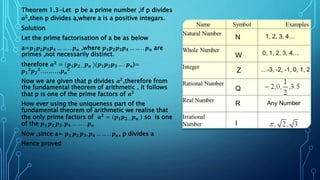
Theorem 1.3-Let p be a prime number ,if p divides
𝒂𝟐
,then p divides a,where a is a positive integars.
Solution
Let the prime factorisation of a be as below
a=𝒑𝟏𝒑𝟐𝒑𝟑𝒑𝟒 … … . . 𝒑𝒏 ,where 𝒑𝟏𝒑𝟐𝒑𝟑𝒑𝟒 … … . . 𝒑𝒏 are
primes ,not necessarily distinct.
therefore 𝒂𝟐
= (𝒑𝟏𝒑𝟐….𝒑𝒏 )(𝒑𝟏𝒑𝟐𝒑𝟑 … . 𝒑𝒏)=
𝒑𝟏
𝟐
𝒑𝟐
𝟐
……….𝒑𝒏
𝟐
Now we are given that p divides 𝒂𝟐,therefore from
the fundamental theorem of arithmetic , it follows
that p is one of the prime factors of 𝒂𝟐
How ever using the uniqueness part of the
fundamental theorem of arithmetic we realise that
the only prime factors of 𝒂𝟐
= 𝒑𝟏𝒑𝟐….𝒑𝒏 so is one
of the 𝒑𝟏,𝒑𝟐,𝒑𝟑, 𝒑𝟒 … … . . 𝒑𝒏
Now ,since a= 𝒑𝟏,𝒑𝟐,𝒑𝟑, 𝒑𝟒 … … . . 𝒑𝒏, p divides a
Hence proved
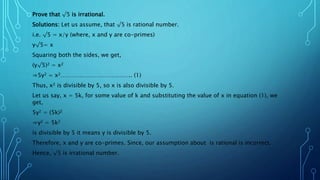
Prove that √5 is irrational.
Solutions: Let us assume, that √5 is rational number.
i.e. √5 = x/y (where, x and y are co-primes)
y√5= x
Squaring both the sides, we get,
(y√5)2 = x2
⇒5y2 = x2……………………………….. (1)
Thus, x2 is divisible by 5, so x is also divisible by 5.
Let us say, x = 5k, for some value of k and substituting the value of x in equation (1), we
get,
5y2 = (5k)2
⇒y2 = 5k2
is divisible by 5 it means y is divisible by 5.
Therefore, x and y are co-primes. Since, our assumption about is rational is incorrect.
Hence, √5 is irrational number.
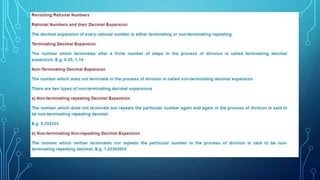
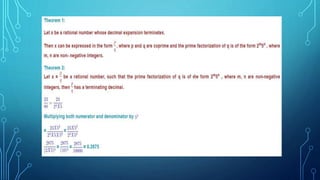
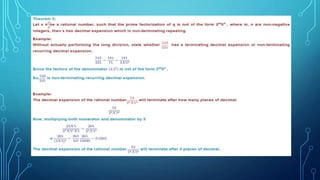
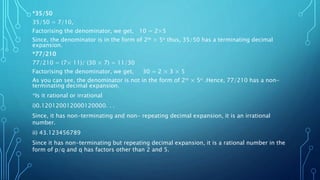
*35/50
35/50 = 7/10,
Factorising the denominator, we get, 10 = 2×5
Since, the denominator is in the form of 2m × 5n thus, 35/50 has a terminating decimal
expansion.
*77/210
77/210 = (7× 11)/ (30 × 7) = 11/30
Factorising the denominator, we get, 30 = 2 × 3 × 5
As you can see, the denominator is not in the form of 2m × 5n .Hence, 77/210 has a non-
terminating decimal expansion.
*Is it rational or irrational
i)0.120120012000120000. . .
Since, it has non-terminating and non- repeating decimal expansion, it is an irrational
number.
ii) 43.123456789
Since it has non-terminating but repeating decimal expansion, it is a rational number in the
form of p/q and q has factors other than 2 and 5.
THANK YOU

Chapetr 1 real number class 10 th

  • 1.
    GLORY ENGLISH MEDIUM SCHOOL SUBJECT:MATHEMATICS CLASS: 10TH TOPIC:REAL NUMBER(CHAPTER 1) PRESENTED BY POOJA VAISH
  • 2.
  • 7.
  • 11.
    THE FUNDAMENTAL THEOREMOF ARITHMATIC The fundamental theorem of arithmetic -states, "Every composite number can be factorized as a product of primes, and this factorization is unique, apart from the order in which the prime factors occur". This is also called unique factorization theorem. So we have factorised 1092 as 2*3*2*7*13 as a product of prime. Qu: Express each no as a product of its prime factor. (i) 140 By Taking the LCM of 140, we will get the product of its prime factor. Therefore, 140 = 2 × 2 × 5 × 7 × 1 = 22×5×7 (ii) 156 By Taking the LCM of 156, we will get the product of its prime factor.
  • 12.
    HCF(A,B)=PRODUCT OF THESMALLEST POWER OF EACH COMMON PRIME FACTORS IN THE NUMBERS LCM(A,B)=PRODUCT OF THE GREATEST POWER OF EACH PRIME FACTOR INVOLVED IN NUMBERS FOR ANY TWO POSITIVE INTEGAR ,HCF(A,B)*LCM(A,B) =A*B Find the LCM and HCF of the following pairs of integers and verify that LCM × HCF = product of the two number. 510 and 92 510 and 92 Expressing 510 and 92 as product of its prime factors, we get, 510 = 2 × 3 × 17 × 5 × 1 92 = 2 × 2 × 23 × 1 Therefore, LCM(510, 92) = 2 × 2 × 3 × 5 × 17 × 23 = 23460 And HCF (510, 92) = 2 Verification Now, product of 510 and 92 = 510 × 92 = 46920 And Product of LCM and HCF = 23460 × 2 = 46920 Hence, LCM × HCF = product of the 510 and 92.
  • 13.
    • FIND LCM& HCF BY APPLYING THE PRIME FACTORISATION METHOD 12,15,21 Writing the product of prime factors for all the three numbers, we get, 12=2×2×3 15=5×3 21=7×3 Therefore, HCF(12,15,21) = 3 LCM(12,15,21) = 2 × 2 × 3 × 5 × 7 = 420 • REVISITING IRRATIONAL NUMBER RATIONAL NUMBER +IRRATIONAL NUMBER=REAL NUMBER A number is called Irrational if it cannot be written in the form of p/q , where p and q are integers and q ≠0 √2,√3,√15,Π,0.11011101111…….,
  • 14.
    Theorem 1.3-Let pbe a prime number ,if p divides 𝒂𝟐 ,then p divides a,where a is a positive integars. Solution Let the prime factorisation of a be as below a=𝒑𝟏𝒑𝟐𝒑𝟑𝒑𝟒 … … . . 𝒑𝒏 ,where 𝒑𝟏𝒑𝟐𝒑𝟑𝒑𝟒 … … . . 𝒑𝒏 are primes ,not necessarily distinct. therefore 𝒂𝟐 = (𝒑𝟏𝒑𝟐….𝒑𝒏 )(𝒑𝟏𝒑𝟐𝒑𝟑 … . 𝒑𝒏)= 𝒑𝟏 𝟐 𝒑𝟐 𝟐 ……….𝒑𝒏 𝟐 Now we are given that p divides 𝒂𝟐,therefore from the fundamental theorem of arithmetic , it follows that p is one of the prime factors of 𝒂𝟐 How ever using the uniqueness part of the fundamental theorem of arithmetic we realise that the only prime factors of 𝒂𝟐 = 𝒑𝟏𝒑𝟐….𝒑𝒏 so is one of the 𝒑𝟏,𝒑𝟐,𝒑𝟑, 𝒑𝟒 … … . . 𝒑𝒏 Now ,since a= 𝒑𝟏,𝒑𝟐,𝒑𝟑, 𝒑𝟒 … … . . 𝒑𝒏, p divides a Hence proved
  • 15.
    Prove that √5is irrational. Solutions: Let us assume, that √5 is rational number. i.e. √5 = x/y (where, x and y are co-primes) y√5= x Squaring both the sides, we get, (y√5)2 = x2 ⇒5y2 = x2……………………………….. (1) Thus, x2 is divisible by 5, so x is also divisible by 5. Let us say, x = 5k, for some value of k and substituting the value of x in equation (1), we get, 5y2 = (5k)2 ⇒y2 = 5k2 is divisible by 5 it means y is divisible by 5. Therefore, x and y are co-primes. Since, our assumption about is rational is incorrect. Hence, √5 is irrational number.
  • 19.
    *35/50 35/50 = 7/10, Factorisingthe denominator, we get, 10 = 2×5 Since, the denominator is in the form of 2m × 5n thus, 35/50 has a terminating decimal expansion. *77/210 77/210 = (7× 11)/ (30 × 7) = 11/30 Factorising the denominator, we get, 30 = 2 × 3 × 5 As you can see, the denominator is not in the form of 2m × 5n .Hence, 77/210 has a non- terminating decimal expansion. *Is it rational or irrational i)0.120120012000120000. . . Since, it has non-terminating and non- repeating decimal expansion, it is an irrational number. ii) 43.123456789 Since it has non-terminating but repeating decimal expansion, it is a rational number in the form of p/q and q has factors other than 2 and 5.
  • 20.