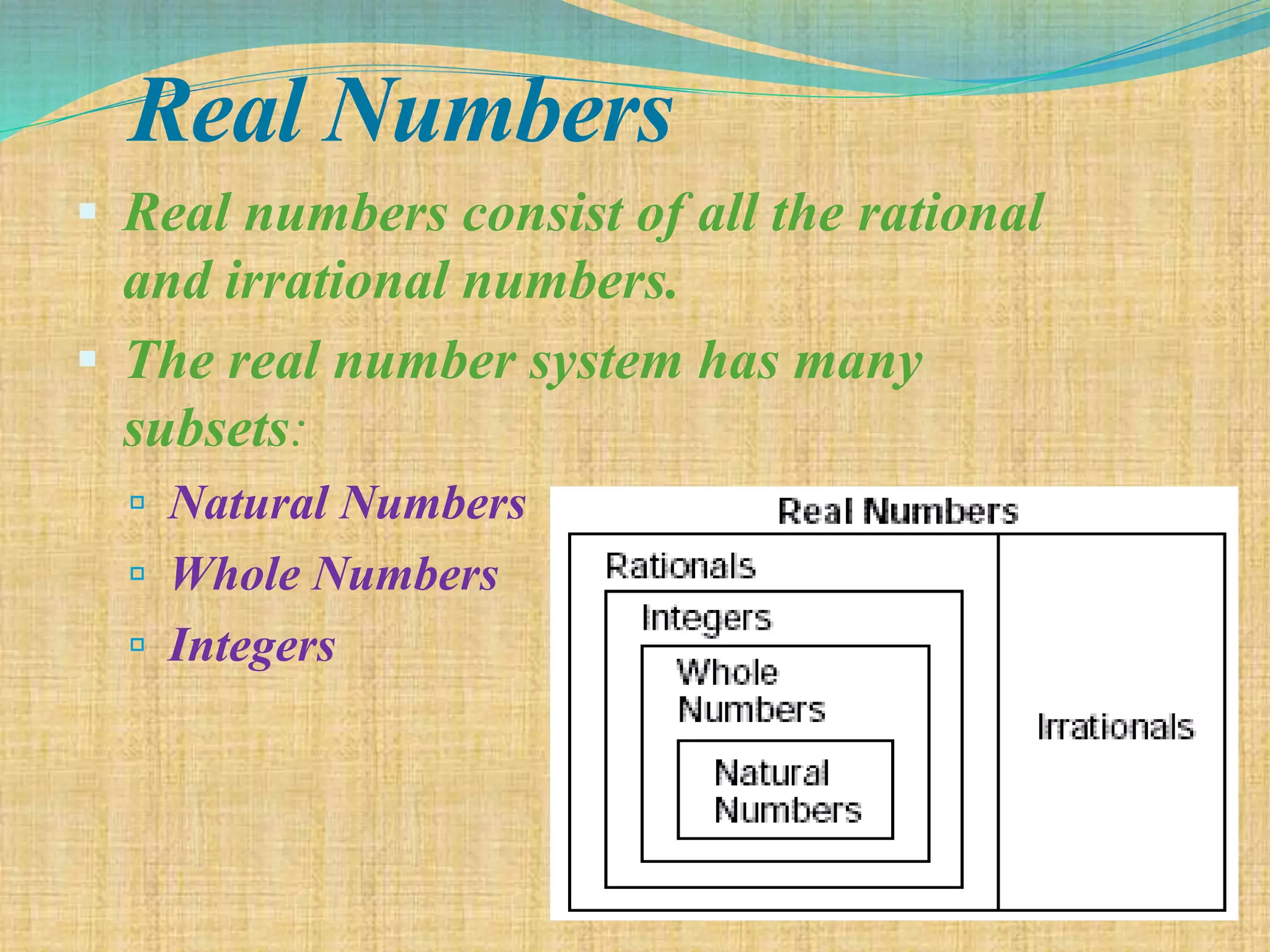
 Real numbers consist of all the rational
and irrational numbers.
 The real number system has many
subsets:
 Natural Numbers
 Whole Numbers
 Integers
Real Numbers
Natural Numbers
Natural numbers are the set of counting
numbers which starts from 1.
They are denoted by N
Example : {1, 2, 3,…}
Whole Numbers
Whole numbers are the set of numbers
that include 0 plus the set of natural
numbers.
Example : {0, 1, 2, 3, 4, 5,…}
An integer is a whole
number (not a fractional
number) that can be
positive, negative, or zero.
It is denoted by Z .
Example : Z = {..., -3, -2, -
1, 0, 1, 2, 3, ...}
Rational Numbers
Rational numbers are any numbers that can
be expressed in the form of a/b , where a and
b are integers, and b ≠ 0.
They can always be expressed by using
terminating decimals or repeating decimals.
Example : 2/3, 6/7,1
Terminating Decimals
Terminating decimals are
decimals that contain a
finite number of digits.
Examples:
 36.8
 0.125
 4.5
Repeating Decimals
Repeating decimals are decimals
that contain a infinite number of
digits.
Examples:
 0.333…
 7.689689…
While expressing a fraction into a decimal by
the division method, if the division process
continues indefinitely, and zero remainder is
never obtained then such a decimal
is called Non-Terminating Decimal
OR
A non-terminating decimal is a decimal
never repeats. Example :
0.076923...., 0.05882352.....
Euclid's Division Lemma
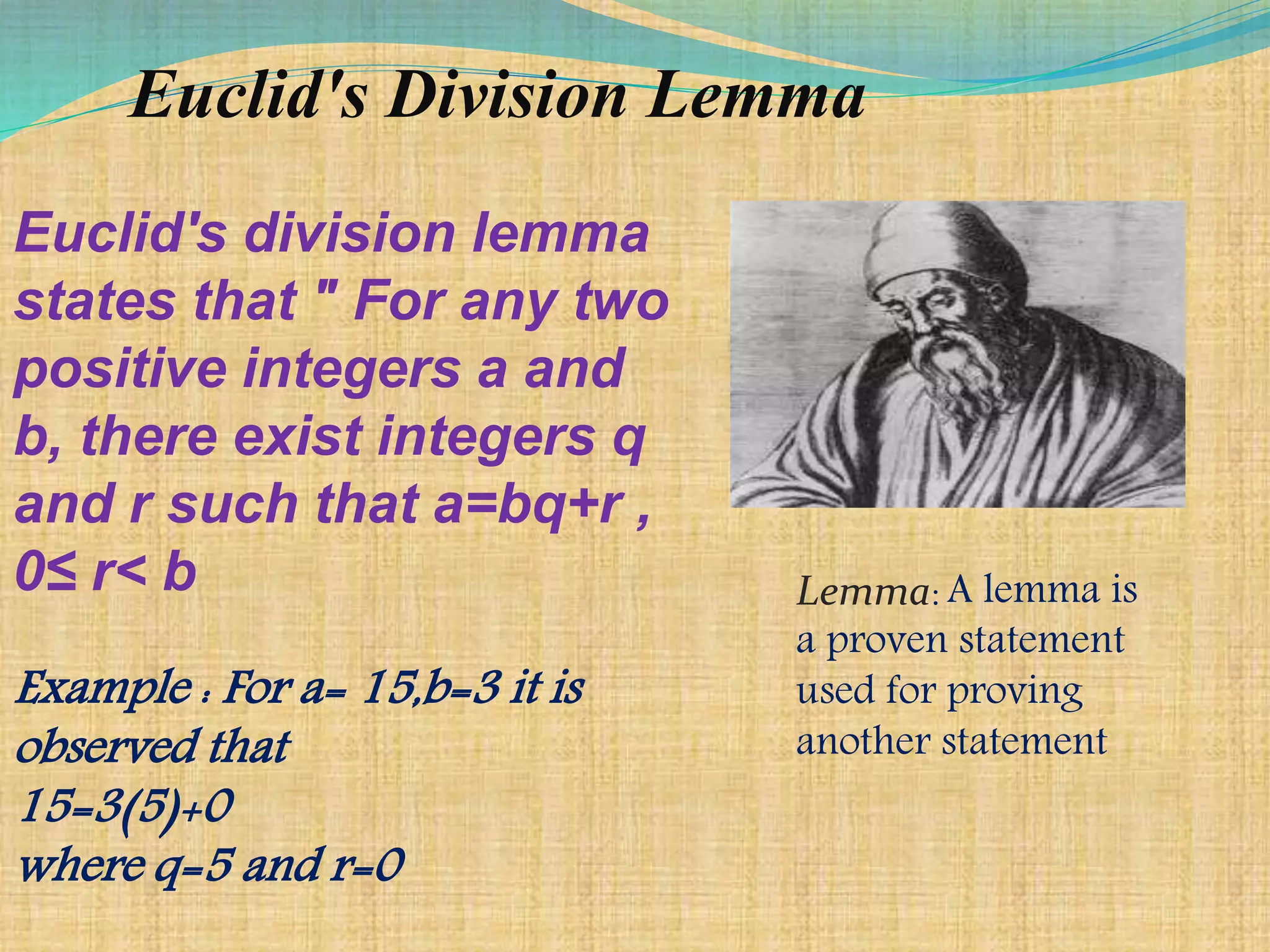
Euclid's division lemma
states that " For any two
positive integers a and
b, there exist integers q
and r such that a=bq+r ,
0≤ r< b
Example : For a= 15,b=3 it is
observed that
15=3(5)+0
where q=5 and r=0
Lemma: A lemma is
a proven statement
used for proving
another statement
Algorithm: An algorithm is a series of well defined
steps which gives a procedure for solving a type of
problem.
Euclid division algorithm can be used to find the HCF of two numbers.
It can also be used to find some common properties of numbers.
To obtain the HCF of two positive integers,say c and d, with c>d ,
we have to follow the steps below:
STEP 1: Apply euclid division lemma, to c and d. So, we find whole
numbers,q and r such that c=dq+r
STEP 2: If r=0,d is the HCF of c and d. If r does not equal to 0 , apply
the division lemma to d and r.
STEP 3: Continue the process till the remainder is zero. The divisior
at this stage will be the required HCF.
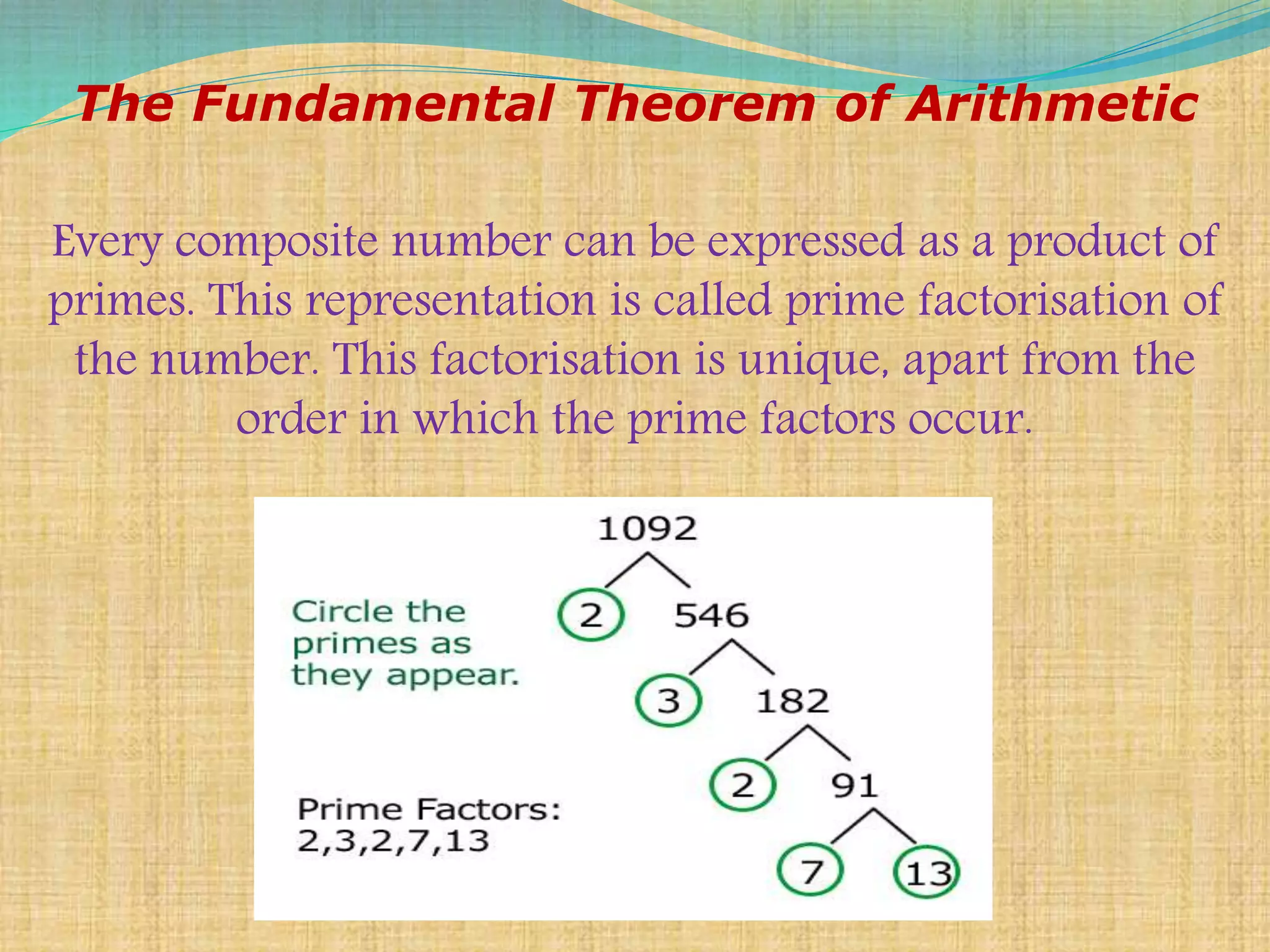
The Fundamental Theorem of Arithmetic
Every composite number can be expressed as a product of
primes. This representation is called prime factorisation of
the number. This factorisation is unique, apart from the
order in which the prime factors occur.
The HCF of two numbers is equal
to the product of the terms
containing the least powers of
common prime factors of the two
numbers.
The LCM of two numbers is equal to
the product of the terms containing
the greatest powers of all prime
factors of the two numbers.
For any two positive
integers a and b,
HCF (a, b) × LCM (a, b)
= a × b
Example : if a=3 and b=6
HCF(3,6) × LCM(3,6) = 3× 6
3 × 6 = 18
18 = 18
Hence verified……..
Therefore HCF(306,657) LCM(306,657) = 306 657
9 LCM(306,657) = 306 657
LCM(306,657) = 306 657/9
LCM =22338
×
×
×
×
×
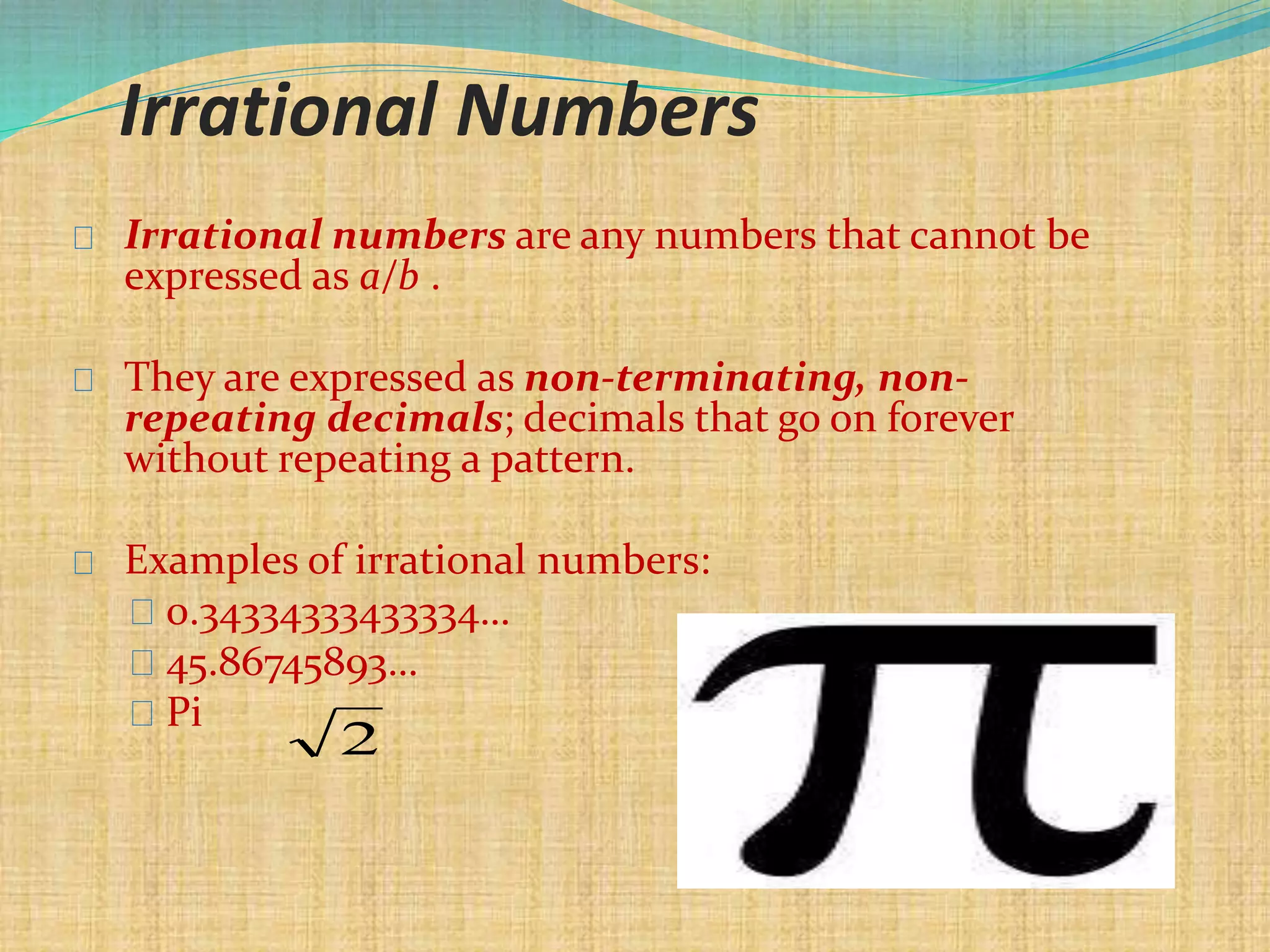
Irrational Numbers
Irrational numbers are any numbers that cannot be
expressed as a/b .
They are expressed as non-terminating, non-
repeating decimals; decimals that go on forever
without repeating a pattern.
Examples of irrational numbers:
0.34334333433334…
45.86745893…
Pi
2
Sol : We have 17/8
=17/23×52
So , the denominator 8 of 17/8 is of the form 2m×5n
therefore it has a terminating decimal expansion.
Sol : We have 29/343
=29/35
Clearly 343 is not of the form 2m×5n
therefore it has a non terminating decimal
expansion.
MADE BY
SMRITI SHARMA
IX-C
Real Numbers

Real Numbers

  • 2.
     Real numbersconsist of all the rational and irrational numbers.  The real number system has many subsets:  Natural Numbers  Whole Numbers  Integers Real Numbers
  • 3.
    Natural Numbers Natural numbersare the set of counting numbers which starts from 1. They are denoted by N Example : {1, 2, 3,…}
  • 4.
    Whole Numbers Whole numbersare the set of numbers that include 0 plus the set of natural numbers. Example : {0, 1, 2, 3, 4, 5,…}
  • 5.
    An integer isa whole number (not a fractional number) that can be positive, negative, or zero. It is denoted by Z . Example : Z = {..., -3, -2, - 1, 0, 1, 2, 3, ...}
  • 7.
    Rational Numbers Rational numbersare any numbers that can be expressed in the form of a/b , where a and b are integers, and b ≠ 0. They can always be expressed by using terminating decimals or repeating decimals. Example : 2/3, 6/7,1
  • 8.
    Terminating Decimals Terminating decimalsare decimals that contain a finite number of digits. Examples:  36.8  0.125  4.5 Repeating Decimals Repeating decimals are decimals that contain a infinite number of digits. Examples:  0.333…  7.689689… While expressing a fraction into a decimal by the division method, if the division process continues indefinitely, and zero remainder is never obtained then such a decimal is called Non-Terminating Decimal OR A non-terminating decimal is a decimal never repeats. Example : 0.076923...., 0.05882352.....
  • 9.
    Euclid's Division Lemma Euclid'sdivision lemma states that " For any two positive integers a and b, there exist integers q and r such that a=bq+r , 0≤ r< b Example : For a= 15,b=3 it is observed that 15=3(5)+0 where q=5 and r=0 Lemma: A lemma is a proven statement used for proving another statement
  • 10.
    Algorithm: An algorithmis a series of well defined steps which gives a procedure for solving a type of problem. Euclid division algorithm can be used to find the HCF of two numbers. It can also be used to find some common properties of numbers. To obtain the HCF of two positive integers,say c and d, with c>d , we have to follow the steps below: STEP 1: Apply euclid division lemma, to c and d. So, we find whole numbers,q and r such that c=dq+r STEP 2: If r=0,d is the HCF of c and d. If r does not equal to 0 , apply the division lemma to d and r. STEP 3: Continue the process till the remainder is zero. The divisior at this stage will be the required HCF.
  • 11.
    The Fundamental Theoremof Arithmetic Every composite number can be expressed as a product of primes. This representation is called prime factorisation of the number. This factorisation is unique, apart from the order in which the prime factors occur.
  • 12.
    The HCF oftwo numbers is equal to the product of the terms containing the least powers of common prime factors of the two numbers. The LCM of two numbers is equal to the product of the terms containing the greatest powers of all prime factors of the two numbers.
  • 13.
    For any twopositive integers a and b, HCF (a, b) × LCM (a, b) = a × b Example : if a=3 and b=6 HCF(3,6) × LCM(3,6) = 3× 6 3 × 6 = 18 18 = 18 Hence verified……..
  • 14.
    Therefore HCF(306,657) LCM(306,657)= 306 657 9 LCM(306,657) = 306 657 LCM(306,657) = 306 657/9 LCM =22338 × × × × ×
  • 15.
    Irrational Numbers Irrational numbersare any numbers that cannot be expressed as a/b . They are expressed as non-terminating, non- repeating decimals; decimals that go on forever without repeating a pattern. Examples of irrational numbers: 0.34334333433334… 45.86745893… Pi 2
  • 17.
    Sol : Wehave 17/8 =17/23×52 So , the denominator 8 of 17/8 is of the form 2m×5n therefore it has a terminating decimal expansion. Sol : We have 29/343 =29/35 Clearly 343 is not of the form 2m×5n therefore it has a non terminating decimal expansion.
  • 18.