kendriya 
vidyalaya
MATHS 
PROJECT 
WORK
1.INTRODUCTION 
2.POLYNOMIALS IN ONE VARIABLE 
3.ZERO POLYNOMIAL 
4.REMAINDER THEOREM 
5. FACTOR THEOREM 
6. FACTORISATION OF POLYNOMIALS 
7.ALGEBRIC IDENTITIES
INTRODUCTION 
We know about algebric 
expressions, their additions, 
subtraction, multiplication and 
division in earlier classes. We 
have studied how to factorise 
some algebraic expressions.
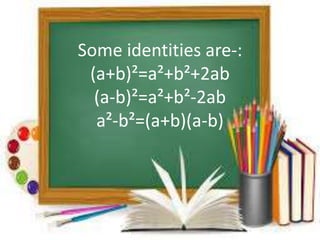
Some identities are-: 
(a+b)²=a²+b²+2ab 
(a-b)²=a²+b²-2ab 
a²-b²=(a+b)(a-b)
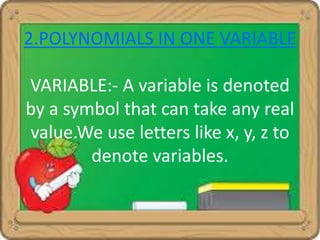
2.POLYNOMIALS IN ONE VARIABLE 
VARIABLE:- A variable is denoted 
by a symbol that can take any real 
value.We use letters like x, y, z to 
denote variables.
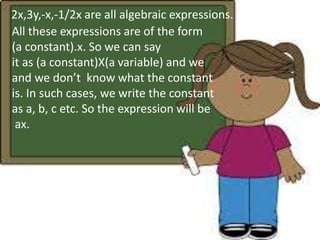
2x,3y,-x,-1/2x are all algebraic expressions. 
All these expressions are of the form 
(a constant).x. So we can say 
it as (a constant)X(a variable) and we 
and we don’t know what the constant 
is. In such cases, we write the constant 
as a, b, c etc. So the expression will be 
ax.
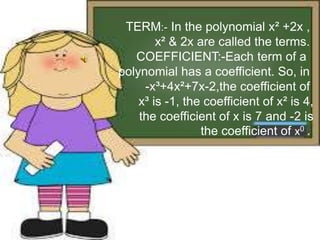
TERM:- In the polynomial x² +2x , 
x² & 2x are called the terms. 
COEFFICIENT:-Each term of a 
polynomial has a coefficient. So, in 
-x³+4x²+7x-2,the coefficient of 
x³ is -1, the coefficient of x² is 4, 
the coefficient of x is 7 and -2 is 
the coefficient of x0 .
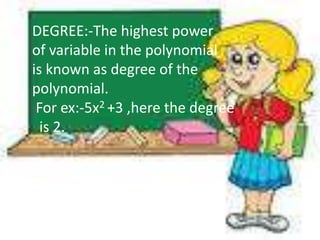
DEGREE:-The highest power 
of variable in the polynomial 
is known as degree of the 
polynomial. 
For ex:-5x2 +3 ,here the degree 
is 2.
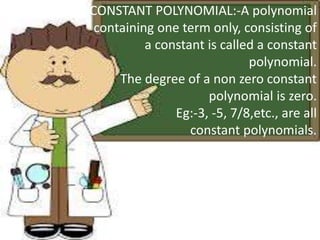
CONSTANT POLYNOMIAL:-A polynomial 
containing one term only, consisting of 
a constant is called a constant 
polynomial. 
The degree of a non zero constant 
polynomial is zero. 
Eg:-3, -5, 7/8,etc., are all 
constant polynomials.
3.ZERO POLYNOMIAL :-A 
polynomial consisting one term 
only, namelyzero only, is called 
a zero polynomial. 
The degree of a zero 
polynomial is not defined.
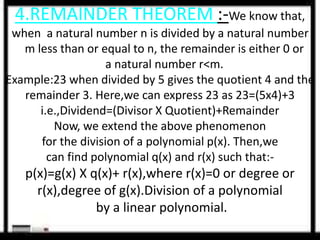
4.REMAINDER THEOREM :-We know that, 
when a natural number n is divided by a natural number 
m less than or equal to n, the remainder is either 0 or 
a natural number r<m. 
Example:23 when divided by 5 gives the quotient 4 and the 
remainder 3. Here,we can express 23 as 23=(5x4)+3 
i.e.,Dividend=(Divisor X Quotient)+Remainder 
Now, we extend the above phenomenon 
for the division of a polynomial p(x). Then,we 
can find polynomial q(x) and r(x) such that:- 
p(x)=g(x) X q(x)+ r(x),where r(x)=0 or degree or 
r(x),degree of g(x).Division of a polynomial 
by a linear polynomial.
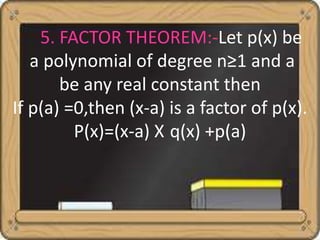
5. FACTOR THEOREM:-Let p(x) be 
a polynomial of degree n≥1 and a 
be any real constant then 
If p(a) =0,then (x-a) is a factor of p(x). 
P(x)=(x-a) X q(x) +p(a)
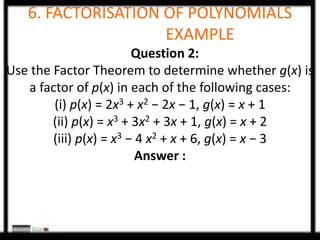
6. FACTORISATION OF POLYNOMIALS 
EXAMPLE 
Question 2: 
Use the Factor Theorem to determine whether g(x) is 
a factor of p(x) in each of the following cases: 
(i) p(x) = 2x3 + x2 − 2x − 1, g(x) = x + 1 
(ii) p(x) = x3 + 3x2 + 3x + 1, g(x) = x + 2 
(iii) p(x) = x3 − 4 x2 + x + 6, g(x) = x − 3 
Answer :
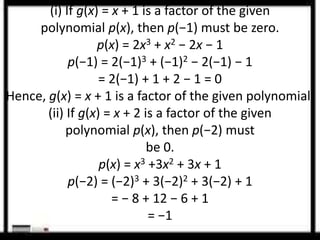
(i) If g(x) = x + 1 is a factor of the given 
polynomial p(x), then p(−1) must be zero. 
p(x) = 2x3 + x2 − 2x − 1 
p(−1) = 2(−1)3 + (−1)2 − 2(−1) − 1 
= 2(−1) + 1 + 2 − 1 = 0 
Hence, g(x) = x + 1 is a factor of the given polynomial. 
(ii) If g(x) = x + 2 is a factor of the given 
polynomial p(x), then p(−2) must 
be 0. 
p(x) = x3 +3x2 + 3x + 1 
p(−2) = (−2)3 + 3(−2)2 + 3(−2) + 1 
= − 8 + 12 − 6 + 1 
= −1
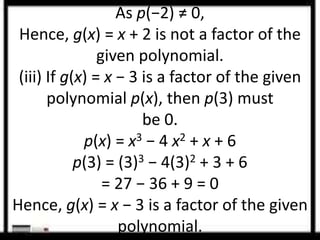
As p(−2) ≠ 0, 
Hence, g(x) = x + 2 is not a factor of the 
given polynomial. 
(iii) If g(x) = x − 3 is a factor of the given 
polynomial p(x), then p(3) must 
be 0. 
p(x) = x3 − 4 x2 + x + 6 
p(3) = (3)3 − 4(3)2 + 3 + 6 
= 27 − 36 + 9 = 0 
Hence, g(x) = x − 3 is a factor of the given 
polynomial.
7.ALGEBRIC IDENTITIES 
1.(x + a)(x - b) = x2 + (a - b) x - ab 
2. (x - a)(x + b) = x2 + (b - a) x - ab 
3.(x - a)(x - b) = x2 - (a + b)x + ab 
4.(a + b)3 = a3 + b3 +3ab (a + b) 
5.(a - b)3 = a3 - b3 - 3ab (a - b) 
z)2 + (z -x)2]
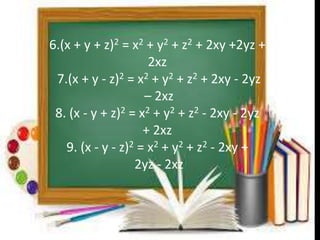
6.(x + y + z)2 = x2 + y2 + z2 + 2xy +2yz + 
2xz 
7.(x + y - z)2 = x2 + y2 + z2 + 2xy - 2yz 
– 2xz 
8. (x - y + z)2 = x2 + y2 + z2 - 2xy - 2yz 
+ 2xz 
9. (x - y - z)2 = x2 + y2 + z2 - 2xy + 
2yz - 2xz
10.x3 + y3 + z3 - 3xyz = (x + y + z) (x2 + y2 
+ z2 - xy - yz -xz) 
11. x2 + y2 = 12 [(x+y)2 + (x-y)2] 
12. (x+a) (x+b) (x+c) = x3+ (a + b + c ) 
x2 + (ab + bc +ca) x + abc 
13. x3 + y3 = (x + y) ( x2 - xy + y2) 
14. x3 - y3 = (x - y) ( x2 + xy + y2) 
15. x2 + y2 + z2 -xy -yz -zx = 12 
[(x-y)2 + (y -
SUBMITTED TO 
P.K. SRIVASTAVA SIR 
{THANX SIR FOR LIGHTING US WITH UR 
KNOWLEDGE}
THE END 
THANK YOU

polynomials class 9th maths presentation

  • 1.
  • 2.
  • 4.
    1.INTRODUCTION 2.POLYNOMIALS INONE VARIABLE 3.ZERO POLYNOMIAL 4.REMAINDER THEOREM 5. FACTOR THEOREM 6. FACTORISATION OF POLYNOMIALS 7.ALGEBRIC IDENTITIES
  • 5.
    INTRODUCTION We knowabout algebric expressions, their additions, subtraction, multiplication and division in earlier classes. We have studied how to factorise some algebraic expressions.
  • 6.
    Some identities are-: (a+b)²=a²+b²+2ab (a-b)²=a²+b²-2ab a²-b²=(a+b)(a-b)
  • 7.
    2.POLYNOMIALS IN ONEVARIABLE VARIABLE:- A variable is denoted by a symbol that can take any real value.We use letters like x, y, z to denote variables.
  • 8.
    2x,3y,-x,-1/2x are allalgebraic expressions. All these expressions are of the form (a constant).x. So we can say it as (a constant)X(a variable) and we and we don’t know what the constant is. In such cases, we write the constant as a, b, c etc. So the expression will be ax.
  • 9.
    TERM:- In thepolynomial x² +2x , x² & 2x are called the terms. COEFFICIENT:-Each term of a polynomial has a coefficient. So, in -x³+4x²+7x-2,the coefficient of x³ is -1, the coefficient of x² is 4, the coefficient of x is 7 and -2 is the coefficient of x0 .
  • 10.
    DEGREE:-The highest power of variable in the polynomial is known as degree of the polynomial. For ex:-5x2 +3 ,here the degree is 2.
  • 11.
    CONSTANT POLYNOMIAL:-A polynomial containing one term only, consisting of a constant is called a constant polynomial. The degree of a non zero constant polynomial is zero. Eg:-3, -5, 7/8,etc., are all constant polynomials.
  • 12.
    3.ZERO POLYNOMIAL :-A polynomial consisting one term only, namelyzero only, is called a zero polynomial. The degree of a zero polynomial is not defined.
  • 15.
    4.REMAINDER THEOREM :-Weknow that, when a natural number n is divided by a natural number m less than or equal to n, the remainder is either 0 or a natural number r<m. Example:23 when divided by 5 gives the quotient 4 and the remainder 3. Here,we can express 23 as 23=(5x4)+3 i.e.,Dividend=(Divisor X Quotient)+Remainder Now, we extend the above phenomenon for the division of a polynomial p(x). Then,we can find polynomial q(x) and r(x) such that:- p(x)=g(x) X q(x)+ r(x),where r(x)=0 or degree or r(x),degree of g(x).Division of a polynomial by a linear polynomial.
  • 16.
    5. FACTOR THEOREM:-Letp(x) be a polynomial of degree n≥1 and a be any real constant then If p(a) =0,then (x-a) is a factor of p(x). P(x)=(x-a) X q(x) +p(a)
  • 17.
    6. FACTORISATION OFPOLYNOMIALS EXAMPLE Question 2: Use the Factor Theorem to determine whether g(x) is a factor of p(x) in each of the following cases: (i) p(x) = 2x3 + x2 − 2x − 1, g(x) = x + 1 (ii) p(x) = x3 + 3x2 + 3x + 1, g(x) = x + 2 (iii) p(x) = x3 − 4 x2 + x + 6, g(x) = x − 3 Answer :
  • 18.
    (i) If g(x)= x + 1 is a factor of the given polynomial p(x), then p(−1) must be zero. p(x) = 2x3 + x2 − 2x − 1 p(−1) = 2(−1)3 + (−1)2 − 2(−1) − 1 = 2(−1) + 1 + 2 − 1 = 0 Hence, g(x) = x + 1 is a factor of the given polynomial. (ii) If g(x) = x + 2 is a factor of the given polynomial p(x), then p(−2) must be 0. p(x) = x3 +3x2 + 3x + 1 p(−2) = (−2)3 + 3(−2)2 + 3(−2) + 1 = − 8 + 12 − 6 + 1 = −1
  • 19.
    As p(−2) ≠0, Hence, g(x) = x + 2 is not a factor of the given polynomial. (iii) If g(x) = x − 3 is a factor of the given polynomial p(x), then p(3) must be 0. p(x) = x3 − 4 x2 + x + 6 p(3) = (3)3 − 4(3)2 + 3 + 6 = 27 − 36 + 9 = 0 Hence, g(x) = x − 3 is a factor of the given polynomial.
  • 20.
    7.ALGEBRIC IDENTITIES 1.(x+ a)(x - b) = x2 + (a - b) x - ab 2. (x - a)(x + b) = x2 + (b - a) x - ab 3.(x - a)(x - b) = x2 - (a + b)x + ab 4.(a + b)3 = a3 + b3 +3ab (a + b) 5.(a - b)3 = a3 - b3 - 3ab (a - b) z)2 + (z -x)2]
  • 21.
    6.(x + y+ z)2 = x2 + y2 + z2 + 2xy +2yz + 2xz 7.(x + y - z)2 = x2 + y2 + z2 + 2xy - 2yz – 2xz 8. (x - y + z)2 = x2 + y2 + z2 - 2xy - 2yz + 2xz 9. (x - y - z)2 = x2 + y2 + z2 - 2xy + 2yz - 2xz
  • 22.
    10.x3 + y3+ z3 - 3xyz = (x + y + z) (x2 + y2 + z2 - xy - yz -xz) 11. x2 + y2 = 12 [(x+y)2 + (x-y)2] 12. (x+a) (x+b) (x+c) = x3+ (a + b + c ) x2 + (ab + bc +ca) x + abc 13. x3 + y3 = (x + y) ( x2 - xy + y2) 14. x3 - y3 = (x - y) ( x2 + xy + y2) 15. x2 + y2 + z2 -xy -yz -zx = 12 [(x-y)2 + (y -
  • 23.
    SUBMITTED TO P.K.SRIVASTAVA SIR {THANX SIR FOR LIGHTING US WITH UR KNOWLEDGE}
  • 25.