Comparing
Quantities
Ratios
The ratio is used to compare
two quantities. These
quantities must have the
same units.
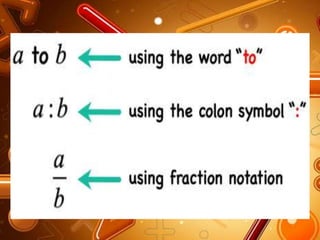
The ratio is represented
by “:”, which is read
as “to”. We can write it in the
form of “fraction”.
Equivalent Ratios
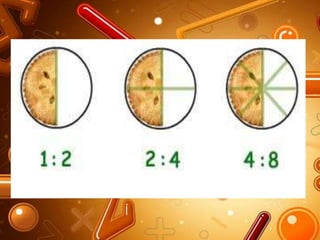
The equivalent ratio is like the
equivalent fractions so to find
the equivalent ratio we need to
write it in the form of a fraction.
To find the equivalent ratio we
need to multiply or divide the
numerator and denominator
with the same number.
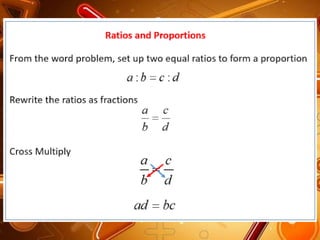
Proportion
Proportion shows
the equality between
two ratios. If two
ratios are in
proportion then
these must be equal.
Unitary Method
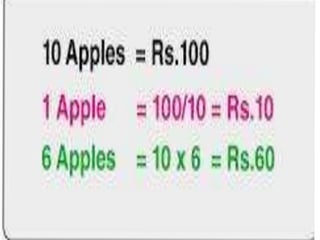
The unitary method is a
method in which you find
the value of a unit and
then the value of a
required number of units.
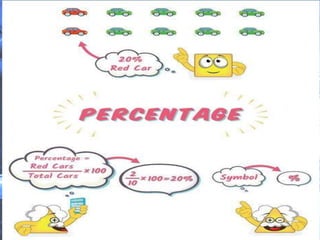
Percentage
The percentage is another way
of comparisons. In ratios we
have to make the denominator
same then only we can
compare them but in
percentage, we can compare by
calculating the percentage of
the given quantity.
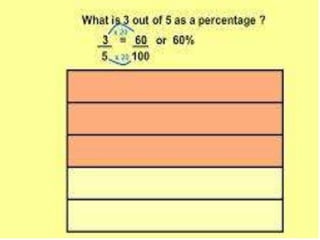
Percentage if the total is
not a hundred
If the total number of
quantity is not hundred i.e.
the denominator is not
hundred then to find the
percentage we need to
make the denominator 100.
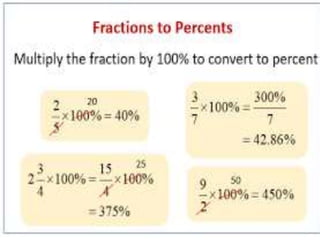
Fractions to Percentage
(%)
Fractional numbers have
different denominator and
to convert them into
percentage we have to
multiply the fraction with
the 100%.
Converting decimals to
percentage
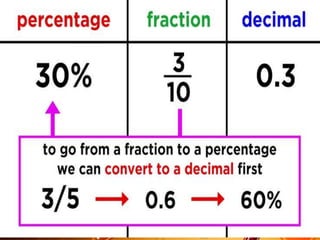
To convert the decimal into a
percentage, first, we need to
convert the decimal into
fraction then multiply it by
100%.
Parts always add to give
a whole
If we know the one part of a
whole then we can find the
other part because all the
parts together form a whole or
100%.
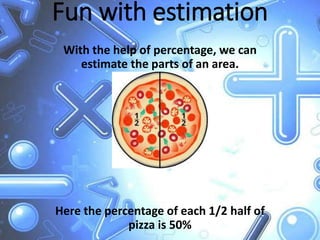
Fun with estimation
With the help of percentage, we can
estimate the parts of an area.
Here the percentage of each 1/2 half of
pizza is 50%
Use of Percentages
Interpreting percentages
To use the percentages in real life
we must be able to interpret the
percentage.
Example
If we say that Seema is spending
20% of her income then it means
that Seema is spending Rs. 25 out of
every Rs. 100 she earns.
Converting percentages to
“How many”.
Example
If 20% of students get a distinction out
of 45 students in a class, then how many
students got the distinction?
Solution
The number of students got distinction =
[20/100] × 45 = 9.
Hence, 9 students out of 45 got the
distinction.
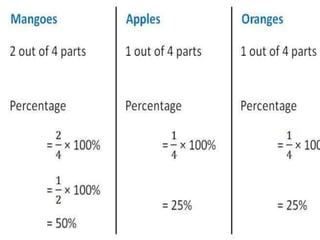
Ratios to percent
Ratio to percentage conversion helps
us in obtaining accuracy in mixtures
of elements, or while calculating the
percentage score in a test. At times
you are given parts of a quantity in
the form of ratios. They can also be
represented in the form of
percentages.
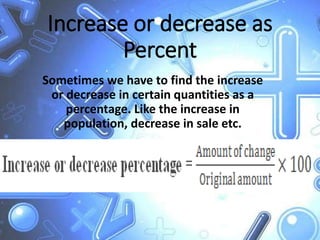
Increase or decrease as
Percent
Sometimes we have to find the increase
or decrease in certain quantities as a
percentage. Like the increase in
population, decrease in sale etc.
Cost Price and Selling
Price
Cost price is the price at which you
buy some product. It is written as CP
Selling price is the price at which you
sell something. It is written as SP.
These are the factors which tell us
that the sale of some product is
profitable or not.
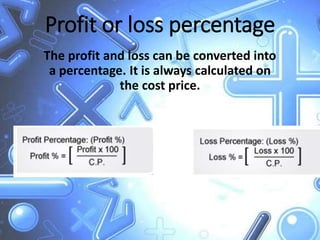
Profit or loss percentage
The profit and loss can be converted into
a percentage. It is always calculated on
the cost price.
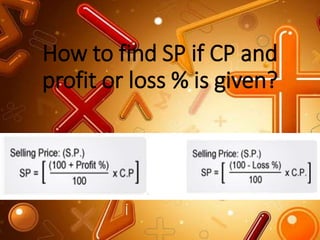
How to find SP if CP and
profit or loss % is given?
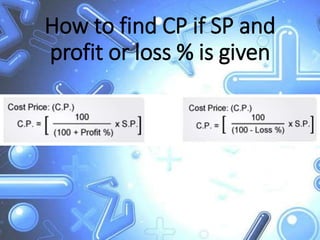
How to find CP if SP and
profit or loss % is given
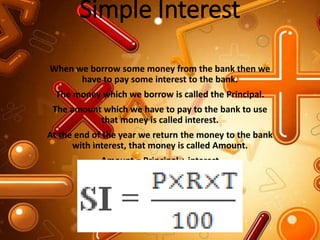
Simple Interest
When we borrow some money from the bank then we
have to pay some interest to the bank.
The money which we borrow is called the Principal.
The amount which we have to pay to the bank to use
that money is called interest.
At the end of the year we return the money to the bank
with interest, that money is called Amount.
Amount = Principal + interest
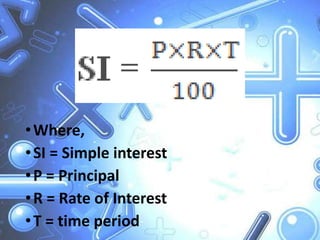
•Where,
•SI = Simple interest
•P = Principal
•R = Rate of Interest
•T = time period
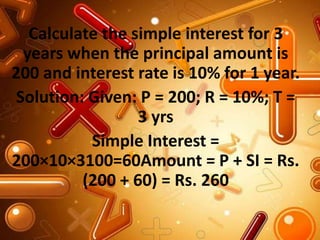
Calculate the simple interest for 3
years when the principal amount is
200 and interest rate is 10% for 1 year.
Solution: Given: P = 200; R = 10%; T =
3 yrs
Simple Interest =
200×10×3100=60Amount = P + SI = Rs.
(200 + 60) = Rs. 260
Comparing Quantities

Comparing Quantities

  • 1.
  • 2.
    Ratios The ratio isused to compare two quantities. These quantities must have the same units. The ratio is represented by “:”, which is read as “to”. We can write it in the form of “fraction”.
  • 4.
    Equivalent Ratios The equivalentratio is like the equivalent fractions so to find the equivalent ratio we need to write it in the form of a fraction. To find the equivalent ratio we need to multiply or divide the numerator and denominator with the same number.
  • 6.
    Proportion Proportion shows the equalitybetween two ratios. If two ratios are in proportion then these must be equal.
  • 8.
    Unitary Method The unitarymethod is a method in which you find the value of a unit and then the value of a required number of units.
  • 10.
    Percentage The percentage isanother way of comparisons. In ratios we have to make the denominator same then only we can compare them but in percentage, we can compare by calculating the percentage of the given quantity.
  • 12.
    Percentage if thetotal is not a hundred If the total number of quantity is not hundred i.e. the denominator is not hundred then to find the percentage we need to make the denominator 100.
  • 14.
    Fractions to Percentage (%) Fractionalnumbers have different denominator and to convert them into percentage we have to multiply the fraction with the 100%.
  • 16.
    Converting decimals to percentage Toconvert the decimal into a percentage, first, we need to convert the decimal into fraction then multiply it by 100%.
  • 18.
    Parts always addto give a whole If we know the one part of a whole then we can find the other part because all the parts together form a whole or 100%.
  • 19.
    Fun with estimation Withthe help of percentage, we can estimate the parts of an area. Here the percentage of each 1/2 half of pizza is 50%
  • 20.
    Use of Percentages Interpretingpercentages To use the percentages in real life we must be able to interpret the percentage. Example If we say that Seema is spending 20% of her income then it means that Seema is spending Rs. 25 out of every Rs. 100 she earns.
  • 21.
    Converting percentages to “Howmany”. Example If 20% of students get a distinction out of 45 students in a class, then how many students got the distinction? Solution The number of students got distinction = [20/100] × 45 = 9. Hence, 9 students out of 45 got the distinction.
  • 22.
    Ratios to percent Ratioto percentage conversion helps us in obtaining accuracy in mixtures of elements, or while calculating the percentage score in a test. At times you are given parts of a quantity in the form of ratios. They can also be represented in the form of percentages.
  • 24.
    Increase or decreaseas Percent Sometimes we have to find the increase or decrease in certain quantities as a percentage. Like the increase in population, decrease in sale etc.
  • 25.
    Cost Price andSelling Price Cost price is the price at which you buy some product. It is written as CP Selling price is the price at which you sell something. It is written as SP. These are the factors which tell us that the sale of some product is profitable or not.
  • 26.
    Profit or losspercentage The profit and loss can be converted into a percentage. It is always calculated on the cost price.
  • 27.
    How to findSP if CP and profit or loss % is given?
  • 28.
    How to findCP if SP and profit or loss % is given
  • 29.
    Simple Interest When weborrow some money from the bank then we have to pay some interest to the bank. The money which we borrow is called the Principal. The amount which we have to pay to the bank to use that money is called interest. At the end of the year we return the money to the bank with interest, that money is called Amount. Amount = Principal + interest
  • 30.
    •Where, •SI = Simpleinterest •P = Principal •R = Rate of Interest •T = time period
  • 31.
    Calculate the simpleinterest for 3 years when the principal amount is 200 and interest rate is 10% for 1 year. Solution: Given: P = 200; R = 10%; T = 3 yrs Simple Interest = 200×10×3100=60Amount = P + SI = Rs. (200 + 60) = Rs. 260