MICROBUBBLE
Presentation By
SHAH ABDUL BARI
Guided By
DR.QAZI MAJAZ SIR
M.Pharm First Year
(QA SEM 1)
[Roll No. 08]
SEAT NO: 517628
Jamia Islamia Isha-atul Uloom’s
Ali-Allana College of Pharmacy
Akkalkuwa, Dist. Nandurbar.
Defination
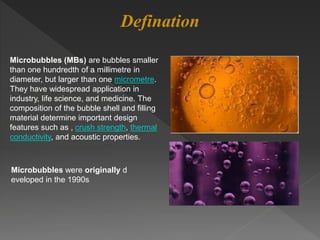
Microbubbles (MBs) are bubbles smaller
than one hundredth of a millimetre in
diameter, but larger than one micrometre.
They have widespread application in
industry, life science, and medicine. The
composition of the bubble shell and filling
material determine important design
features such as , crush strength, thermal
conductivity, and acoustic properties.
Microbubbles were originally d
eveloped in the 1990s
WHAT ARE MICROBUBBLES?
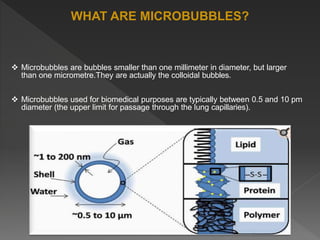
 Microbubbles are bubbles smaller than one millimeter in diameter, but larger
than one micrometre.They are actually the colloidal bubbles.
 Microbubbles used for biomedical purposes are typically between 0.5 and 10 pm
diameter (the upper limit for passage through the lung capillaries).
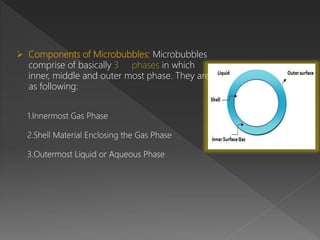
 Components of Microbubbles: Microbubbles
comprise of basically 3 phases in which
inner, middle and outer most phase. They are
as following:
1.Innermost Gas Phase
2.Shell Material Enclosing the Gas Phase
3.Outermost Liquid or Aqueous Phase
 The gas core is a single chamber and comprises a large majority of the
total particle volume. The shell acts as a barrier between the
encapsulated gas and the surrounding aqueous medium.
 Different shell materials may be used, including lipid (-3 nm thick),
protein (15-20 nm thick) and polymer (100-200 nm thick).
 The lipid molecules are held together through physical force fields,
such as hydrophobic and van der Waals interactions.
 Wheareas protein shell held by disulfide bond.
PROPERTIES OF MICROBUBBLES
The ideal properties of microbubbles can be divided into
two classes,
1) Functional Properties
a) Inject ability:
b) Ultrasound Scattering Efficiency:
c) Biocompatibility:
2) Structural Properties
1. Diameter: should be between the ranges of 1-10
μM.
2. Density & compressibility: In Body, They are act as contrast
agents because their density & compressibility difference between
themselves & the surrounding body tissues to create acoustic impedance
to scatter ultrasound at a much higher intensity than the body tissues.
3.Other properties
 Unlike ordinary bubbles they don't burst at water
surface rather they shrink as they rises upward.
 Interior gas pressure higher than ordinary bubble.
 Surface electricity produced due to the accumulation of ions(mainly H+ &
OH-) on surface.
Free radical generation on collapsing of microbubble
TYPES OF MICROBUBBLES
Based on the chemical nature of shell there are 4 types of microbubbles.
I. PROTEIN SHELL
II. SURFACTANT SHELL
III. LIPID SHELL
IV. POLYMER SHELL.
1.PROTEIN SHELL
 Albumin shell were the first to be produced.
 The first albumin microbubble formulation to be a was Albunex (GE
Healthcare) with a size range from 1 to 4.5 pm diameter.
 Albumin-coated microbubbles are formed by sonication of a heated
solution of 5% (w/v) human serum albumin in the presence of air.
2.SURFACTANT SHELL
 stabilized by mixtures of the synthetic surfactants SPAN-40 and
TWEEN-40.
 The SPAN/TWEEN solution was sonicated in the presence of air to
form stable microbubbles.
 The correct ratio of SPAN to TWEEN (roughly 1:1) to use for
maximum film stability.
 They have limited biomedical application.
3.LIPID SHELL
 Bio inspired since microbubbles stabilized by acyl lipids & glycoprotein already found
in marine ecosystem.
 Imitates the stability & compliance of lung surfactants.
Among bio surfactants rhamnolipids have been widely used as lipid
alternative.
 Commercially available formulations includes Definity (Lantheus Medical
Imaging) and Sonovue® (Bracco Diagnostics).
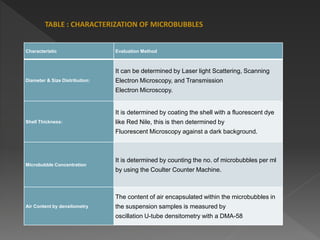
Characteristic Evaluation Method
Diameter & Size Distribution:
It can be determined by Laser light Scattering, Scanning
Electron Microscopy, and Transmission
Electron Microscopy.
Shell Thickness:
It is determined by coating the shell with a fluorescent dye
like Red Nile, this is then determined by
Fluorescent Microscopy against a dark background.
Microbubble Concentration
It is determined by counting the no. of microbubbles per ml
by using the Coulter Counter Machine.
Air Content by densitometry
The content of air encapsulated within the microbubbles in
the suspension samples is measured by
oscillation U-tube densitometry with a DMA-58
TABLE : CHARACTERIZATION OF MICROBUBBLES
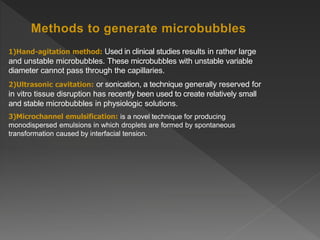
Methods to generate microbubbles
1)Hand-agitation method: Used in clinical studies results in rather large
and unstable microbubbles. These microbubbles with unstable variable
diameter cannot pass through the capillaries.
2)Ultrasonic cavitation: or sonication, a technique generally reserved for
in vitro tissue disruption has recently been used to create relatively small
and stable microbubbles in physiologic solutions.
3)Microchannel emulsification: is a novel technique for producing
monodispersed emulsions in which droplets are formed by spontaneous
transformation caused by interfacial tension.
 Application of Microbubbles:
 For Diagnosis: They are used as contrast agents because they are elastic
and compressible &undergo compression and creating an acoustic impedance
mismatch between biological tissues and fluids. These are used as diagnostic
aids for:
• Blood Volume and Perfusion
• Inflammation
• Cancer
• Liver
• Also used to scan the tumors arising in the body.
• Used for imaging the gall bladder stone.
 Drug Delivery: Two factors consider during drug delivery are as
follows:
1.Incorporation of drug into these Microbubbles
2.Drug release from these Microbubbles
For Incorporation of drug into Microbubbles methods which are used they .
Method A shows Drugs can also be attached to the shell of the microbubble.
Method B shows if the microbubble is made up of multiple layers it can also be
incorporated within the various layers of these Microbubbles.
Method C shows Drug molecules can also be incorporated within the bubble
membrane or shell material of the microbubble.
Method D shows drug can also be attached to the microbubble surface via a ligand.
Method E shows Drug molecules can be incorporated within the bubble.
In Drug release from Microbubbles, bursting or breakup of the microbubble on
application of ultrasound occurs called cavitation. On cavitation the body fluids start
creating acoustic cavitation
Drug delivery
 Cavitation of bubbles in an ultrasound field can increase the
permeability of an endothelial vasculature, allowing small
molecules to enter into tissue from the blood stream, a technique
known as sonoporation.
 Once the shells are destroyed, the contents of the microbubbles
spill into the surrounding area and the drugs reach the target
directly instead of going through the whole bloodstream.
 This localized release technique prevents the drugs from
influencing other systems in the body.
 Gene Delivery: Microbubbles also used in gene delivery due
to It
 Microbubbles are metabolically inert
 When injected into the body they do not produce any immune
response
 Also the gene encapsulated or attached to the microbubble is
carried to its target without getting digested by the various
enzymes.
Gene delivery
 Protein microbubbles used for this purpose
because:
1)The nucleic acids may be incorporated in the
shell during covalent crosslinking of proteins
during the formulation stage.
2)The charged protein surface is amenable to
adsorption of nucleic acids without significantly
altering the acoustic response.
* Gene delivery mediated by albumin microbubble
first attempted by Shohet et al(2000).
COMMONLY USED MICROBUBBLES
Echovist- Used in Right heart Myocardium, Liver and gynaecological applications.
Albunex- used in Liver, Kidneys and heartcontrast imaging
SonoVue- Most Commonly used in INDIA. Used in study of Liver, Kidneys and
Gynaecological studies.
 CONCLUSION:
 The potential utility of microbubbles in biomedical applications is
continually growing as novel formulations and methods emerge.
 Microbubbles provide a unique range of responses to ultrasound, which
makes them useful for contrast ultrasound imaging,
 identifying molecular expression and targeting drugs to specific tissue
sites
REFRENCES:
1. Rajesh Patel; Microbubble: An ultrasound contrast agent in molecular imaging,
Pharma Times, May 2008; Vol. 40; 15.
2. Nalini Kurup; Microbubble: A novel drug Delivery system; JPRHC; Vol -2; Issue 3;
228-234.
3. Akimi Serizawa; Laminiarization of microbubble containing milky bubbly flow in a
pipe; Third European-Japanese Two phase flow group meeting certosa di
pontignanao.
4. Deepika Maliwal; Microbubbles Contrast Agents Using Ultrasound; Research
Journal of Pharmacy and Technology; Vol. 1(3); July-Sept. 2008.
5. Eniola A.O. and Hammer D.A.; In vitro characterization of leukocyte mimetic for
targeting therapeutics to the endothelium using two receptors; Biomaterials; 2005;
Vol.26; 7136-44.
6. Eniola A.O., Willcox P.J. and Hammer D.A.; Interplay between rolling and firm
adhesion elucidated with a cell-free system engineered with two distinct receptor-
ligand pairs; Biophys. J.; 2003; 85; 2720-31.
THANK YOU

A project on microbubble.

  • 1.
    MICROBUBBLE Presentation By SHAH ABDULBARI Guided By DR.QAZI MAJAZ SIR M.Pharm First Year (QA SEM 1) [Roll No. 08] SEAT NO: 517628 Jamia Islamia Isha-atul Uloom’s Ali-Allana College of Pharmacy Akkalkuwa, Dist. Nandurbar.
  • 2.
    Defination Microbubbles (MBs) arebubbles smaller than one hundredth of a millimetre in diameter, but larger than one micrometre. They have widespread application in industry, life science, and medicine. The composition of the bubble shell and filling material determine important design features such as , crush strength, thermal conductivity, and acoustic properties. Microbubbles were originally d eveloped in the 1990s
  • 3.
    WHAT ARE MICROBUBBLES? Microbubbles are bubbles smaller than one millimeter in diameter, but larger than one micrometre.They are actually the colloidal bubbles.  Microbubbles used for biomedical purposes are typically between 0.5 and 10 pm diameter (the upper limit for passage through the lung capillaries).
  • 4.
     Components ofMicrobubbles: Microbubbles comprise of basically 3 phases in which inner, middle and outer most phase. They are as following: 1.Innermost Gas Phase 2.Shell Material Enclosing the Gas Phase 3.Outermost Liquid or Aqueous Phase
  • 5.
     The gascore is a single chamber and comprises a large majority of the total particle volume. The shell acts as a barrier between the encapsulated gas and the surrounding aqueous medium.  Different shell materials may be used, including lipid (-3 nm thick), protein (15-20 nm thick) and polymer (100-200 nm thick).  The lipid molecules are held together through physical force fields, such as hydrophobic and van der Waals interactions.  Wheareas protein shell held by disulfide bond.
  • 6.
    PROPERTIES OF MICROBUBBLES Theideal properties of microbubbles can be divided into two classes, 1) Functional Properties a) Inject ability: b) Ultrasound Scattering Efficiency: c) Biocompatibility: 2) Structural Properties 1. Diameter: should be between the ranges of 1-10 μM. 2. Density & compressibility: In Body, They are act as contrast agents because their density & compressibility difference between themselves & the surrounding body tissues to create acoustic impedance to scatter ultrasound at a much higher intensity than the body tissues.
  • 7.
    3.Other properties  Unlikeordinary bubbles they don't burst at water surface rather they shrink as they rises upward.  Interior gas pressure higher than ordinary bubble.  Surface electricity produced due to the accumulation of ions(mainly H+ & OH-) on surface. Free radical generation on collapsing of microbubble
  • 8.
    TYPES OF MICROBUBBLES Basedon the chemical nature of shell there are 4 types of microbubbles. I. PROTEIN SHELL II. SURFACTANT SHELL III. LIPID SHELL IV. POLYMER SHELL.
  • 9.
    1.PROTEIN SHELL  Albuminshell were the first to be produced.  The first albumin microbubble formulation to be a was Albunex (GE Healthcare) with a size range from 1 to 4.5 pm diameter.  Albumin-coated microbubbles are formed by sonication of a heated solution of 5% (w/v) human serum albumin in the presence of air.
  • 10.
    2.SURFACTANT SHELL  stabilizedby mixtures of the synthetic surfactants SPAN-40 and TWEEN-40.  The SPAN/TWEEN solution was sonicated in the presence of air to form stable microbubbles.  The correct ratio of SPAN to TWEEN (roughly 1:1) to use for maximum film stability.  They have limited biomedical application.
  • 11.
    3.LIPID SHELL  Bioinspired since microbubbles stabilized by acyl lipids & glycoprotein already found in marine ecosystem.  Imitates the stability & compliance of lung surfactants. Among bio surfactants rhamnolipids have been widely used as lipid alternative.  Commercially available formulations includes Definity (Lantheus Medical Imaging) and Sonovue® (Bracco Diagnostics).
  • 12.
    Characteristic Evaluation Method Diameter& Size Distribution: It can be determined by Laser light Scattering, Scanning Electron Microscopy, and Transmission Electron Microscopy. Shell Thickness: It is determined by coating the shell with a fluorescent dye like Red Nile, this is then determined by Fluorescent Microscopy against a dark background. Microbubble Concentration It is determined by counting the no. of microbubbles per ml by using the Coulter Counter Machine. Air Content by densitometry The content of air encapsulated within the microbubbles in the suspension samples is measured by oscillation U-tube densitometry with a DMA-58 TABLE : CHARACTERIZATION OF MICROBUBBLES
  • 13.
    Methods to generatemicrobubbles 1)Hand-agitation method: Used in clinical studies results in rather large and unstable microbubbles. These microbubbles with unstable variable diameter cannot pass through the capillaries. 2)Ultrasonic cavitation: or sonication, a technique generally reserved for in vitro tissue disruption has recently been used to create relatively small and stable microbubbles in physiologic solutions. 3)Microchannel emulsification: is a novel technique for producing monodispersed emulsions in which droplets are formed by spontaneous transformation caused by interfacial tension.
  • 14.
     Application ofMicrobubbles:  For Diagnosis: They are used as contrast agents because they are elastic and compressible &undergo compression and creating an acoustic impedance mismatch between biological tissues and fluids. These are used as diagnostic aids for: • Blood Volume and Perfusion • Inflammation • Cancer • Liver • Also used to scan the tumors arising in the body. • Used for imaging the gall bladder stone.
  • 15.
     Drug Delivery:Two factors consider during drug delivery are as follows: 1.Incorporation of drug into these Microbubbles 2.Drug release from these Microbubbles For Incorporation of drug into Microbubbles methods which are used they . Method A shows Drugs can also be attached to the shell of the microbubble. Method B shows if the microbubble is made up of multiple layers it can also be incorporated within the various layers of these Microbubbles. Method C shows Drug molecules can also be incorporated within the bubble membrane or shell material of the microbubble. Method D shows drug can also be attached to the microbubble surface via a ligand. Method E shows Drug molecules can be incorporated within the bubble. In Drug release from Microbubbles, bursting or breakup of the microbubble on application of ultrasound occurs called cavitation. On cavitation the body fluids start creating acoustic cavitation
  • 16.
    Drug delivery  Cavitationof bubbles in an ultrasound field can increase the permeability of an endothelial vasculature, allowing small molecules to enter into tissue from the blood stream, a technique known as sonoporation.  Once the shells are destroyed, the contents of the microbubbles spill into the surrounding area and the drugs reach the target directly instead of going through the whole bloodstream.  This localized release technique prevents the drugs from influencing other systems in the body.
  • 17.
     Gene Delivery:Microbubbles also used in gene delivery due to It  Microbubbles are metabolically inert  When injected into the body they do not produce any immune response  Also the gene encapsulated or attached to the microbubble is carried to its target without getting digested by the various enzymes.
  • 18.
    Gene delivery  Proteinmicrobubbles used for this purpose because: 1)The nucleic acids may be incorporated in the shell during covalent crosslinking of proteins during the formulation stage. 2)The charged protein surface is amenable to adsorption of nucleic acids without significantly altering the acoustic response. * Gene delivery mediated by albumin microbubble first attempted by Shohet et al(2000).
  • 19.
    COMMONLY USED MICROBUBBLES Echovist-Used in Right heart Myocardium, Liver and gynaecological applications. Albunex- used in Liver, Kidneys and heartcontrast imaging SonoVue- Most Commonly used in INDIA. Used in study of Liver, Kidneys and Gynaecological studies.
  • 20.
     CONCLUSION:  Thepotential utility of microbubbles in biomedical applications is continually growing as novel formulations and methods emerge.  Microbubbles provide a unique range of responses to ultrasound, which makes them useful for contrast ultrasound imaging,  identifying molecular expression and targeting drugs to specific tissue sites
  • 21.
    REFRENCES: 1. Rajesh Patel;Microbubble: An ultrasound contrast agent in molecular imaging, Pharma Times, May 2008; Vol. 40; 15. 2. Nalini Kurup; Microbubble: A novel drug Delivery system; JPRHC; Vol -2; Issue 3; 228-234. 3. Akimi Serizawa; Laminiarization of microbubble containing milky bubbly flow in a pipe; Third European-Japanese Two phase flow group meeting certosa di pontignanao. 4. Deepika Maliwal; Microbubbles Contrast Agents Using Ultrasound; Research Journal of Pharmacy and Technology; Vol. 1(3); July-Sept. 2008. 5. Eniola A.O. and Hammer D.A.; In vitro characterization of leukocyte mimetic for targeting therapeutics to the endothelium using two receptors; Biomaterials; 2005; Vol.26; 7136-44. 6. Eniola A.O., Willcox P.J. and Hammer D.A.; Interplay between rolling and firm adhesion elucidated with a cell-free system engineered with two distinct receptor- ligand pairs; Biophys. J.; 2003; 85; 2720-31.
  • 22.