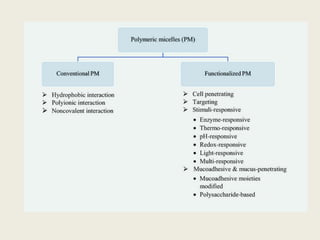
Polymeric Micelles
with Application
Submitted by, Submitted to,
Mohd Sufiyan Dr. Abdul Hafeez
M.Pharm 1st year Dept. of Pharmaceutics
Dept. of Pharmaceutics
Why and When Does Self-Assembly Occur?
• In a diluted state, polymers will be present as
dispersed polymer units in a medium. At a certain
concentration, the polymers will tend to arrange
themselves in an ordered structure, and this
concentration is named “critical micelle
concentration” (CMC).
• The products of the self-assembly of amphiphilic
polymers or the spontaneous aggregation of
amphiphilic polymers are called “micelles” and
“vesicles”
Polymeric Micelles
• Self-assembly of amphiphilic polymers with hydrophilic
and hydrophobic units results in micelles (polymeric
nanoparticles), where polymer concentrations are above
critical micelle concentrations (CMCs).
• Recently, micelles with metal nanoparticles (MNPs) have
been utilized in many bio-applications because of their
excellent biocompatibility, pharmacokinetics, adhesion to
biosurfaces, targetability, and longevity.
• The size of the micelles is in the range of 10 to 100 nm,
and different shapes of micelles have been developed for
applications.
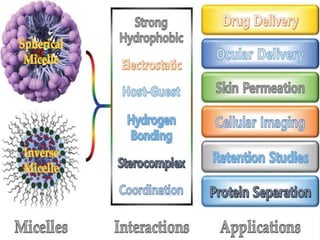
Polymeric Spherical Micelles
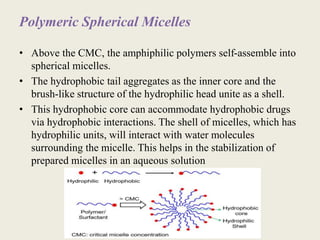
• Above the CMC, the amphiphilic polymers self-assemble into
spherical micelles.
• The hydrophobic tail aggregates as the inner core and the
brush-like structure of the hydrophilic head unite as a shell.
• This hydrophobic core can accommodate hydrophobic drugs
via hydrophobic interactions. The shell of micelles, which has
hydrophilic units, will interact with water molecules
surrounding the micelle. This helps in the stabilization of
prepared micelles in an aqueous solution
Polymeric Inverse Micelle
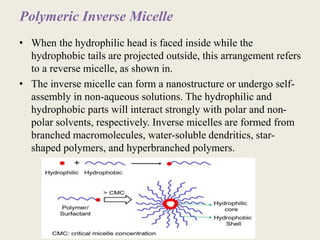
• When the hydrophilic head is faced inside while the
hydrophobic tails are projected outside, this arrangement refers
to a reverse micelle, as shown in.
• The inverse micelle can form a nanostructure or undergo self-
assembly in non-aqueous solutions. The hydrophilic and
hydrophobic parts will interact strongly with polar and non-
polar solvents, respectively. Inverse micelles are formed from
branched macromolecules, water-soluble dendritics, star-
shaped polymers, and hyperbranched polymers.
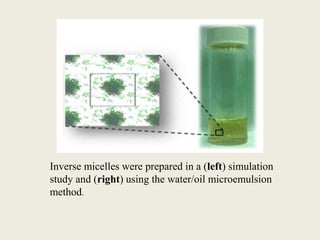
Inverse micelles were prepared in a (left) simulation
study and (right) using the water/oil microemulsion
method.
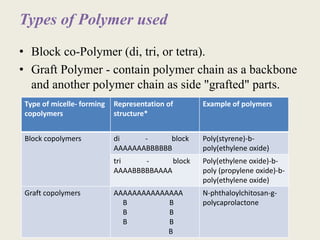
Types of Polymer used
• Block co-Polymer (di, tri, or tetra).
• Graft Polymer - contain polymer chain as a backbone
and another polymer chain as side "grafted" parts.
Type of micelle- forming
copolymers
Representation of
structure*
Example of polymers
Block copolymers di - block
AAAAAAABBBBBB
Poly(styrene)-b-
poly(ethylene oxide)
tri - block
AAAABBBBBAAAA
Poly(ethylene oxide)-b-
poly (propylene oxide)-b-
poly(ethylene oxide)
Graft copolymers AAAAAAAAAAAAAAA
B B
B B
B B
B
N-phthaloylchitosan-g-
polycaprolactone
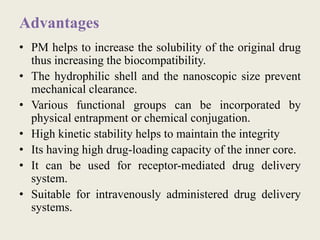
Advantages
• PM helps to increase the solubility of the original drug
thus increasing the biocompatibility.
• The hydrophilic shell and the nanoscopic size prevent
mechanical clearance.
• Various functional groups can be incorporated by
physical entrapment or chemical conjugation.
• High kinetic stability helps to maintain the integrity
• Its having high drug-loading capacity of the inner core.
• It can be used for receptor-mediated drug delivery
system.
• Suitable for intravenously administered drug delivery
systems.
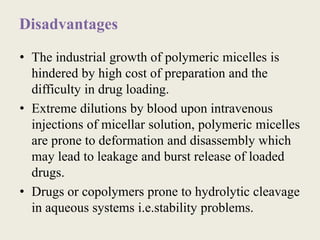
Disadvantages
• The industrial growth of polymeric micelles is
hindered by high cost of preparation and the
difficulty in drug loading.
• Extreme dilutions by blood upon intravenous
injections of micellar solution, polymeric micelles
are prone to deformation and disassembly which
may lead to leakage and burst release of loaded
drugs.
• Drugs or copolymers prone to hydrolytic cleavage
in aqueous systems i.e.stability problems.
Application
• Doxorubicin-Loaded Polymeric Micelles
Conjugated with CKR- and EVQ-FLT3 Peptides
for Cytotoxicity in Leukemic Stem Cells
• Freshly synthesized DMs displaying FLT3 peptides showed
particle sizes smaller than 50 nm and a high drug entrapment
level, comparable with DMs. DM-CKR+DM-EVQ was
considerably more toxic to KG-1a (AML LSC-like cell model)
than Dox-HCl. These FLT3-targeted DMs could increase drug
uptake and induce apoptosis induction. Due to an increase in
micelle-LSC binding and uptake, DMs displaying both
peptides tended to improve the potency of Dox compared to a
single peptide-coupled micelle.
Abstract
• Doxorubicin (Dox) is the standard chemotherapeutic agent for
acute myeloblastic leukemia (AML) treatment. However, 40%
of Dox-treated AML cases relapsed due to the presence of
leukemic stem cells (LSCs). Thus, poloxamer 407 and CKR-
and EVQ-FLT3 peptides were used to formulate Dox-micelles
(DMs) and DM conjugated with peptides (CKR and EVQ) for
improving AML-LSC treatment. Results indicated that DMs
with a weight ratio of Dox to P407 of 1:200 had a particle size
of 23.3 ± 1.3 nm with a high percentage of Dox entrapment.
They were able to prolong drug release and maintain
physicochemical stability. Following effective DM
preparation, P407 was modified and conjugated with FLT3
peptides, CKR and EVQ to formulate DM-CKR, DM-EVQ,
and DM-CKR+DMEVQ.
Preparation of DMs
• The amount of Dox-HCl was set at 0.5 mg while the amount of P407 was
varied in many conditions to optimize the most suitable formulation for
Dox-micelle synthesis. To produce Dox encapsulated polymeric micelles, a
film-hydration technique in cooperation with a pH-induced self-assembly
method was performed [39]. In brief, poloxamer P407 was dissolved in
methanol for a final concentration of 20 mg/mL.
• The blank micelle-films were formed by evaporation under reduced
pressure in a rotary evaporator at 45 ◦C, 50 rpm, for 20 min, and then dried
at room temperature (RT) overnight. To form DMs, the blank micelle-film
was resuspended in normal saline solution (NSS) and stirred at 350 rpm for
30 min at RT. Afterwards, 10×PBS at pH 7.4 and doxorubicin aqueous
solution (Dox-HCl) were dropped into the micelle solution at the rate of
200 µL/min while stirring.
• The final volume ratio for NSS:10×PBS:Dox-HCl was 7:1:2. Following
overnight stirring, the DM solution was centrifuged at 12,000 rpm for 10
min, and then filtered through a 0.22 mm filter to obtain DMs. All samples
were stored in light-protecting containers.
Results
 In Vitro Release Profile of DM
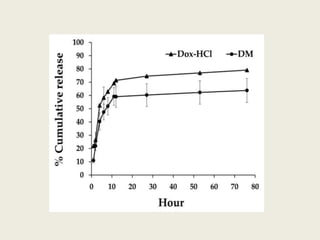
• The in vitro Dox-releasing capacity of DMs and Dox-HCl in
PBS, pH 7.4, that corresponds to the extracellular pH reported
in cancer patients, was evaluated. The cumulative release
profiles at 24 h of incubation time of Dox in solution and
polymeric micelles were approximately 75% and 60%,
respectively.
• The release of Dox in aqueous form was appeared to be
significantly higher than Dox from DM, suggesting that the
P407 polymeric micelle had the ability to encapsulate Dox
within the hydrophobic core of micelle and may extend the
drug release time.
Conclusion
• Dox-loaded micelles were successfully formulated using Dox
aqueous solution and poloxamer 407 at a weight ratio of 1:200
mg. This formulation of DMs exhibited particle sizes in the
nanoscale and high Dox encapsulation, with long
physiochemical stability at −80 ◦C. Furthermore, DMs could
prolong drug release and maintain their physical properties
when incubated in conditions mimicking circulation.
• FLT3 peptides, CKR and EVQ, were conjugated to a modified
P407 or cargo azide to improve DM uptake in FLT3- positive
AML cells.
• The use of P407 micelles in combination with FLT3 peptides
could increase Dox uptake, resulting in increased Dox
accumulation and the ability to destroy LSCs, which could be
a selective approach for developing a new AML-LSC
treatment strategy.
• Thus, the combination of polymeric micelles conjugated with
the duo of different peptides may be a new strategic model and
new research finding for chemotherapeutic treatment as a drug
delivery system in the future.
References
• Marras, A.E.; Ting, J.M.; Stevens, K.C.; Tirrell, M.V. Advances in the structural
design of polyelectrolyte complex micelles. J. Phys. Chem. B 2021, 125, 7076–
7089. [Google Scholar] [CrossRef] [PubMed]
• Dewald, I.; Fery, A. Polymeric micelles and vesicles in polyelectrolyte multilayers:
Introducing hierarchy and compartmentalization. Adv. Mater. Interfaces 2017, 4,
1600317. [Google Scholar] [CrossRef]
• Discher, D.E.; Eisenberg, A. Polymer vesicles. Science 2002, 297, 967–973.
[Google Scholar] [CrossRef] [PubMed][Green Version]
• u, S.; Liang, F.; Hu, D.; Li, H.; Yang, W.; Zhu, Q. Determining the critical micelle
concentration of surfactants by a simple and fast titration method. Anal.
Chem. 2020, 92, 4259–4265. [Google Scholar] [CrossRef]
• Su, H.; Wang, F.; Ran, W.; Zhang, W.; Dai, W.; Wang, H.; Anderson, C.F.; Wang,
Z.; Zheng, C.; Zhang, P.; et al. The role of critical micellization concentration in
efficacy and toxicity of supramolecular polymers. Proc. Natl. Acad. Sci.
USA 2020, 117, 4518–4526. [Google Scholar] [CrossRef]
• Chueahongthong, F.; Tima, S.; Chiampanichayakul, S.; Dejkriengkraikul, P.;
Okonogi, S.; Sasarom, M.; Rodwattanagul, S.; Berkland, C.; Anuchapreeda, S.
Doxorubicin-Loaded Polymeric Micelles Conjugated with CKR- and EVQ-FLT3
Peptides for Cytotoxicity in Leukemic Stem Cells. Pharmaceutics 2022, 14, 2115.
https://doi.org/10.3390/ pharmaceutics14102115
Thank You…….

Polymeric Micelles.pptx

  • 1.
    Polymeric Micelles with Application Submittedby, Submitted to, Mohd Sufiyan Dr. Abdul Hafeez M.Pharm 1st year Dept. of Pharmaceutics Dept. of Pharmaceutics
  • 2.
    Why and WhenDoes Self-Assembly Occur? • In a diluted state, polymers will be present as dispersed polymer units in a medium. At a certain concentration, the polymers will tend to arrange themselves in an ordered structure, and this concentration is named “critical micelle concentration” (CMC). • The products of the self-assembly of amphiphilic polymers or the spontaneous aggregation of amphiphilic polymers are called “micelles” and “vesicles”
  • 3.
    Polymeric Micelles • Self-assemblyof amphiphilic polymers with hydrophilic and hydrophobic units results in micelles (polymeric nanoparticles), where polymer concentrations are above critical micelle concentrations (CMCs). • Recently, micelles with metal nanoparticles (MNPs) have been utilized in many bio-applications because of their excellent biocompatibility, pharmacokinetics, adhesion to biosurfaces, targetability, and longevity. • The size of the micelles is in the range of 10 to 100 nm, and different shapes of micelles have been developed for applications.
  • 6.
    Polymeric Spherical Micelles •Above the CMC, the amphiphilic polymers self-assemble into spherical micelles. • The hydrophobic tail aggregates as the inner core and the brush-like structure of the hydrophilic head unite as a shell. • This hydrophobic core can accommodate hydrophobic drugs via hydrophobic interactions. The shell of micelles, which has hydrophilic units, will interact with water molecules surrounding the micelle. This helps in the stabilization of prepared micelles in an aqueous solution
  • 7.
    Polymeric Inverse Micelle •When the hydrophilic head is faced inside while the hydrophobic tails are projected outside, this arrangement refers to a reverse micelle, as shown in. • The inverse micelle can form a nanostructure or undergo self- assembly in non-aqueous solutions. The hydrophilic and hydrophobic parts will interact strongly with polar and non- polar solvents, respectively. Inverse micelles are formed from branched macromolecules, water-soluble dendritics, star- shaped polymers, and hyperbranched polymers.
  • 8.
    Inverse micelles wereprepared in a (left) simulation study and (right) using the water/oil microemulsion method.
  • 9.
    Types of Polymerused • Block co-Polymer (di, tri, or tetra). • Graft Polymer - contain polymer chain as a backbone and another polymer chain as side "grafted" parts. Type of micelle- forming copolymers Representation of structure* Example of polymers Block copolymers di - block AAAAAAABBBBBB Poly(styrene)-b- poly(ethylene oxide) tri - block AAAABBBBBAAAA Poly(ethylene oxide)-b- poly (propylene oxide)-b- poly(ethylene oxide) Graft copolymers AAAAAAAAAAAAAAA B B B B B B B N-phthaloylchitosan-g- polycaprolactone
  • 10.
    Advantages • PM helpsto increase the solubility of the original drug thus increasing the biocompatibility. • The hydrophilic shell and the nanoscopic size prevent mechanical clearance. • Various functional groups can be incorporated by physical entrapment or chemical conjugation. • High kinetic stability helps to maintain the integrity • Its having high drug-loading capacity of the inner core. • It can be used for receptor-mediated drug delivery system. • Suitable for intravenously administered drug delivery systems.
  • 11.
    Disadvantages • The industrialgrowth of polymeric micelles is hindered by high cost of preparation and the difficulty in drug loading. • Extreme dilutions by blood upon intravenous injections of micellar solution, polymeric micelles are prone to deformation and disassembly which may lead to leakage and burst release of loaded drugs. • Drugs or copolymers prone to hydrolytic cleavage in aqueous systems i.e.stability problems.
  • 12.
    Application • Doxorubicin-Loaded PolymericMicelles Conjugated with CKR- and EVQ-FLT3 Peptides for Cytotoxicity in Leukemic Stem Cells
  • 13.
    • Freshly synthesizedDMs displaying FLT3 peptides showed particle sizes smaller than 50 nm and a high drug entrapment level, comparable with DMs. DM-CKR+DM-EVQ was considerably more toxic to KG-1a (AML LSC-like cell model) than Dox-HCl. These FLT3-targeted DMs could increase drug uptake and induce apoptosis induction. Due to an increase in micelle-LSC binding and uptake, DMs displaying both peptides tended to improve the potency of Dox compared to a single peptide-coupled micelle.
  • 14.
    Abstract • Doxorubicin (Dox)is the standard chemotherapeutic agent for acute myeloblastic leukemia (AML) treatment. However, 40% of Dox-treated AML cases relapsed due to the presence of leukemic stem cells (LSCs). Thus, poloxamer 407 and CKR- and EVQ-FLT3 peptides were used to formulate Dox-micelles (DMs) and DM conjugated with peptides (CKR and EVQ) for improving AML-LSC treatment. Results indicated that DMs with a weight ratio of Dox to P407 of 1:200 had a particle size of 23.3 ± 1.3 nm with a high percentage of Dox entrapment. They were able to prolong drug release and maintain physicochemical stability. Following effective DM preparation, P407 was modified and conjugated with FLT3 peptides, CKR and EVQ to formulate DM-CKR, DM-EVQ, and DM-CKR+DMEVQ.
  • 15.
    Preparation of DMs •The amount of Dox-HCl was set at 0.5 mg while the amount of P407 was varied in many conditions to optimize the most suitable formulation for Dox-micelle synthesis. To produce Dox encapsulated polymeric micelles, a film-hydration technique in cooperation with a pH-induced self-assembly method was performed [39]. In brief, poloxamer P407 was dissolved in methanol for a final concentration of 20 mg/mL. • The blank micelle-films were formed by evaporation under reduced pressure in a rotary evaporator at 45 ◦C, 50 rpm, for 20 min, and then dried at room temperature (RT) overnight. To form DMs, the blank micelle-film was resuspended in normal saline solution (NSS) and stirred at 350 rpm for 30 min at RT. Afterwards, 10×PBS at pH 7.4 and doxorubicin aqueous solution (Dox-HCl) were dropped into the micelle solution at the rate of 200 µL/min while stirring. • The final volume ratio for NSS:10×PBS:Dox-HCl was 7:1:2. Following overnight stirring, the DM solution was centrifuged at 12,000 rpm for 10 min, and then filtered through a 0.22 mm filter to obtain DMs. All samples were stored in light-protecting containers.
  • 16.
    Results  In VitroRelease Profile of DM • The in vitro Dox-releasing capacity of DMs and Dox-HCl in PBS, pH 7.4, that corresponds to the extracellular pH reported in cancer patients, was evaluated. The cumulative release profiles at 24 h of incubation time of Dox in solution and polymeric micelles were approximately 75% and 60%, respectively. • The release of Dox in aqueous form was appeared to be significantly higher than Dox from DM, suggesting that the P407 polymeric micelle had the ability to encapsulate Dox within the hydrophobic core of micelle and may extend the drug release time.
  • 18.
    Conclusion • Dox-loaded micelleswere successfully formulated using Dox aqueous solution and poloxamer 407 at a weight ratio of 1:200 mg. This formulation of DMs exhibited particle sizes in the nanoscale and high Dox encapsulation, with long physiochemical stability at −80 ◦C. Furthermore, DMs could prolong drug release and maintain their physical properties when incubated in conditions mimicking circulation. • FLT3 peptides, CKR and EVQ, were conjugated to a modified P407 or cargo azide to improve DM uptake in FLT3- positive AML cells.
  • 19.
    • The useof P407 micelles in combination with FLT3 peptides could increase Dox uptake, resulting in increased Dox accumulation and the ability to destroy LSCs, which could be a selective approach for developing a new AML-LSC treatment strategy. • Thus, the combination of polymeric micelles conjugated with the duo of different peptides may be a new strategic model and new research finding for chemotherapeutic treatment as a drug delivery system in the future.
  • 20.
    References • Marras, A.E.;Ting, J.M.; Stevens, K.C.; Tirrell, M.V. Advances in the structural design of polyelectrolyte complex micelles. J. Phys. Chem. B 2021, 125, 7076– 7089. [Google Scholar] [CrossRef] [PubMed] • Dewald, I.; Fery, A. Polymeric micelles and vesicles in polyelectrolyte multilayers: Introducing hierarchy and compartmentalization. Adv. Mater. Interfaces 2017, 4, 1600317. [Google Scholar] [CrossRef] • Discher, D.E.; Eisenberg, A. Polymer vesicles. Science 2002, 297, 967–973. [Google Scholar] [CrossRef] [PubMed][Green Version] • u, S.; Liang, F.; Hu, D.; Li, H.; Yang, W.; Zhu, Q. Determining the critical micelle concentration of surfactants by a simple and fast titration method. Anal. Chem. 2020, 92, 4259–4265. [Google Scholar] [CrossRef] • Su, H.; Wang, F.; Ran, W.; Zhang, W.; Dai, W.; Wang, H.; Anderson, C.F.; Wang, Z.; Zheng, C.; Zhang, P.; et al. The role of critical micellization concentration in efficacy and toxicity of supramolecular polymers. Proc. Natl. Acad. Sci. USA 2020, 117, 4518–4526. [Google Scholar] [CrossRef] • Chueahongthong, F.; Tima, S.; Chiampanichayakul, S.; Dejkriengkraikul, P.; Okonogi, S.; Sasarom, M.; Rodwattanagul, S.; Berkland, C.; Anuchapreeda, S. Doxorubicin-Loaded Polymeric Micelles Conjugated with CKR- and EVQ-FLT3 Peptides for Cytotoxicity in Leukemic Stem Cells. Pharmaceutics 2022, 14, 2115. https://doi.org/10.3390/ pharmaceutics14102115
  • 21.