



ABDUL MUHEEM
M.Pharm, IInd sem.,
Department of Pharmaceutics
Faculty of Pharmacy,
Jamia Hamdard


                              1
Content
   Definition
   Introduction
   Colloidal systems
   Formulation additives
   Commercial NEs Formulations
   Advantages
   Methods of preparation
   Techniques of preparation
       High -pressure homogenization
       Microfluidization
       Phase inversion temperature technique
       Titration method
   Characterisation of microemulsion
   Applications of nanoemulsion
   conclusion


                                                2
Abbreviations
 NE- nanoemulsion
 SME-sub-micron emulsion
 o/w- oil in water
 w/o- water in oil
 PCMX –parachlorometaxylenol
 TEWL- trans epidermal water loss


                                     3
Definition
 Nanoemulsions can be defined as oil-in-water
  (o/w) emulsions with mean droplet diameters
  ranging from 50 to 1000 nm.
 Synonyms: sub-micron emulsion and mini-
  emulsion.
 Usually SMEs contain 10 to 20 per cent oil
  stabilized with 0.5 to 2 per cent egg or
  soyabean lecithin.


                                                 4
Introduction
 NEs are a group of dispersed particles used
  for pharmaceutical and biomedical aids and
  vehicles that show great promise for the
  future of cosmetics, diagnostics, drug
  therapies, and biotechnologies
 Due to their small droplet size NEs possess
  stability against sedimentation or creaming
  with Ostwald ripening forming the main
  mechanism of NE breakdown.


                                                5
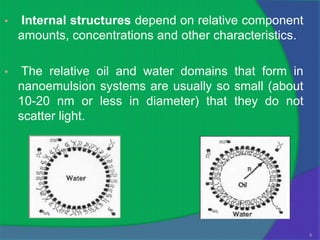
•    Internal structures depend on relative component
    amounts, concentrations and other characteristics.

•    The relative oil and water domains that form in
    nanoemulsion systems are usually so small (about
    10-20 nm or less in diameter) that they do not
    scatter light.


                                                         6
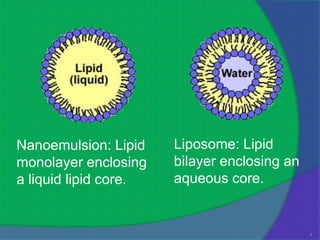
Nanoemulsion: Lipid    Liposome: Lipid
monolayer enclosing    bilayer enclosing an
a liquid lipid core.   aqueous core.


                                              7
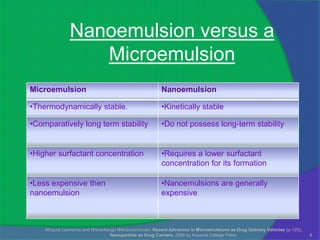
Nanoemulsion versus a
                  Microemulsion
Microemulsion                                           Nanoemulsion

•Thermodynamically stable.                              •Kinetically stable

•Comparatively long term stability                      •Do not possess long-term stability


•Higher surfactant concentration                        •Requires a lower surfactant
                                                        concentration for its formation

•Less expensive then                                    •Nanoemulsions are generally
nanoemulsion                                            expensive


    MJayne Lawrence and Warankanga Warisnoicharoen, Recent Advances in Microemulsions as Drug Delivery Vehicles (p-125),
                                Nanoparticle as Drug Carriers, 2006 by Imperial College Press                              8
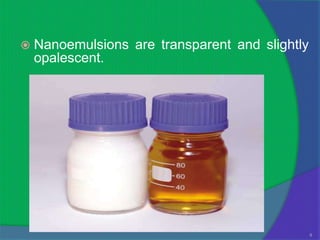
   Nanoemulsions are transparent and slightly
    opalescent.


                                                 9
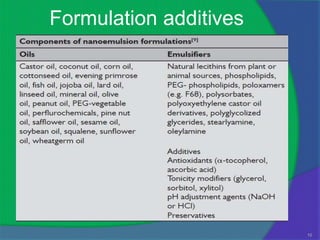
Formulation additives


                        10
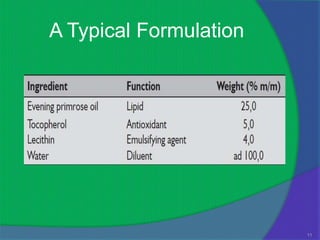
A Typical Formulation


                        11
Advantages
 NEs have a much higher surface area and
  free energy than macro emulsions that make
  them an effective transport system.
 NEs do not show the problems of inherent
  creaming, flocculation, coalescence, and
  sedimentation,      which    are    commonly
  associated with macroemulsions.
 NEs can be formulated in variety of
  formulations              such           as
  foams, creams, liquids, and sprays.

                                             12
Advantages
 NEs are non-toxic and non-irritant, hence
  can be easily applied to skin and mucous
  membranes.
 Since NEs are formulated with surfactants,
  which are approved for human consumption
  (GRAS), they can be taken by enteric route.
 NEs do not damage healthy human and
  animal cells, hence are suitable for human
  and veterinary therapeutic purposes.

                                                13
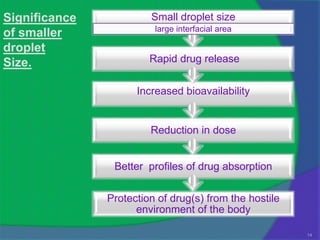
Significance            Small droplet size
                         large interfacial area
of smaller
droplet
Size.                   Rapid drug release


                     Increased bioavailability


                        Reduction in dose


                Better profiles of drug absorption

               Protection of drug(s) from the hostile
                     environment of the body

                                                        14
Techniques of preparation
a.    High -pressure homogenization

b.    Micro fluidization

c.    Phase inversion temperature technique.


                                               15
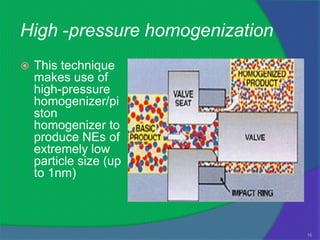
High -pressure homogenization
   This technique
    makes use of
    high-pressure
    homogenizer/pi
    ston
    homogenizer to
    produce NEs of
    extremely low
    particle size (up
    to 1nm)


                                16
MICROFLUIDIZATION:
 It involves the use of device that is micro fluidizer
 It uses high-pressure positive displacement
  pump of (500-20000)psi, which forces the
  product through the interaction chamber, which
  consists of small channels called “micro
  channels”.
 The product flows through the micro channels
  on to an impingement area resulting in very fine
  particles of submicron range. The two solutions
  (aq. Phase and oily phase) are combined
  together and processed to obtain a stable
  nanoemulsion.


                                                          17
Microfluidization


    www.ttlindia.com/images/microfluidics1.jpg   18
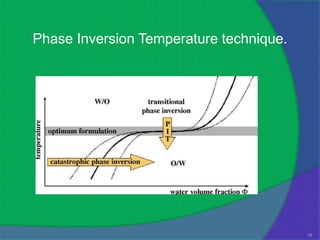
Phase Inversion Temperature technique.


                                         19
Characterization of
          Nanoemulsion
 transmission   electron microscopy,
 NE droplet size analysis,
 viscosity determination,
 refractive index,
 in vitro skin permeation studies,


                                        20
Characterization of
Nanoemulsion
 skin  irritation test,
 in vivo efficacy study,
 thermodynamic stability studies,
  and
 surface characteristics.


                                     21
Thermodynamic Stability
             Studies
 To overcome the problem of metastable
  formulation
 Selected formulations were centrifuged at 3500
  rpm for 30 minutes
 Heating and cooling cycle
 Six cycles between refrigerator temperatures of
  4°C and 45°C for 48 hours were done
 Freeze-thaw cycle test done for the formulations
  between –21°C and +25°C.
                                                22
Droplet Size Analysis
 droplet size of the nanoemulsion is determined
  by photon correlation spectroscopy
 The formulation (0.1 mL) is dispersed in 50 mL
  of water
 Gently mix by inverting the flask.
 Measurement is done using a Zetasizer 1000
  HS.
 Light scattering is monitored at 25°C at a 90°
  angle

                                               23
Transmission Electron
Microscopy
 The morphology and structure of the
  nanoemulsion
 the nanoemulsion formulation is diluted with
  water (1/100).
 A drop of the diluted nanoemulsion is directly
  deposited on the holey film grid and observed
  after drying


                                               24
Viscosity Determination
 The viscosity of the formulations (0.5 g) can
  be determined without dilution using a
  Brookfield DV III ultra V6.0 RV cone and plate
  rheometer at 25 ± 0.5°C.
 one    software used for the viscosity
  calculations       is      Rheocalc     V2.6.


                                               25
Applications of
           Nanoemulsions
   Use of nanoemulsions in cosmetics

   Antimicrobial nanoemulsions

   Prophylactic in bio-terrorism attack

   Nanoemulsions as a mucosal vaccines

   Nanoemulsion as non-toxic disinfectant
    cleaner

                                             26
Applications of
Nanoemulsions
 Nanoemulsion in the treatment of
  various other disease conditions
 Nanoemulsion formulations for
  improved oral delivery of poorly
  soluble drugs
 Nanoemulsions as a vehicle for
  transdermal delivery
 Self-nanoemulsifying drug delivery
  systems

                                       27
Applications of
Nanoemulsions
   Nanoemulsions in cell culture technology

   Nanoemulsion in cancer therapy and in
    targeted drug delivery

   Solid self-nanoemulsifying delivery
    systems as a platform technology for
    formulation of poorly soluble drugs


                                               28
Nanoemulsion as non-toxic
disinfectant cleaner
   The disinfectant formulation is made up of
    nanospheres of oil droplets #106 mm that are
    suspended in water to create a NE requiring only
    miniscule amounts of the active ingredient, PCMX
    (parachlorometaxylenol).
   The nanospheres carry surface charges that
    efficiently penetrate the surface charges on
    microorganisms' membranes-much like breaking
    through an electric fence.
   Rather than "drowning" cells, the formulation allows
    PCMX to target and penetrate cell walls.
   As a result, PCMX is effective at concentration levels
    1-2 orders of magnitude lower than those of other
    disinfectants; hence, there are no toxic effects on
    humans, animals, or the environment.

                                                             29
Nanoemulsions as a mucosal
vaccines
   Used to deliver either recombinant proteins or
    inactivated organisms to a mucosal surface to
    produce an immune response.
   An influenza vaccine and an HIV vaccine, can
    proceed to clinical trials.
   The NE causes proteins applied to the
    mucosal surface to be adjunted and it
    facilitates uptake by antigen-presenting cells.
   This results in a significant systemic and
    mucosal immune response that involves the
    production of specific IgG and IgA antibody as
    well as cellular immunity.


                                                      30
Antimicrobial
nanoemulsions
 The NE has a broad-spectrum activity against
  bacteria (e.g. E. coil,          Salmonella, S.
  aureus), enveloped viruses (e.g. HIV, Herpes
  simplex),                fungi              (e.g.
  Candida, Dermatophytes), and spores (e.g.
  anthrax).
 The NE particles are thermodynamically
  driven to fuse with lipid-containing organisms.


                                                  31
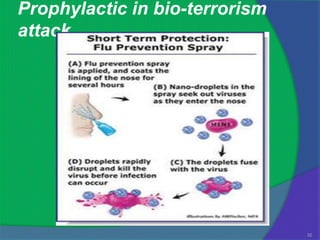
Prophylactic in bio-terrorism
attack


                                32
Use of nanoemulsions in
cosmetics
   NEs support the skin penetration of active ingredients
    and thus increase their concentration in the skin.
    Another advantage is the small-sized droplet with its
    high surface area allowing effective transport of the
    API to the skin.
   Have own bioactive effects. This may reduce the trans-
    epidermal water loss, indicating that the barrier
    function of the skin is strengthened.
   NEs are acceptable in cosmetics because there are no
    inherent creaming, sedimentation, flocculation, or
    coalescence that are observed with macroemulsions.


                                                         33
Fluorine-containing
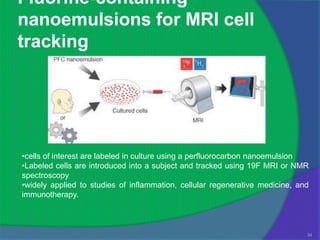
nanoemulsions for MRI cell
tracking


•cells of interest are labeled in culture using a perfluorocarbon nanoemulsion
•Labeled cells are introduced into a subject and tracked using 19F MRI or NMR
spectroscopy
•widely applied to studies of inflammation, cellular regenerative medicine, and
immunotherapy.


                                                                              34
Nanoemulsions as a vehicle for
transdermal delivery
  Low systemic absorption
  Site-specificity and increased drug
   levels at injured tissues
  Reduced toxicity
  Improved pharmacological activity


                                         35
Parenteral Delivery
   In order to increase the solubility of the drug,
   To reduce drug toxicity,
   To reduce hypersensitivity,
   To reduce pain upon injection,
   Formulated as long circulating vehicles,
   Control the release rate,
   As drug targeting agents,
   Alternative formulation to long circulating vesicles,
   On the basis of their small size avoiding uptake by the RES,
    Their stability and their ease of preparation.


                                                                   36
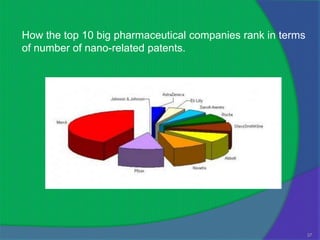
How the top 10 big pharmaceutical companies rank in terms
of number of nano-related patents.


                                                            37
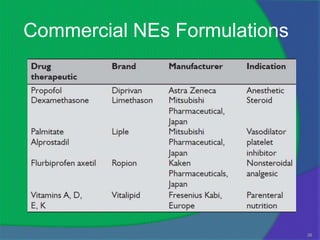
Commercial NEs Formulations


                              38
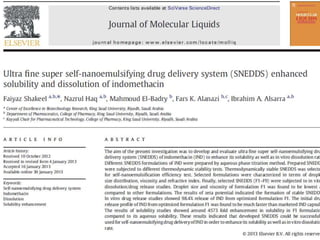
Conclusion
    NE formulations offer several advantages for the delivery of
    drugs, biologicals, or diagnostic agents.
   Several other products for drug delivery applications such as
    Diprivan® (propofol, astra zeneca) and Ropion® (flurbiprofen)
    have also reached the marketplace.
   NEs are chiefly seen as vehicles for administering aqueous
    insoluble drugs, as colloidal carriers for targeted delivery of
    various anticancer drugs, photosensitizers, neutron capture
    therapy agents, or diagnostic agents.
   Because of their submicron size, they can be easily targeted
    to the tumor area.
   Research with perflurochemical NEs has shown promising
    results for the treatment of cancer in conjugation with other
    treatment modalities and targeted delivery to the
    neovasculature. It is expected that further research and
    development work will be carried out in the near future for
    clinical realization of these targeted delivery vehicles.
                                                                      39
40
41
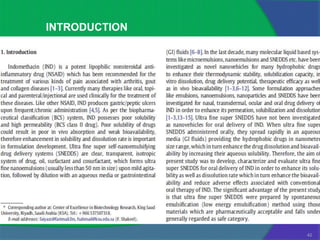
INTRODUCTION


               42
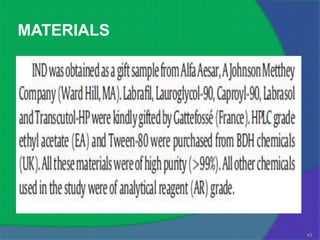
MATERIALS


            43
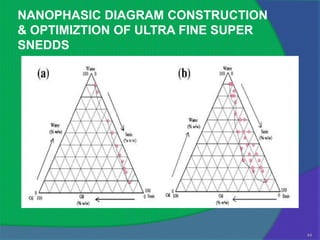
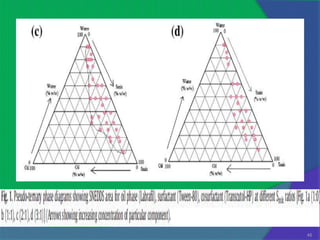
NANOPHASIC DIAGRAM CONSTRUCTION
& OPTIMIZTION OF ULTRA FINE SUPER
SNEDDS


                                    44
45
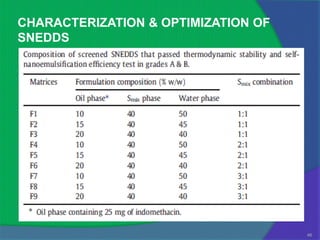
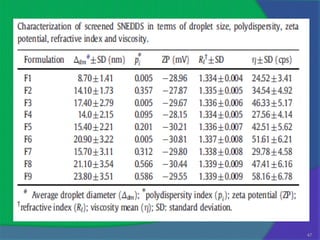
CHARACTERIZATION & OPTIMIZATION OF
SNEDDS


                                     46
47
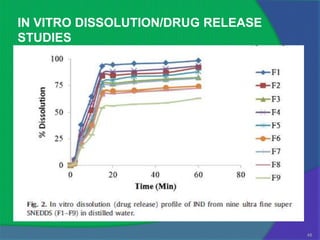
IN VITRO DISSOLUTION/DRUG RELEASE
STUDIES


                                    48
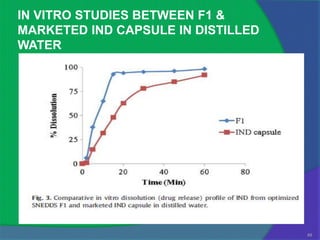
IN VITRO STUDIES BETWEEN F1 &
MARKETED IND CAPSULE IN DISTILLED
WATER


                                    49
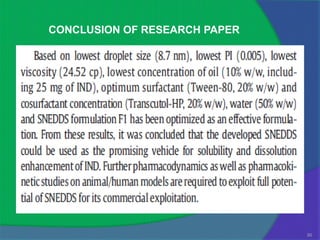
CONCLUSION OF RESEARCH PAPER


                               50
References:
1.   Jia Xi, Qi Chang, Chak K. Chan et al, Formulation
     Development and Bioavailability Evaluation of a Self-
     Nanoemulsified Drug Delivery System of Oleanolic Acid.
     AAPS PharmSciTech, Vol. 10, No. 1, March 2009 (#
     2009).

2. Nicolas Anton & Thierry F. Nano-emulsions and Micro-
  emulsions: Clarifications of the CriticalDifferences
  www.springerlink.com/index/J4880Q76V1374601.pdf.

3. Shah P, Bhalodia D, Shelat P. Nanoemulsion: A
   pharmaceutical review. Syst Rev Pharm [serial online]
   2010 [cited 2011 Mar 16];1:24-32. Available
   from: http://www.sysrevpharm.org/text.asp?2010/1/1/24/5
   9509
                                                          51
Thank You


            52