Real Time -PCR
Bharat Bhushan Negi
M.Tech. Biotechnology
174106012
IIT Guwahati
(2017-2019)
What is Real Time-PCR ?
• Real-Time PCR is a specialized technique that allows a PCR
reaction to be visualized “in real time” as the reaction
progresses.
• This enables researchers to quantify the amount of DNA in the
sample at the start of the reaction!
• It differs from standard PCR in a way that it can detect the
amplified product as the reaction progresses with time but in
standard PCR the amplified product is detected at the end of the
reaction by agarose gel electrophoresis.
Why Real Time? What's wrong with
Agarose Gels ?
• End point analysis
- End point result is time consuming
- End point is variable from sample to sample, while gels may
not be able to resolve these variability's in yields.
• Low resolution
• Low sensitivity
• Size-based discrimination only
Real-time PCR enables the amount of
starting material to be quantified
Real Time Principle
• It is based on the detection and quantitation of a
fluorescent reporter
• In stead of measuring the endpoint we focus on the first
significant increase in the amount of PCR product.
• If there are only a few DNA molecules at the beginning of
the PCR then relatively little product will be made, but if
there are many starting molecules then the product yield
will be higher.
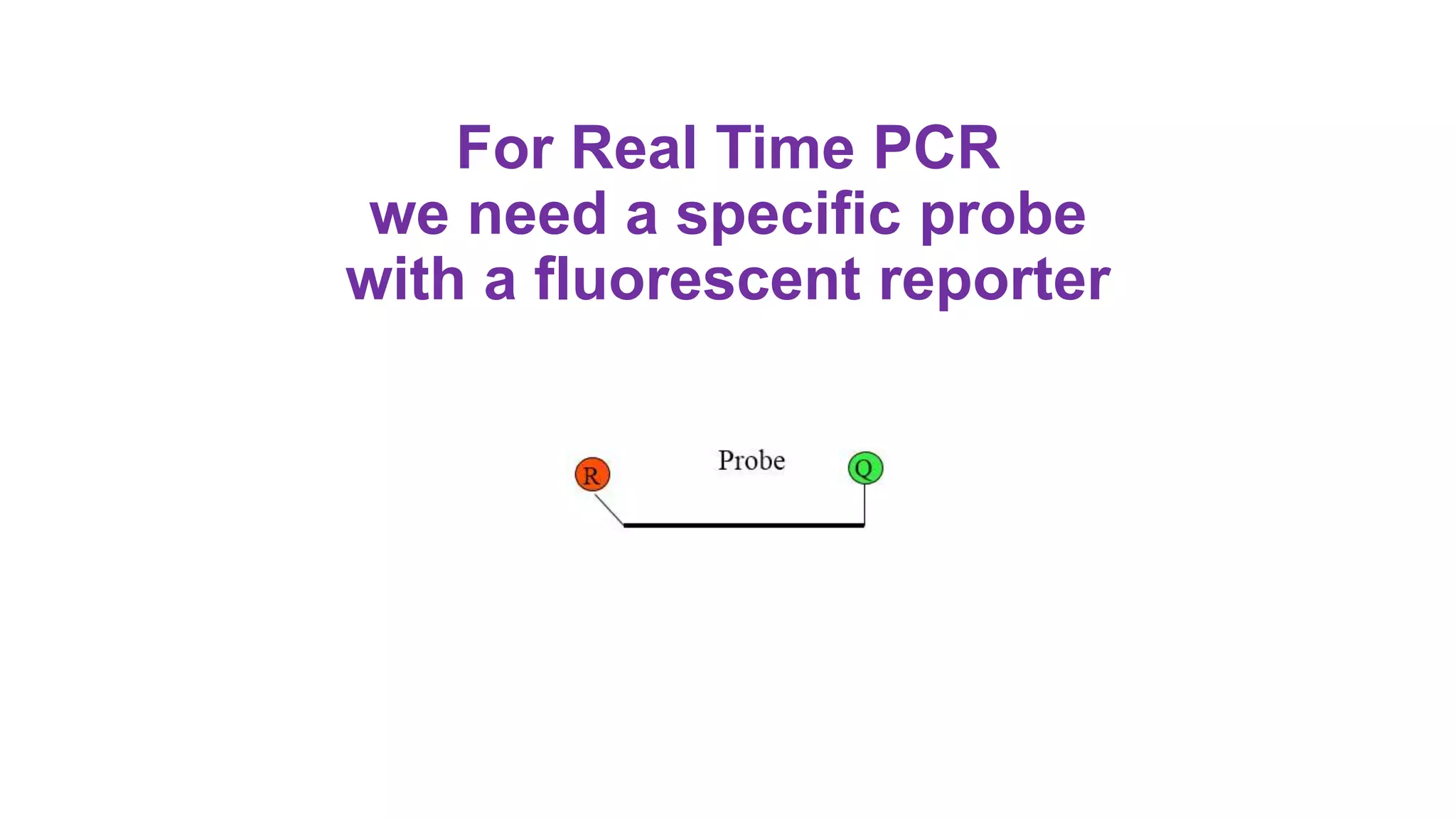
For Real Time PCR
we need a specific probe
with a fluorescent reporter
• The probe consists of two types of fluorophores, which are the fluorescent
parts of reporter proteins [Green Fluorescent Protein (GFP) has an often-
used fluorophore].
• While the probe is attached or unattached to the template DNA and before
the polymerase acts, the quencher (Q) fluorophore (usually a long-
wavelength colored dye, such as red) reduces the fluorescence from the
reporter (R) fluorophore (usually a short-wavelength colored dye, such as
green).
• It does this by the use of Fluorescence (or Förster) Resonance Energy
Transfer (FRET), which is the inhibition of one dye caused by another
without emission of a proton.
• The reporter dye is found on the 5’ end of the probe and the quencher at the
3’ end.
The Taqman probe. The red circle represents the
quenching dye that disrupts the observable signal
from the reporter dye (green circle) when it is within a
short distance
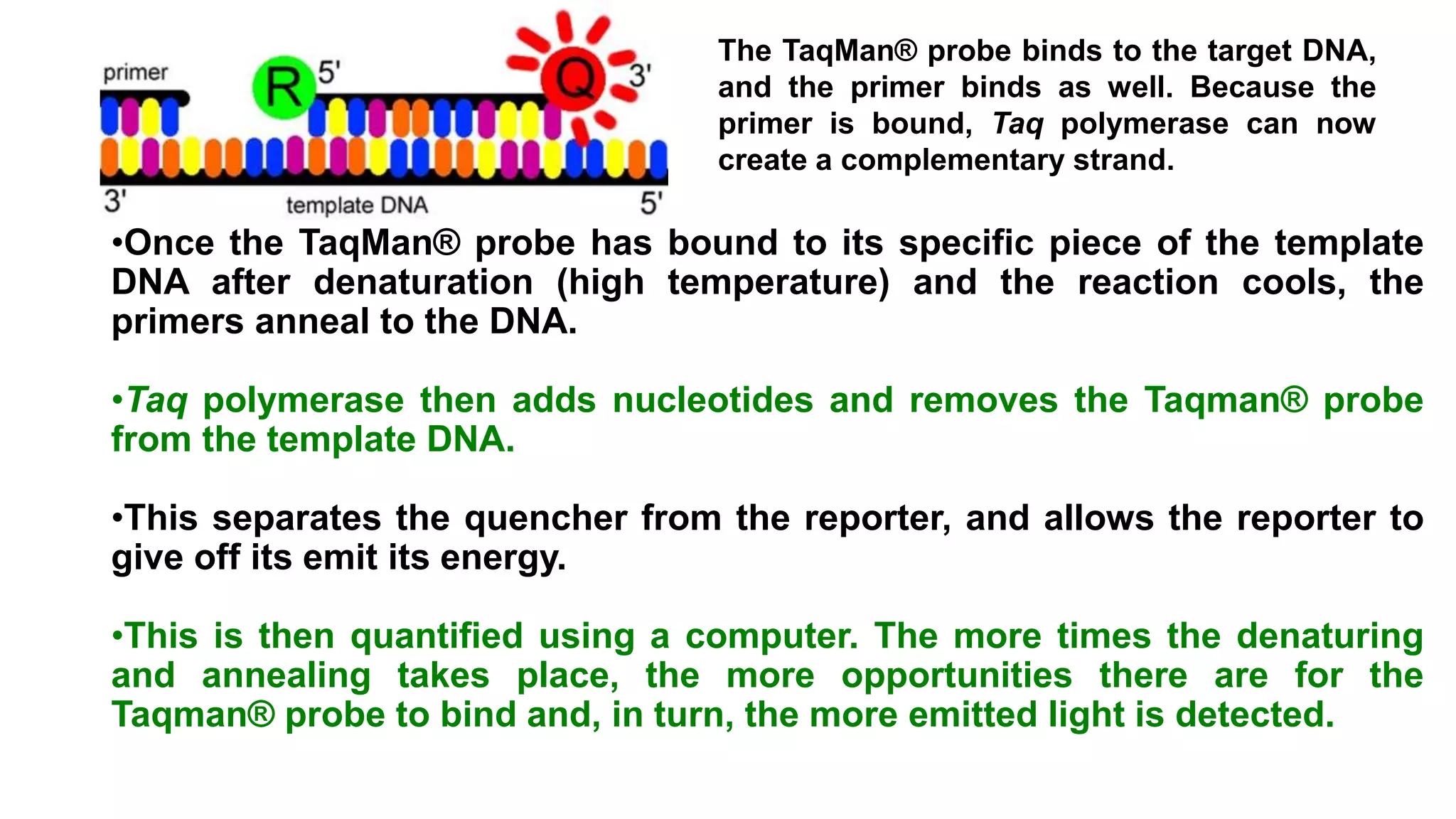
•Once the TaqMan® probe has bound to its specific piece of the template
DNA after denaturation (high temperature) and the reaction cools, the
primers anneal to the DNA.
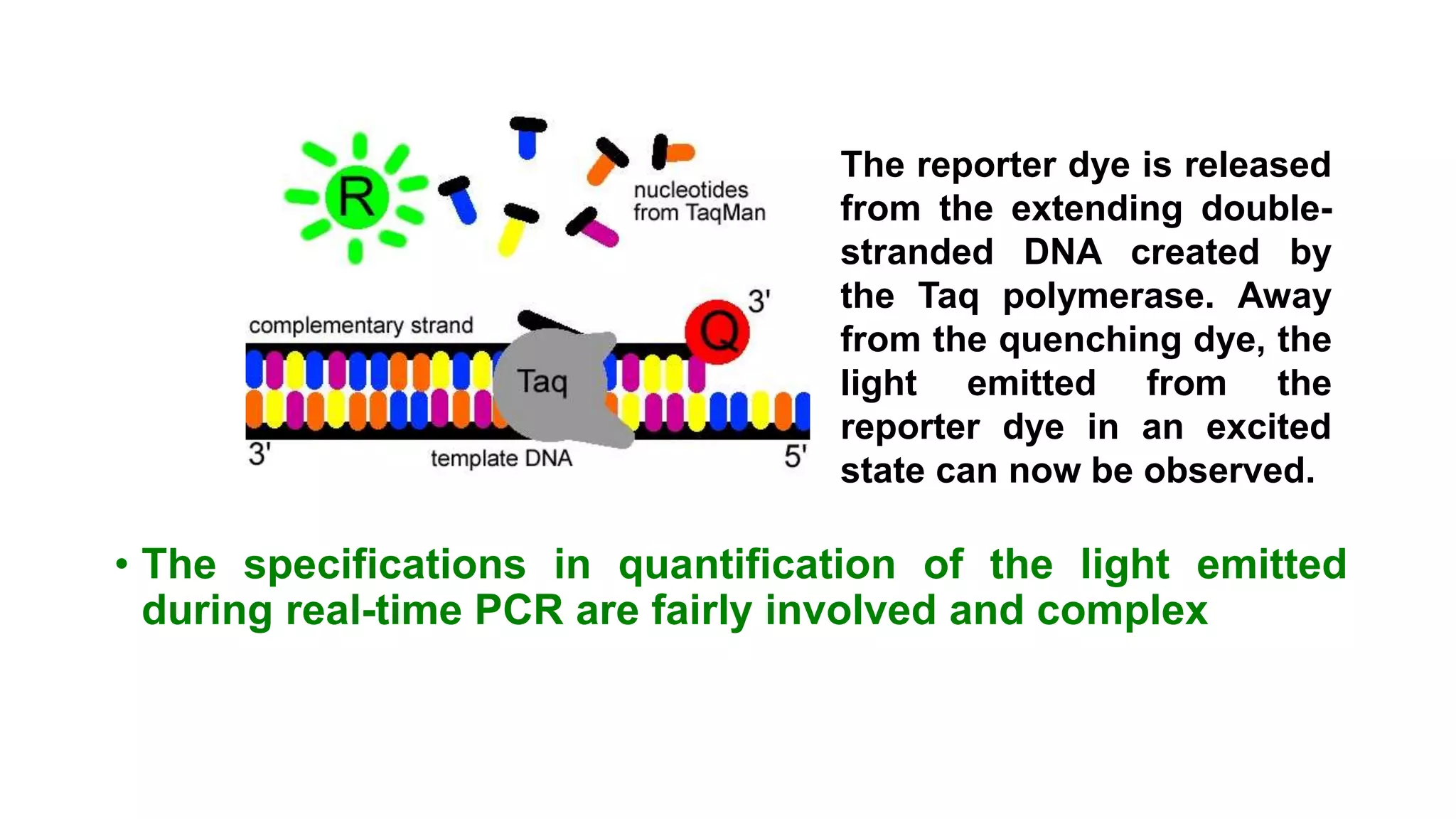
•Taq polymerase then adds nucleotides and removes the Taqman® probe
from the template DNA.
•This separates the quencher from the reporter, and allows the reporter to
give off its emit its energy.
•This is then quantified using a computer. The more times the denaturing
and annealing takes place, the more opportunities there are for the
Taqman® probe to bind and, in turn, the more emitted light is detected.
The TaqMan® probe binds to the target DNA,
and the primer binds as well. Because the
primer is bound, Taq polymerase can now
create a complementary strand.
• The specifications in quantification of the light emitted
during real-time PCR are fairly involved and complex
The reporter dye is released
from the extending double-
stranded DNA created by
the Taq polymerase. Away
from the quenching dye, the
light emitted from the
reporter dye in an excited
state can now be observed.
Other Real Time PCR Methods
1. Molecular Beacon
2. SYBR® Green method
•The molecular beacon method utilizes a reporter probe that is
wrapped around into a hairpin. It also has a quencher dye that
must be in close contact to the reporter to work.
•An important difference of the molecular beacon method in
comparison to the TaqMan® method is that the probe remains
intact throughout the PCR product, and is rebound to the target
at every cycle.
This beacon is 33 nucleotides
long with a reporter dye
attached to the 5' end and a
quencher attached to the 3'
end.
The nine 5' bases are able to
form base pairs with the nine 3'
bases which brings the reporter
and quencher in very close
proximity.
• Therefore, when the reporter is excited by the
appropriate light, its emission is absorbed by the
quencher and no fluorescence is detected.
• The pink lines represent nucleotides that can form base
pairs with the PCR product under investigation.
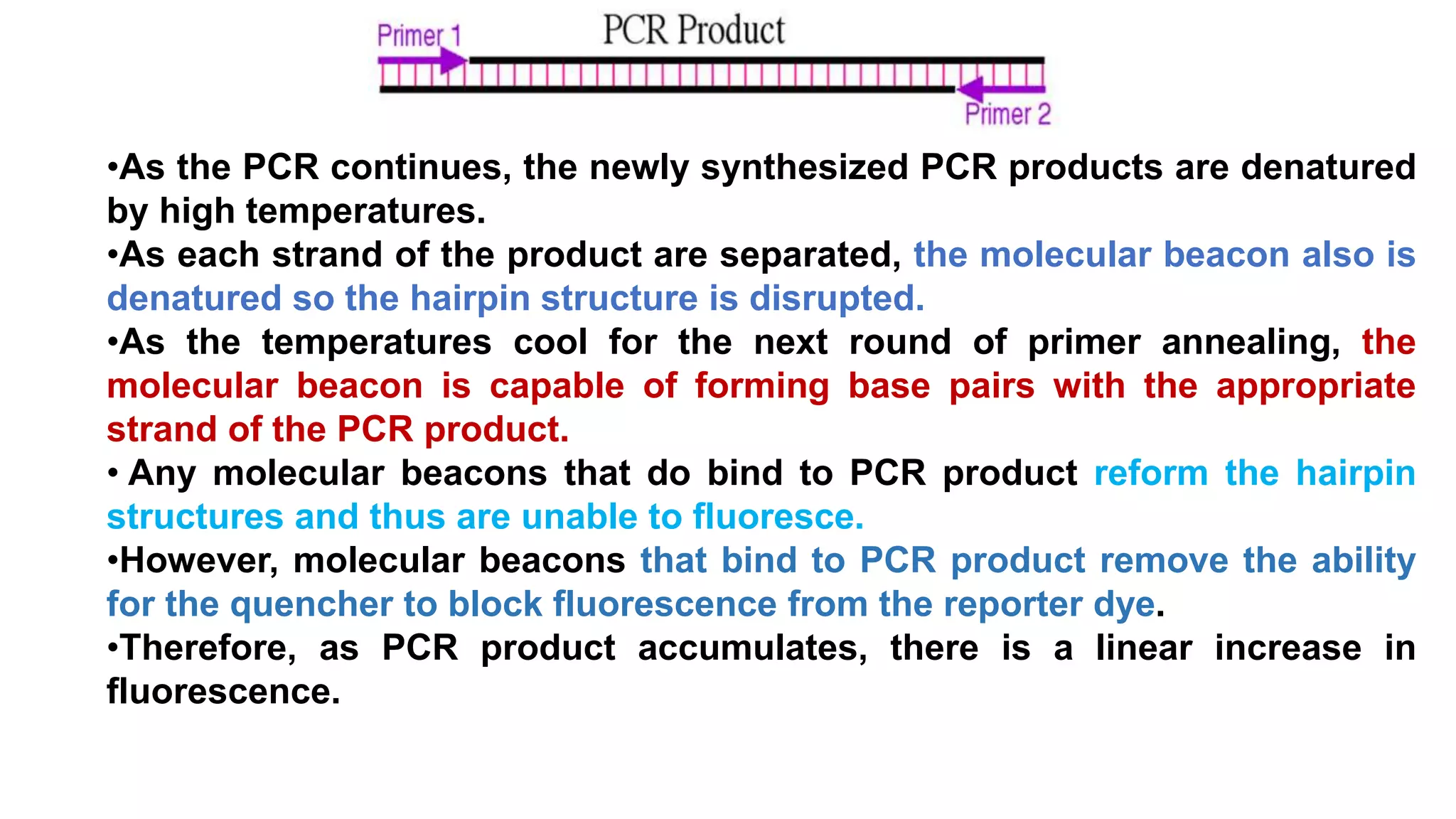
•As the PCR continues, the newly synthesized PCR products are denatured
by high temperatures.
•As each strand of the product are separated, the molecular beacon also is
denatured so the hairpin structure is disrupted.
•As the temperatures cool for the next round of primer annealing, the
molecular beacon is capable of forming base pairs with the appropriate
strand of the PCR product.
• Any molecular beacons that do bind to PCR product reform the hairpin
structures and thus are unable to fluoresce.
•However, molecular beacons that bind to PCR product remove the ability
for the quencher to block fluorescence from the reporter dye.
•Therefore, as PCR product accumulates, there is a linear increase in
fluorescence.
Detection of PCR product by molecular beacon.
•When the beacon binds to the PCR product, it is able to
fluoresce when excited by the appropriate wavelength of
light.
• The amount of fluorescence is directly proportional to the
amount of PCR product amplified.
2. SYBR® Green probe method
• The SYBR® Green probe was the first to be used in real-
time PCR. It binds to double-stranded DNA and emits light
when excited.
• Unfortunately, it binds to any double-stranded DNA which
could result in inaccurate data, especially compared with
the specificity found in the other two methods.
• Requires extensive optimisation
• Longer amplicons create a stronger signal
• It´s cheap
How do we carry out PCR if RNA is
the starting material?
• Real-time PCR is often used to quantify the amount of DNA
in an extract
• However, this method can be used as a means of
measuring RNA amounts, in particular to determine the
extent of expression of a particular gene by quantifying its
mRNA.
• The first step in this procedure is to convert the RNA
molecules into single-stranded complementary DNA
(cDNA) using Reverse Transcriptase Enzyme.
• Once this preliminary step has been carried out, the PCR
primers and Taq polymerase are added and the experiment
proceeds exactly as in the standard technique.
Advantages of Real Time PCR
• No post-PCR processing of products (high throughput, low
contamination risk)
• Not influenced by non-specific amplification
• Amplification can be monitored real-time
• Most specific, sensitive and reproducible
Disadvantages of Real Time PCR
• Setting up requires high technical skill and support
• High equipment cost
• Runs are more expensive than conventional PCR
• DNA contamination (in mRNA analysis)
Applications of Real Time PCR
• Quantitation of gene expression
• Drug therapy efficacy / drug monitoring
• Viral quantitation
• Pathogen detection
References:
1. IIT Kharagpur- Classroom lecture of Recombinant DNA
Technology (PCR)
2. Gene cloning and DNA analysis by T.A Brown
3. NPTEL – Proteomics and Genomics by Dr. Vikash Kumar
Dubey (IIT Guwahati)
4. PCR - Applied Biosystem

Real Time PCR

  • 1.
    Real Time -PCR BharatBhushan Negi M.Tech. Biotechnology 174106012 IIT Guwahati (2017-2019)
  • 2.
    What is RealTime-PCR ? • Real-Time PCR is a specialized technique that allows a PCR reaction to be visualized “in real time” as the reaction progresses. • This enables researchers to quantify the amount of DNA in the sample at the start of the reaction! • It differs from standard PCR in a way that it can detect the amplified product as the reaction progresses with time but in standard PCR the amplified product is detected at the end of the reaction by agarose gel electrophoresis.
  • 3.
    Why Real Time?What's wrong with Agarose Gels ? • End point analysis - End point result is time consuming - End point is variable from sample to sample, while gels may not be able to resolve these variability's in yields. • Low resolution • Low sensitivity • Size-based discrimination only Real-time PCR enables the amount of starting material to be quantified
  • 4.
    Real Time Principle •It is based on the detection and quantitation of a fluorescent reporter • In stead of measuring the endpoint we focus on the first significant increase in the amount of PCR product. • If there are only a few DNA molecules at the beginning of the PCR then relatively little product will be made, but if there are many starting molecules then the product yield will be higher.
  • 5.
    For Real TimePCR we need a specific probe with a fluorescent reporter
  • 6.
    • The probeconsists of two types of fluorophores, which are the fluorescent parts of reporter proteins [Green Fluorescent Protein (GFP) has an often- used fluorophore]. • While the probe is attached or unattached to the template DNA and before the polymerase acts, the quencher (Q) fluorophore (usually a long- wavelength colored dye, such as red) reduces the fluorescence from the reporter (R) fluorophore (usually a short-wavelength colored dye, such as green). • It does this by the use of Fluorescence (or Förster) Resonance Energy Transfer (FRET), which is the inhibition of one dye caused by another without emission of a proton. • The reporter dye is found on the 5’ end of the probe and the quencher at the 3’ end. The Taqman probe. The red circle represents the quenching dye that disrupts the observable signal from the reporter dye (green circle) when it is within a short distance
  • 7.
    •Once the TaqMan®probe has bound to its specific piece of the template DNA after denaturation (high temperature) and the reaction cools, the primers anneal to the DNA. •Taq polymerase then adds nucleotides and removes the Taqman® probe from the template DNA. •This separates the quencher from the reporter, and allows the reporter to give off its emit its energy. •This is then quantified using a computer. The more times the denaturing and annealing takes place, the more opportunities there are for the Taqman® probe to bind and, in turn, the more emitted light is detected. The TaqMan® probe binds to the target DNA, and the primer binds as well. Because the primer is bound, Taq polymerase can now create a complementary strand.
  • 8.
    • The specificationsin quantification of the light emitted during real-time PCR are fairly involved and complex The reporter dye is released from the extending double- stranded DNA created by the Taq polymerase. Away from the quenching dye, the light emitted from the reporter dye in an excited state can now be observed.
  • 9.
    Other Real TimePCR Methods 1. Molecular Beacon 2. SYBR® Green method •The molecular beacon method utilizes a reporter probe that is wrapped around into a hairpin. It also has a quencher dye that must be in close contact to the reporter to work. •An important difference of the molecular beacon method in comparison to the TaqMan® method is that the probe remains intact throughout the PCR product, and is rebound to the target at every cycle.
  • 10.
    This beacon is33 nucleotides long with a reporter dye attached to the 5' end and a quencher attached to the 3' end. The nine 5' bases are able to form base pairs with the nine 3' bases which brings the reporter and quencher in very close proximity. • Therefore, when the reporter is excited by the appropriate light, its emission is absorbed by the quencher and no fluorescence is detected. • The pink lines represent nucleotides that can form base pairs with the PCR product under investigation.
  • 11.
    •As the PCRcontinues, the newly synthesized PCR products are denatured by high temperatures. •As each strand of the product are separated, the molecular beacon also is denatured so the hairpin structure is disrupted. •As the temperatures cool for the next round of primer annealing, the molecular beacon is capable of forming base pairs with the appropriate strand of the PCR product. • Any molecular beacons that do bind to PCR product reform the hairpin structures and thus are unable to fluoresce. •However, molecular beacons that bind to PCR product remove the ability for the quencher to block fluorescence from the reporter dye. •Therefore, as PCR product accumulates, there is a linear increase in fluorescence.
  • 12.
    Detection of PCRproduct by molecular beacon. •When the beacon binds to the PCR product, it is able to fluoresce when excited by the appropriate wavelength of light. • The amount of fluorescence is directly proportional to the amount of PCR product amplified.
  • 13.
    2. SYBR® Greenprobe method • The SYBR® Green probe was the first to be used in real- time PCR. It binds to double-stranded DNA and emits light when excited. • Unfortunately, it binds to any double-stranded DNA which could result in inaccurate data, especially compared with the specificity found in the other two methods. • Requires extensive optimisation • Longer amplicons create a stronger signal • It´s cheap
  • 14.
    How do wecarry out PCR if RNA is the starting material? • Real-time PCR is often used to quantify the amount of DNA in an extract • However, this method can be used as a means of measuring RNA amounts, in particular to determine the extent of expression of a particular gene by quantifying its mRNA.
  • 15.
    • The firststep in this procedure is to convert the RNA molecules into single-stranded complementary DNA (cDNA) using Reverse Transcriptase Enzyme. • Once this preliminary step has been carried out, the PCR primers and Taq polymerase are added and the experiment proceeds exactly as in the standard technique.
  • 16.
    Advantages of RealTime PCR • No post-PCR processing of products (high throughput, low contamination risk) • Not influenced by non-specific amplification • Amplification can be monitored real-time • Most specific, sensitive and reproducible
  • 17.
    Disadvantages of RealTime PCR • Setting up requires high technical skill and support • High equipment cost • Runs are more expensive than conventional PCR • DNA contamination (in mRNA analysis)
  • 18.
    Applications of RealTime PCR • Quantitation of gene expression • Drug therapy efficacy / drug monitoring • Viral quantitation • Pathogen detection
  • 19.
    References: 1. IIT Kharagpur-Classroom lecture of Recombinant DNA Technology (PCR) 2. Gene cloning and DNA analysis by T.A Brown 3. NPTEL – Proteomics and Genomics by Dr. Vikash Kumar Dubey (IIT Guwahati) 4. PCR - Applied Biosystem